How to book Accademia Gallery tickets
Florence: Accademia Gallery — David skip-the-line ticket
- Skip the line
- Instant confirmation
How do you book Accademia Gallery tickets?
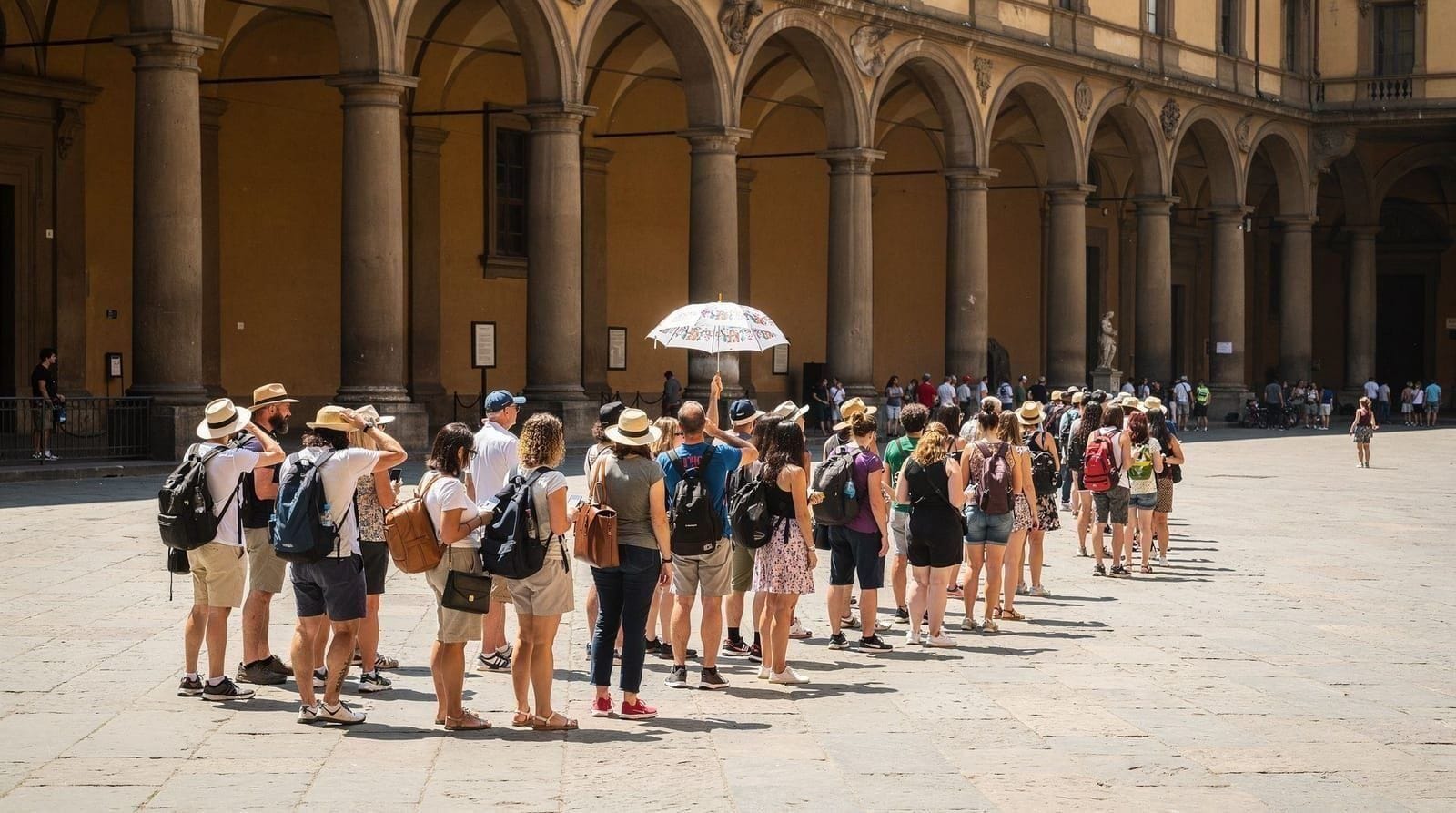
Book on the official site (firenzemusei.it or uffizi.it) or via GetYourGuide. Standard entry is €16 plus a €3 booking fee. Pre-book at least one week ahead outside peak season; 2–3 weeks ahead from April to October. The queue without a ticket can hit 90 minutes by 10 am on summer days.
Michelangelo’s David is arguably the single most famous sculpture in the world, and seeing it in person — all 5.17 metres of it, carved from a single flawed block of Carrara marble — is one of those experiences that genuinely lives up to the hype. The Galleria dell’Accademia di Firenze is a small, focused museum built essentially around this one extraordinary object. Getting your visit right requires some planning, but it’s far less complicated than many visitors expect.
| Where | Via Ricasoli 58–60, 10 minutes from the Duomo |
| Cost | Around €16–19/person (official + booking fee) |
| Time needed | 60–90 minutes |
| Getting there | Walk from the centre; bus C1 or 14 |
| Best time | 8:15am opening slot or after 4pm |
The Accademia in sixty seconds
The Accademia Gallery houses far more than the David, though the David is understandably the main draw. The collection includes:
- Michelangelo’s David (1501–1504) — the undisputed centrepiece
- The Prisoners (Prigioni) — four unfinished Michelangelo sculptures showing figures emerging from stone
- Saint Matthew — another unfinished Michelangelo
- Florentine painting from the 13th–16th centuries — a strong collection in the adjacent galleries
- The Giambologna plaster cast collection — fascinating technical art history
- Musical instruments — a surprisingly excellent collection including some of the earliest surviving violins
The museum occupies a converted convent on Via Ricasoli, about a 10-minute walk from the Duomo. It is compact by major museum standards, which is part of its appeal — you won’t leave feeling overwhelmed.
Ticket prices
| Ticket type | Price |
|---|---|
| Standard adult entry (online) | €16 + €3 booking fee |
| EU citizens under 18 | Free (timed slot required) |
| Non-EU under 18 | Reduced (check current rates) |
| Walk-up (if available) | €16 (no booking fee) |
Note that the Accademia is slightly cheaper than the Uffizi. The booking fee is €3 per transaction on the official site, not per ticket.
Where to buy tickets
Official booking platform
The Accademia is part of the Musei del Bargello group. Tickets are sold at ticketoffice.museibarollo.it or via the Uffizi’s own site (uffizi.it handles many Florentine state museum tickets). Navigating Italian government booking sites can be frustrating — the interface is dated and occasionally times out. If you have difficulty, GetYourGuide is a reliable and often cheaper alternative after fees.
GetYourGuide
GYG holds reseller allocation and often has tickets available when the official site shows sold out. Prices for a standard skip-the-line entry run €19–25; guided tours with expert art historians start around €35–45. The cancellation policy (typically free up to 24 hours before) is more flexible than the official site.
Combo tickets
If you’re also visiting the Uffizi — which you should, as they complement each other perfectly — combo options offer modest savings and single-booking convenience. The Uffizi and Accademia combo covers both museums with skip-the-line access, typically priced €35–45 per person.
When to book
The Accademia has a smaller total daily capacity than the Uffizi, which means it can sell out faster during peak periods despite being less famous.
| Time of year | Recommended advance booking |
|---|---|
| January–February | 3–5 days |
| March | 1 week |
| April–June | 2–3 weeks |
| July–August | 3–5 weeks |
| September–October | 2 weeks |
| November–December | 3–7 days |
The skip-the-line entrance
With a pre-booked ticket, you bypass the main queue and enter via the dedicated pre-booked visitors entrance on Via Ricasoli. This entrance is typically a separate door just to the right or left of the main ticket window — look for the signs “prenotazioni” or “online tickets.”
Arrive within your booked time window (±10 minutes is usually accepted, but don’t push it in high season). The timed entry system is enforced by staff who check QR codes at the gate.
What to see: priorities if your time is limited
The David (20–30 minutes minimum)
The Tribune — the domed octagonal hall that houses the David — is designed specifically to allow visitors to walk all the way around the sculpture. Take advantage of this. The back of the David is as carefully finished as the front, with the tension in the sling-carrying hand particularly striking from behind. The veins in the hands, the concentrated gaze, the slightly oversized head and hands (designed to be seen from below on Florence’s cathedral) — the more slowly you look, the more you see.
The David was carved between 1501 and 1504 when Michelangelo was just 26 years old. He worked from a block of marble that two other sculptors had already abandoned as too narrow and difficult. The subject — the moment before David’s battle with Goliath, not the triumphant aftermath — was revolutionary for its time.
The Prisoners (Prigioni) — 10 minutes
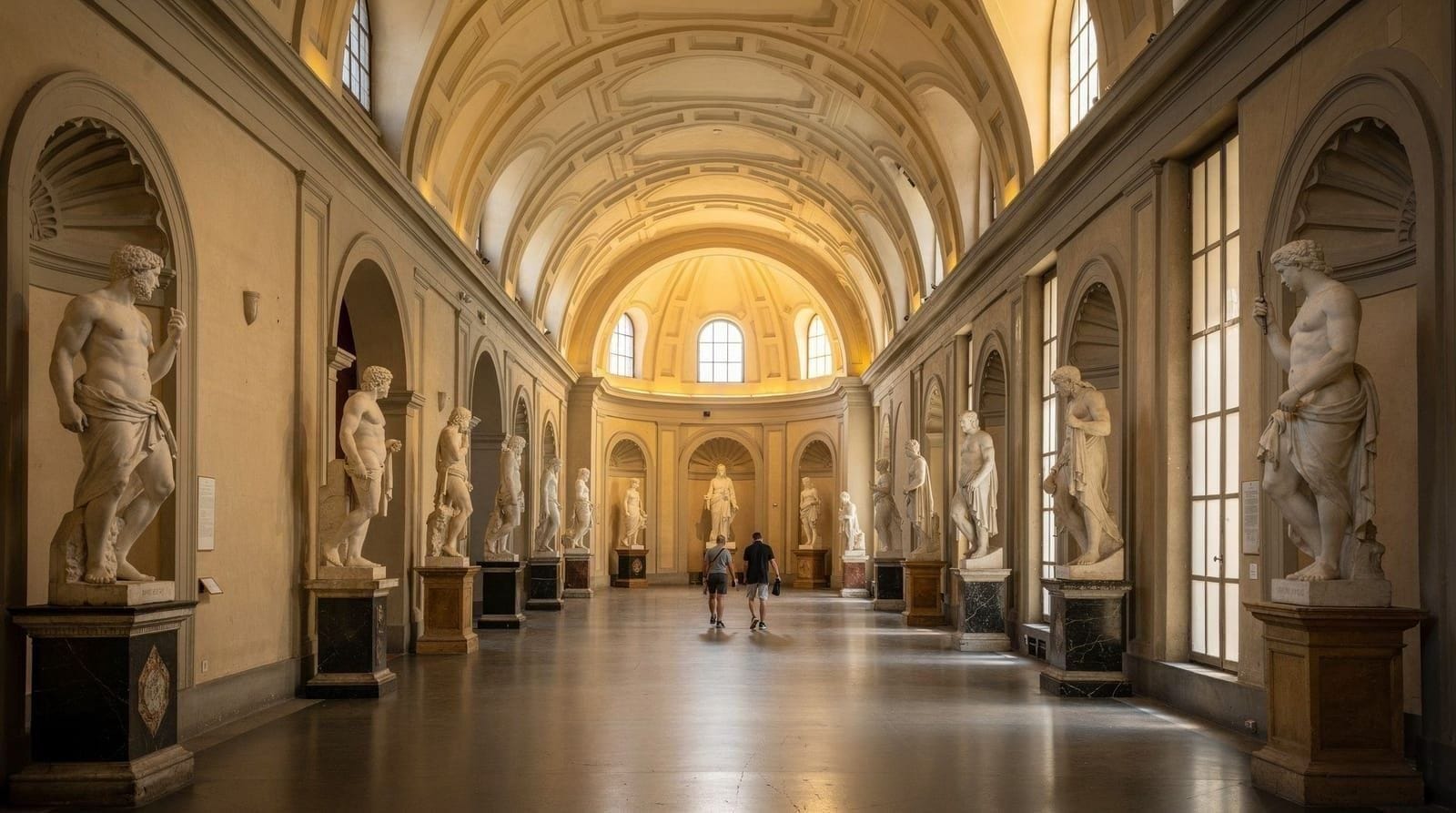
Four unfinished statues line the hall leading to the David. Michelangelo left them deliberately incomplete, or possibly ran out of time and commission money — art historians still debate the question. Seeing these rough, partially-emerged figures before arriving at the perfection of the David makes the finished work even more extraordinary.
Florentine painting galleries — 20–30 minutes
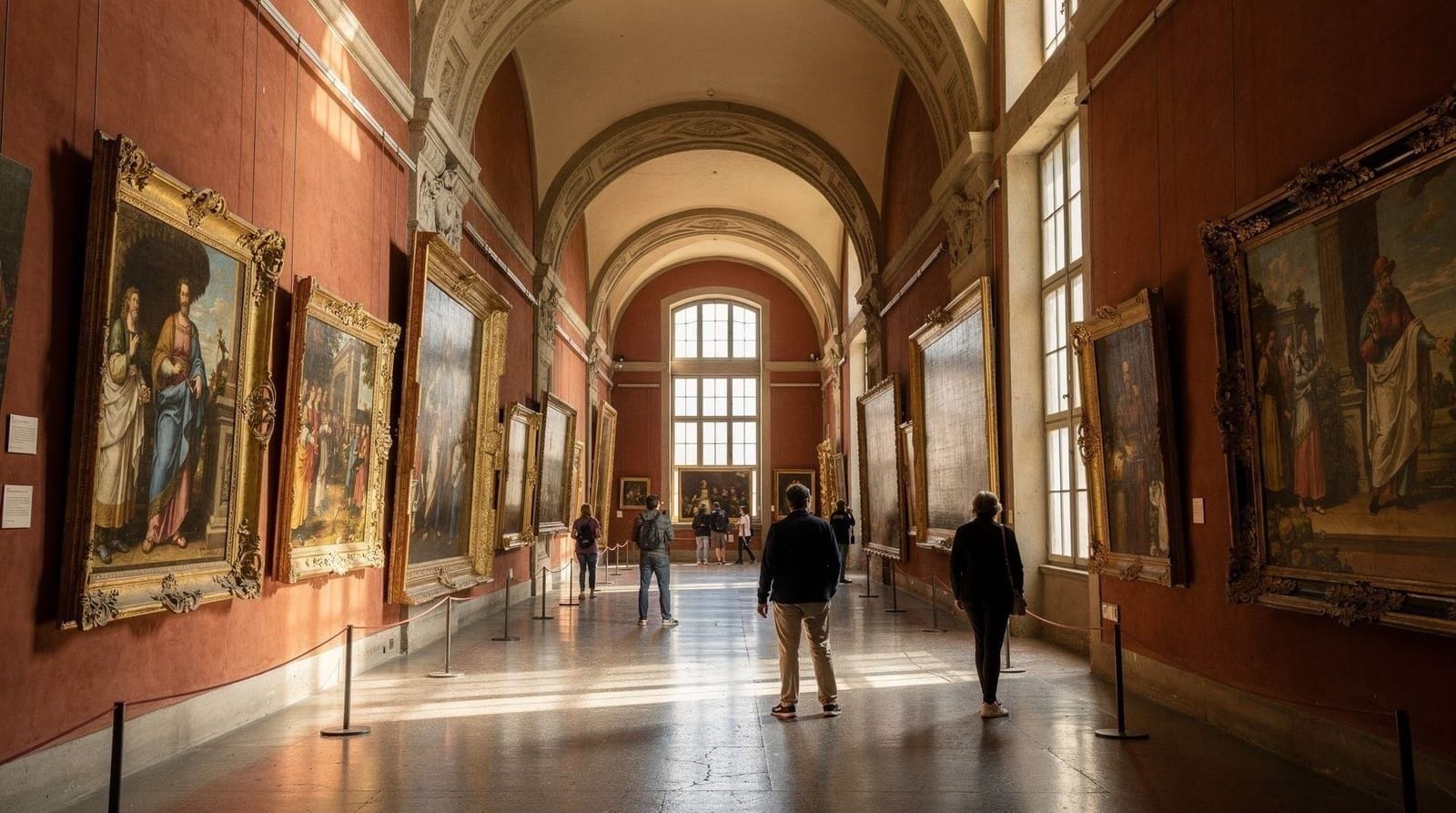
The adjacent rooms contain Florentine paintings from Cimabue, Ghirlandaio, Filippino Lippi and others. These are not the Uffizi’s collection, but they are significant works in their own right and usually visited in relative peace.
Musical instruments collection — 15 minutes
Often overlooked but genuinely excellent. The Accademia’s collection of historical instruments includes violins by Antonio Stradivari and early keyboard instruments. A brief detour adds real depth to the visit.
Guided tours: is it worth it?
For the David specifically, a guided tour is more valuable than at almost any other attraction in Florence. The art historical context — the commissioning of the work, the technical challenges Michelangelo solved, the symbolism of the pose, the decision to move it indoors in 1873 after the uomini illustri scheme collapsed — transforms what could be a photo stop into something genuinely memorable.
Guided tours run 60–90 minutes, led by licensed art historians in groups of typically 8–15 people. Prices start at around €35 per person; private tours for groups of up to four people cost approximately €100–140 and allow you to tailor the itinerary.
Practical details
| Detail | Information |
|---|---|
| Address | Via Ricasoli 58–60, Florence |
| Opening hours | Tue–Sun 8:15 am – 6:30 pm (last entry 5:30 pm) |
| Closed | Every Monday |
| Nearest landmark | 10-minute walk from the Duomo |
| Photography | Yes, without flash; no tripods |
| Bag storage | Free cloakroom for large bags |
| Accessibility | Ground floor is fully accessible; David is visible without stairs |
Getting there without a car
The Accademia is a 10-minute walk from the Duomo and about 15 minutes from Piazza della Repubblica. It sits well inside the ZTL zone, so do not attempt to drive. Fines for ZTL violations are sent automatically to rental car companies and then forwarded to you — often weeks after you return home, with an added administration fee.
From Santa Maria Novella station: 20-minute walk through the historic centre; pleasant route via Via dei Cerretani and Via Cavour.
Bus routes C1 and 14 stop near Via Ricasoli.
Accademia vs Uffizi: which first?
If you have only half a day and must choose, visit the Accademia first. The David can be seen in 60–90 minutes; the Uffizi requires a minimum of 2.5 hours to do it justice. Many visitors do both in a single day — Accademia in the morning (8:15 am slot), lunch in the San Marco neighbourhood, Uffizi in the early afternoon (2 pm slot). This is an ambitious but very doable itinerary.
For a full comparison of itinerary options, see the Accademia and Uffizi on the same day.
Related guides
- Accademia Gallery: complete visitor guide
- How to book Uffizi Gallery tickets
- Best Florence combo tickets
- Skip-the-line guide for Florence
- Florence museum passes compared
Frequently asked questions about booking Accademia tickets
Is it cheaper to buy tickets at the Accademia door?
The door price is €16 vs €19 (€16 + €3 fee) online. You save €3 by walking up, but you risk a 60–120 minute queue in peak season, or finding tickets sold out. Unless you are visiting in January or February on a weekday, the small saving is not worth the risk.
Can I buy Accademia tickets the day before?
Yes, if availability exists. From April to October, same-day or next-day availability is common early in the morning but often exhausted by mid-afternoon. Book a few days ahead to be safe; a few weeks ahead in peak season.
What languages are Accademia guided tours available in?
English, French, German, Spanish, Italian and other languages are available depending on the operator. GetYourGuide listings specify tour language. Private tours can be arranged in almost any language with sufficient notice.
Is the Accademia suitable for young children?
Yes, although the visit works best if you focus on the David and keep the tour short (60–75 minutes). Children are often genuinely impressed by the sheer size of the David. The Prisoners sculptures can also spark interesting conversations about unfinished work and artistic process. The musical instruments gallery may or may not interest younger children depending on their temperament.
Is there a café inside the Accademia?
The Accademia does not have an in-museum café, unlike the Uffizi’s rooftop terrace. There are several good cafés on Via Ricasoli and in the San Marco neighbourhood immediately outside. A coffee at Caffè Giubbe Rosse near Piazza della Repubblica after your visit is a good reward.
Is a Firenzecard worth it just to skip Accademia booking?
Usually not, if the Accademia and Uffizi are your only two paid stops — a standalone timed-entry ticket for each is typically cheaper than the card once you add up the numbers. The card starts paying off once you’re visiting 4 or more paid attractions within its validity window. See Firenzecard vs individual tickets for a full cost comparison.
Can I visit the Accademia without a guide and still understand what I’m seeing?
Yes — the museum provides good wall text in English and Italian, and an audio guide is available to rent on-site or via the official app. A guide adds context and storytelling that panels can’t, which is why it’s worth it for some visitors, but it isn’t required to have a meaningful visit.
The Accademia in context: why it exists
The Galleria dell’Accademia was not originally designed as a museum. It began as a teaching institution — the Accademia di Belle Arti di Firenze, founded in 1784 under the Grand Duke Pietro Leopoldo (Lorraine dynasty, post-Medici). The gallery was created to give art students access to models — meaning plaster casts and significant original works — from which they could study and copy.
The collection of Florentine paintings accumulated because they were deemed useful models of composition, technique, and subject matter. The musical instrument collection was added because music was part of a complete artistic education. And the David was moved here in 1873 because it needed protection from the elements — the gallery’s role as a teaching institution came with the benefit of a large, purpose-built space that could accommodate a five-metre marble statue.
This origin explains some of the Accademia’s quirks: the plaster cast collection upstairs (teaching models), the mix of painting styles in the permanent collection (representing different approaches for student comparison), and the somewhat functional quality of the building itself. The Accademia was never a royal palace or private villa converted to museum use; it was built to work, not to impress.
The move of the David in 1873 transformed the institution. What had been a professional school with an accompanying gallery became, effectively, a shrine to a single masterwork — though the other collections have always been present, they’ve been overshadowed ever since.
Booking tips for specific circumstances
If the official site shows sold out
The Accademia’s official booking site (ticketoffice.museibarollo.it) and GetYourGuide draw from different ticket allocations. If the official site shows no availability for your desired date, check GetYourGuide before concluding the museum is full. Different platforms release their allocations on different schedules; a time slot that was exhausted on the official site a month ago may have opened again as cancellations came in.
If both show sold out for your first-choice date, check the adjacent day. The Accademia’s daily capacity is not dramatically different day to day; a Tuesday that’s full may have a Wednesday with availability.
For disabled visitors or visitors with accessibility needs
The Accademia’s ground floor — where the David is located — is fully accessible. The lift serves upper floors. Staff are helpful with navigating accessibility needs. Call ahead (+39 055 098 7100) if you have specific requirements; they can advise on the best entrance and routing.
For visitors arriving from outside Italy without mobile data
Download your QR code confirmation to your phone before leaving your accommodation’s Wi-Fi. The Accademia is in a dense urban area, but mobile connectivity at the entrance queue can be unreliable. A screenshot or saved PDF is your security backup.
For spontaneous visitors (no advance booking)
If you arrive in Florence without pre-booked Accademia tickets, check availability on your phone the evening before your planned visit. Cancellations frequently open up slots 12–24 hours before. 8:15 am the following morning is often more available than the same afternoon.
In low season (November–February), walk-up is often feasible — arrive before 9:00 am on a weekday and you’ll typically find tickets at the door. In these months, the daily capacity constraint relaxes considerably.
What to do after the Accademia
The immediate neighbourhood around Via Ricasoli offers several worthwhile stops:
Piazza San Marco: 3-minute walk north. The museum on the north side of the piazza (Museo di San Marco) houses Fra Angelico’s cell frescoes — a world-class art experience in its own right that requires a separate ticket but complements the Accademia visit well. The piazza itself has cafés and is a good orientation point for the surrounding neighbourhood.
Spedale degli Innocenti: 5 minutes east on Piazza Santissima Annunziata. Brunelleschi’s loggia of the foundling hospital (1419) — the first expression of Renaissance architectural proportion applied to a civic building — faces a piazza that remains one of Florence’s most beautiful and is far less crowded than Piazza della Signoria or Piazza del Duomo. The museum inside covers the history of the institution and houses artworks including a Ghirlandaio altarpiece and Della Robbia terracotta roundels.
Mercato Centrale: 10 minutes west via Via Ricasoli and Via de’ Ginori. The upper floor food hall (opened 2014) serves high-quality Florentine street food, pasta, lampredotto (tripe), and wine in an informal setting. Good for lunch after a morning at the Accademia.
Should you also get the Firenze Card or a combo pass?
If the Accademia is one of several major museums on your list, it’s worth pricing out the alternatives before buying a single ticket. The Firenzecard worth it? guide breaks down when the city-wide pass pays for itself, and Firenzecard vs individual tickets compares the two approaches directly. As a rule of thumb: if you’re visiting fewer than 4–5 paid museums, individual timed-entry tickets (including the Accademia) usually work out cheaper and simpler than a card.
Comparing your Accademia booking options
| Option | Price (approx.) | Skip-the-line | Best for |
|---|---|---|---|
| Official site (standard entry) | €19 (€16 + €3 fee) | Yes | Budget-conscious, comfortable with Italian booking sites |
| GetYourGuide standard entry | €19–25 | Yes | Easier interface, flexible cancellation |
| GetYourGuide guided tour | €35–45 | Yes | First-time visitors who want context |
| Uffizi + Accademia combo | €35–45 total | Yes, both | Visitors doing both museums same day |
| Walk-up (Nov–Feb only) | €16 | No | Off-season, flexible schedule |
Top experiences
Bookable activities with verified prices and instant confirmation on GetYourGuide.

Florence: Accademia Gallery skip-the-line entry ticket
- Skip the line
- Mobile ticket
Florence: Accademia Gallery and Michelangelo's David tour
- Skip the line
- Small group
Florence: Accademia Gallery — David statue small group tour
- Skip the line
- Small group
Florence: Uffizi and Accademia Gallery skip-the-line ticket
- Skip the line
- Free cancellation
Florence: Accademia and Uffizi combo priority entry tickets
- Skip the line
- Instant confirmation