Val d'Orcia
Val d'Orcia UNESCO landscape: cypress roads, golden fields, Brunello and Vino Nobile. How to road-trip Tuscany's most iconic valley from Florence.
Val d'Orcia: Montepulciano, Pienza and Montalcino with winery
- Free cancellation
- Small group
Quick facts
- Distance from Florence
- 120 km / 1 hr 45 min to Pienza
- Best for
- Scenic landscape, wine, hill towns, photography
- Transport
- Car essential; no practical public transport
- Budget
- €50-100/day including wine tasting and lunch
The landscape that defines Tuscany
When people picture Tuscany — golden wheat fields rolling to the horizon, cypresses marking a road that curves over a hill, a medieval village at the top, a farmhouse half-hidden by olive trees — they are usually picturing Val d’Orcia. The valley of the Orcia river, stretching roughly 50 kilometres between Siena and Monte Amiata, was inscribed as a UNESCO World Cultural Landscape in 2004. That is an unusual designation: the landscape itself, not a specific monument or city, was judged to be of outstanding universal value.
The UNESCO rationale is worth reading. The valley’s landscape was largely shaped by deliberate aesthetic decisions made by the powerful Sienese banking families of the 14th and 15th centuries, who redesigned the agricultural terrain to accord with Renaissance ideals of ordered beauty. The perfectly placed farmhouses (poderi), the radiating cypress avenues, the managed proportions of hill and field — these were not accidental. They were designed to look the way they look. The moderns inherited a masterwork.
Val d’Orcia is also serious wine country. The two DOCG zones of Brunello di Montalcino and Vino Nobile di Montepulciano are among Italy’s most prestigious, and the landscape through which you drive between tastings is world-class backdrop for the experience.
| Where | Between Siena and Monte Amiata, ~120km south of Florence |
| Cost | Around €50-100/day incl. wine tasting and lunch |
| Time needed | 1 day feasible; 2-3 days recommended |
| Getting there | Car essential; ~1h45 to Pienza from Florence |
| Best time | Late May-June for gold fields; Sept-Oct for harvest colours |
Getting to Val d’Orcia from Florence
A car is essential. There is no practical public transport to the Val d’Orcia hill towns from Florence or Siena (buses to Montalcino and Montepulciano are extremely infrequent and require complex connections). Renting a car from Florence for a day or two is the standard approach. See our guide to renting a car in Tuscany for what to know about ZTL zones, road signs and insurance.
Driving times from Florence:
- Siena (gateway to the valley): 1 hour 15 minutes via the Superstrada
- Montepulciano: 1 hour 45 minutes
- Pienza: 1 hour 50 minutes
- Montalcino: 2 hours
- San Quirico d’Orcia: 1 hour 45 minutes
The standard approach is to take the Superstrada Firenze-Siena south, then join the SR2 (Via Cassia) south of Siena toward San Quirico d’Orcia. From San Quirico, you are in the heart of the valley and all the main towns are within 30 minutes.
The main towns of Val d’Orcia
Pienza
Pienza is the smallest and most perfectly formed of the Val d’Orcia towns. Pope Pius II (born Enea Silvio Piccolomini in the hamlet of Corsignano here in 1405) renamed his birthplace after himself and commissioned the Florentine architect Bernardo Rossellino to rebuild it as an ideal Renaissance city in the 1460s. The result is a tiny but intact example of Renaissance urban planning: a cathedral, bishop’s palace, civic palace and pope’s private palace arranged around a central piazza in deliberate geometric relationship. The whole ensemble is a UNESCO World Heritage Site.
The town is also famous for Pecorino di Pienza, a sheep’s milk cheese produced in the surrounding countryside. The alimentari and cheese shops along Corso Rossellino sell dozens of varieties — fresh, semi-aged, aged, dusted with ash, rubbed with herbs or walnuts. Buy some; it is genuinely outstanding.
See our dedicated Pienza guide for full details.
Montepulciano
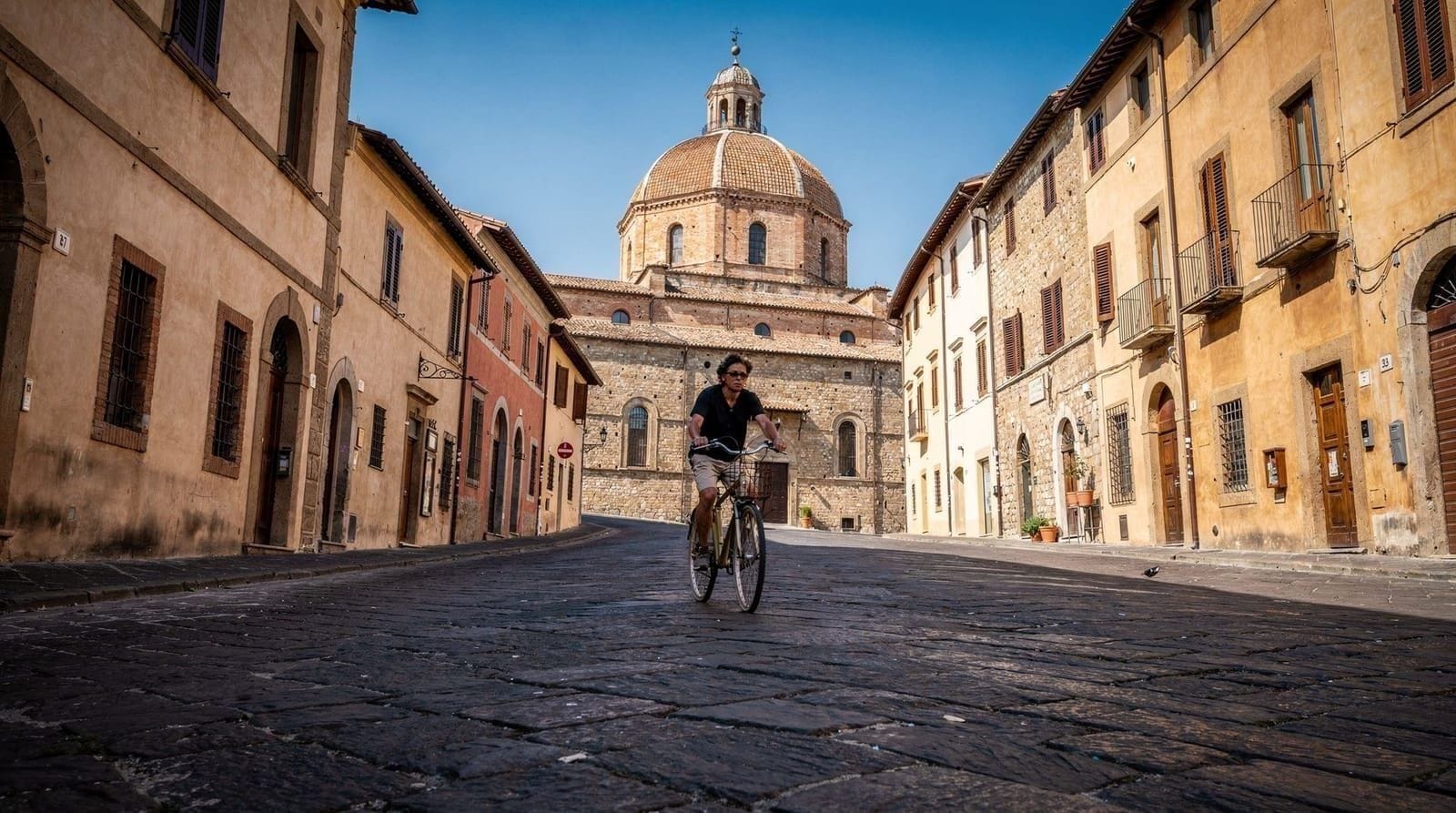
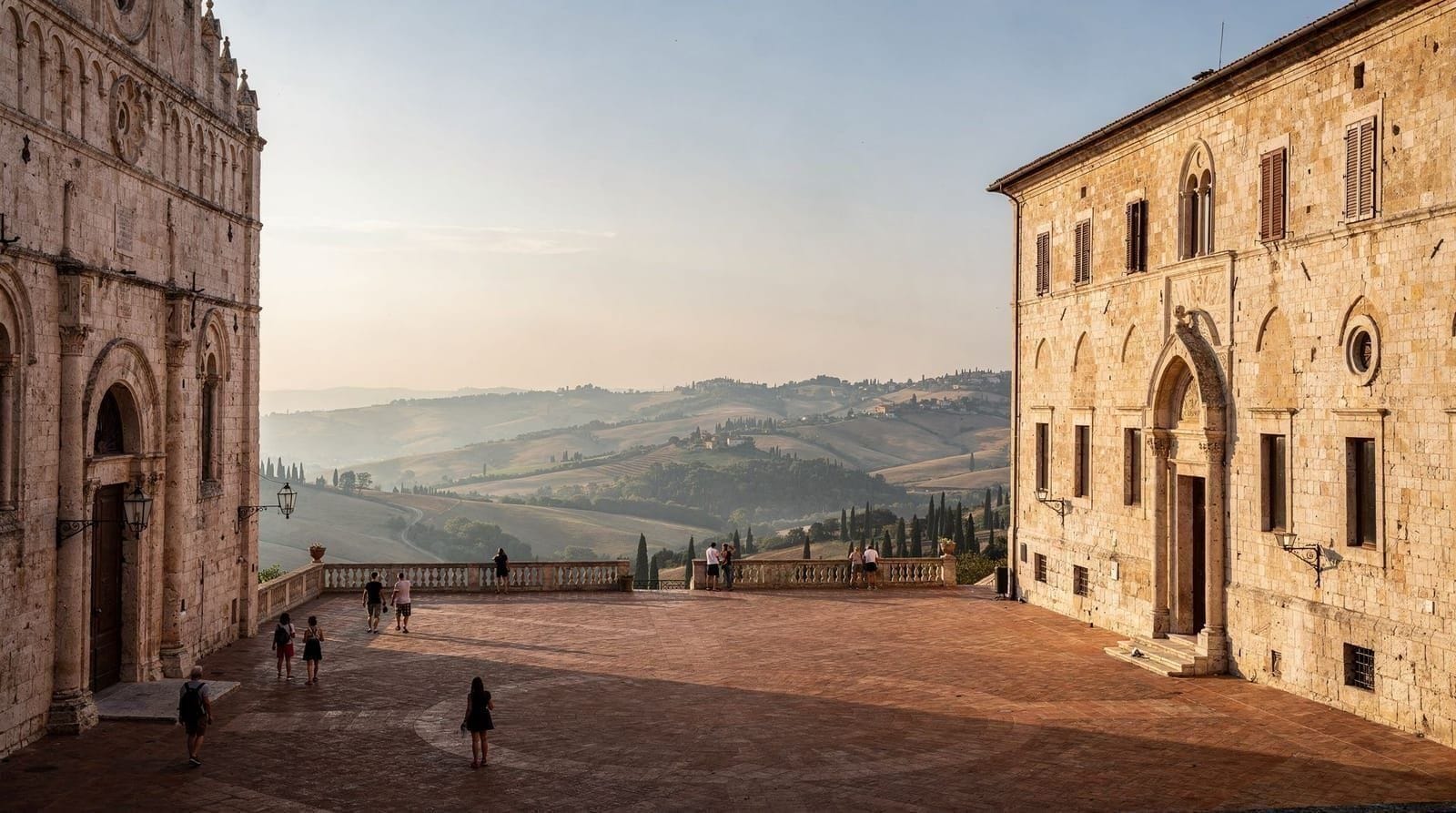
Built on a ridge at nearly 600 metres, Montepulciano is the largest of the Val d’Orcia towns and the home of Vino Nobile di Montepulciano DOCG, one of Italy’s great red wines (made from Sangiovese, known locally as Prugnolo Gentile). The town has a long main street, the Corso, lined with Renaissance palaces and wine shops (cantine), leading to the Piazza Grande at the summit with the unfinished cathedral, the Palazzo Comunale and sweeping views.
Montepulciano’s wine cantinas are concentrated in the cellars beneath the town — many are free to visit and offer tastings for €5-10. The most dramatic is the Contucci cellar inside the Palazzo Contucci on the main piazza.
See our dedicated Montepulciano guide for full details.
Montalcino
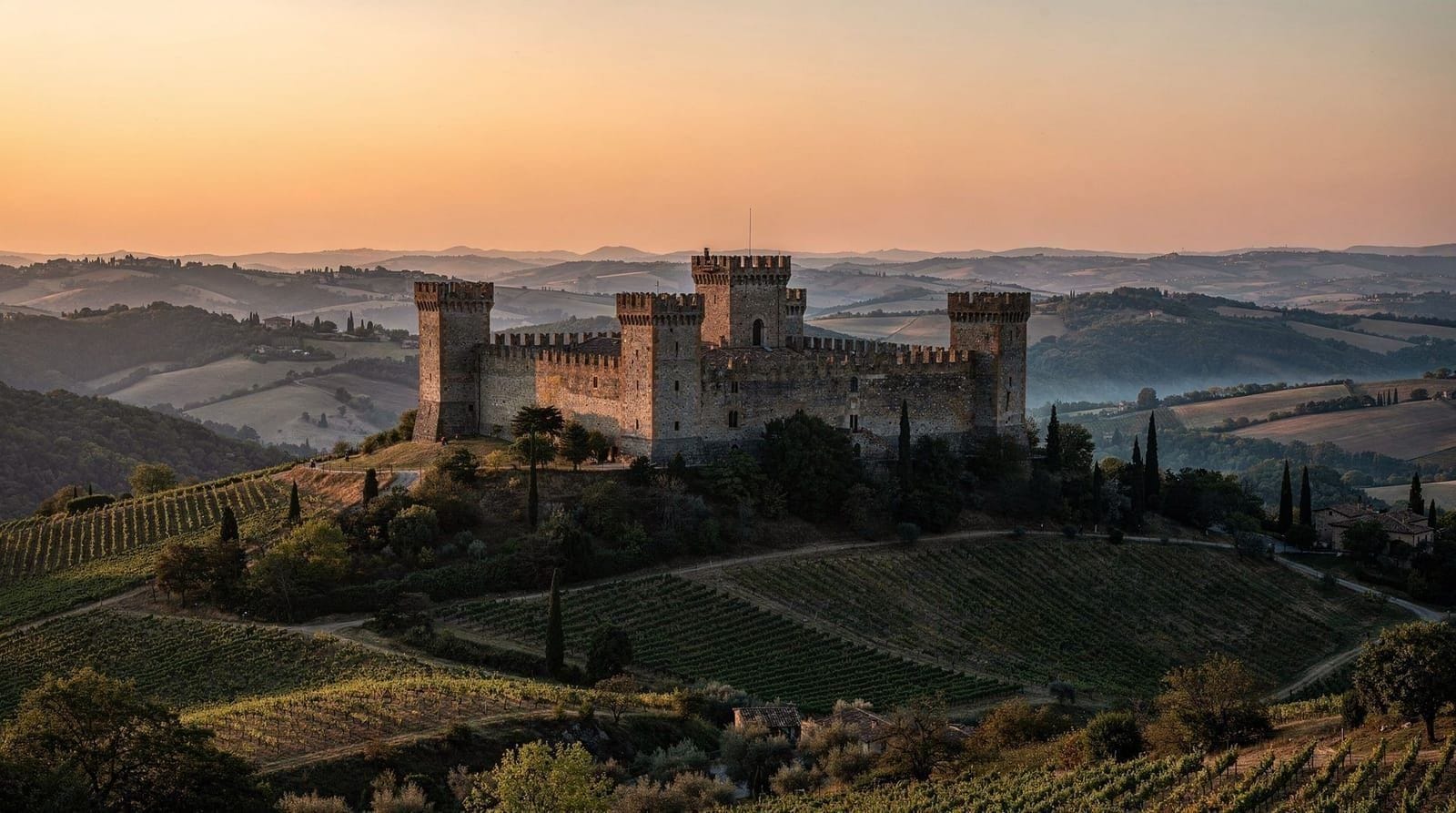
Montalcino is a compact hilltop town 25 kilometres west of Pienza and the home of Brunello di Montalcino DOCG — considered by many the greatest Italian red wine and certainly one of the most collectible, with top examples aging 20-30 years. The Fortezza (15th-century castle) at the top of the town has an enoteca selling Brunello and Rosso di Montalcino by the glass in the atmospheric setting of the castle’s internal courtyard. Worth an hour even if you are not a serious wine collector.
See our dedicated Montalcino guide for full details.
San Quirico d’Orcia
The geographic heart of Val d’Orcia and the most practical stopping point if you want to access the valley’s most iconic landscapes. The town has a fine Romanesque collegiate church (Collegiata dei Santi Quirico e Giulitta, 12th-13th century) with elaborately carved portals and a beautiful medieval hospital building (L’Ospedale della Scala). The Horti Leonini, 16th-century box hedge gardens on the edge of town, offer a peaceful lunch stop and views across the valley.
San Quirico is not as well visited as Pienza or Montepulciano and is the better for it.
Bagno Vignoni
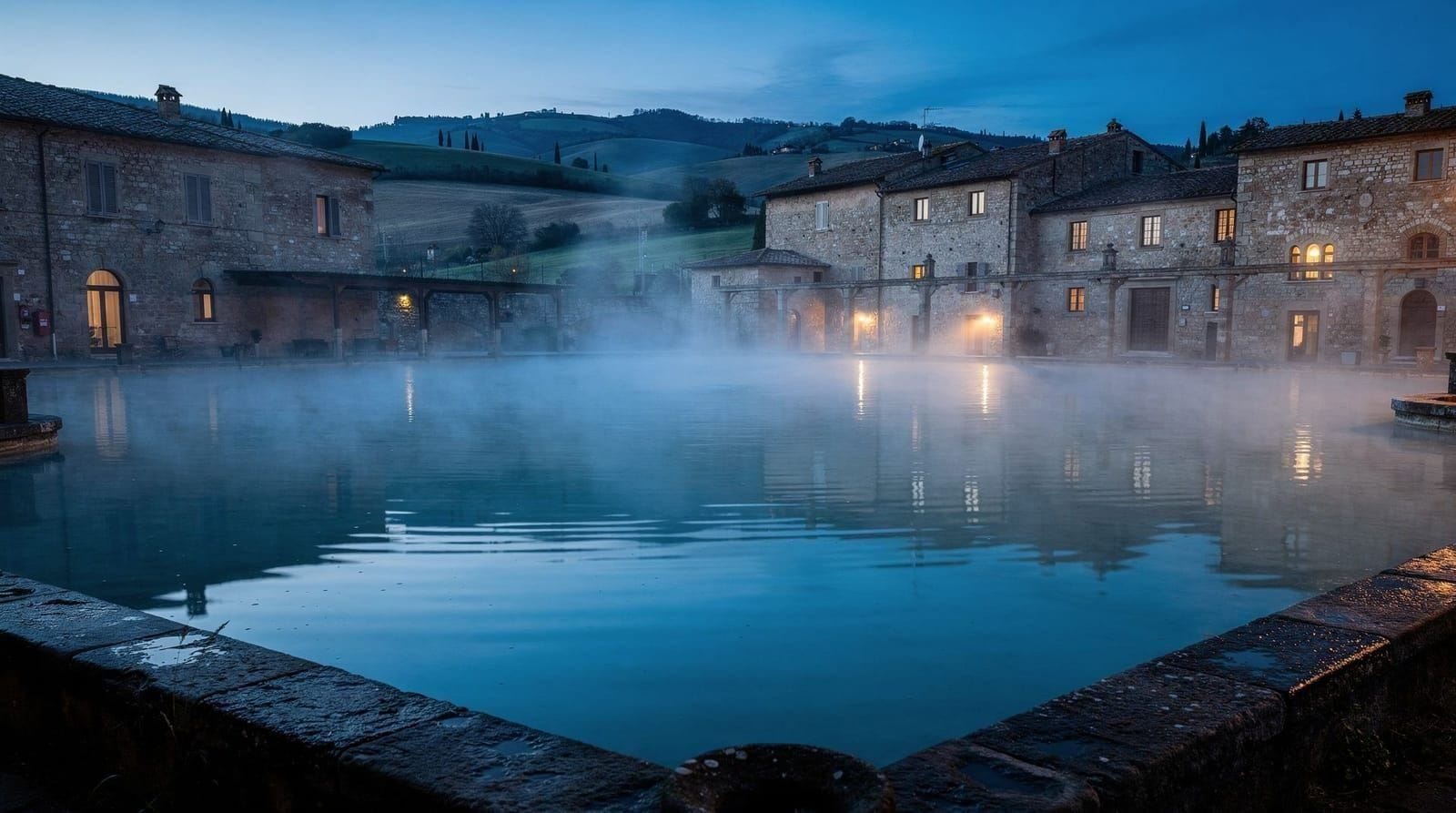
Technically a hamlet of San Quirico, Bagno Vignoni is one of the stranger places in Tuscany. Its main “piazza” is not a piazza at all but a large open-air thermal pool, built by the Medici in the 15th century over natural sulphur springs that have been in use since Roman times. You cannot swim in the historic pool (it is a protected monument) but you can stand on its edge and look into its steaming, mineral-green depths. The hot spring water flows down to the valley floor, where a series of natural cascades (free) and a commercial thermal spa (Terme Posta Marcucci, €20-30 entry) offer proper swimming.
See our dedicated Bagno Vignoni guide for full details.
The iconic landscapes: where to photograph Val d’Orcia
The landscapes that appear in every Tuscany photograph are real and accessible, but knowing exactly where to go is necessary — “Val d’Orcia” covers a large area.
Belvedere di San Quirico: The most photographed viewpoint, showing the Casetta di Spedaletto farmhouse on a cypress-lined track in the foreground with rolling fields behind. Located on the SS146 road south of San Quirico toward Pienza. The closest pull-off is approximately 3 kilometres south of San Quirico. Sunrise is the classic time (5:30-6:30 in May-June); late afternoon golden hour works almost as well.
Gladiator road (Via dell’Amore / Orcia road near Bagno Vignoni): The winding road south of Bagno Vignoni toward Castiglione d’Orcia, with a famous S-curve section. This road featured in the opening sequence of Ridley Scott’s Gladiator (2000).
Agriturismo Poggio Covili: Located between San Quirico and Castiglione d’Orcia, this working farm estate has a tree-lined lane and hay-roll fields that become a cliché subject in early summer because the reality is extraordinary.
Montechiello: A small, mostly un-touristy village perched above the valley east of Pienza, with views along the Val d’Orcia that are as dramatic as anything near San Quirico but far fewer visitors.
Practical photography note: The classic “golden fields” images are possible late May-late June before harvest. After harvest (July-August), the fields are brown stubble. Hay bales appear in July-August. Spring (April-May) shows green fields and occasional poppies. Autumn shows ploughed brown earth, which can be dramatic in the right light.
Wine and food in Val d’Orcia
The wines
Val d’Orcia produces two internationally recognised DOCG red wines:
-
Brunello di Montalcino DOCG: Aged minimum 5 years (6 for Riserva), made from 100% Sangiovese Grosso. Deep, tannic, complex; great examples age 20-40 years. Prices range from €25 (Rosso di Montalcino, the accessible younger version) to €200+ for top Riserva bottlings.
-
Vino Nobile di Montepulciano DOCG: Made from minimum 70% Prugnolo Gentile (Sangiovese clone). Less austere than Brunello, with cherry fruit and earthy notes. Aged minimum 2 years (3 for Riserva). Prices €15-60.
-
Orcia DOC: A newer, more flexible designation covering the valley itself. Lighter, more everyday wines for drinking young. Good value at €8-15.
Food specialities
- Pecorino di Pienza: Sheep’s milk cheese in multiple styles. Buy directly from cheese shops in Pienza.
- Pici: Thick hand-rolled pasta, the regional speciality. Served all’aglione (with a tomato and garlic sauce) or al cinghiale (wild boar).
- Acquacotta: Literally “cooked water” — a simple peasant soup of vegetables and bread, elevated by good ingredients.
- Lardo di Cinta Senese: Cured fatback from the native Cinta Senese pig, with extraordinary flavour.
Planning a Val d’Orcia itinerary
Day trip from Florence (one day)
Leave Florence by 8:30. Drive 1:45 to San Quirico d’Orcia; stop briefly for the Collegiata and Horti Leonini (30 minutes). Continue 12 km to Pienza for cheese shopping and the Piazzale Rossellino (1.5 hours). Lunch in Pienza or on the road. Drive east 13 km to Montepulciano for a cantina visit and walk up the Corso (2 hours). Return to Florence via Siena (2 hours). This is a long day (departure by 8:30, return by 20:00) but entirely feasible.
What you miss in a day: Montalcino, Bagno Vignoni, the photography viewpoints, and any sense of the landscape at its most atmospheric (dawn and dusk).
Two days (recommended minimum)
Day 1: Montepulciano (morning/lunch), Pienza (afternoon), Bagno Vignoni (late afternoon thermal soak, dinner). Stay overnight in Pienza or a surrounding agriturismo. Day 2: Dawn photography near San Quirico, Montalcino (morning/winery), Castelnuovo dell’Abate, drive home.
See our full Val d’Orcia road trip itinerary for detailed routing and accommodation suggestions.
Three days or more
Adds time to explore lesser-known towns (San Quirico in depth, Montechiello, Castiglione d’Orcia, Radicofani), visit multiple wineries, and take in the valley at different times of day.
Tours from Florence
If driving yourself is not possible or practical, several excellent guided tours cover Val d’Orcia from Florence, typically combining Montepulciano, Pienza and Montalcino in a single full-day excursion with a winery visit and lunch included.
Cheese, wine and farm shops worth a stop
Beyond the sit-down restaurants in Pienza and Montepulciano, Val d’Orcia rewards stopping at roadside farm shops (aziende agricole) that sell direct — pecorino cheese aged in hay or walnut leaves, cold-pressed olive oil from the previous autumn’s harvest, honey, and saffron, which the area around San Quirico and Pienza has grown since medieval times. These stops rarely have fixed opening hours in the way a shop in central Florence would; a hand-painted sign and an open gate is usually the invitation. Buying directly supports smaller producers who don’t distribute through the wine-shop and gift-shop network in the main piazzas, and prices are typically lower than in town.
Practical driving notes for the valley
The roads within Val d’Orcia itself are mostly excellent — well-maintained SP (provincial) roads winding through the hills, with light traffic outside peak midsummer weekends. A handful of the most scenic connecting roads (notably the strada bianca sections near Pienza and around Monticchiello) are unpaved white gravel roads; standard rental cars handle them fine at moderate speed, but avoid them after heavy rain when they can turn slick. Fuel stations are sparse away from the main towns, so fill up in Siena, Montepulciano or Montalcino rather than assuming a station will appear along a scenic backroad. Mobile signal is generally reliable but can drop in the lower valley sections, so download offline maps before setting out.
Val d’Orcia vs. Chianti and San Gimignano for a first-timer
Travellers with only one countryside day from Florence often ask which region to choose. Chianti is closer (about an hour) and easier without a car via organised tours, with vineyards and hill towns like Greve in Chianti at a gentler pace. San Gimignano offers a single, highly photogenic medieval skyline reachable by bus in a morning. Val d’Orcia asks more of you — a longer drive, no practical public transport, and a full day at minimum — but rewards that effort with the UNESCO landscape and the region’s two most serious wines, Brunello and Vino Nobile. If this is a single Tuscany trip with limited time, Chianti or San Gimignano are the easier choices; if the golden cypress-lined roads are the specific image driving the whole Tuscany trip, Val d’Orcia is worth the extra distance.
Frequently asked questions about Val d’Orcia
Is Val d’Orcia worth visiting in winter?
Yes, but differently. The landscape is less lush (brown ploughed fields rather than golden wheat), but winter offers clear skies with snow on Monte Amiata in the background, far fewer visitors, and excellent access to wineries for serious tastings. Temperatures are cold (5-10°C). Many agriturismo close November-March; check in advance.
What is the best base for exploring Val d’Orcia?
Pienza is the most attractive base for two or three nights — small, central, beautiful and with good restaurants and cheese shops. Montepulciano has more accommodation options. Montalcino suits wine enthusiasts specifically. Agriturismo farms scattered throughout the valley offer the most atmospheric experience.
When are the golden wheat fields of Val d’Orcia at their best?
Late May to late June. The fields are cut in late June-early July depending on the year. By July the landscape turns brown. Spring (April-May) shows green fields and occasional poppies, which is also beautiful though different from the iconic images.
How do I get to Val d’Orcia without a car?
It is genuinely difficult. The most practical option is a guided tour from Florence that includes transport. Independent public transport to Montalcino requires a train to Buonconvento or Siena plus a bus with very infrequent service. Self-driving or a rental car is strongly recommended.
Can I swim in the hot springs at Bagno Vignoni?
Not in the historic central pool (protected monument). The natural cascades at the Mulino di Bagno Vignoni at the valley floor are free. The Terme Posta Marcucci spa charges approximately €20-30 entry for their thermal pools. See our Bagno Vignoni guide for details.
What is Brunello di Montalcino and why is it expensive?
Brunello di Montalcino is a Sangiovese-based red wine from the Montalcino commune, aged a minimum of 5 years before release. It is regarded as Italy’s most prestigious wine, with the ability to age for decades. Prices reflect the long aging requirement, limited production zone and international demand. Entry-level bottles start around €25 for Rosso di Montalcino (the younger, less aged version); Brunello starts around €35-40 and rises sharply for top estates.
What is the difference between Val d’Orcia and Chianti?
Chianti is further north, closer to Florence, centred on the Sangiovese-based Chianti Classico DOCG. The landscape is also rolling hills with vineyards but less dramatic than Val d’Orcia. Val d’Orcia is more remote, more dramatically shaped by the UNESCO-protected agricultural landscape, and home to heavier, age-worthy wines (Brunello, Vino Nobile). For a first Tuscany trip, Chianti is easier; for the classic landscape experience and deeper wine culture, Val d’Orcia is worth the extra distance.
Top experiences
Bookable activities with verified prices and instant confirmation on GetYourGuide.

Val d'Orcia: Montepulciano, Pienza and Montalcino with winery
- Free cancellation
- Small group
Florence: Val d'Orcia highlights tour with wine tasting
- Free cancellation
- Small group
Florence: Val d'Orcia cheese and wine tasting tour
- Free cancellation
- Small group

Florence: Montalcino, Montepulciano and Val d'Orcia with lunch
- Free cancellation
- Small group
Siena: hot air balloon over Pienza, Montalcino and Val d'Orcia
- Free cancellation