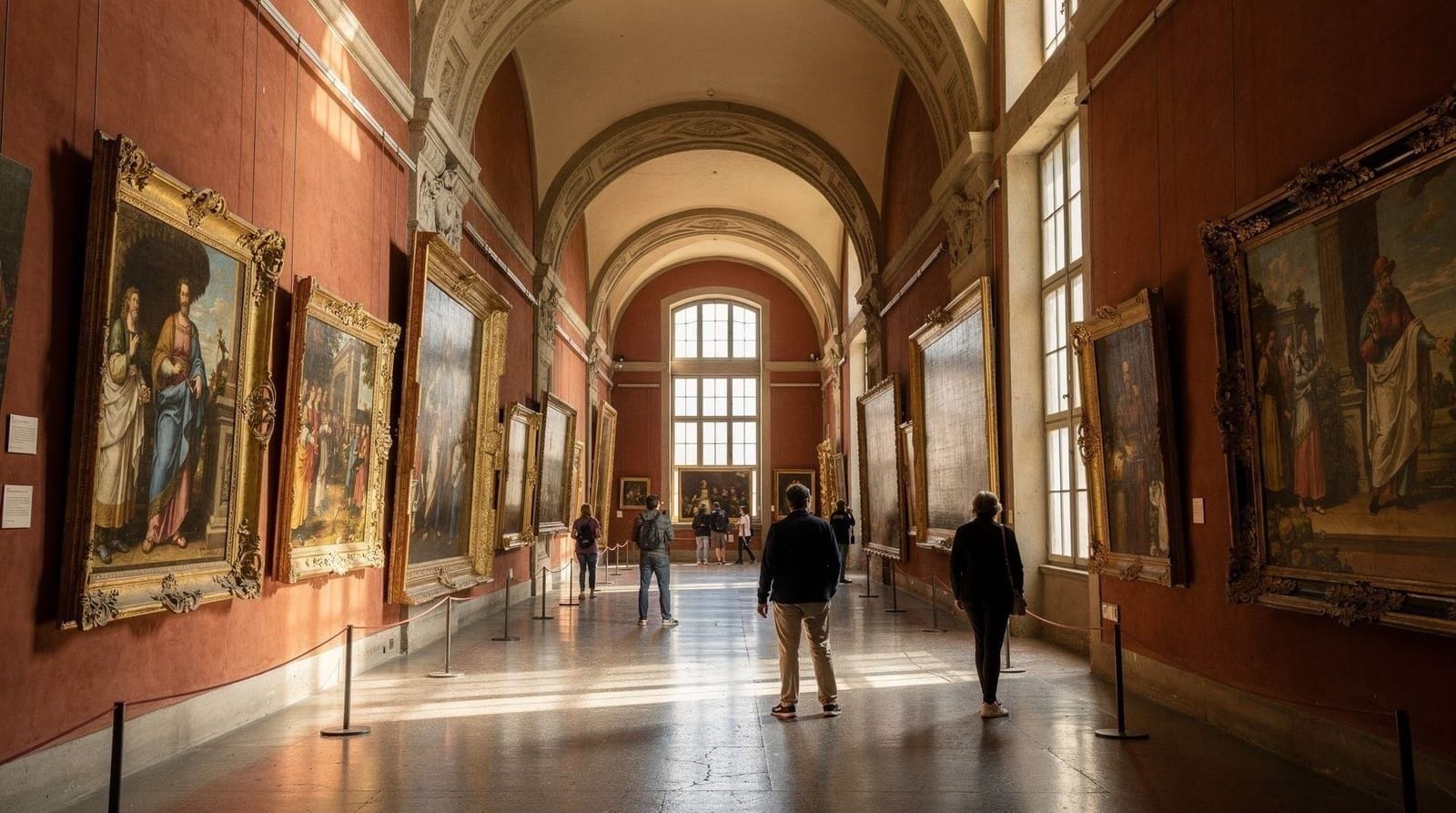
Accademia Gallery: complete visitor guide
Florence: Accademia Gallery and Michelangelo's David tour
- Skip the line
- Small group
What is in the Accademia Gallery in Florence?
The Accademia Gallery houses Michelangelo's original David (5.17 metres tall), the four unfinished Prisoners sculptures, Saint Matthew by Michelangelo, Florentine paintings from the 13th–16th centuries, and a musical instruments collection with some of the world's earliest violins. Entry is €16; pre-booking essential from April to October.
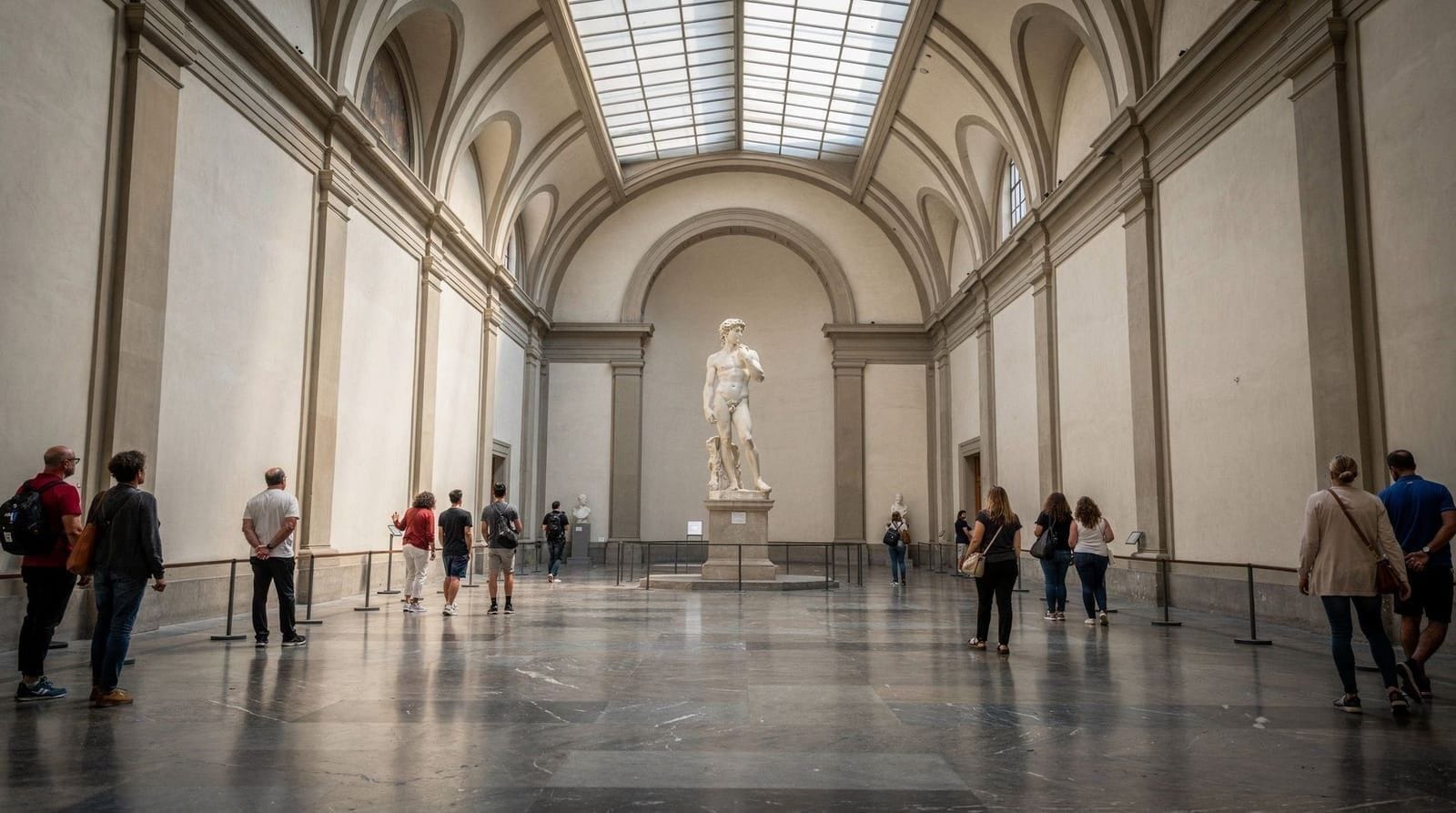
There is no preparation that fully accounts for the physical reality of the David. Every visitor has seen photographs, knows it’s “big,” has some general awareness that it’s a famous Renaissance sculpture. And then they walk into the Tribune and find themselves genuinely stopped. The David is not famous because it’s famous. It is famous because it is, by any measurement, extraordinary.
The Galleria dell’Accademia di Firenze was built specifically to house and protect Michelangelo’s David. But the rest of the museum — the Prisoners, the paintings, the musical instrument collection — is worth as much time as you can give it.
Essential facts before you visit
| Where | Via Ricasoli 58–60, 10-min walk from the Duomo |
| Cost | €16 + €3 online booking fee |
| Time needed | 60–90 minutes minimum |
| Hours | Tue–Sun 8:15am–6:30pm, closed Mondays |
| Booking | Essential April–October |
Tickets: €16 + €3 online booking fee. Pre-booking essential April–October. Walk-up possible November–March but queues still form. Full booking guide: How to book Accademia Gallery tickets.
Hours: Tuesday–Sunday, 8:15 am – 6:30 pm (last entry 5:30 pm). Closed Mondays.
Time needed: 60–90 minutes minimum; 2 hours for a thorough visit.
Location: Via Ricasoli 58–60, between the Duomo and Piazza San Marco. 10-minute walk from the Duomo.
Getting there: Entirely within the ZTL zone. Walk from the Duomo (10 min) or from Santa Maria Novella station (20 min). Do not attempt to drive — ZTL fines are automatic and unavoidable.
The David: everything you need to know
The commission and the block
In 1501, the Opera del Duomo (the organization that managed Florence Cathedral) commissioned Michelangelo to carve a figure from a marble block that had been sitting in a courtyard for 35 years. Two previous sculptors had abandoned it as too narrow and damaged. The block was 5.5 metres tall, poorly proportioned, and had a large hole partway up where Agostino di Duccio had begun carving in the 1460s.
Michelangelo was 26 years old. He worked for approximately two years, in relative secrecy, to produce the David.
The subject matter
The David depicts the Biblical hero David at the moment just before his battle with the giant Goliath — not the triumphant aftermath, but the tense anticipation. The sling is over David’s left shoulder; his head is turned slightly to the right, his gaze focused and calculating. The body is tensed, ready.
This choice of moment was revolutionary. Previous David sculptures (Donatello’s bronze David, also in Florence, and Verrocchio’s) showed the moment after victory. Michelangelo’s David is all potential energy, all pre-battle concentration. The viewer stands where Goliath would soon stand.
The sculpture itself
Standing below the David, the first thing you notice is the scale. Five metres of marble is an abstract measurement; 5 metres of perfectly rendered human anatomy is viscerally different. The veins in the hands. The tendons in the neck. The slight asymmetry of the torso. The expression — often described as “fearful” or “concentrated” by various observers over the centuries — is genuinely difficult to read, which may be part of its power.
The head and hands are slightly larger than anatomically proportional. This was intentional: the David was originally intended to be placed high on Florence Cathedral, viewed from below. Looking up, the oversized head and hands would appear correct. When city leaders decided instead to place it in Piazza della Signoria at ground level, the slight disproportion became visible — and has prompted endless scholarly discussion ever since.
Walk all the way around. The back of the David, often ignored by visitors focused on the famous front view, shows the sling in detail and the muscles of the lower back and legs with extraordinary fineness.
The move indoors
The David stood in Piazza della Signoria from 1504 until 1873. By then, weather damage (Florence gets frost and driving rain in winter) had caused serious deterioration to the surface. The Accademia was built to receive it, and the original was moved indoors while a marble copy replaced it in the piazza.
The decision to build a purpose-designed museum room — the domed Tribune — around a single statue was itself unusual. Architect Emilio de Fabris designed the space so that natural light would fall on the David from above, replicating something of the outdoor setting. On a sunny morning, this creates a genuinely luminous effect.
The 1991 attack
In 1991, a man entered the museum and attacked the David with a hammer, striking the left foot and causing damage to two toes. Security at Italian museums became considerably more serious after this incident. The damaged area has been conserved but not fully restored.
The Prisoners (Prigioni)
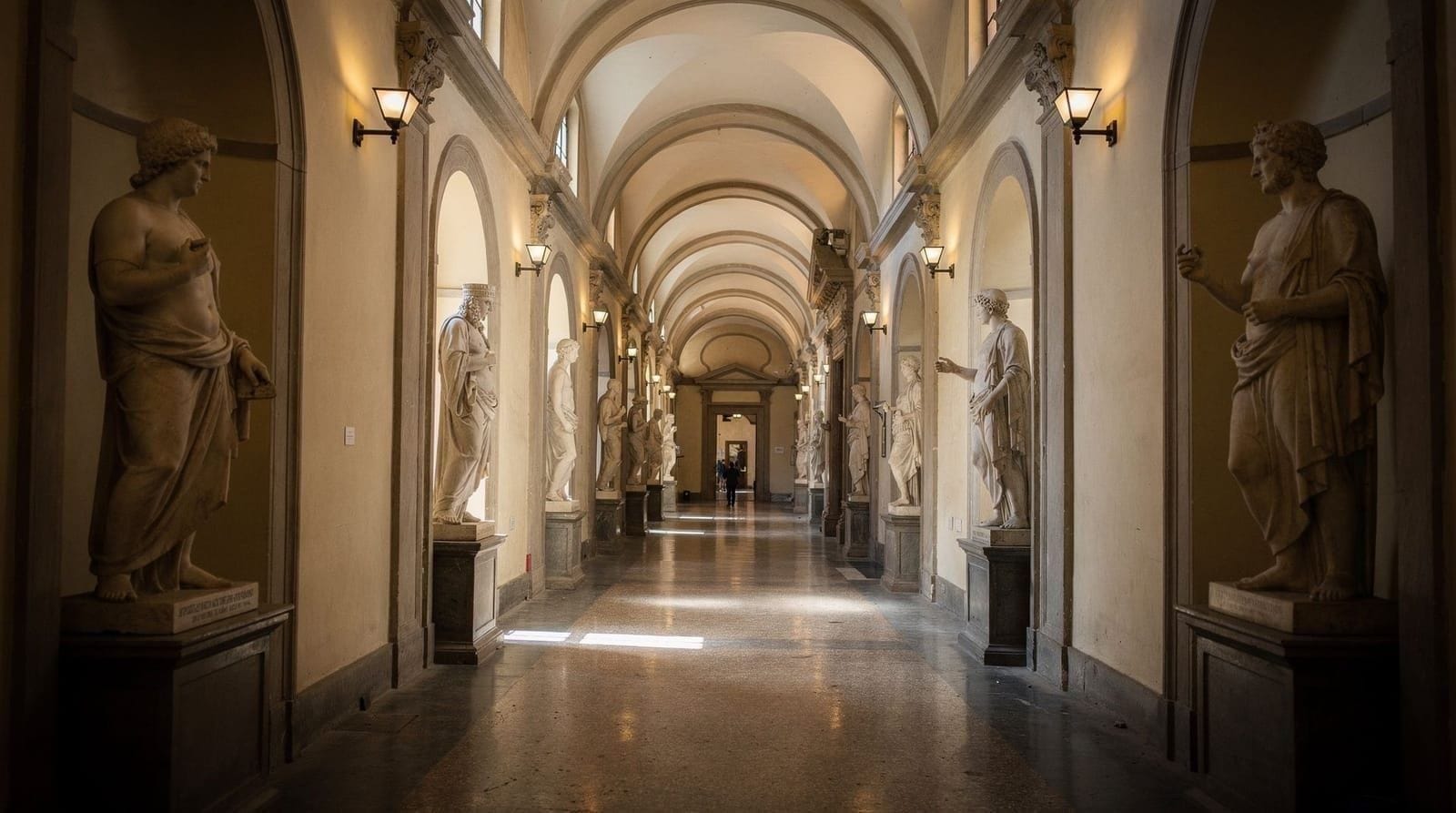
The four unfinished Michelangelo sculptures that line the gallery approach to the Tribune are among the most fascinating works in the museum. Known as the Prigioni (Prisoners or Slaves), they were carved between approximately 1519 and 1534 for the tomb of Pope Julius II — a project that Michelangelo worked on, abandoned, resumed, and ultimately never completed over four decades.
The four figures are:
- The Awakening Slave — the most unfinished, showing a figure apparently struggling to emerge from the block
- The Young Slave — more developed, with a smooth torso emerging from rough stone
- The Bearded Slave — head and upper body largely finished
- The Atlas — most dramatically raw, the head buried in the marble block
What makes the Prisoners extraordinary is that they make Michelangelo’s method visible. He worked from the front of the block backward, revealing the figure he claimed was already present within the marble. In the most unfinished figures, you can see exactly where the chisel worked and where it didn’t — a process normally hidden by completion.
A fifth Michelangelo — Saint Matthew, carved around 1506 — stands at the end of the gallery. It was intended as part of a 12-apostle series for the cathedral; only Matthew was ever begun.
The Florentine painting collection
The gallery wings off the central Tribune contain an excellent collection of Florentine painting from the 13th to 16th centuries. Less visited than the sculpture halls, these rooms offer some genuinely important works:
- Painted altarpieces by Fra Bartolomeo, Ghirlandaio, and Filippino Lippi
- Crucifixes and devotional panels that trace the development from Byzantine convention to naturalistic Renaissance style
- A large collection of paintings by Andrea Orcagna and followers showing the Florentine Gothic style
If you have only 60 minutes, prioritise the David and Prisoners. If you have 90–120 minutes, the painting galleries add real depth, particularly if you’re also planning to visit the Uffizi and want comparative context.
The musical instruments collection
One of the most underappreciated collections in Florence. The Accademia’s Museo degli Strumenti Musicali occupies several rooms near the museum entrance and contains instruments from the 15th–19th centuries, including:
- Violins by Antonio Stradivari (17th century)
- Instruments made for the Medici court, some from as early as the 1500s
- Early keyboard instruments, including a cembalo d’arco (bowed keyboard instrument) that exists in almost no other surviving examples
The collection is particularly strong in early Italian string instruments. Music history enthusiasts will find it fascinating; for most visitors, a 15–20 minute browse adds a nice counterpoint to the sculpture-heavy main galleries.
Temporary exhibitions
The Accademia hosts temporary exhibitions in dedicated spaces, typically running 3–6 months. These have focused on Florentine art history, music, and specific artists or periods. A separate or additional ticket is usually required. Check the museum’s website before your visit to see what’s on.
The plaster cast collection
Upstairs from the main gallery, the Accademia holds a large collection of 19th-century plaster casts — models and study pieces accumulated when the museum functioned as an active art school. Less celebrated than the permanent collection but interesting for understanding how 19th-century Florentine artists learned their craft.
Practical visit planning
How to structure your visit
A suggested route for a 90-minute visit:
- Entry hall and first rooms (10 min): orientation, the painting collection along the left wall
- The Prisoners gallery (15 min): walk slowly down the hall, examining each unfinished figure
- The Tribune — the David (30 min): walk all the way around; look up; step back for the full figure; get close for the hands and face
- Florentine painting rooms (20 min): the adjacent wings
- Musical instruments (15 min): the dedicated collection near the entrance area
If you have more time, spend it in the Tribune. The David rewards repeated, slow looking in a way that few objects in any museum do.
Guided tours
A guide is more valuable at the Accademia than at almost any other Florence museum, because the David’s art historical context — the troubled commission, the technical innovations, the political symbolism of the chosen subject — transforms the experience. A 60–90 minute guided tour covers the David, the Prisoners, and key paintings. Private tours for groups of up to four people offer maximum depth at approximately €100–140.
Combination visits: Accademia + other museums
Accademia and Uffizi on the same day
Ambitious but doable. The ideal sequence:
- 8:15 am: Accademia (first entry slot, see the David before crowds arrive)
- 10:00 am: Explore the San Marco area or grab coffee/breakfast in the neighbourhood
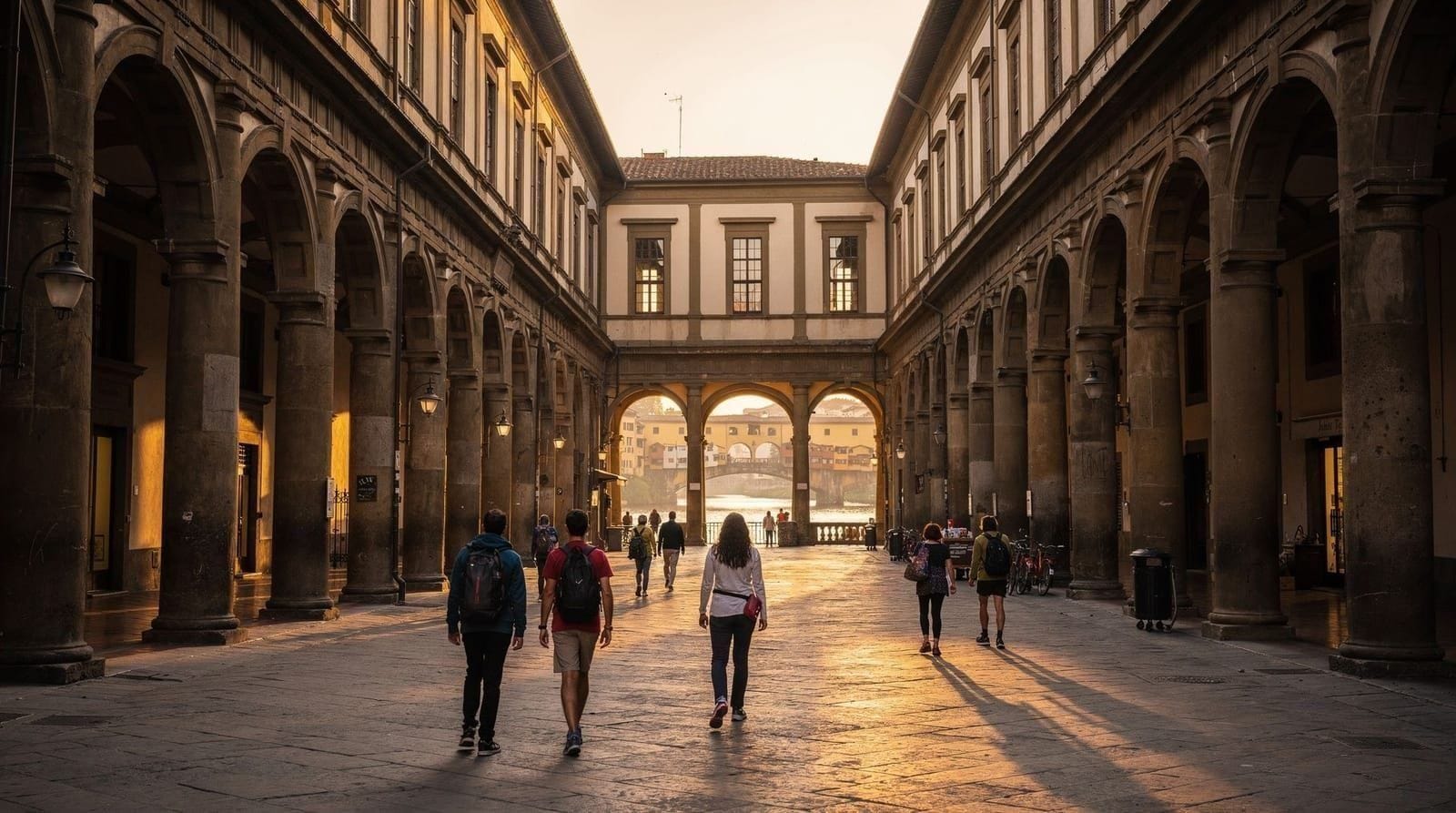
- 12:00 pm or 1:00 pm: Walk to the Uffizi (15–20 minutes on foot)
- Uffizi until 4:00–5:00 pm
This makes for a genuinely full art day. Take breaks — museum fatigue is real.
Accademia and Medici Chapels
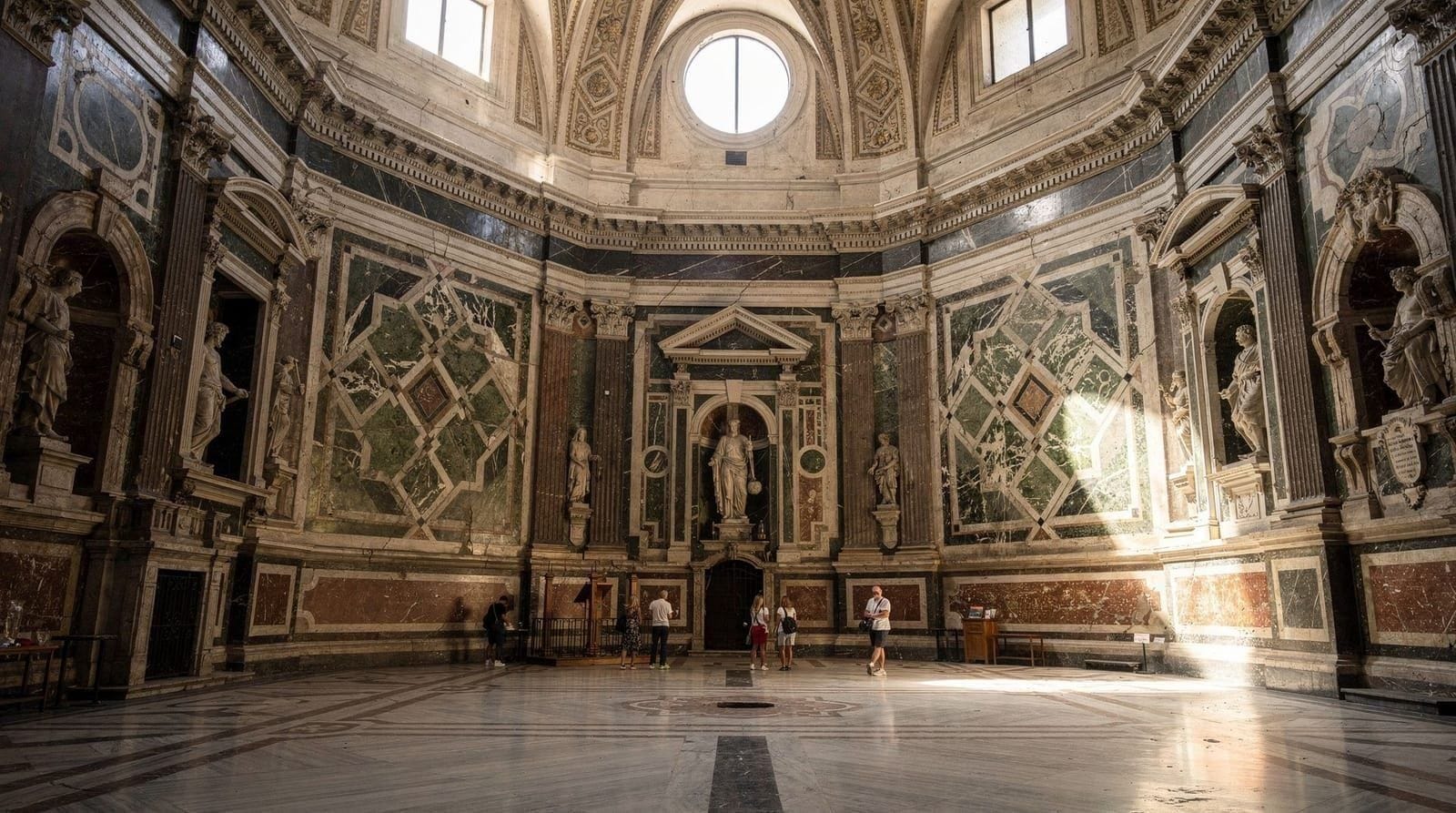
Both are in the San Lorenzo neighbourhood and can be combined in a half-day. Start at the Accademia (morning), walk 10 minutes to San Lorenzo, visit the Medici Chapels (Michelangelo’s New Sacristy is the key feature), and have lunch at the Mercato Centrale around the corner.
After the Accademia
The museum’s Via Ricasoli location puts you within easy walking distance of:
- Piazza San Marco: 3-minute walk, site of the San Marco Museum (Fra Angelico frescoes)
- Piazza Santissima Annunziata: one of Florence’s most beautiful and least tourist-crowded piazzas
- San Lorenzo and Mercato Centrale: 10-minute walk, good lunch options and the Medici Chapels
- The Duomo: 10-minute walk for the dome complex
Related guides
- How to book Accademia Gallery tickets
- Uffizi Gallery: complete visitor guide
- Medici Chapels visitor guide
- San Marco Museum guide
- Best Florence combo tickets
Frequently asked questions about the Accademia Gallery
Why does the David look angry?
The expression is intentionally ambiguous. Scholars have described it variously as focused concentration, righteous anger, pre-battle fear, or divine calm. The slightly raised lip and the furrowed brow suggest tension without clearly resolving into a specific emotion. This ambiguity may be deliberate — Michelangelo’s figures rarely have simple emotional expressions.
Is the Accademia photography-friendly?
Photography without flash is permitted throughout the museum, including in the Tribune. Tripods are not allowed. The Tribune’s natural skylight lighting is generally good for photography, though expect other visitors in frame for most of the day.
Can I visit the Accademia with a pushchair or wheelchair?
The ground floor galleries including the Tribune are fully accessible. A lift is available for the upper floor. Staff are helpful with accessibility needs. The entrance ramp is suitable for pushchairs and wheelchairs. Call ahead (055 098 7100) if you have specific accessibility requirements.
How is the Accademia different from the Uffizi?
The Accademia is smaller (60–90 minutes vs 2.5–3 hours for the Uffizi) and focused primarily on sculpture — specifically Michelangelo’s sculpture. It doesn’t have the breadth of the Uffizi’s painting collection. The Uffizi is for a comprehensive overview of Italian Renaissance painting; the Accademia is for the David and Michelangelo’s sculptural process. Both are essential Florence visits.
Are there cafés inside the Accademia?
No in-museum café. There are several good options immediately outside on Via Ricasoli and the surrounding streets. Caffè San Marco near Piazza San Marco (a 3-minute walk) is pleasant and less tourist-oriented than places directly outside the museum entrance.
The David and its replicas: understanding what you’re seeing where
Florence has three versions of Michelangelo’s David, which confuses visitors more than it should. Here’s a clear summary:
Accademia Gallery (Via Ricasoli): The original marble sculpture, carved by Michelangelo between 1501 and 1504. This is the definitive version. Pre-booking required; €16 entry.
Piazza della Signoria (outdoor): A marble copy commissioned in the 19th century when the original was moved indoors for protection. Installed in the location where Michelangelo’s original stood from 1504 until 1873. Free to view at any time. The copy is a faithful reproduction of the original but lacks the surface quality and condition of the Accademia original.
Piazzale Michelangelo (hillside viewpoint): A bronze cast of the David on the terrace that gives panoramic views over Florence. Free to view. Less detailed than either of the marble versions; primarily serves as a landmark.
For tourists, the practical implication: the copy in Piazza della Signoria gives you a sense of the David in its original outdoor civic context (this is where Florence displayed it for 370 years), which has genuine value. The original in the Accademia gives you the actual sculpture up close, with all its condition and detail. Both are worth seeing; neither duplicates the other’s value.
Michelangelo in Florence: the broader picture
Visitors who come to Florence primarily for Michelangelo often don’t realise how much of his work is concentrated in the city. The Accademia is the major institutional home of his sculpture, but it’s far from the only location:
Accademia Gallery: David, four Prisoners, Saint Matthew, and the Bandini Pietà (now moved to the Opera del Duomo Museum — see below)
Opera del Duomo Museum: Bandini Pietà (also called the Florence Pietà), carved in his 70s, intended for his own tomb. See Opera del Duomo Museum guide.
Medici Chapels (Cappelle Medicee): New Sacristy with the four allegories (Dawn, Dusk, Day, Night) and the Madonna and Child — see Medici Chapels guide.
Bargello Museum: Bacchus (c. 1497), Brutus, and early works — see Bargello Museum guide.
Uffizi Gallery: The Doni Tondo (the only finished easel painting by Michelangelo in any museum) — see Uffizi Gallery guide.
Santa Croce: Michelangelo’s tomb (designed by Vasari after Michelangelo’s death) and associated memorial monuments.
A Michelangelo-focused itinerary for Florence could cover the Accademia (morning), Opera del Duomo Museum (midday), and Medici Chapels (afternoon) in a single intense day — seeing the full arc from the youthful virtuosity of the David to the exhausted grandeur of the Bandini Pietà.
How the Accademia compares to other major art museums
First-time visitors sometimes ask how the Accademia compares to major museums they may have already visited — the Louvre, the Metropolitan, the British Museum. The comparison helps set expectations.
The Accademia is intentionally narrow: it houses Michelangelo’s major sculpture in Florence and a supporting collection. It is not trying to be comprehensive. A visit to the Accademia takes 60–90 minutes compared to 3–4 hours at the Louvre, not because it’s inferior but because it has a different and more focused purpose.
The analogy that works best: the Accademia is to Michelangelo’s Florence sculpture what the National Portrait Gallery is to British portraiture — a deep, focused engagement with a specific tradition rather than a broad survey. The Uffizi plays the comprehensive survey role in Florence; the Accademia plays the focused masterwork role. Both are indispensable; neither substitutes for the other.
Is the Accademia worth it if you’re short on time?
If you have to choose one Florence museum and only one, it’s a genuinely close call between the Accademia and the Uffizi. The Accademia wins on speed and impact per minute — 60–90 minutes delivers the David, the Prisoners, and a genuinely moving experience without the fatigue of a 2.5–3 hour Uffizi visit. The Uffizi wins on breadth. For a single-day Florence visit with limited museum time, the Accademia is the higher-certainty choice: nothing in it disappoints, and the payoff is immediate. For anyone spending 2+ days, both belong on the itinerary, ideally on separate mornings — see the best Florence combo tickets guide for how to book them together efficiently.
Top experiences
Bookable activities with verified prices and instant confirmation on GetYourGuide.

Florence: Accademia Gallery — David skip-the-line ticket
- Skip the line
- Instant confirmation
Florence: Accademia Gallery skip-the-line entry ticket
- Skip the line
- Mobile ticket
Florence: Accademia Gallery — David statue small group tour
- Skip the line
- Small group
Florence: Uffizi and Accademia Gallery skip-the-line ticket
- Skip the line
- Free cancellation
Florence: Accademia Gallery entry ticket with David guided tour
- Skip the line
- Free cancellation