Bardini Gardens Florence
Florence: Pitti Palace and Boboli Gardens walking tour
- Small group
- Free cancellation
How much does it cost to visit the Bardini Gardens in Florence?
Tickets to the Bardini Gardens cost €10 for adults, which includes access to the garden and the Villa Bardini. Combined tickets with the Boboli Gardens are available for €16. Free on the first Sunday of each month. The garden is at its most spectacular in late April and early May when the wisteria is in bloom.
Florence’s best-kept garden secret
The Bardini Gardens are, by a significant margin, Florence’s most underrated outdoor space. Located on the Costa San Giorgio hillside in the Oltrarno neighbourhood, directly adjacent to (but separate from) the Boboli Gardens, the Bardini covers about 5 hectares of terraced gardens, woodland, and formal parterres with views that few places in the city can match.
Most visitors to Florence never find them. The Boboli, just across the wall, draws queues; the Bardini, with a quieter entrance and less publicity, remains largely peaceful. This guide explains what makes it worth seeking out — and how it compares to the rest of the best gardens in Florence.
| Where | Costa San Giorgio, Oltrarno |
| Cost | €10 adult; €16 combined with Boboli |
| Time needed | 1.5–2 hours |
| Best time | Late April–early May for wisteria; 8:15am opening for fewer crowds |
| Free | First Sunday of every month |
History: from medieval olive grove to English-Italian garden
The hill behind Ponte Vecchio has been cultivated since medieval times. The terraced gardens here appear in 14th-century Florentine paintings. The property changed hands many times over the centuries before being purchased by Stefano Bardini — a remarkable 19th-century Florentine antiquarian, art dealer, and collector whose name is also attached to the Museo Bardini (a museum of decorative arts near the Ponte alle Grazie).
Bardini acquired the property in the early 20th century and redesigned the garden in a hybrid style that mixes elements of the Italian formal garden (terraces, stairs, geometric parterres) with the looser, more “natural” English landscape garden approach. The result is a garden that has a different mood in each section — formal hedges giving way to woodland paths, classical grottos appearing between wild-growing shrubs.
The villa itself dates from earlier centuries and was extensively modified by Bardini. His collection of decorative arts, furniture, and paintings was donated to the state and the garden has been publicly accessible since 2007 after a major restoration.
What to see in the Bardini Gardens
The grand staircase and wisteria pergola
The defining image of the Bardini is the 17th-century baroque grand staircase that climbs from the lower garden to the terrace. In late April and early May, this staircase is covered by a pergola draped in wisteria (Wisteria sinensis) in heavy purple clusters. The effect, with the staircase framing the view of Florence below, is extraordinary — photographers line up for the shot at opening time.
The wisteria flowers for approximately 2–3 weeks. The exact timing varies year to year depending on spring temperatures, but late April to early May is a reliable window. The Florence tourism authority usually announces the peak bloom dates on social media about a week before they peak.
Outside wisteria season, the staircase is still beautiful — the baroque ornament, the espaliered citrus trees on the walls, the box hedges forming geometric patterns in the lower terrace.
The upper garden and panoramic terrace
From the top of the staircase, you reach the upper garden and, above it, a terrace with a wooden pavilion. The views from here encompass almost all of historic Florence: the Duomo and Brunelleschi’s dome to the east, Giotto’s campanile, Palazzo Vecchio’s tower, and the Arno below. The Ponte Vecchio is directly in front.
This is, arguably, the best view of the Ponte Vecchio available from any public space in Florence. The angle and elevation are better than from most of the city’s celebrated viewpoints. Come in the evening light if possible.
The baroque garden parterres
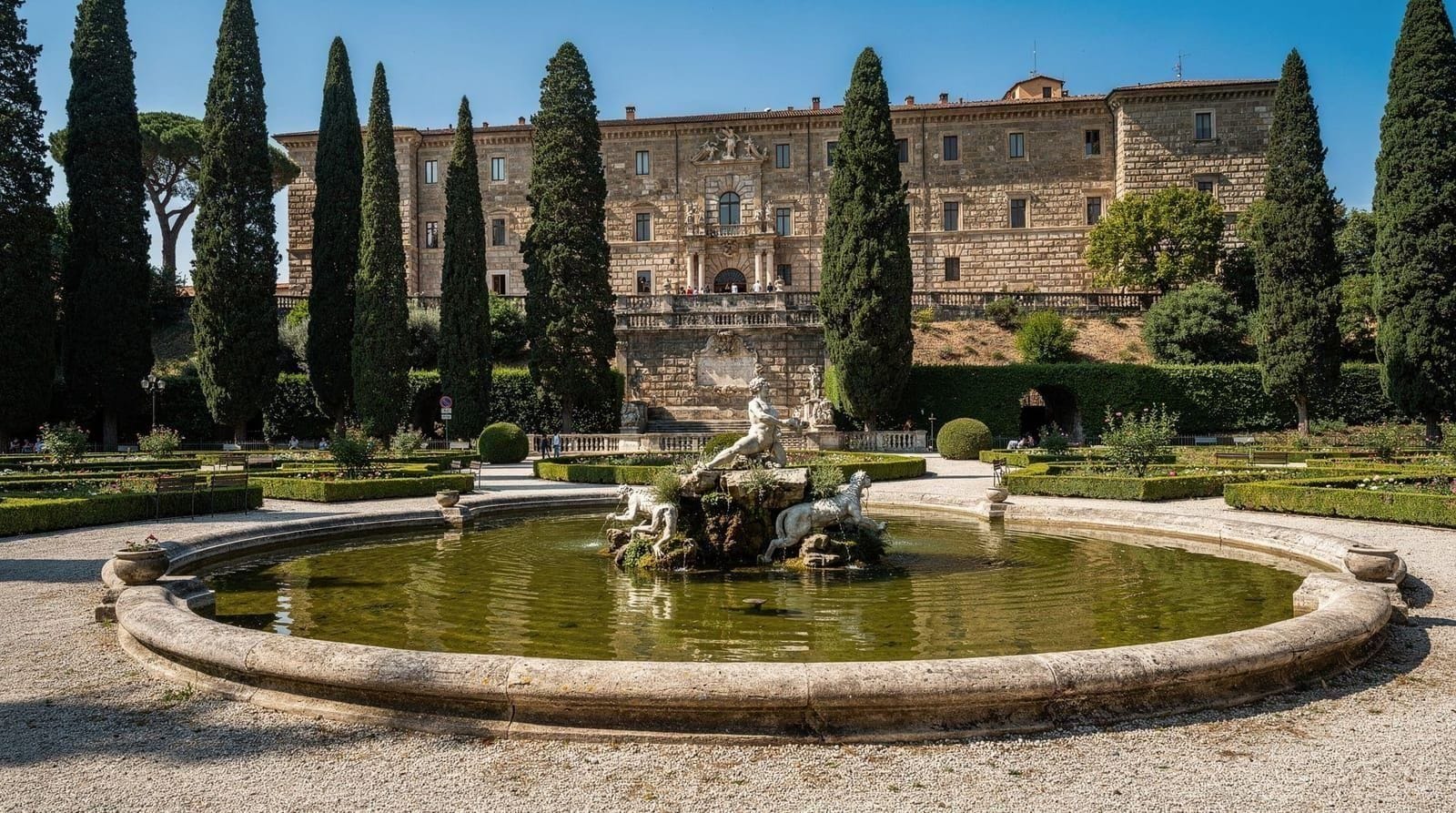
Below the main staircase, formal parterres laid out with low box hedges form geometric patterns visible from above. These were restored in the 2007 renovation using designs from historical documentation. In spring, the parterres are planted with seasonal flowers; in summer they maintain their green geometric form.
The woodland section
The western section of the garden is less formal — a mixture of woodland paths, stone benches, and old trees including ancient holm oaks and cypresses. This area feels more like a private park than a formal garden and provides deep shade in summer. Children enjoy the paths and the sudden surprises of statuary and fountains in unexpected corners.
The Kiwi Pergola
A long iron pergola covered in kiwi vines — an unusual and beautiful feature in the central section. The kiwi fruit in autumn is genuinely decorative.
Villa Bardini and the museums
The villa houses two small museums on rotating display. The Roberto Capucci Museum presents rotating selections from the archive of the Florentine-born fashion designer (b.1930), known for sculptural ball gowns and theatrical fashion design. The Pietro Annigoni Collection shows works by the British-trained Florentine portrait painter whose commissions included Queen Elizabeth II.
Neither museum is a must-see, but both are included in the ticket price and each takes 30 minutes.
Practical information
Tickets and hours
- Adult ticket: €10
- Combined Boboli + Bardini: €16 (good value if you’re visiting both)
- Free: First Sunday of each month
Hours follow the Boboli Gardens schedule:
- June–August: 8:15am–7:30pm
- March–May, September–October: 8:15am–6:30pm
- November–February: 8:15am–4:30pm
- Closed: First and last Monday of each month
The main entrance is via the Costa San Giorgio (off Via de’ Bardi), but you can also enter from Via Bardini (via the Annalena gate connection area). Check the Uffizi Galleries website for current ticketing as the Bardini falls under the same management.
Getting there
The Bardini Gardens are in the Oltrarno neighbourhood, about 10 minutes walk from Ponte Vecchio. From Piazza Santa Croce, cross the Ponte alle Grazie and turn uphill on Via de’ Bardi. The entrance is signposted on the Costa San Giorgio.
No practical bus route runs directly to the entrance — it’s most easily reached on foot from the Oltrarno. The Costa San Giorgio is steep.
When to visit
The garden rewards visiting outside peak tourist hours:
Wisteria season (late April–mid May): Book the earliest entry time possible. By 10am the garden fills with photographers.
Summer mornings: The upper woodland provides good shade; the garden is quieter than the Boboli on the same morning.
Autumn: The colors of the old trees and the kiwi fruit on the pergola are attractive. Significantly fewer visitors than spring.
Winter: Very quiet. Some of the formal elements (roses, annuals) are dormant, but the bones of the garden and the views remain excellent. The holm oaks are evergreen.
Stefano Bardini: the man behind the garden
Understanding the Bardini Gardens is easier if you know something about their creator. Stefano Bardini (1836–1922) is one of the most significant figures in late 19th-century Italian art dealing — a man who shaped the collection of every major American museum of his era.
Born in Figline Valdarno near Florence, Bardini trained as a painter before pivoting to the antiques trade. He was not merely a dealer: he was a restorer, an assembler, an excavator, and at times a controversial operator who acquired medieval and Renaissance objects from deconsecrated churches and private collections across Italy during a period of significant cultural disruption (the Risorgimento, Italian unification, and the stripping of church assets in the 1870s).
By the 1890s, Bardini was the most important antique dealer in Italy. He sold to J.P. Morgan, Isabella Stewart Gardner, the Rothschilds, and the Victoria and Albert Museum. His palazzo on the south bank of the Arno (now the Museo Bardini, accessible nearby) contains architectural fragments, furniture, ceramics, bronzes, and paintings assembled over a lifetime of systematic acquisition.
The Costa San Giorgio property was his country refuge and his final project — redesigning the garden in the early 20th century as an idealized Italian-English hybrid, blending the formal terrace tradition of Tuscany with the more naturalistic English landscape taste that had influenced Italian garden design since the early 19th century.
When Bardini died in 1922, he left the palazzo and gardens to the city of Florence. The gardens fell into disrepair over subsequent decades and were comprehensively restored in 2007, re-opening with the current ticket system.
Photography in the Bardini: practical advice
The Bardini Gardens are one of the most photographed gardens in Italy during wisteria season (late April–early May). A few tips for getting the best images:
The staircase shot: The most iconic composition is from the base of the grand staircase looking up, with the wisteria pergola framing the ascending steps and Florence visible in the gaps. This requires a wide-angle lens or the ultra-wide mode on a smartphone. Best light: early morning from the east (the sun hits the staircase from the right side) or late afternoon from the west.
The panorama from the upper terrace: Use a 24–50mm equivalent for the city view. The Duomo is easily identifiable at centre-left; the Campanile and Palazzo Vecchio tower are to the right. Autumn provides the clearest air (less haze than summer).
The Kiwi Pergola: The iron structure of the pergola against the sky creates strong graphic lines. Best in autumn when the kiwi fruit is visible.
Crowds management: The wisteria period attracts significant crowds by 10am. Arrive at 8:15am opening and you’ll have the staircase largely to yourself for the first hour. Social media has significantly increased visitor numbers here in the last 5 years — manage expectations accordingly on weekends in late April.
Combining the Bardini with other Oltrarno visits
The Bardini is in the Oltrarno — Florence’s most characterful neighbourhood, south of the river, less touristy than the centro storico. A logical half-day in this area:
Morning: Enter Bardini Gardens at opening. 1.5–2 hours. If timed right in late April, the wisteria will justify the whole trip.
Midday: Walk down Costa San Giorgio or Via de’ Bardi to the Ponte Vecchio. Cross and explore the Oltrarno’s side streets — Via Maggio, the Santo Spirito district, and around Piazza Santo Spirito. Lunch at one of the trattorie around Piazza Santo Spirito — see the where to eat in Oltrarno guide for options.
Afternoon: Enter the Boboli Gardens through the Pitti Palace entrance. The combined ticket covers both. Spend 1.5–2 hours in the Boboli and consider the Pitti Palace’s Palatine Gallery if time allows.
Late afternoon: Enoteca Pitti Gola e Cantina on Piazza dei Pitti — outdoor tables overlooking the piazza, good wine by the glass.
This is one of the most rewarding day itineraries in Florence and avoids most of the tourist concentration around the Duomo and Uffizi.
Frequently asked questions about the Bardini Gardens
Are the Bardini Gardens worth it if I’ve already seen the Boboli?
Definitely. They’re different in character — more intimate, better views, and in spring the wisteria makes them genuinely more spectacular than the Boboli. If you’ve bought a combined ticket, the marginal cost of the Bardini addition is €6.
Is the garden accessible for wheelchairs or pushchairs?
The upper sections and the main staircase are not wheelchair accessible. The lower terraces are paved and manageable. For visitors with limited mobility, the lower garden still has good views and the villa is accessible. Contact the Uffizi Galleries administration for specific accessibility information before visiting.
Can I see the wisteria from outside the gardens?
Some limited views of the wisteria on the pergola are possible from the Costa San Giorgio street below, but the full spectacle — the staircase, the flowers, and the city below — is only visible from inside. The €10 entry is genuinely worth it during peak bloom.
Are there cafés inside the Bardini Gardens?
There is a small café in the Villa Bardini (seasonal hours). For a proper lunch or dinner, the Oltrarno neighbourhood around Piazza Santo Spirito (5 minutes walk) has the best selection in this part of Florence.
How does the Bardini compare to Piazzale Michelangelo for views?
Both give panoramic city views, but they’re different. Piazzale Michelangelo is higher, further from the centre, and looks across the whole Arno valley — it’s the classic postcard view, and it’s free and always open. The Bardini’s terrace is closer to the centre, frames the Ponte Vecchio specifically, and comes with the garden and (in season) the wisteria as a bonus. If you only have time for one, Piazzale Michelangelo is the better sunset spot; the Bardini is the better daytime combination of garden and view. Doing both on the same Oltrarno day is entirely possible — see the San Niccolò guide for the neighbourhood that connects them.
Top experiences
Bookable activities with verified prices and instant confirmation on GetYourGuide.