Boboli Gardens guide
Florence: Pitti Palace and Boboli Gardens ticket
- Instant confirmation
- Mobile ticket
How much does it cost to enter the Boboli Gardens in Florence?
The Boboli Gardens are included in the Pitti Palace complex ticket: €16 for the combined Pitti Palace + Boboli + Palatine Gallery ticket. A Boboli Gardens-only ticket costs €10. Free on the first Sunday of each month. Book online to skip the queue, especially in summer.
Florence’s most spectacular outdoor space
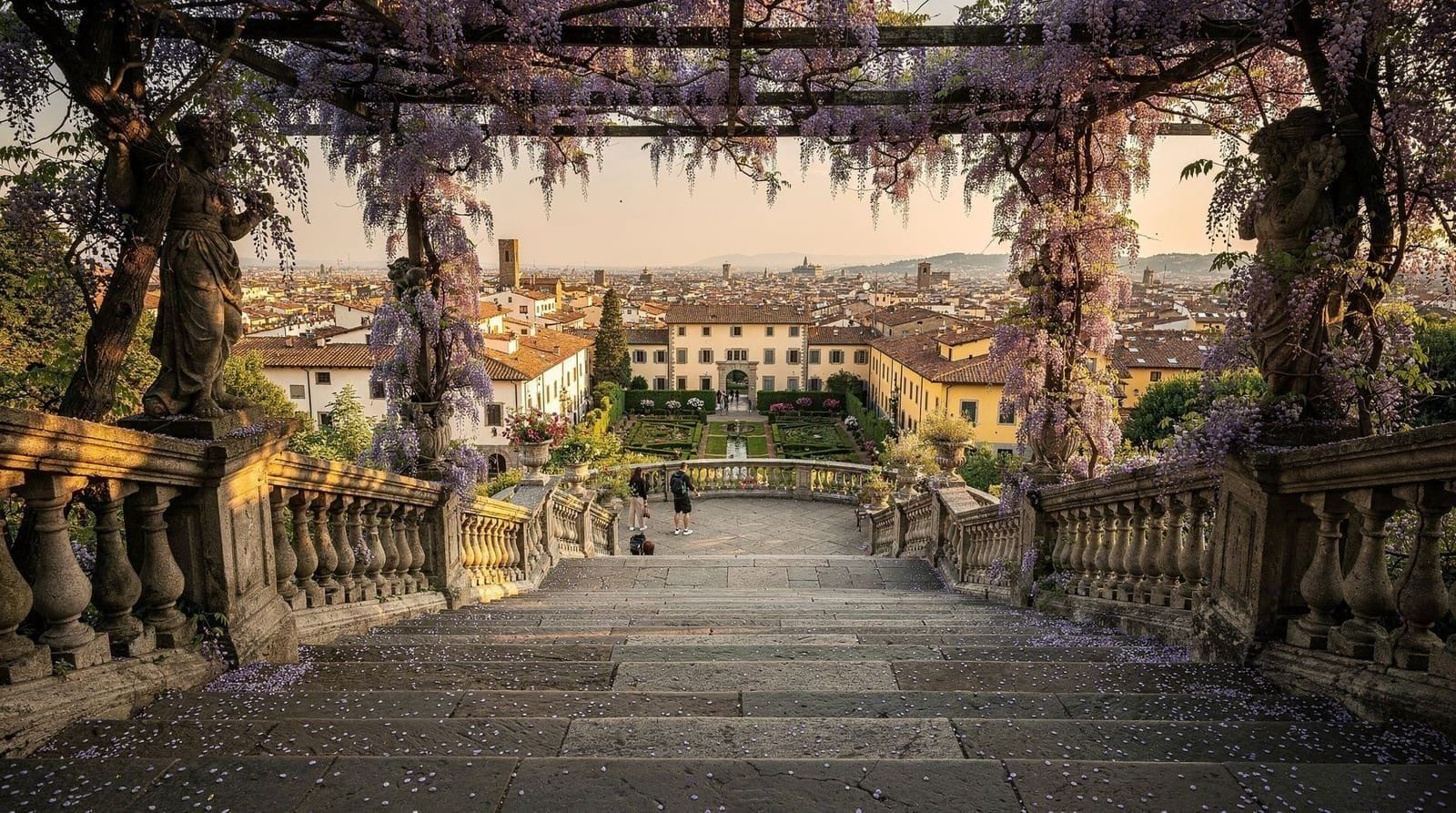
The Boboli Gardens are the finest surviving example of the Italian Renaissance garden in Italy — and one of the most important gardens in Europe, full stop. Stretching across 45,000 square metres behind the Pitti Palace, they represent the Medici family’s vision of perfected nature: geometry imposed on landscape, views framed like paintings, sculpture placed to surprise and delight.
But beyond the art history, the Boboli is also simply a magnificent place to spend a few hours. The city of Florence in summer is hot, crowded, and paved with reflective stone. The gardens offer shade under ancient ilex oaks, the sound of fountains, and views over the Arno valley that take your breath away.
| Where | Behind Pitti Palace, Oltrarno, 20–25 min walk from the Duomo |
| Cost | €10 gardens only; €16 combined with Pitti Palace + Palatine Gallery |
| Time needed | 1.5–2.5 hours for the main axis, more with the Palatine Gallery |
| Getting there | Walk via Ponte Vecchio, or bus D/11 from the centre |
| Best time | Opening time (8:15am) or after 4pm; avoid midday July–August |
History: four centuries of Medici ambition
The land behind the Pitti Palace was purchased by Eleonora of Toledo, wife of Cosimo I de’ Medici, in 1549. The architect Niccolò Tribolo began laying out the garden that year, and work continued under Giorgio Vasari and Bartolomeo Ammanati. Tribolo died in 1550, before seeing the results of his vision; Ammanati completed the amphitheatre and several key features.
Later additions came under subsequent Medici: the Buontalenti Grotto was completed in 1593, the Isolotto (the elliptical island garden) in 1612, and the upper Kaffeehaus pavilion in 1776 under the Lorraine rulers who succeeded the Medici. The garden reflects four centuries of evolving taste while maintaining the Renaissance geometric foundation.
The name “Boboli” is thought to derive from the Bogolesi family, who previously owned land in the area — but its precise origin is uncertain.
What to see in the Boboli Gardens
The Amphitheatre
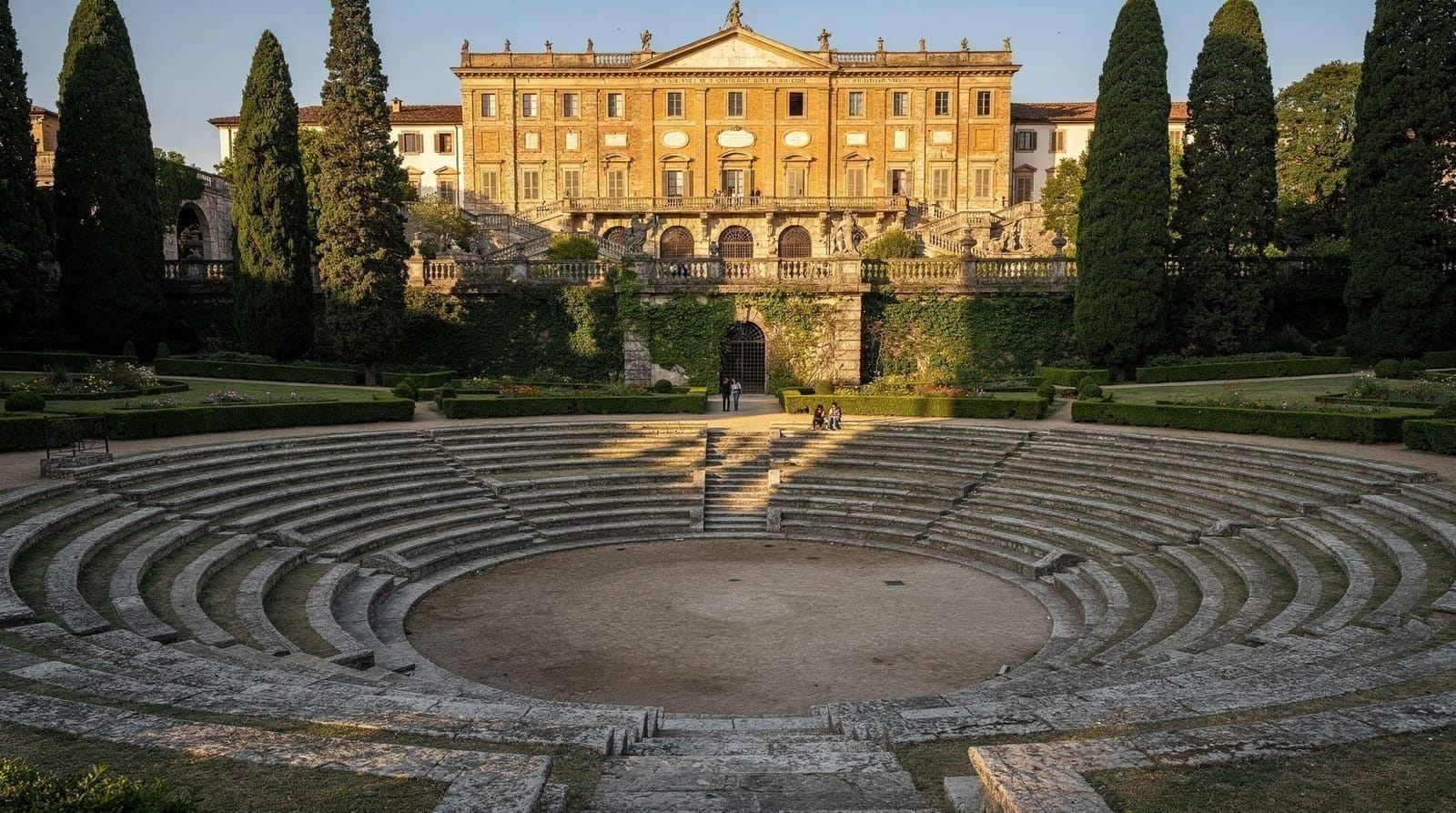
Immediately behind the Pitti Palace, the garden’s most dramatic space. An elliptical open-air theatre carved into the hillside, seating several thousand. The obelisk at its centre is Egyptian, from Luxor — one of four brought to Rome by the emperors and later distributed to Italian cities. The granite basin in front was brought from the Baths of Caracalla in Rome.
Cosimo II used this space for elaborate theatrical performances and the first operas ever staged — the Boboli amphitheatre is thus linked to the birth of opera as an art form.
The Neptune Fountain
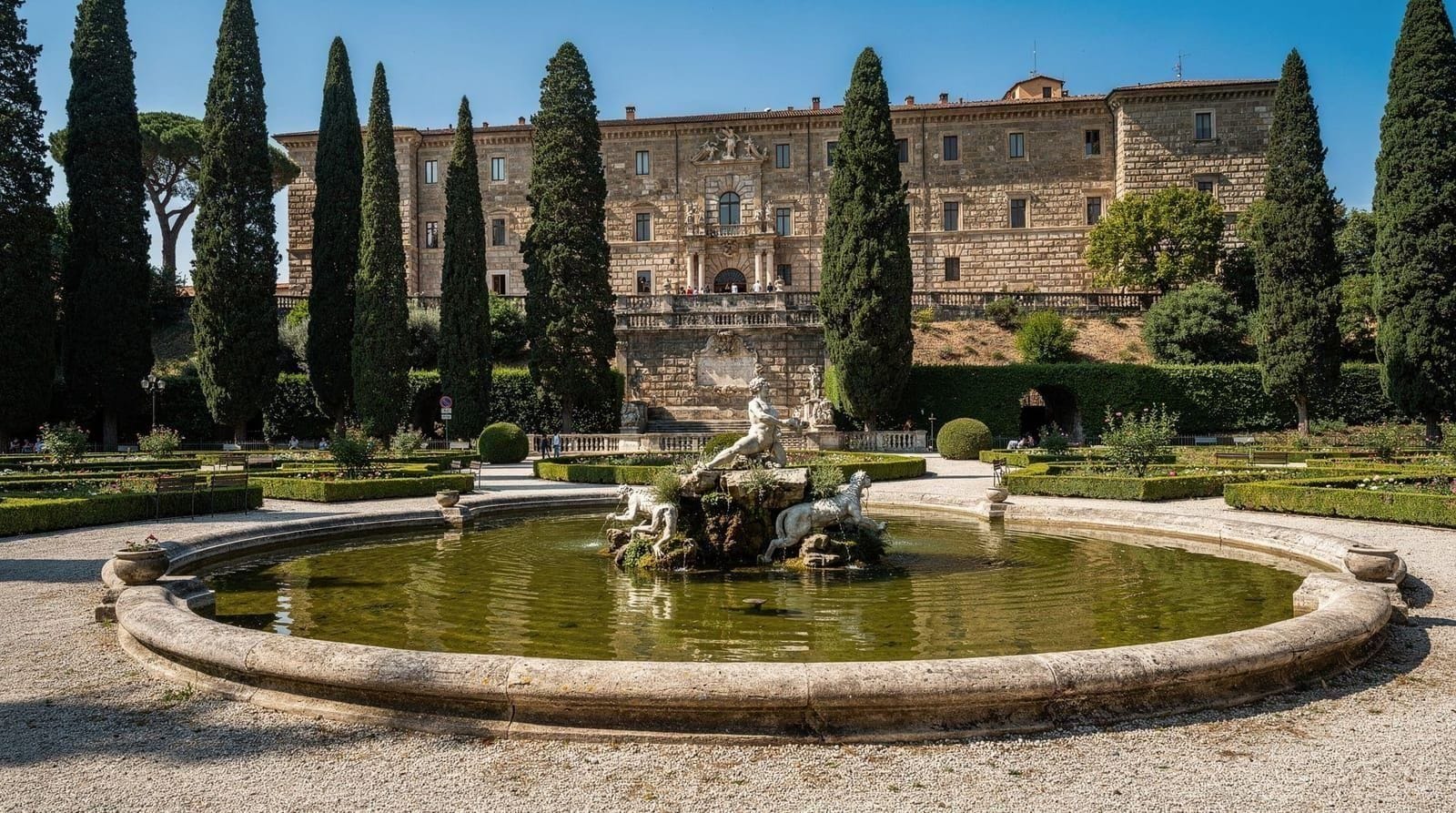
Immediately above the amphitheatre, a large stone basin with a bronze Neptune and attendant figures. Dating from the late 16th century, it marks the primary axis of the garden and provides the first of several fountain-centred focal points as you ascend the hill.
The Buontalenti Grotto
One of the strangest and most rewarding spaces in Florence. Designed by Bernardo Buontalenti (official architect to Francesco I de’ Medici) and completed in 1593, this three-chambered artificial cave is decorated with stalactite-like formations made from sponge, shells, coloured stones, and terracotta figures. In the first chamber, embedded in the rock formations, are casts of Michelangelo’s four Prisoners (Slaves) — the originals now in the Accademia Gallery. The effect is deliberately uncanny: art half-emerging from nature.
In the third chamber, once concealed behind doors, stands Giambologna’s Venus — a small, delicately erotic figure that the Medici kept for private viewing.
The grotto has limited capacity and is one of the most underrated spaces in Florence. Allow time to absorb the peculiar atmosphere.
The Viottolone (Main Avenue)
The long, steeply inclined cypress-lined avenue that forms the garden’s central spine, running from the Neptune Fountain up to the Kaffeehaus and beyond. The trees are mature Holm oaks (ilex), giving deep shade in summer. Walking up this avenue — past ancient statues, mossy urns, and glimpses of Florence through the gaps — is one of the great Florence experiences.
The Isolotto
At the garden’s southwestern corner, the Isolotto is an elliptical island garden surrounded by a moat. The island contains a central fountain with Perseus and Andromeda, surrounded by citrus trees in terracotta pots. The Oceanus Fountain in the centre (the original is in the Bargello Museum; what you see here is a copy) rises from the island.
The Isolotto feels like a garden within a garden — quieter and more enclosed than the main axis. In spring, when the citrus trees are in flower, the scent is extraordinary.
The Giardino del Cavaliere
The highest part of the gardens, reached by a steep ascent past the Kaffeehaus pavilion. The views from here over the Oltrarno neighbourhood and south toward the Florentine hills are exceptional. This was originally a formal flower garden; today it contains the Porcelain Museum (worth a 30-minute stop if you’re interested in decorative arts). For an even higher, wider panorama afterwards, Piazzale Michelangelo is a further 15–20 minute walk uphill.
The Kaffeehaus
A rococo coffee house built in 1776, now functioning as a café serving drinks and light meals. The terrace has panoramic views over Florence. Open in warmer months. A coffee here, looking over the city, is one of those moments that makes a day in Florence memorable.
Practical information
Tickets
- Boboli Gardens only: €10
- Pitti Palace + Boboli + Palatine Gallery combo: €16
- Free: First Sunday of each month (expect crowds)
- 5-day combined pass (Uffizi + Pitti + Boboli): A very good deal for multi-museum visitors
Tickets can be purchased at the Pitti Palace ticket office or online (recommended). In summer, online booking avoids waits of 30–60 minutes at the ticket window. Children under 18 from the EU enter free.
Getting there
The Boboli Gardens are behind the Pitti Palace in the Oltrarno neighbourhood, directly across the Ponte Vecchio from the historic centre.
By foot from the Duomo: 20–25 minutes walk through the Oltrarno. By bus: Line D or line 11 from the centre. By taxi: 5–7 minutes from Piazza della Repubblica.
The gardens are not easily accessible by car — Oltrarno has ZTL restrictions and very limited parking.
When to visit
Early morning (opening time, 8:15am): The gardens are almost empty. The light through the ilex canopy is beautiful. Best for photography.
Late afternoon: The light is warm and the tourist crowds that peak at midday begin to thin after 4pm.
Avoid: Midday in July and August. The main paved areas are exposed and extremely hot; the garden offers some shade but it’s uncomfortable. Come early or late.
Seasonal highlights:
- April–May: Irises and roses in flower; citrus blossoms on the Isolotto
- September: The vineyard near the upper garden produces grapes; warm light
- Winter: Quiet, atmospheric, free of crowds — but some fountains are turned off
What to bring
The Boboli is large and hilly. Comfortable walking shoes are essential — heeled shoes or flip-flops are genuinely impractical. Bring water; the fountains are decorative, not drinking. Sun protection in summer is important on the exposed upper sections. The gardens are partly shaded but the main avenue faces south and can be brutal at midday.
The sculpture collection
The Boboli Gardens contain over 200 sculptures, making it one of the largest open-air sculpture museums in Italy. Most of the works are copies of antique originals (the originals now in the Bargello or national museums), but many are genuine Renaissance and Baroque works placed in situ centuries ago.
Key sculptural highlights:
Morgante on a Tortoise (Gian Bologna, 1560): Near the Neptune Fountain, a peculiar and deliberately humorous work depicting Cosimo I’s favourite dwarf (Morgante) astride a tortoise. This is an original work in situ, not a copy, and is one of the more surreal Renaissance sculptures in any Italian garden.
The Oceanus Fountain (Isolotto): The central figure of the Isolotto island is a copy — the original 1576 Giambologna Oceanus is now in the Bargello Museum. But the composition of the island, the moat, and the surrounding figures creates the spatial experience the artist intended.
Venus of the Grotto (Buontalenti Grotto): An original Giambologna bronze in the third chamber of the grotto, more intimate and personal than his public works. The Venus was placed here for private Medici viewing — a significant artwork in what was essentially a royal bathroom.
The Abundance Fountain: At the upper end of the Viottolone, a 17th-century figure by Giambologna’s workshop representing the abundance of the Medici lands.
The garden also contains significant collections of ancient Roman busts and sarcophagi, mostly acquired by the Medici from Rome in the 16th century.
The Boboli vineyard
Few visitors notice the small vineyard in the upper section of the garden, below the Kaffeehaus. This working vineyard produces several hundred bottles of wine per year — officially the most urban vineyard in Florence. The grapes are harvested in September by the Uffizi Galleries staff. The wine is not publicly sold, but the vineyard itself is a charming detail of an institution that, unlike most European royal gardens, maintained agricultural production throughout its history.
Beyond the main attractions: hidden corners
The Boboli is large enough that even on busy days, some sections remain quiet. After completing the main axis (amphitheatre, Neptune Fountain, Viottolone, Isolotto), walk through the Annalena gate area and the Giardino del Cavaliere for the sections most visitors skip.
The meadow behind the Forte di Belvedere wall (accessible in the upper garden) provides an informal space where Florentines sometimes picnic. In spring it’s scattered with wildflowers. This part of the garden feels more like a private park than a formal museum.
The Boboli and its neighbours
The Boboli connects naturally to the Bardini Gardens, Florence’s other major historic garden. The Bardini sits adjacent to the Boboli and can be visited on the same day — the combined effect is a full half-day of Florence’s most beautiful green spaces.
The Pitti Palace itself — one of Florence’s largest and most significant museums — is directly attached. The Palatine Gallery (first floor) contains one of the finest collections of Raphael and Titian outside the Vatican. The combined Boboli + Palatine Gallery visit is one of the most rewarding full-day options in Florence, covering art history from the Renaissance through the Baroque alongside the greatest garden in the city. Full coverage of the interior collections is in the Palazzo Pitti galleries guide.
See the best gardens in Florence guide for a comparison of all the city’s garden options, and the hiking around Florence guide if the Boboli’s shaded avenues leave you wanting more green space beyond the ticketed gardens.
A suggested route for a first visit
With 45,000 square metres and no single obvious path, first-time visitors often waste time backtracking. A logical route: enter behind the Pitti Palace and start at the Amphitheatre, then climb to the Neptune Fountain, detour left to the Buontalenti Grotto near the entrance before it gets crowded (it has limited capacity and queues build by mid-morning), then follow the Viottolone avenue up to the Kaffeehaus for a coffee break, continue to the Giardino del Cavaliere for the view, then descend to the Isolotto on the way back down. This covers all the highlights in a logical loop of roughly 1.5–2 hours without significant backtracking, longer if you linger at the Kaffeehaus terrace or add the Palatine Gallery.
Frequently asked questions about the Boboli Gardens
Are the Boboli Gardens included in the Firenzecard?
The Firenzecard is Florence’s multi-museum pass. It covers Palazzo Vecchio, Bargello, and various civic museums, but NOT the Boboli Gardens or Pitti Palace, which are managed by the Uffizi Galleries organisation with their own ticket structure. You’ll need a separate Pitti/Boboli ticket even with a Firenzecard.
Is there food available in the Boboli Gardens?
Yes. The Kaffeehaus near the top of the garden serves coffee, drinks, and light snacks in warm months. The café at the Pitti Palace entrance also has a restaurant. Bringing a picnic (from the Mercato Santo Spirito in Oltrarno, for example) is permitted and popular.
Can I see the Boboli Gardens on a Florence walking tour?
The Boboli requires a ticket and most standard walking tours don’t include it. Specialist Pitti Palace and Boboli guided tours exist — these provide a guide who covers the history and sculpture throughout the garden. Worth considering for visitors who want to understand what they’re looking at.
Is there a dress code?
No dress code applies to the gardens (unlike Florence’s churches, which require covered shoulders and knees). Wear whatever is comfortable for a long outdoor walk.
How much time should I budget for the Boboli Gardens?
A focused walk through the main highlights (Amphitheatre, Neptune Fountain, Buontalenti Grotto, Viottolone, Isolotto) takes about 1.5 hours. Add the Giardino del Cavaliere and a coffee stop at the Kaffeehaus for closer to 2.5 hours, or a full half-day if combining with the Palatine Gallery inside the Pitti Palace.
Are the Boboli Gardens suitable for a stroller or wheelchair?
Partially. The main central axis along the Viottolone and the amphitheatre area are paved and reasonably accessible, but the steeper paths toward the Giardino del Cavaliere and some upper sections involve gravel and inclines that are difficult for wheelchairs or strollers without assistance. Plan a route that sticks to the lower, paved sections if mobility is a concern.
Top experiences
Bookable activities with verified prices and instant confirmation on GetYourGuide.

Florence: Pitti Palace and Boboli Gardens ticket
- Instant confirmation
- Mobile ticket
Florence: Pitti Palace and Boboli Gardens guided tour
- Small group
- Free cancellation
Florence: Pitti Palace and Boboli Gardens walking tour
- Small group
- Free cancellation
Florence: Pitti Palace, Boboli Garden and Palatine Gallery tour
- Small group
- Free cancellation
Florence: Uffizi, Pitti Palace and Boboli 5-day ticket
- Skip the line
- Free cancellation