Best gardens in Florence
Florence: Pitti Palace and Boboli Gardens ticket
- Instant confirmation
- Mobile ticket
What is the best garden to visit in Florence?
The Boboli Gardens (behind Pitti Palace) are the largest and most historic — essential for any visit. For a quieter, more photogenic experience, the Bardini Gardens next door win on views and are far less crowded. The free Giardino delle Rose on the slope below Piazzale Michelangelo is excellent in May.
Florence’s gardens: beyond the museums
Florence’s reputation rests on its art museums — the Uffizi, Accademia, Bargello — but the city also possesses some of the finest historic gardens in Italy. Most visitors focus on the Boboli and miss the smaller, quieter green spaces that offer just as much atmosphere with a fraction of the crowds.
This guide covers all the significant gardens in Florence, from the grandeur of the Boboli to the free Rose Garden on the hillside — with honest practical information about what each one offers and when to visit.
| Where | Oltrarno hillside (Boboli, Bardini, Rose Garden) and around Piazzale Michelangelo (Iris Garden) |
| Cost | Free (Rose, Iris, Cascine) to around €10–16 (Boboli, Bardini) |
| Time needed | 1–2 hours per garden, or a half-day combining several |
| Getting there | Walkable from Ponte Vecchio; Cascine and villa gardens need a bus |
| Best time | Late April–May for wisteria, roses and irises together |
The Boboli Gardens
Florence’s most famous garden, and deservedly so. The Boboli covers 45,000 square metres behind the Pitti Palace, combining Renaissance geometry (the main axis, the amphitheatre, the Viottolone cypress avenue) with baroque elements (the Buontalenti Grotto, the Isolotto) accumulated over four centuries of Medici rule.
Highlights: the Buontalenti Grotto with its bizarre stalactite interior and copies of Michelangelo’s Prisoners; the Isolotto with its citrus trees and moat; the Viottolone avenue of ancient ilex oaks; the Kaffeehaus terrace with panoramic views. Full coverage in the Boboli Gardens guide.
Tickets: €10 garden only; €16 combined with Pitti Palatine Gallery; free first Sunday of the month. Hours: 8:15am–7:30pm (summer); closes earlier in winter. Best for: Renaissance history, sculpture, a full half-day exploration.
The Bardini Gardens
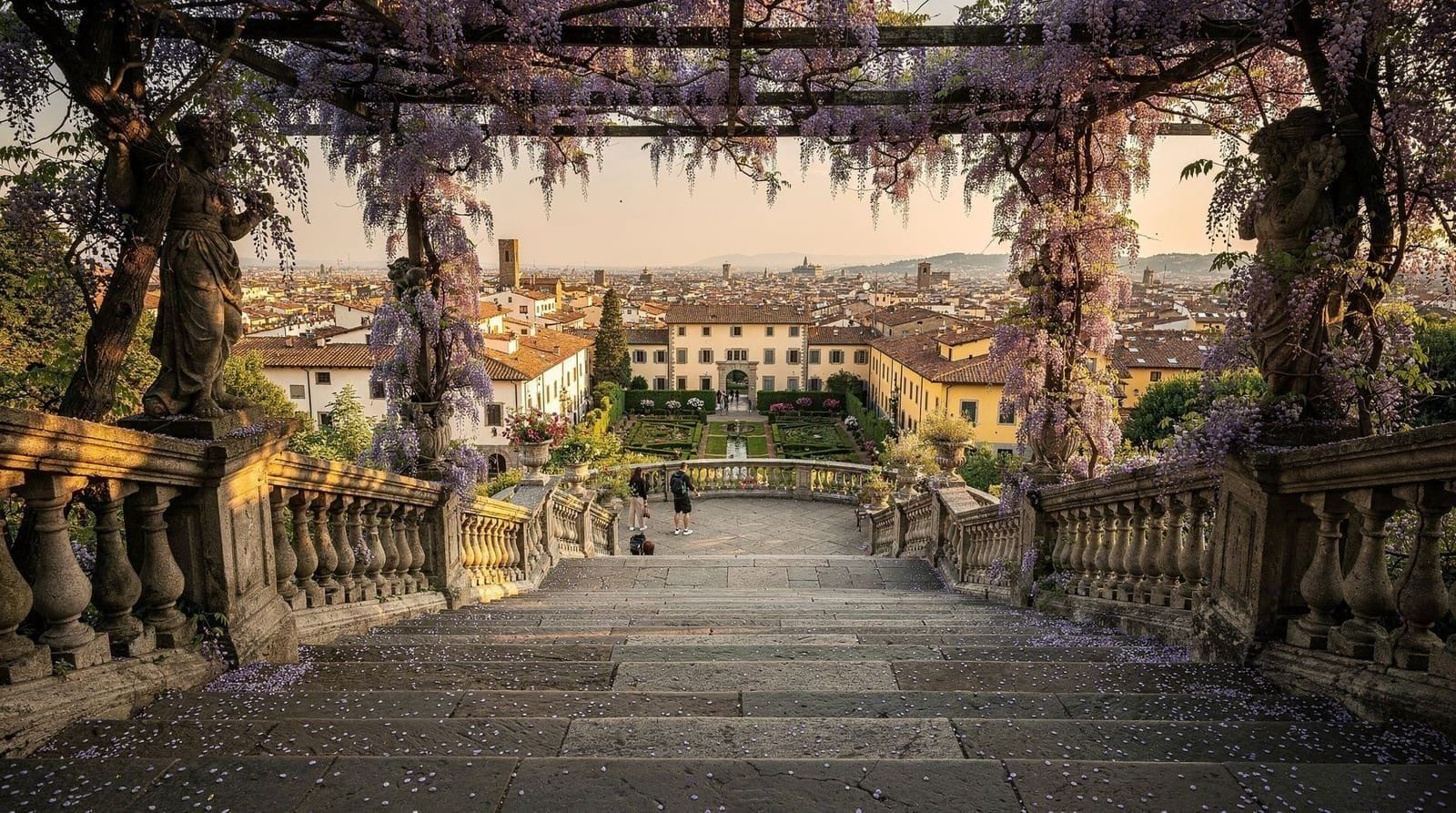
The Boboli’s smaller, quieter neighbour — separated by a shared wall but managed separately. The Bardini is more intimate and varied in character, mixing formal Italian parterres with English-style woodland and a baroque grand staircase.
The selling point: in late April and early May, a wisteria pergola covering the main staircase is in full bloom — one of the most beautiful garden spectacles in Tuscany. The views from the upper terrace over the Ponte Vecchio and city are, arguably, better than from any comparable public space in Florence.
Full detail in the Bardini Gardens guide.
Tickets: €10; €16 combined with Boboli. Hours: Same as Boboli. Best for: Photography, quieter atmosphere, wisteria season (late April–early May).
Giardino delle Rose (Rose Garden)
Location: Via di Poggio Imperiale, Costa San Giorgio hillside Ticket: Free, open to all Season: Roses bloom mid-April to June; some rose varieties flower in September
The Rose Garden is one of Florence’s best free green spaces — a terraced hillside planted with over 350 rose varieties, including some ancient and rare cultivars, scattered among Japanese bronze sculptures commissioned from the sculptor Chadwick in the 1980s. The sculptures add an unexpected contemporary element.
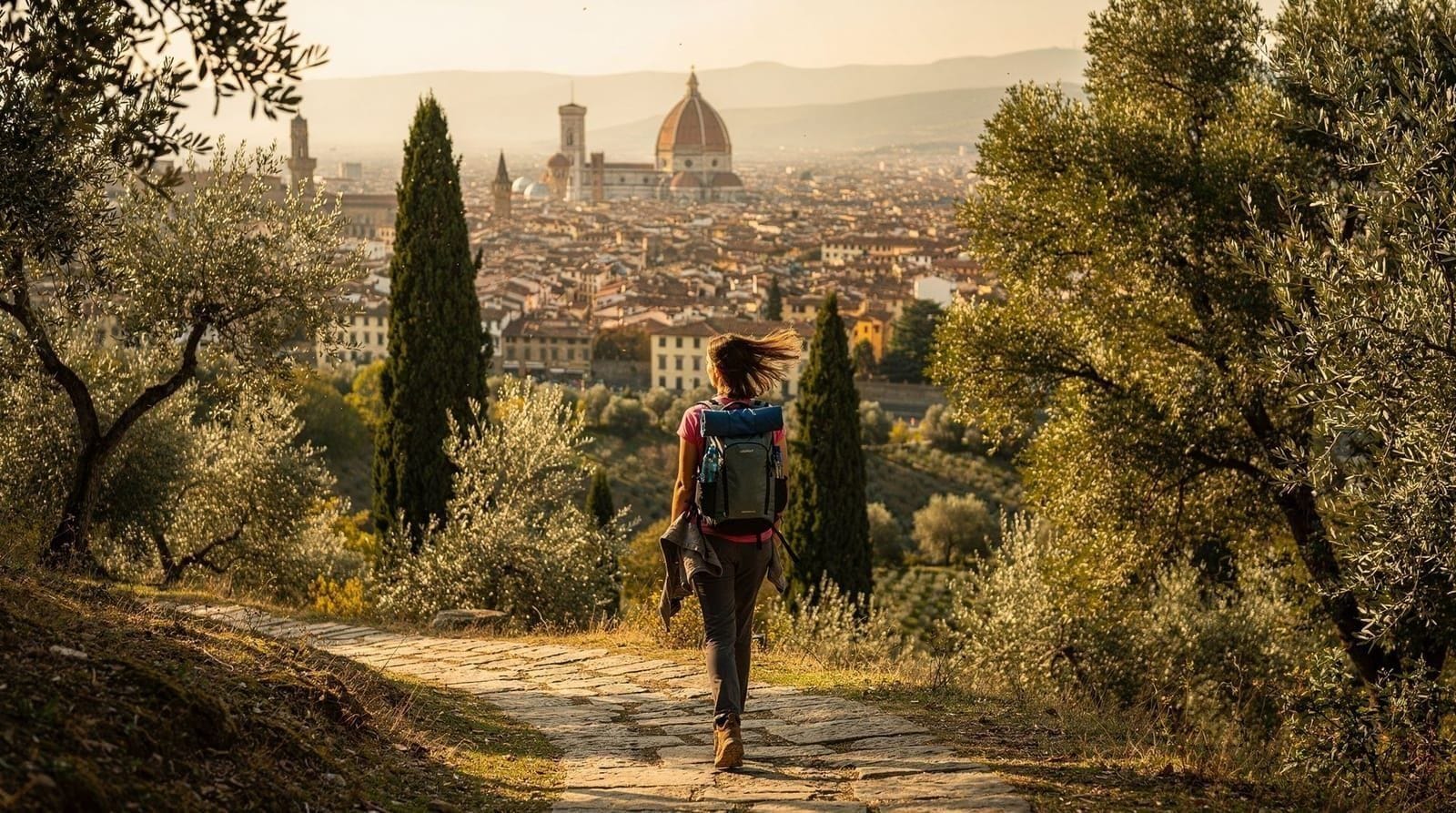
The garden has excellent views over the city from its upper terraces. It’s a 15-minute uphill walk from Ponte Vecchio, on the same hillside as the Bardini and Boboli gardens — making a natural combination visit.
Best visited in May when the roses are at peak bloom and the path from Ponte Vecchio to Piazzale Michelangelo becomes a tunnel of pink, white, and red flowers. Outside rose season, the garden has less to see but remains a pleasant, uncrowded green space.
Getting there: Walk from the Ponte Vecchio via Via de’ Bardi and then up the Costa San Giorgio. Alternatively, take bus 12 or 13 toward Piazzale Michelangelo.
Giardino dell’Iris (Iris Garden)
Location: Viale dei Colli, adjacent to Piazzale Michelangelo Ticket: Free; open only in May during iris season Season: Open strictly May only
Florence’s most seasonal garden — open for exactly one month per year. The Iris Garden contains approximately 2,500 iris varieties from around the world, planted in formal beds on a hillside below Piazzale Michelangelo. The display is spectacular when in bloom (typically early to mid-May).
The garden hosts an annual competition for new iris varieties, open to breeders internationally. Florence has historical connections to the iris: the city’s heraldic lily (the Giglio) is stylised from a white iris, and the purple iris (Iris florentina) appears throughout Renaissance Florentine art. Orris root — derived from the dried rhizome of certain iris species — has been a key ingredient in Florentine perfume and cosmetics since the 13th century.
If you’re in Florence in May, this is a 30-minute detour well worth making. Combine with Piazzale Michelangelo (5 minutes walk) for the city panorama, or extend into a full morning of Florence’s best photo spots along the same hillside.
Parco delle Cascine
Location: Northwest of the city centre, along the Arno Ticket: Free, always open Character: Public park, more Florentine than touristy
The Cascine is Florence’s largest public park — 118 hectares of lawns, woodland, and cycle paths stretching 3.5 km along the Arno’s north bank. It’s where Florentines actually go for recreation: jogging, cycling, family picnics, and the city’s biggest market (Tuesday morning, when hundreds of stalls fill the park’s allées).
Historically, the Cascine was a Medici agricultural estate — hence the name (cascina means dairy farm). Later it became a racing track and hunting ground before being opened as a public park. The English poet Percy Bysshe Shelley wrote “Ode to the West Wind” while sitting in the Cascine in 1819.
Not a garden in the historic sense — it’s a park. But the Tuesday market (7am–2pm) is one of the best in Florence for clothes, fabrics, local produce, and cheap street food. The paths along the Arno are excellent for morning runs and the park provides welcome relief from the stone surfaces of the city centre.
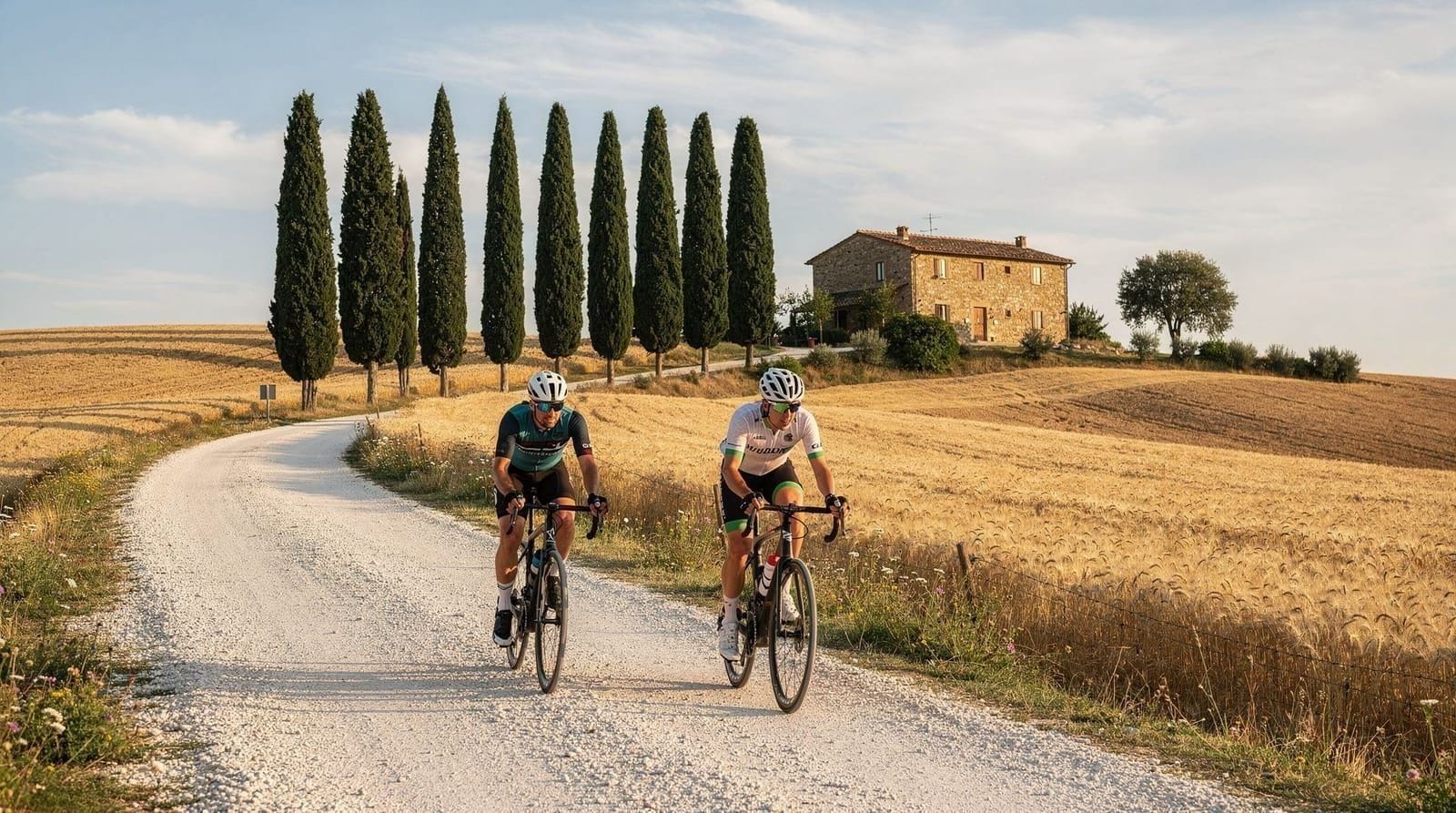
Getting there: Bus 17 from the city centre, or walk 30–40 minutes from Piazza Santa Maria Novella. The park also anchors several of the best walking and cycling routes around Florence for anyone wanting greenery beyond the formal gardens.
Giardino Torrigiani
Location: Via dei Serragli, Oltrarno Access: Private; occasional guided tours by arrangement
Florence’s largest private garden still in private hands — 7 hectares in the heart of the Oltrarno, invisible from the street but extensive behind its high walls. The Torrigiani family has owned the property since the 15th century. The garden was redesigned in the early 19th century in the English landscape style by the architect Luigi Cambray Digny, creating a pastoral landscape complete with an artificial gothic tower (the only tower in Florence not built in the Middle Ages).
Not regularly open to the public, but the Torrigiani family occasionally offers guided visits. These are worth booking if you have a serious interest in Italian garden history — the scale and atmosphere of an intact private garden of this age is extraordinary.
The gardens of the Medici villas
Florence’s environs contain several Medici villa gardens that are technically outside the city but easily accessible:
Villa di Poggio a Caiano (15 km west): The most important Medici country villa, designed by Giuliano da Sangallo for Lorenzo the Magnificent. The gardens are partly open to visitors. Free entry to the grounds; ticket required for the villa interior.
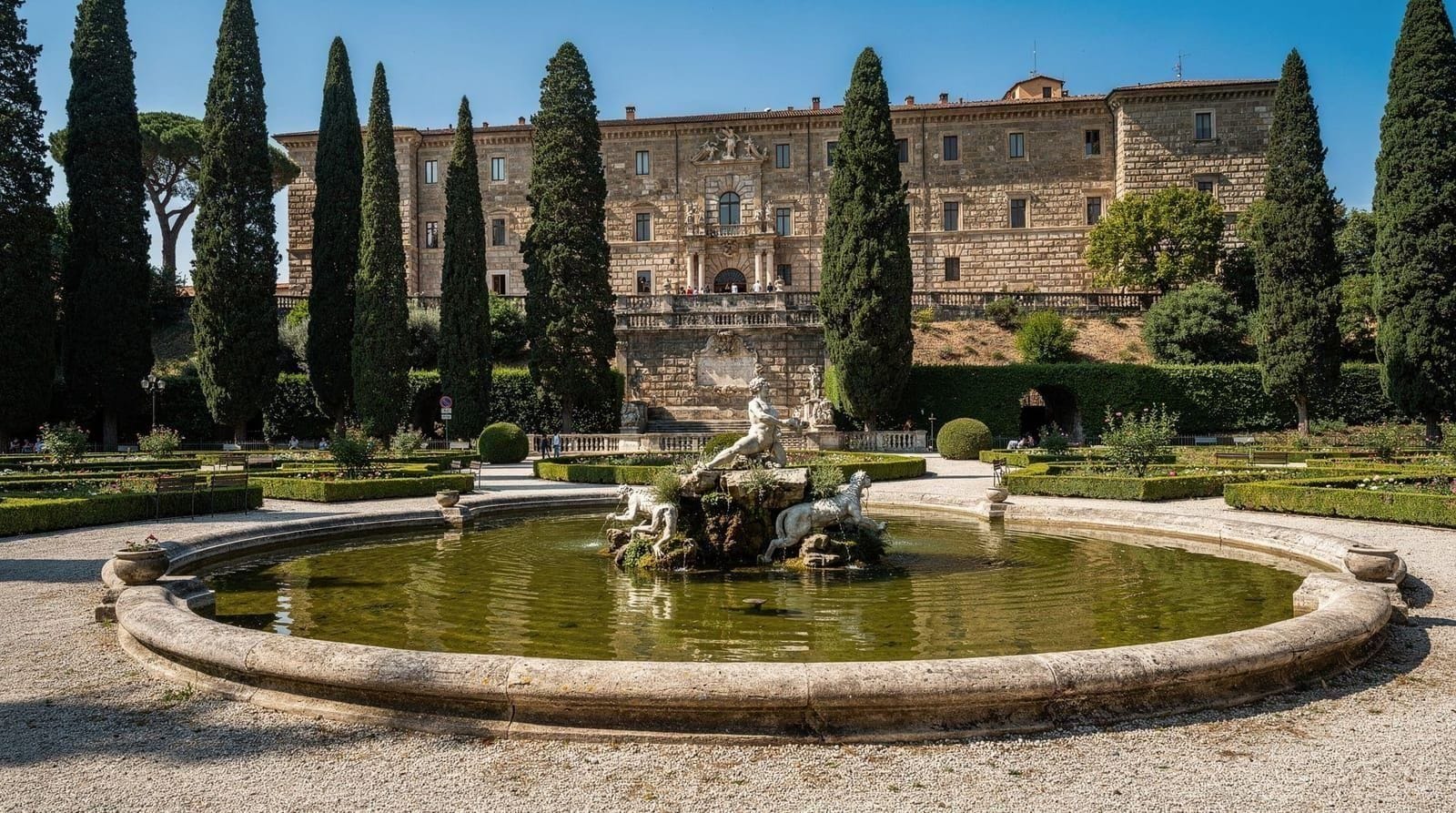
Villa della Petraia (5 km north): A formal Italian garden with terraces, fountain, and views over the city. State property, partially open. The Villino Borghese at the top has panoramic views.
Villa di Castello (5 km north, adjacent to Petraia): Garden designed by Tribolo (who also started the Boboli) for Cosimo I de’ Medici in the 1530s. Famous for its fountains and the Grotta degli Animali (Grotto of the Animals) — a 16th-century artificial cave decorated with bronze animal sculptures and semi-precious stones.
These villas are reached by bus 28 from the city (approximately 30 minutes). Both gardens can be visited in a half-day from Florence — logically combined since they’re adjacent.
The first Medici garden of all sits further out, in Fiesole, where Cosimo de’ Medici commissioned a formal terraced garden in 1459 for the Villa Medici — the starting point of the whole Renaissance garden tradition covered below. It pairs naturally with a Fiesole half-day trip for the Roman theatre and hilltop views.
Which garden suits which traveller
Not every garden suits every visit. This quick comparison helps decide where to spend limited time.
| Garden | Best for | Time needed | Cost |
|---|---|---|---|
| Boboli | History, sculpture, a proper half-day | 1.5–2.5 hours | ~€10–16 |
| Bardini | Views, photography, quieter pace | 45–75 minutes | ~€10 (combined ticket) |
| Giardino delle Rose | Free views, May roses, families | 30–45 minutes | Free |
| Giardino dell’Iris | May-only specialists, quick detour | 20–30 minutes | Free |
| Cascine | Local life, jogging, Tuesday market | Open-ended | Free |
| Villa gardens (Castello/Petraia) | Garden-history enthusiasts with a car | Half-day | Free–modest |
The concept of the Italian garden
Florence’s gardens didn’t develop in isolation — they were part of a coherent Renaissance theory of how nature should relate to human habitation. Understanding this theory makes the gardens significantly more interesting to visit.
The Italian Renaissance garden concept — articulated by Leon Battista Alberti in the 15th century and realised in the Boboli, Villa Castello, and dozens of other Florentine gardens — held that nature must be ordered and controlled by human intelligence. The garden is the boundary between the built world (architecture) and wild nature, and it must show that human reason has been applied to organise the landscape into a legible, meaningful system.
This is why:
- Axes: Every Italian garden has a primary axis (usually from the house/building toward a focal point), with secondary axes branching from it. The Boboli’s axis runs from the Pitti Palace through the amphitheatre, up the Viottolone, to the Kaffeehaus.
- Geometry: Box hedges, topiary, geometric parterres — nature cut into regular shapes shows mastery over chaos.
- Water: Fountains, pools, cascades. Water represents abundance and engineering skill simultaneously.
- Sculpture: Statues in the garden refer to myth, history, and allegory — the garden is also a text, readable to educated visitors.
- Views: Axial views are framed and controlled. You’re meant to see the landscape from specific points.
This is completely different from the English landscape garden (the other major garden tradition), which deliberately avoided geometry and tried to replicate wild nature. The Bardini’s hybrid character — Italian axes plus English woodland — creates a fascinating tension between the two philosophies.
Garden history in Florence: a timeline
1459: Cosimo de’ Medici commissions a formal garden at the Villa Medici in Fiesole — one of the earliest Renaissance gardens to survive in recognisable form.
1538: Niccolò Tribolo begins designing the Villa di Castello gardens for Cosimo I — featuring the Grotta degli Animali and innovative hydraulic systems.
1549: Construction begins on the Boboli Gardens behind the newly acquired Pitti Palace.
1596: Completion of the Buontalenti Grotto in the Boboli — considered the masterpiece of Italian grotto design.
1776: The Kaffeehaus and Limonaia added to the Boboli under the Lorraine succession — the last major addition.
1815–1885: Wave of English landscape garden conversions affects several Florentine villa gardens, softening the strict Italian formality with more naturalistic planting.
Early 1900s: Stefano Bardini redesigns the Costa San Giorgio garden in Italian-English hybrid style.
2007: Comprehensive restoration of the Bardini Gardens; first public opening.
Seasonal garden calendar
| Month | What’s happening |
|---|---|
| March | First flowers, garden opening times extend |
| April–May | Peak season: wisteria (Bardini), roses, irises, azaleas |
| May (only) | Giardino dell’Iris open |
| June–August | Hot, best in early morning. Some plants dormant |
| September | Late roses, early autumn colour. Grapes in the Boboli |
| October | Rich autumn colours, fewer visitors |
| November–February | Low season. Boboli and Bardini open but winter hours |
Practical tips for garden visits in Florence
Combine the Oltrarno gardens: The Bardini, Boboli, and Giardino delle Rose are all on the same hillside and can be visited in sequence. Start at the Bardini (8:15am opening), cross to the Boboli via Via Romana, then walk up to the Rose Garden before lunch. Three gardens in a morning is achievable.
Photography: Both the Bardini and the Boboli are excellent for photography in early morning light. The Giardino delle Rose in May offers classic Florentine garden-with-view images. The blue hour before sunset at Piazzale Michelangelo provides the classic Florence skyline shot.
Children: The Boboli has the most space and variety for children — the grotto is fascinating, the amphitheatre invites running, and the Viottolone provides shade. The Cascine is best for families wanting open space and a playground.
Picnics: Permitted in the Boboli and in the Cascine. The Giardino delle Rose and Bardini ask that food be consumed at the café rather than throughout the garden. Bring supplies from the Oltrarno’s markets and alimentari.
Rain plan: Florence’s gardens are outdoor experiences with limited shelter beyond the Kaffeehaus and a handful of loggias, so a wet morning is the wrong time to attempt the Boboli or Bardini properly. If rain sets in, swap the itinerary for one of the best museums in Florence and save the gardens for a clearer day — the light matters as much as the flowers for photography.
Frequently asked questions about Florence’s gardens
Do I need to book tickets for the Boboli Gardens in advance?
In peak season (May–September), online booking is strongly recommended to avoid queues of 30–60 minutes at the ticket window. The first-of-month free entry days are particularly crowded. The Boboli online ticket system is managed through the Uffizi Galleries portal.
Is there anywhere to sit and rest inside the Boboli?
Yes. The Kaffeehaus terrace has seating and a café. Scattered benches exist throughout the garden. The amphitheatre’s stone tiers serve as informal seating. The Isolotto has a low wall around the moat where visitors often sit.
Are strollers/pushchairs allowed in the Boboli?
Yes, in most areas. The main central axis (Viottolone) and amphitheatre area are paved and accessible. The steeper paths in the upper garden and woodland areas are more challenging. The Bardini’s main staircase is not stroller-friendly.
Are the gardens part of any guided Florence walking tours?
Most standard Florence city tours don’t include the gardens. The specialist tours that combine the Pitti Palace with the Boboli are excellent for historical context. The Pitti Palace and Boboli guided tour covers both interior and garden with a licensed guide.
Can I combine the gardens with a day trip out of the city?
Yes, but keep it realistic — the hillside gardens are best done as a Florence morning or afternoon, not tacked onto a day trip. If you want greenery further afield, the Fiesole half-day trip or a Chianti day trip both pair well with a garden visit the same day, provided you don’t try to squeeze everything into one itinerary.
Is the Rose Garden worth visiting outside of May?
It’s quieter and greener rather than flower-filled, but the free entry and the view over the city from its upper terraces make it worthwhile any time of year, especially combined with a walk up to Piazzale Michelangelo.
Top experiences
Bookable activities with verified prices and instant confirmation on GetYourGuide.

Florence: Pitti Palace and Boboli Gardens ticket
- Instant confirmation
- Mobile ticket
Florence: Pitti Palace and Boboli Gardens guided tour
- Small group
- Free cancellation
Florence: on e-bike to Piazzale Michelangelo
- Free cancellation
- Small group
Florence: local hills e-bike tour with olive oil tasting
- Free cancellation
- Small group