Fake leather in Florence: how to spot it and where to buy the real thing
Is leather at the San Lorenzo market in Florence genuine?
Most stalls at the outdoor San Lorenzo market sell low-grade leather, bonded leather or PU-coated fabric labelled 'vera pelle' or 'made in Italy'. These labels are legal but misleading — the goods are typically manufactured in China or Eastern Europe. Real Florentine leather craftsmanship is available at the Scuola del Cuoio inside Santa Croce, from artisan workshops in the Oltrarno neighbourhood, and via leather crafting experiences.
Florence and leather: the real history
Florence’s relationship with leather is genuinely ancient. The city was a centre of leather tanning and craftsmanship from the medieval period, with the tanneries historically located south of the Arno along the streams that fed into the river. The Arte dei Cuoiai e Galigai — the leather tanners’ guild — was one of the city’s major trade guilds.
This history is real, and genuine Florentine leather craftsmanship still exists. The problem is that the tourist leather market near the San Lorenzo market and throughout the city centre is almost entirely disconnected from this tradition — it sells goods manufactured elsewhere at prices that suggest artisan local production.
Understanding the difference is straightforward once you know what to look for.
| Where genuine leather is | Scuola del Cuoio (Santa Croce), Oltrarno workshops |
| Where fakes concentrate | Outdoor San Lorenzo market stalls |
| Real wallet cost | Around €70–150 for artisan vegetable-tanned |
| Market wallet cost | €20–60, usually bonded leather or PU |
| Best alternative | A leather-making workshop instead of buying pre-made |
The San Lorenzo outdoor market: what is actually being sold
The open-air market surrounding the Basilica di San Lorenzo is one of Florence’s largest tourist commercial zones. It operates 7 days a week and sells everything from ceramics to scarves to printed T-shirts. The leather section — wallets, bags, belts, jackets — is the most heavily marketed category.
The typical customer interaction: a vendor calls out “handmade leather, very good quality, best price,” shows a wallet priced at €40 but quickly offers it for €25-30, and produces multiple similar items in rapid succession. The “handmade” and “made in Italy” labels are prominently displayed.
What the labels actually mean:
“Made in Italy” is a regulated designation — but the regulation requires only that the “last substantial transformation” occurred in Italy. This threshold has been interpreted liberally. Under some readings, assembling pre-cut components constitutes substantial transformation. A leather item cut and stitched in China, with a final clasp or lining added in Italy, can legally bear a “made in Italy” label.
“Vera pelle” (genuine leather) describes any product containing real leather fibre — including bonded leather, which is 20-50% leather content embedded in polyurethane. It is not limited to full-grain or top-grain leather.
“Artigianale” (artisanal) has no legal definition for this purpose.
At the price points typical of the San Lorenzo market stalls (€20-60 for wallets, €40-100 for bags), genuine full-grain Florentine vegetable-tanned leather is economically impossible. The material cost of properly tanned leather alone exceeds those prices.
How to physically assess leather quality
If you want to evaluate what you’re holding:
The edge test: Slice through a piece of full-grain leather and the cut edge shows natural fibrous texture — irregular, slightly rough, with grain visible. Bonded leather has a uniformly manufactured edge that may show a fine grid or compressed texture. PU-coated fabric has a fabric edge under a plastic outer layer.
The crease test: Fold a corner of the leather sharply. Full-grain leather creases naturally and the crease fades when released. Bonded leather or heavy PU coatings may crack or delaminate at the crease point after repeated flexing.
The smell test: Vegetable-tanned leather has a distinctive organic, slightly earthy smell. Chrome-tanned leather smells more chemically processed but still organic. Bonded leather and PU materials smell of adhesive or plastic. Perfume applied to a product may be masking a synthetic smell.
The price test: Below €30 for a wallet: almost certainly bonded leather or PU. €30-60: possibly genuine chrome-tanned leather of varying quality. €60-100+: consistent with genuine leather at varying levels of finish. Vegetable-tanned artisan wallets start at approximately €80-120 from legitimate Florentine producers.
The vera pelle label in practice
Here is a comparison of products all legally entitled to carry the “vera pelle” label:
| Product type | Leather content | Durability | Price range (legitimate) |
|---|---|---|---|
| Full-grain vegetable-tanned (Florentine traditional) | 100% top layer of hide | 20-40+ years with care | €80-300 (wallet), €300-800 (bag) |
| Top-grain chrome-tanned | 100% leather, surface sanded | 10-20 years | €50-150 (wallet), €150-400 (bag) |
| Corrected-grain | Genuine leather, surface heavily treated | 5-10 years | €30-80 (wallet), €80-200 (bag) |
| Bonded leather | 20-50% leather fibre in PU matrix | 2-5 years | Should be €15-40 but often sold for more |
| PU-coated fabric | No leather | 1-3 years before peeling | Should be labelled accordingly |
The San Lorenzo market primarily sells corrected-grain at best and bonded leather more commonly, at prices suggesting top-grain quality.
Where to buy genuine Florentine leather
Scuola del Cuoio (Leather School of Florence)
Location: Inside the Santa Croce Basilica complex, Piazza di Santa Croce 16 Founded: 1950 by the Gori family with Franciscan Friars What it is: A working leather school and atelier where craftspeople have been making leather goods since 1950. You can observe the workshop and buy directly. The leather is Tuscan vegetable-tanned, the making is genuinely on site. Price range: Wallets €70-150, bags €250-600, belts €60-120
Madova Gloves
Location: Via Guicciardini 1r, Oltrarno Founded: 1919 What it is: One of the oldest dedicated glovers in Italy. Makes all gloves in the Florentine workshop using local leather and a range of linings. Staff can advise on sizing and leather type. Price range: €50-200 depending on leather and lining
Oltrarno artisan workshops
The area between Piazza de’ Mozzi and Borgo San Jacopo on the south side of the Arno has several genuine leather workshops. Look for working spaces where tools and half-finished items are visible. Legitimate artisans do not need to solicit from the street. Our Oltrarno neighbourhood guide and artisan workshops of the Oltrarno cover the wider craft scene beyond leather, including glass, paper and jewellery makers on the same streets.
Key areas: Via Maggio, Via de’ Serragli, Borgo San Jacopo, the streets east of Ponte Vecchio on the south bank. A slow walk through this part of Oltrarno is worthwhile even if you don’t buy anything — the open workshop doors are part of the neighbourhood’s character.
Leather crafting experiences
Rather than buying pre-made goods, several workshops offer the experience of making your own leather item — a wallet, a belt or a small bag — under artisan guidance, using genuine Florentine leather. This produces a genuine handmade Florentine leather item and is a more memorable use of the same budget as a market bag. See the GYG-linked leather workshops for current options, and read one visitor’s account in florentine leather workshop experience for what an afternoon actually involves.
How leather shopping fits into the wider tourist-trap picture
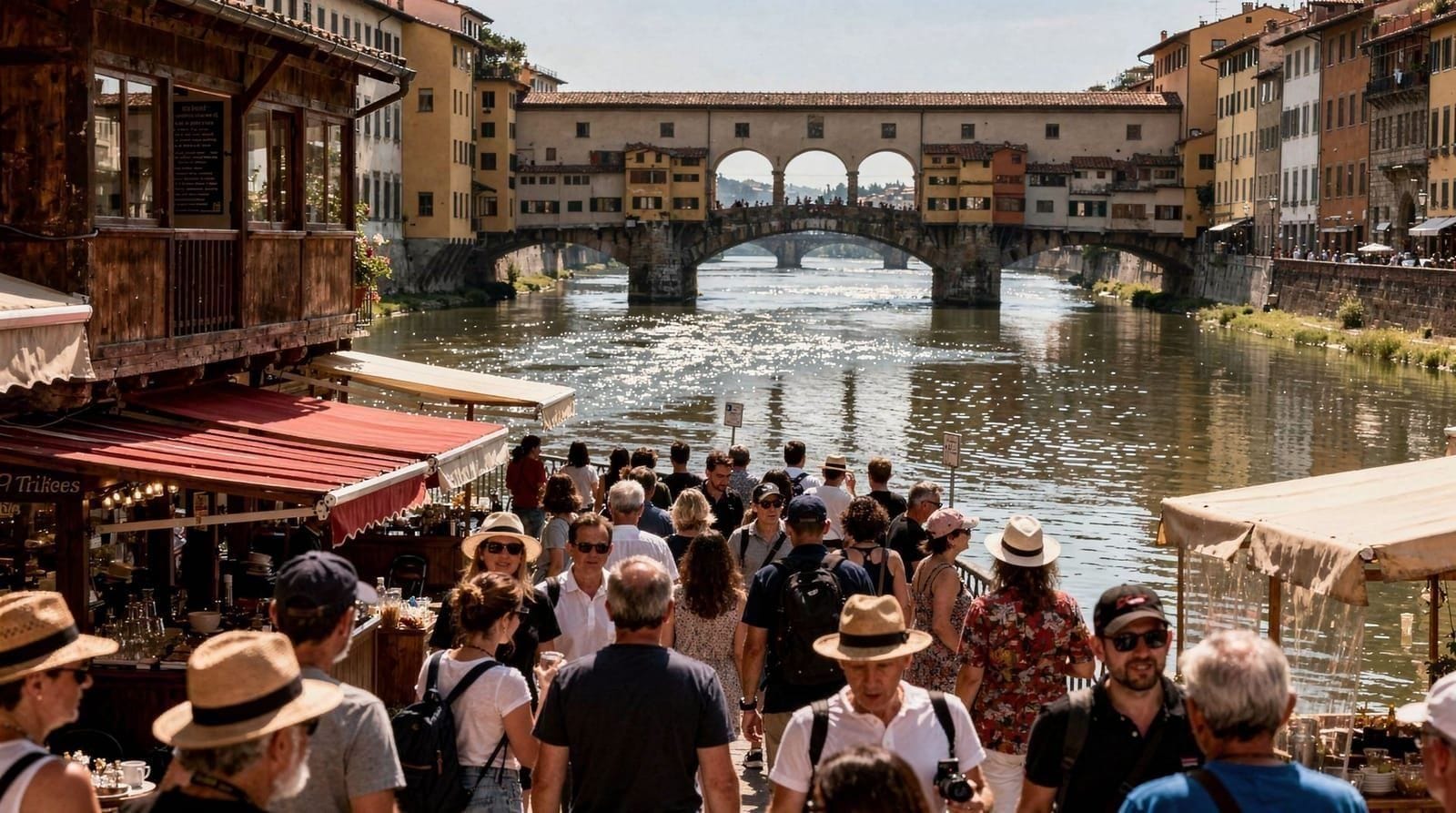
Fake or overpriced leather is one of several recurring traps in central Florence, alongside inflated restaurant bills near major sights and street vendors pushing “free” bracelets or roses. The pattern is consistent across all of them: high-pressure selling, vague or misleading claims about authenticity, and pricing pitched just low enough to feel like a bargain. If you want the fuller picture before you travel, Florence tourist traps and restaurant scams in Florence cover the other common ones, and overrated things in Florence is a useful companion piece on where else expectations and reality diverge. Ponte Vecchio itself, lined with jewellers rather than leather stalls, has its own reputation worth checking before you shop there — see Ponte Vecchio: a reality check.
The “made in Florence” jacket problem
Leather jackets are the highest-stakes San Lorenzo purchase because the price points are higher (€150-300 for “genuine leather” jackets at the market) and the quality differential is greatest.
A leather jacket at €200 that appears to be full leather is almost certainly made from split leather (the underside of the hide after the grain surface has been separated), corrected and coated to appear smooth. It may be produced in China, Bangladesh or elsewhere, and assembled or labelled in Italy. Split leather has inferior durability and very different ageing characteristics to full-grain leather.
A genuine leather jacket from an Italian artisan (not necessarily Florentine — Milan and Naples have their own leather traditions) runs €500-1,500+. Below that price, in a market stall setting, the quality will not match the marketing.
Outlet and legitimate discount leather
Several brands and craftspeople in the Florence area offer genuine Italian leather at more accessible prices:
The Mall Outlets (Leccio Reggello, 30 minutes from Florence) includes luxury brand factory stores including Ferragamo — genuinely made-in-Italy products at 20-50% discount. Transport and access requires planning (shuttle bus from Florence or rental car) but the products are authentic.
End-of-season sales at legitimate leather shops in the Oltrarno and Santa Croce area can produce genuine full-grain items at 30-40% below regular price.
Red flags at any leather seller
If you see any of these at a leather stall or shop, adjust your quality expectations immediately:
- Prices below €30 for wallets promoted as “made in Italy” or “vera pelle”
- Aggressive active solicitation from the seller
- Inability or refusal to identify the leather type (full-grain, top-grain, split, bonded)
- “Special price for you today only” pressure
- Perfume sprayed on leather items (often masks synthetic smells)
- Location: outdoor San Lorenzo market stalls specifically
Frequently asked questions about leather in Florence
Is there any genuine leather at the San Lorenzo market?
A small number of stalls at the covered Mercato Centrale (the indoor market, not the outdoor stalls) sell better-quality leather items. The covered market on the ground floor includes some genuine craft sellers among the food vendors. The outdoor market is a different operation with much lower quality consistency.
How do I negotiate at a market stall if I do want to buy there?
If you decide to buy from the outdoor market — fully aware of the quality limitations — treat it as buying a souvenir at a souvenir price, not a leather investment. Negotiating is normal. The opening price is typically 30-40% above what the seller will accept. Never accept the first price. Never appear eager. Offering 50-60% of the opening price is a reasonable starting point. The “special deal” is always available; walk away briefly if you want to see the floor price.
Are leather goods at Florence Airport genuine?
Airport leather goods shops in Florence are legitimate retailers selling genuine leather goods from Italian and international brands. The prices reflect airport retail margins (high) but the product authenticity is real. This is not a place for artisanal Florentine leather specifically, but it is not a fake leather trap either.
Is Gucci leather from Florence actually made in Florence?
Gucci’s historical headquarters and some production are in the Florence area, and Gucci was founded in Florence in 1921. Contemporary Gucci production is distributed across Italian factories, not all of which are Florentine. Buying Gucci in Florence is not inherently different from buying it in Paris or Tokyo — you are buying an Italian luxury brand, not specifically a Florentine artisan product.
Can I visit a Florentine tannery?
The Conceria Walpier-Conceria Vera Pelle in Santa Croce sull’Arno (about 40 minutes from Florence) is one of the most important remaining Tuscan vegetable tanneries and occasionally offers visits. The Santa Croce sull’Arno area (different from the Florence church) is Italy’s primary leather-tanning district. Some organised leather and Tuscany tours include tannery visits — a genuinely interesting industrial heritage experience.
Is it worth taking a leather-making workshop instead of just buying?
For most visitors, yes. A 2–3 hour workshop typically costs a similar amount to a mid-range genuine leather item, but you leave with something you made yourself under artisan supervision, using the same vegetable-tanned Florentine leather sold in the shops. It also removes the authenticity question entirely, since you watch the material and process firsthand. See florentine leather workshop experience for a first-hand account.
Top experiences
Bookable activities with verified prices and instant confirmation on GetYourGuide.