Inside a Florentine leather workshop: what I made and what I learned
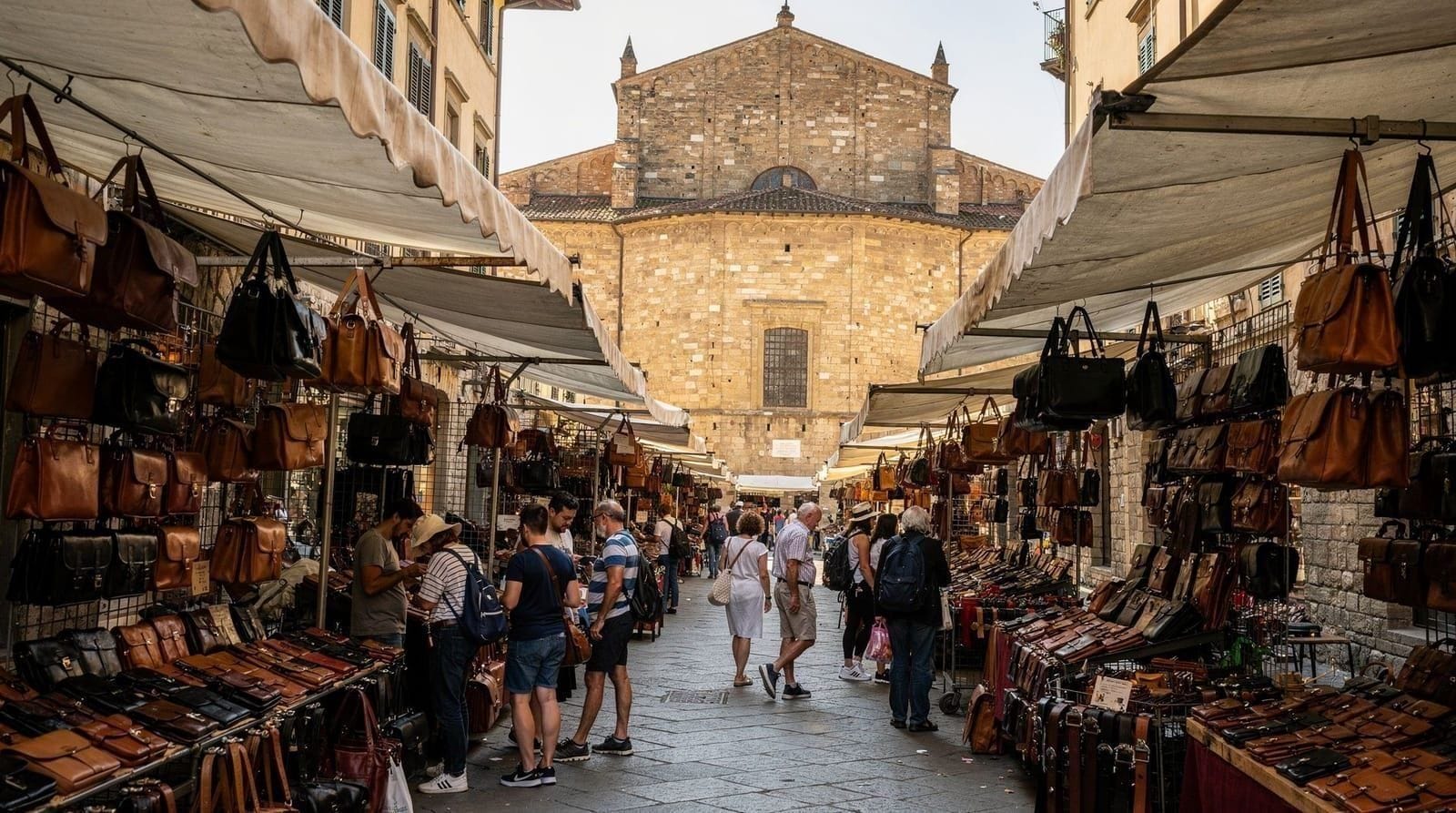
The leather goods piled up on the stalls around the San Lorenzo market are not what most people think they are. The signs say “Genuine Leather” and “Made in Italy” — both of which can technically be true while also meaning the bag was assembled in a factory outside Prato from bonded leather scraps, stamped in Florence, and marked up 400%.
There is a different Florentine leather tradition: the one that has been practiced in the Oltrarno neighborhood since the Medici were commissioning bookbindings and the city’s craft guilds controlled the quality of every glove and saddle made within the walls. That tradition still exists, in a handful of workshops staffed by people who learned the craft over years, not days.
I spent an afternoon in one of them making a bifold wallet and came out understanding why a handmade Florentine leather object costs what it costs.
| Where | Oltrarno neighbourhood, near Via dello Sprone / Via Maggio |
| Cost | Around €65–120 for a class, depending on item made |
| Time needed | 2–3 hours for a small item (wallet, key fob) |
| Booking | A few days ahead in high season |
| Free alternative | Scuola del Cuoio at Santa Croce, entry free |
Finding the right workshop
The honest distinction you need to make is between a tourist craft experience (buy a kit, be supervised while following a template, take home a “handmade” item) and a genuine artisan workshop that happens to teach classes alongside its regular production work.
Signs you’re in a real workshop:
- There’s work in progress that has nothing to do with your class — bags being stitched, leather being cut and skived for orders
- The tools are used and specific, not a photogenic kit laid out for the Instagram shot
- The instructor makes their living doing this craft, not teaching tourists to do it
- The leather smells like leather (vegetable-tanned Tuscan leather has a distinctive, pleasant, earthy smell)
- There are off-cuts in a bin rather than everything being suspiciously neat
The Oltrarno neighborhood — specifically the area around Via dello Sprone, Via Maggio, and the side streets between Piazza Santo Spirito and the river — is where most genuine workshop activity is concentrated. Florence’s leather school tradition is also kept alive by the Scuola del Cuoio (School of Leather), which operates inside the convent of Santa Croce church and sells pieces made by its students.
The class itself
My class was held in a workshop in the Oltrarno, behind a door with a brass handle and no visible sign. The workshop makes custom bags and small leather goods for clients across Europe; the class was run on Tuesday and Thursday afternoons as a secondary activity.
We were four people: me, an Australian couple on their honeymoon, and a Japanese woman who turned out to be a professional bookbinder in Tokyo and was specifically there to understand Florentine leather techniques.
The instructor — Filippo, who had spent 14 years in this workshop — gave us our brief: a bifold wallet, approximately 10x8cm when folded, with two card slots and a note pocket. We chose our leather from a stack of pre-cut pieces in natural tan and dark brown. I chose the tan, which Filippo said was vegetable-tanned calf leather from a tannery in Ponte a Egola, the village south of Florence where most of Florence’s leather is still produced.
The actual craft
Wallet-making involves more stages than you’d expect.
Skiving: The leather at the fold and edge areas needs to be thinned — carved at an angle with a skiving knife so the fold doesn’t create too thick a ridge. Filippo showed us once, then let us do it. My first attempt was uneven. My third attempt was passable. The bookbinder’s first attempt was perfect.
Marking the stitch line: Using a pricking iron (a metal tool with evenly spaced teeth) struck with a mallet, you mark the stitching holes along the edges. The spacing has to be consistent for the stitching to look right.
Hand stitching: Florentine leather work traditionally uses the saddle stitch — two needles, one on each end of the thread, worked through each hole simultaneously in opposite directions. This creates a stitch that, unlike a sewing machine stitch, won’t unravel if a single thread breaks. It’s slower, more demanding, and produces a visibly different (better) result.
The thread Filippo uses is waxed linen, rubbed across a block of beeswax before stitching. The wax helps the thread slide through the holes and creates a slight seal against moisture.
Edge finishing: The edges of the leather are burnished — rubbed rapidly with a wooden bone folder tool — to compress the fibres and create a smooth, slightly polished edge rather than a raw cut. This is one of the most tactile parts of the process: you feel the leather change under the tool.
What I made and what it’s worth
The wallet took about two and a half hours to complete, which seems like a long time for a simple bifold. Filippo explained that a skilled artisan can produce one in 45 minutes — the extra time was our learning curve.
The finished piece is noticeably better than anything I could have bought on the San Lorenzo stalls. The stitching is even (mostly). The edge is burnished cleanly. The fold is flat because the leather was properly skived. And it smells wonderful — that vegetable-tanned leather smell that mass-produced bonded leather doesn’t have.
The class cost €85, which included the leather, thread, and tools. Comparable workshops in Florence range from €65 to €120 depending on what you make (a key fob is at the cheaper end; a shoulder strap or small clutch bag costs more).
The real craft economy
What the class also gave me was a price anchor. After spending an afternoon doing this work, the €380 bag in the window of a proper Oltrarno bottega made complete sense. The €35 “genuine leather” version at the San Lorenzo market did not.
Filippo’s workshop sells its pieces at prices that reflect the actual labour: a bifold wallet, €95-120. A small crossbody bag, €280-350. A bespoke piece made to your specifications: ask, and allow 3-4 weeks.
These numbers might feel high. But these objects will outlast many of the people who buy them. A bag made with saddle-stitch waxed linen thread in full-grain vegetable-tanned leather does not fall apart. It ages into a piece that looks better at ten years than it did at one.
Avoiding the fake leather traps
A few practical shortcuts to separate real from fake in Florence’s leather market:
Real vegetable-tanned leather has a distinctive smell — earthy, slightly sweet, organic. Chrome-tanned or bonded leather smells like chemical or plastic.
Watch how it bends: good leather is supple but firm, recovering its shape after you bend it. Bonded leather cracks at flex points.
Look at the edge: unfinished cut edges of real full-grain leather show the fibres cleanly. Bonded leather has a rough, almost paper-like edge or is coated to hide it.
Price as signal: a proper handmade wallet in Florence starts at €80-90. Below that price, something is compromised — either the labour, the leather, or both.
Shop in the Oltrarno rather than near the market stalls around San Lorenzo, where the tourist-grade volume merchandise concentrates.
The Scuola del Cuoio: accessible for everyone
The most accessible genuine leather experience in Florence is the Scuola del Cuoio (Leather School), operating inside the former Franciscan convent attached to the Santa Croce church since 1950. Originally established to provide vocational training for orphans after the Second World War, it now operates as both a school teaching traditional Florentine leather techniques and a shop selling the work produced.
The school is open to visitors during working hours (Monday-Saturday, 9:30am-6pm roughly, check current hours) — you walk through the working areas, see craftspeople at benches stitching and finishing, and then browse the shop on the way out. Entry is free; you’re not required to buy anything.
The pieces for sale cover everything from small wallets (€50-80) to substantial bags (€250-600). The prices reflect actual craft labour and genuine materials. Compared to the tourist market on Via del Parione, the quality is clearly superior at comparable or lower price points.
Florence versus Tuscany leather: regional differences
Florence is the most famous Italian leather centre, but the craft extends across Tuscany and into other regions.
The Florentine style tends toward refined bookbinding leather — the library tradition of the Medici, the fine binding traditions of the historic Florentine workshops. Colours are often naturals (tan, cognac, dark brown); the finishes are burnished rather than painted; the forms are clean and functional.
The Santa Croce sull’Arno tannery district (south of Florence, near Pisa) is where most of Tuscany’s leather is actually processed — about 200 tanneries in a 25 square kilometre area produce roughly a third of Italy’s leather. Most vegetable-tanned leather sold in Florentine craft shops comes from here.
Pisa and the surrounding area has its own leather tradition, less tourist-oriented, more industrial-scale, with a strong heritage in equestrian leather (saddles, bridles) that goes back centuries.
Understanding this geography helps when buying: “Florentine leather” as a marketing label means made in Florence, not that the raw leather was tanned there. The quality depends on the tannery source, the grade of hide, and the craftsmanship of finishing. All three need to be good.
What to look for when buying leather in Florence
Beyond the basic tests (smell, flex, edge finish), a few additional indicators:
Ask about the tannery: Good craftspeople know where their leather comes from and are happy to tell you. “Vegetable-tanned from Ponte a Egola” or “full-grain calf from the Arno valley tanneries” is the kind of answer that indicates a workshop connected to its materials.
Look at the stitching: Even stitching with consistent spacing and no loose threads is the mark of skill and patience. Machine stitching is faster and uniform; hand stitching has a slightly irregular quality that’s actually a sign of authentic handwork, not a defect.
Ask about ageing: Vegetable-tanned leather develops a patina over years of use — it darkens where your hands touch it most, lightens in creases, develops character that mass-produced leather never achieves. A craftsperson who can describe how a piece will age in ten years understands the material deeply.
Pairing the workshop with the rest of the Oltrarno
A leather class is a natural anchor for a half-day in the neighbourhood rather than a standalone stop. The artisan workshops in Oltrarno guide maps other craft studios nearby — frame-makers, bookbinders, restorers — worth a look before or after your class. If you’re hungry afterward, the where to eat in Oltrarno guide covers the neighbourhood’s trattorias, most of which see far fewer tourists than the centre. And if you want to see the leather-and-shopping question from the other side — how to actually navigate the city’s markets without getting fleeced — the Florence on a budget guide has a section specifically on avoiding the San Lorenzo stall traps.
Is a leather class worth it, or should you just buy?
If your goal is simply owning a well-made leather object, buying directly from a workshop or the Scuola del Cuoio is cheaper and faster than taking a class — you’re not paying for your own (slower, less skilled) labour. But the class earns its price differently: it’s the only way to actually understand what separates a €35 market wallet from a €95 handmade one, and that understanding changes how you shop for the rest of the trip, in Florence and afterward. Families or groups looking for a shared activity rather than a shopping trip get more value from the class than solo buyers focused purely on the end object.
For more on navigating Florence’s shopping scene honestly, see the honest Florence shopping guide and the Oltrarno neighborhood guide for where to find real craft workshops.
Top experiences
Bookable activities with verified prices and instant confirmation on GetYourGuide.