Oltrarno
Florence's most liveable neighbourhood: artisan workshops, Pitti Palace, Boboli Gardens, the best trattorias and the view from Piazzale Michelangelo.
Florence: Pitti Palace and Boboli Gardens ticket
- Instant confirmation
- Mobile ticket
Quick facts
- Best for
- Local atmosphere, artisan culture, Pitti Palace
- Days needed
- 1 full day
- Getting there
- Cross Ponte Vecchio or Ponte alla Carraia from centro storico
- Key sights
- Pitti Palace, Boboli Gardens, San Miniato, Piazzale Michelangelo
Florence’s most underrated neighbourhood
Cross any of the bridges spanning the Arno from the centro storico and you’re in Oltrarno — literally “beyond the Arno.” The name itself signals the neighbourhood’s historical otherness. For centuries it was a separate quarter, home to artisans and craftspeople whose workshops served the Medici and the grand palazzos on the north bank. That artisan identity has survived, barely but genuinely, into the present.
Oltrarno is not a polished tourist experience. Parts of it feel worn and unpretentious in a way that central Florence — relentlessly photographed and priced accordingly — no longer does. The neighbourhood runs from the Palazzo Pitti and Boboli in the west, through the Santo Spirito piazza, down to the San Niccolò streets along the Arno, and up the hill to San Miniato al Monte and Piazzale Michelangelo.
| Where | South bank of the Arno, across from the centro storico |
| Time needed | 1 full day for the highlights |
| Cost | Combined Pitti + Boboli ticket around €16-22 |
| Getting there | Walk across Ponte Vecchio or Ponte alla Carraia |
| Best time | April-May and September-October; evening for aperitivo |
Palazzo Pitti
The Palazzo Pitti was built in 1458 by Luca Pitti, a banker rival of the Medici. The Medici eventually acquired it in 1549 and expanded it to its current extravagant scale. It is now one of the largest art museums in Italy, housing multiple separate collections under one roof:
Palatine Gallery (Galleria Palatina): The principal art collection, displayed in the rooms of the royal apartments with paintings still hung as they were in the 17th and 18th centuries — floor-to-ceiling, overlapping, without the single-work-on-a-wall spacing of modern museums. Contains major Raphael, Titian, Rubens and Caravaggio canvases. Budget 2-3 hours.
Royal Apartments (Appartamenti Reali): The actual living quarters, decorated in 19th-century style when the palace was the royal residence of unified Italy.
Gallery of Modern Art: 800 paintings and sculptures from the 18th-20th centuries, including Macchiaioli works (the Italian equivalent of Impressionism).
Costume Gallery: Fashion from the 18th century onwards, including funeral clothes of the Medici.
Museum of Silver (Museo degli Argenti): Decorative arts and treasures collected by the Medici.
Porcelain Museum and Carriages Museum: in and around the Boboli Gardens.
A combined Palazzo Pitti ticket covering all galleries plus the Boboli Gardens costs approximately €16-22. The 5-day combined ticket with the Uffizi and Accademia is worth considering if you’re doing multiple museums. Guided tours run €25-45.
Note: The Palatine Gallery closes on Mondays. Check each gallery’s individual hours.
Boboli Gardens
Behind the Palazzo Pitti, the Boboli Gardens rise up the hill in a formal Italian garden layout developed from 1549 onwards. At 45,000 square metres, they are the largest historical gardens open to the public in Tuscany.
Key features:
- Amphitheatre: The formal garden theatre behind the palace, built over an ancient quarry used for Pitti’s original building stone.
- Fountain of Neptune: The upper garden’s centrepiece.
- Grotta del Buontalento: An elaborate artificial grotto with plaster stalactites and embedded cast-off casts by Michelangelo; the originals of his unfinished Prisoners once stood here (now in the Accademia).
- Kaffeehaus: The 18th-century pavilion on the hill provides an excellent view across Florence.
- Porcelain Museum: At the highest point of the gardens, worth a short visit.
The gardens involve serious walking and hill climbing. Wear comfortable shoes. In summer they provide the only genuine shade in the area. Entry included in the combined Palazzo Pitti ticket; the gardens can also be entered separately for €10.
Santo Spirito
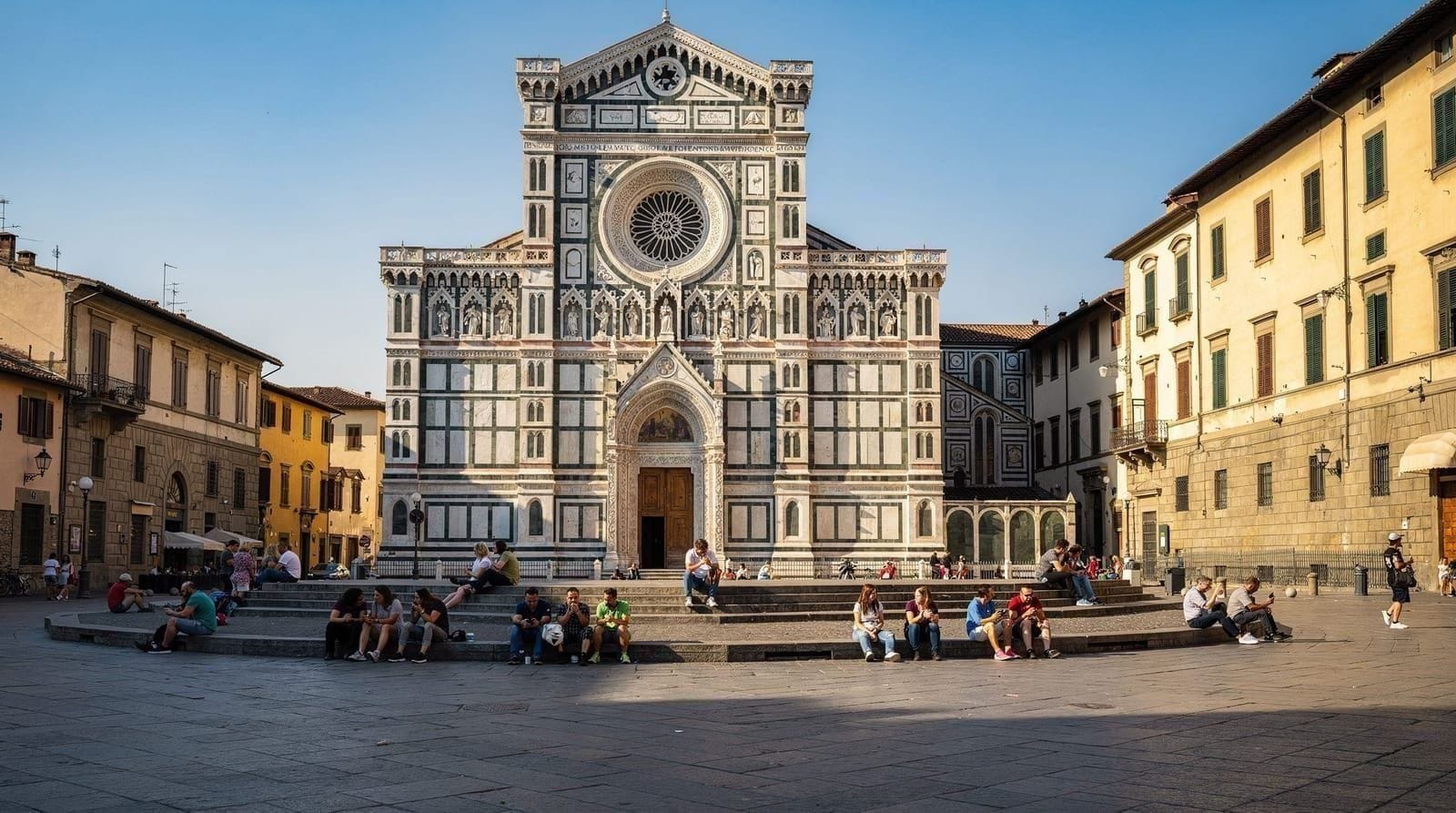
The piazza and church of Santo Spirito is the social centre of Oltrarno. The church itself, designed by Brunelleschi (though finished after his death in 1446), has a disarmingly plain white facade that was never completed — the planned marble cladding was abandoned for lack of funds. Inside, the interior is a masterpiece of early Renaissance proportion, with 40 chapels ringing the nave in a way that rewards slow, careful looking. A wooden cross attributed to Michelangelo is in the sacristy.
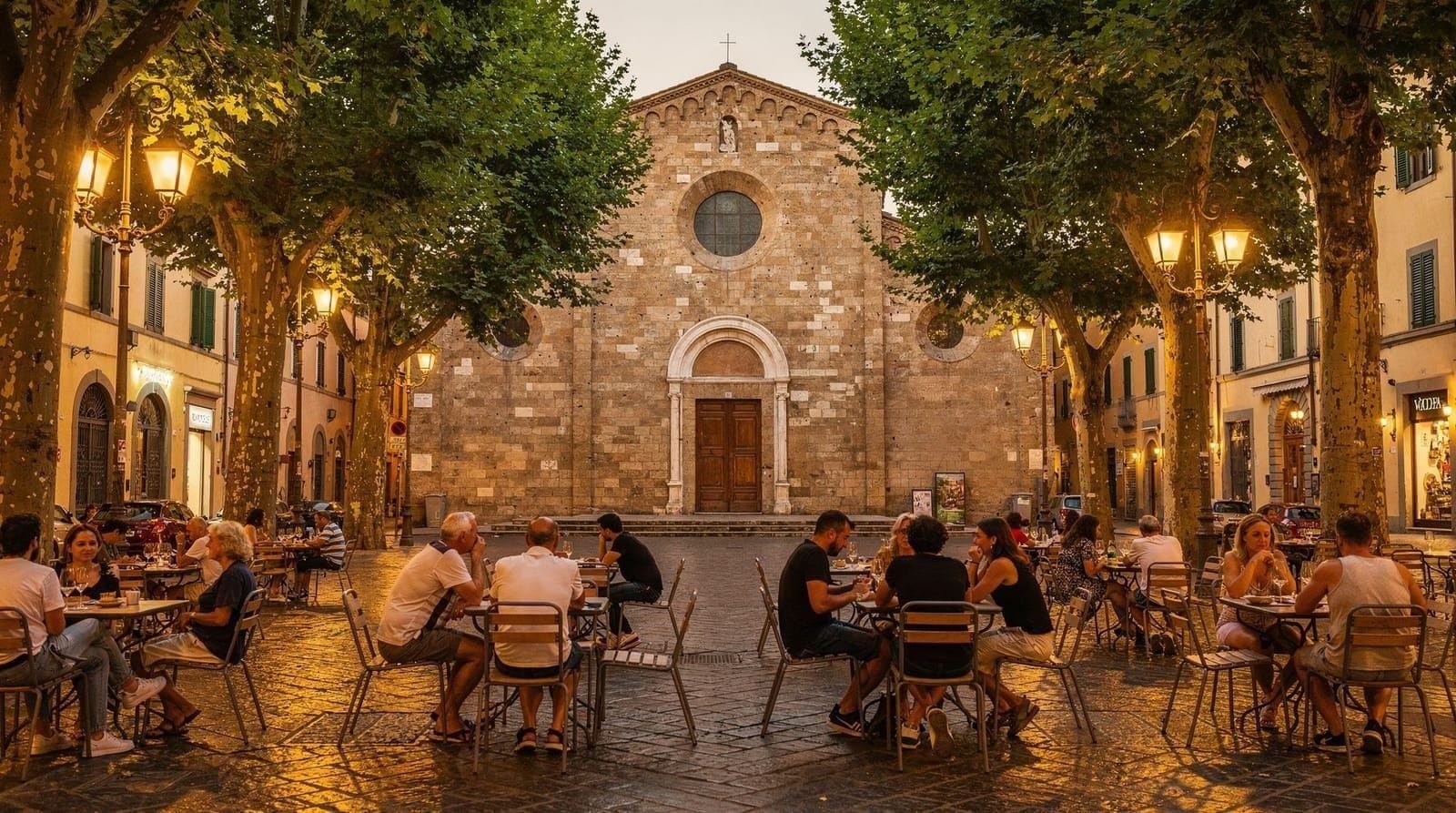
The piazza in front is a neighbourhood gathering point. On Saturday mornings there’s a small market; on weekday evenings, locals of various ages occupy the benches. A cluster of restaurants and bars around the square — Il Borro Tuscan Bistro, Buca dell’Orafo across the river, and the simpler Trattoria da Ruggero on Via Senese — serve the full spectrum from tourist-oriented to genuinely local.
The separate Santo Spirito neighbourhood guide covers the area in more detail.
Artisan workshops of Oltrarno
Florence has been making things by hand since the Medici patronized craftspeople in the 15th century. The highest concentration of surviving workshops is in Oltrarno, particularly on and around Via Maggio, Via dello Sprone, Via della Vigna Nuova and Borgo San Frediano.
What you can still find here:
- Leather goods: Not the San Lorenzo market variety — proper leather workshops where saddlers, bag-makers and bookbinders work on handmade pieces. Prices are higher and quality is genuinely different. Officina Profumo-Farmaceutica di Santa Maria Novella (Via della Scala, technically in San Lorenzo) and Il Bussetto (Via di Santo Spirito) are among the older establishments.
- Picture framers and gilders: Oltrarno has several historic frame-making workshops (corniciai) that restore antique frames and produce new ones using traditional gold leaf techniques.
- Scagliola artists: A nearly extinct craft creating fake marble surfaces using plaster and pigment.
- Furniture restorers: Multiple workshops on Via Maggio specializing in antique restoration.
- Print studios: A few letterpress and intaglio studios remain active.
These are working businesses, not tourist demonstrations. Most accept visitors who show genuine interest, but call ahead or respect the work environment.
Piazzale Michelangelo and the view
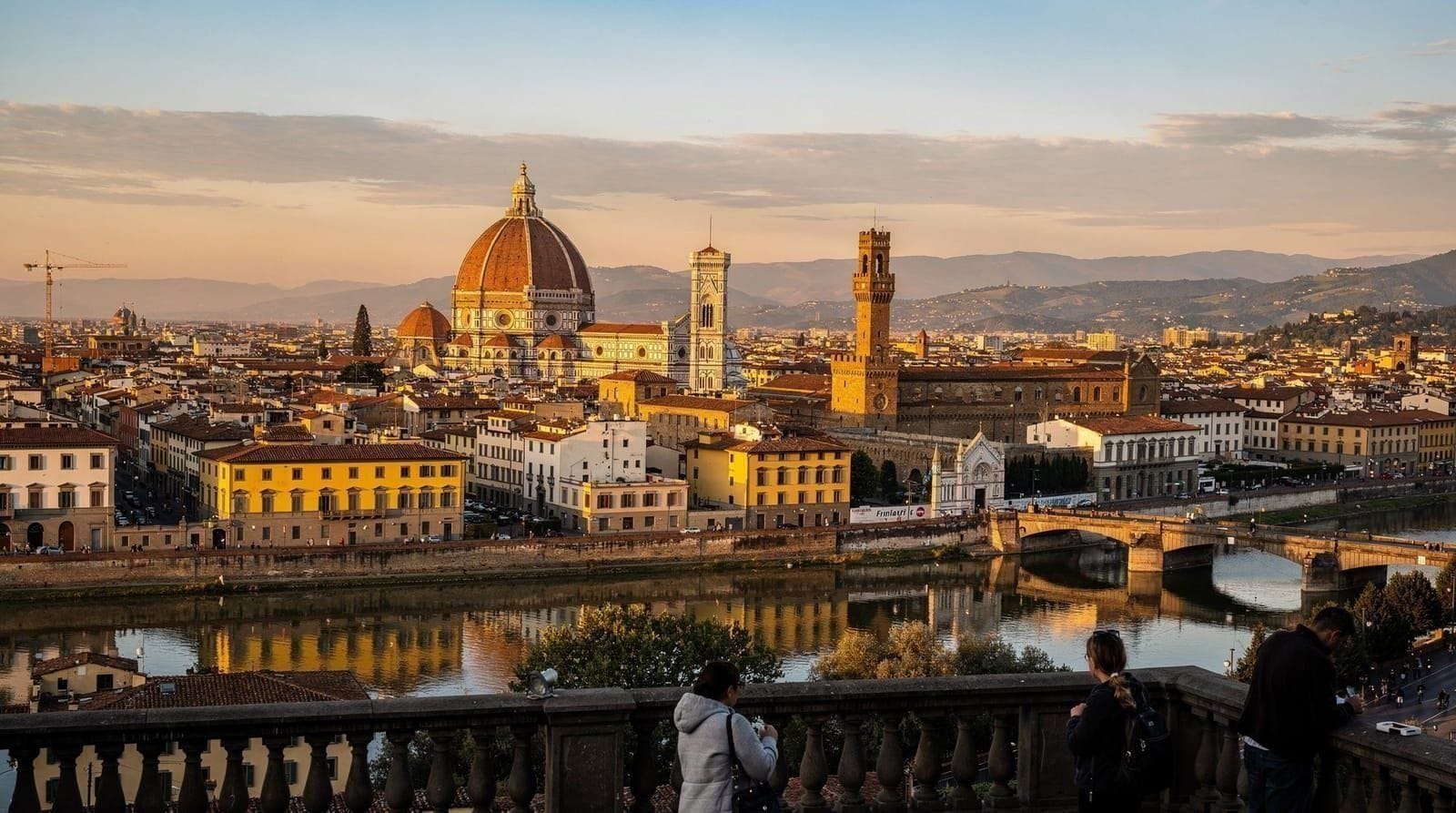
Piazzale Michelangelo is a large terrace high on the Oltrarno hill, accessible by bus (line 13 from SMN — watch for pickpockets), by taxi, or on foot (steep but manageable, about 20 minutes up from Ponte alle Grazie). The view north across Florence — dome, tower, river, terracotta rooftops — is the one on every postcard and at the top of every “best views in Florence” list.
The bronze copy of Michelangelo’s David stands at the centre; the square itself was laid out in the 1860s by Giuseppe Poggi, the architect who redesigned the hillside ring road. The bars and souvenir stands here are expensive and unremarkable; the view is free. Sunrise and golden-hour dusk are the best times to visit.
From the piazzale, it’s a further 10-minute uphill walk to San Miniato al Monte, one of the finest Romanesque churches in Tuscany. Built in the 11th century, with a green-and-white marble facade that prefigures the Duomo, San Miniato is almost always quiet — tourists rarely make the extra climb. The interior has original Cosmati tile floors, a 13th-century mosaic apse, and (in the sacristy) frescoes by Spinello Aretino. Gregorian chant services are still held here. The adjacent cemetery is also notable, with ornate 19th-century tombs including that of Carlo Lorenzini, the author of Pinocchio.
Where to eat and drink in Oltrarno
Oltrarno has the most reliable restaurant-to-price ratio in Florence. Avoid anything with a terrace on the tourist route to Piazzale Michelangelo or the immediate vicinity of Ponte Vecchio. The best options are on side streets.
- Trattoria da Ruggero (Via Senese 89): Old-school Florentine trattoria; ribollita, bistecca and pappa al pomodoro. Lunch and dinner, closed Wednesday. Cash preferred.
- Osteria dell’Enoteca (Via Romana 70): More refined, local wine list, traditional dishes with seasonal precision. Reservations recommended.
- Buca Mario (Piazza degli Ottaviani 16): One of Florence’s oldest restaurants (1886), near Ponte Vecchio; classic Florentine meat dishes.
- Aperitivo scene: Borgo San Frediano and Piazza Santo Spirito have the best early-evening aperitivo (roughly 6-8pm). A spritz or Negroni with free snacks is a Florentine tradition; expect to pay €8-12 for a cocktail with food included.
Getting around Oltrarno
The neighbourhood is entirely walkable from the bridges. Bus lines 11 and D serve the area; bus 13 goes to Piazzale Michelangelo. The area has limited parking and is not well-suited to cars — the ZTL restriction does not fully cover Oltrarno, but narrow streets and restricted access make driving impractical.
Electric scooter rentals and e-bikes are available near Ponte Vecchio and the Pitti area; these are particularly useful for the uphill sections. The Piazzale Michelangelo e-bike tour is a popular way to cover the hill with minimal effort.
The Brancacci Chapel
West of Piazza Santo Spirito, in the church of Santa Maria del Carmine at Piazza del Carmine, the Cappella Brancacci contains the most influential fresco cycle in the history of Italian painting. Masaccio and Masolino painted the Life of St Peter between 1424 and 1427; it was completed by Filippino Lippi in the 1480s after a period of abandonment following the political disgrace of the Brancacci family.
Masaccio’s contribution — particularly the Expulsion of Adam and Eve and the Tribute Money — marks a definitive break with the Byzantine conventions of medieval painting. The figures have genuine weight, cast shadows, and display physical and emotional naturalism that no Italian painter had achieved before. The fresco was studied by virtually every subsequent major artist working in Florence: Leonardo, Michelangelo, Raphael all copied Masaccio’s figures here. The chapel can reasonably claim to be the birthplace of modern painting.
Access requires a timed ticket (maximum 30 people at a time, 30-minute visits). Entry approximately €6-10. Book ahead in peak season; the limited access makes it more fragile to crowds than larger museums. See the Brancacci Chapel booking guide.
Forte di Belvedere
High above the Boboli Gardens, the star-shaped Forte di Belvedere (also called the Forte di San Giorgio) was built by Buontalento for Grand Duke Ferdinand I between 1590 and 1595. It was designed to control the city from above rather than repel external attack — a testament to how paranoid the Medici had become about internal threats.
The fort is now open to the public during temporary art exhibitions (major installations by contemporary artists have been hosted here). The views from the upper bastions — the full panorama of Florence, the Arno valley and the Tuscan hills — are exceptional, arguably better than Piazzale Michelangelo because the fort is higher and the angles are wider.
Check current exhibition and opening status before visiting; the fort is not always open. Entry to exhibitions €10-15; the basic grounds are sometimes free.
Evening aperitivo culture in Oltrarno
The Florentine aperitivo tradition — a cocktail (usually Negroni, Aperol Spritz or Campari Soda) served with free or cheap bar snacks from roughly 6 to 9pm — is most genuine in Oltrarno. The neighbourhood has the right combination: local residents who actually participate in the tradition, venues that haven’t fully pivoted to tourist pricing, and an evening atmosphere created by people ending their working day.
The standard is a cocktail (€7-10) accompanied by a selection of crostini, cheese, salumi, olives and sometimes small warm dishes — enough to constitute a light pre-dinner or, with two drinks, a meal equivalent.
Key aperitivo spots:
- Volume (Piazza Santo Spirito): Books, vintage furniture, cocktails. The reference point for the neighbourhood’s aperitivo scene.
- Il Santino (Via di Santo Spirito 60r): Wine-focused, excellent by-the-glass selection, sophisticated food pairings.
- Rasapì (Via delle Caldaie 24r): Low-key, local, good natural wines.
- Mad Souls and Spirits (Borgo degli Albizi, technically San Niccolò border): Craft cocktails, strong amaro selection.
The evening typically shifts from aperitivo to dinner between 8 and 9pm. Restaurants in Oltrarno fill from 8pm onwards; reservations are recommended on weekends.
Via Maggio and antique dealing
Via Maggio is Oltrarno’s most prestigious street — the 16th-century equivalent of an upscale shopping district, now home to antique dealers, art galleries and specialist artisan shops. The buildings are mostly Renaissance palazzos with ground-floor commercial spaces; several have been in the antique trade for generations.
The character is different from Via de’ Tornabuoni’s luxury brands: this is the trade in old things rather than new ones. Buyers include international collectors, restoration professionals, and Italian institutions. Browsers are welcome; the staff in reputable shops are knowledgeable and generally willing to discuss pieces without purchase pressure.
The Biennale Internazionale dell’Antiquariato di Firenze (held every two years in September-October in odd years) is based in the Palazzo Corsini and Via Maggio area, transforming the neighbourhood into the most concentrated antique fair in Europe for two weeks.
Frequently asked questions about Oltrarno
Is Oltrarno walking distance from the Duomo?
Yes. The Ponte Vecchio is about a 10-15 minute walk from the Duomo. From the bridge, you’re immediately in Oltrarno. The Palazzo Pitti is a further 10-minute walk south through the neighbourhood.
What’s the best time to visit Piazzale Michelangelo?
Sunrise is spectacular and crowd-free (most visitors arrive late morning onwards). Sunset draws a crowd but the atmosphere is worth it. Avoid midday in summer — the terrace has no shade and temperatures can be extreme.
How long should I spend in Pitti Palace?
If you want to see the Palatine Gallery and Boboli Gardens properly, allow a full day. The Palatine Gallery alone takes 2-3 hours. The gardens, depending on how much you wander, take 1-2 hours. A combined Palazzo Pitti + Boboli day is one of Florence’s most rewarding museum experiences.
Are there good workshops open to visitors in Oltrarno?
Several. The leather and bookbinding workshops are the most visitor-friendly. Some participate in “Artigianato e Palazzo” (Crafts at the Palace), an annual event held in the Corsini garden that showcases traditional craftspeople. For year-round visits, walk along Via Maggio and Borgo San Frediano and look for workshops with open doors — most welcome polite visitors.
San Frediano and Borgo San Frediano
West of Piazza Santo Spirito, the San Frediano district is Oltrarno’s least gentrified corner — narrow streets, a genuinely mixed resident population, and a concentration of small workshops that has resisted the boutique-ification affecting parts of Via Maggio. The church of San Frediano itself, with its distinctive octagonal dome (unusual for Florence, closer to a Byzantine or Middle Eastern silhouette), anchors the neighbourhood and is rarely visited by tourists despite being a short walk from Santo Spirito.
Borgo San Frediano, the street running through the district, has become one of Florence’s most interesting evening streets over the past decade — a mix of long-standing artisan shops, natural wine bars and small restaurants that skew toward a younger, more international crowd than the rest of Oltrarno without losing the neighbourhood’s working character. It’s worth a slow evening walk even without a specific destination in mind.
Oltrarno vs the centro storico: which side to base yourself on
Visitors weighing where to stay in Florence often default to the centro storico without considering Oltrarno, which has real advantages for a longer stay:
| Centro storico | Oltrarno | |
|---|---|---|
| Walking distance to Uffizi/Duomo | Immediate | 10-15 min via Ponte Vecchio |
| Noise and crowds | High, especially near major sights | Lower, more residential |
| Restaurant prices | Inflated near landmarks | More consistently fair |
| Atmosphere | Monument-dense, touristic | Neighbourhood life, artisan workshops |
| Evening scene | Bars aimed at visitors | Genuine aperitivo culture |
For a first Florence visit focused on museums, the centro storico’s convenience wins. For a second visit, a longer stay, or anyone prioritising food and atmosphere over walking distance to the Uffizi, Oltrarno is the better base. See the best areas to stay in Florence guide for the full neighbourhood comparison.
A realistic full day in Oltrarno
Morning — Cross Ponte Vecchio, start at Palazzo Pitti and the Palatine Gallery (2-3 hours). Midday — Boboli Gardens (1-2 hours), ending near the Kaffeehaus for the view. Early afternoon — Lunch around Piazza Santo Spirito, then browse the artisan workshops on Via Maggio and Borgo San Frediano. Late afternoon — Walk up to San Miniato al Monte and Piazzale Michelangelo for sunset. Evening — Aperitivo around Piazza Santo Spirito or Borgo San Frediano before dinner in the neighbourhood.
If a full day isn’t available, the Pitti/Boboli combination alone, paired with a short walk through Santo Spirito, makes a satisfying half-day — see the Palazzo Pitti galleries guide for a tighter itinerary within the museum complex.
Top experiences
Bookable activities with verified prices and instant confirmation on GetYourGuide.

Florence: Pitti Palace and Boboli Gardens ticket
- Instant confirmation
- Mobile ticket
Florence: Pitti Palace and Boboli Gardens guided tour
- Small group
- Free cancellation
Florence: on e-bike to Piazzale Michelangelo
- Free cancellation
- Small group
Florence: sunset panoramic tour — Fiesole and Michelangelo Square
- Free cancellation
- Small group