San Lorenzo market Florence guide
Florence: San Lorenzo food market and wine tasting tour
- Free cancellation
- Small group
What is the best thing to buy at San Lorenzo market in Florence?
The indoor Mercato Centrale food hall (upstairs) is excellent for Tuscan food products — olive oil, truffle goods, pasta, charcuterie, wine. The outdoor stalls are good for ceramics, scarves and souvenirs. The outdoor leather goods section is unreliable — see the honest warning below.
San Lorenzo: Florence’s most complicated market
Mercato San Lorenzo occupies a peculiar position in Florence’s tourist geography. It is the most visible, most discussed and most visited market in the city. It is also the market where the gap between expectation and reality is widest.
This guide does not dismiss San Lorenzo — it is genuinely interesting and some of what it sells is excellent. But it starts with the honest picture, then works through what the market actually offers, so you can arrive with the right expectations and leave without regret.
| Where | Via dell’Ariento and surrounding streets, near the Duomo |
| Cost | free to browse; food hall dishes around €4-14 |
| Time needed | 1-2 hours for the outdoor stalls, plus lunch at the food hall |
| Getting there | 10-minute walk from Duomo or Santa Maria Novella station |
| Best time | weekday mornings, before 11am, for fewer crowds |
The two distinct markets at San Lorenzo
The outdoor stalls
The outdoor market covers several blocks: Via dell’Ariento (the main leather stall street), Via Canto de’ Nelli, Via Sant’Antonino, Via Guelfa, and the areas around Piazza del Mercato Centrale. Approximately 200-300 stalls operate here on any given day, selling leather goods, scarves, ceramics, clothing, prints, food products and souvenirs.
This is what most people call “San Lorenzo market.” It is open daily Monday-Saturday, approximately 9 am to 7 pm (winter hours shorter, some stalls close by 5 pm).
Mercato Centrale (the building)
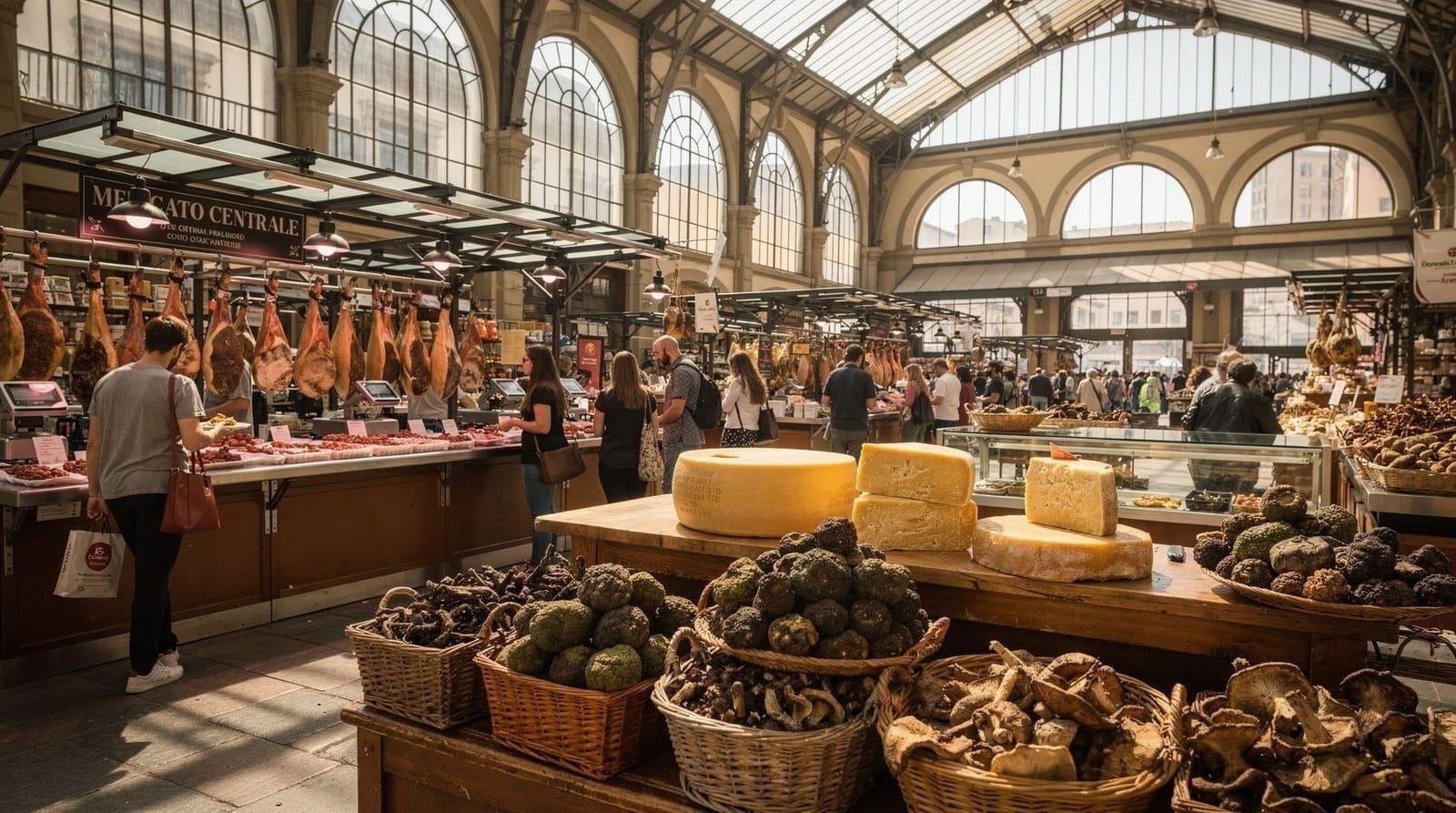
The Mercato Centrale is a separate, architecturally significant iron-and-glass market building at the heart of the district (Via dell’Ariento corner, Piazza del Mercato Centrale). Built in 1874 by Giuseppe Mengoni (the architect of Milan’s Galleria Vittorio Emanuele II), it is the finest 19th-century market building in Florence.
Ground floor: Traditional produce market — vegetables, meat, fish, cheese, pasta, bread. Open Monday-Saturday 7 am to 3 pm. Used primarily by residents and restaurant buyers. Genuine and lively.
First floor food hall: Opened in 2014, this is a modern street food destination with stalls selling pasta, pizza, lampredotto (tripe sandwich, the Florentine street food), truffle dishes, wine by the glass, craft beer, gelato and more. Open daily 10 am to midnight. Excellent for lunch or an early dinner with a glass of wine.
Outdoor stalls vs Mercato Centrale, at a glance
| Outdoor stalls | Mercato Centrale food hall | |
|---|---|---|
| What it’s for | souvenirs, leather, ceramics, scarves | eating lunch or dinner |
| Quality control | none — buyer beware | curated, consistent |
| Bargaining | expected on non-food items | none, fixed prices |
| Crowds | heaviest 11am-4pm | heaviest 12-3pm and 7-9pm |
| Tourist-trap risk | high on leather and “designer” goods | low |
The outdoor market: what to buy (and what to skip)
Buy: Tuscan food products
Several stalls specialize in food products that you can legally carry through airport customs: olive oil in tins or small bottles, truffle salt and truffle paste, dried pasta in premium shapes, bottled Chianti wine (within liquid limits for hand luggage), cantucci (hard almond biscuits), and preserves.
The quality at food stalls varies. Prefer stalls that display the producer’s name and label clearly rather than generic “Tuscan extra-virgin olive oil” in unbranded bottles. Olive oil that lists the producer, the harvest date and the grove location is traceable; olive oil without these details may be Italian in origin but is harder to verify.
Price guide: Extra-virgin olive oil (500ml tin) EUR 8-18, truffle salt (50g) EUR 8-14, dried porcini (50g) EUR 6-12, bottled Chianti Classico DOCG EUR 8-18.
Buy: ceramics with verifiable origin
Ceramic stalls sell a wide range — from Deruta-produced pieces (Deruta, in Umbria, is the main production centre for traditional hand-painted Italian ceramics) to mass-produced imports. Better stalls mark their ceramics with the producer’s name and origin. A Deruta bowl from a reputable producer is EUR 20-50; an equivalent-looking piece from an unverified source may be EUR 5-10.
Look for pieces with a mark or label identifying the ceramicist. Hand-painted pieces have slight variations in the design and visible brushstroke texture. Screen-printed pieces are perfectly uniform — fine for decorative use, but not artisan work.
Buy: scarves, silk and fabric goods
The leather question does not apply to scarves. San Lorenzo has good stalls selling Florentine-printed scarves, silk or silk-mix fabric goods, and patterned textiles. Prices are fair at EUR 10-30 for a scarf. Bargaining is acceptable at these stalls.
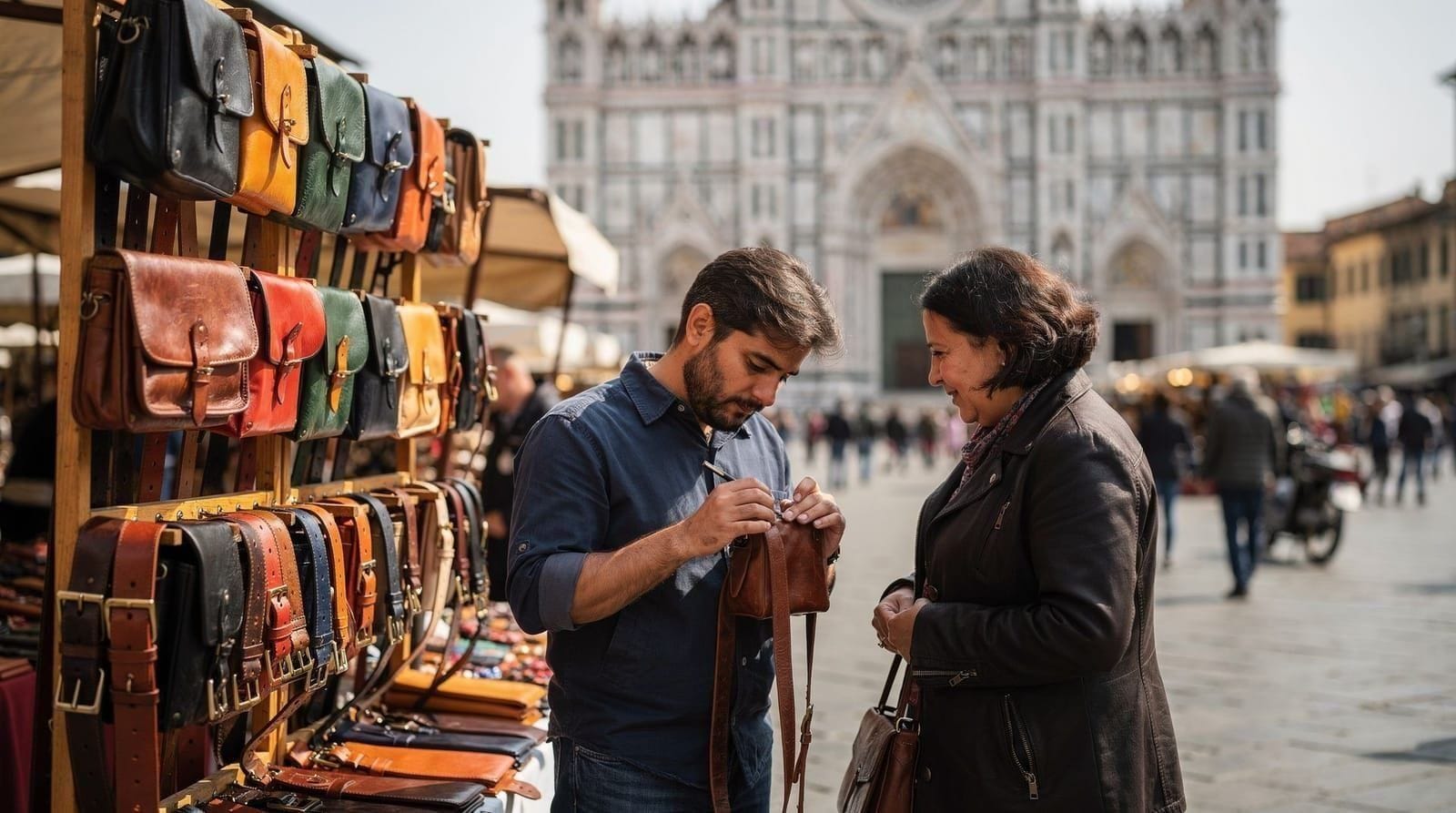
Be cautious: leather goods
The full picture of what is sold as leather at San Lorenzo is covered in our leather markets guide. Brief summary:
Stalls selling wallets for EUR 20-40 are very likely not selling full-grain Florentine leather. “Made in Italy” labels are legally possible on Chinese-manufactured goods that had a final assembly step in Italy. The smell test (rich earthy smell = genuine leather; chemical or plastic edge = not genuine) is the most reliable quick check.
Our recommendation: if you want leather goods as a souvenir and understand you may be buying a mixed-quality product, San Lorenzo is fine. If you want genuine artisan leather, go to the Scuola del Cuoio at Santa Croce or an Oltrarno workshop.
Stalls to look for: A small number of stalls at San Lorenzo do sell good-quality leather at honest prices. They tend to have smaller inventory, better presentation, and staff who are knowledgeable about their products rather than making broad claims. Ask where the leather comes from and how the goods are made; genuine sellers know.
Skip: watches, electronics, branded clothing
Stalls selling branded watches (Rolex, TAG Heuer), electronics, or “designer” clothing at dramatically discounted prices are selling counterfeit goods. Purchasing counterfeits is a crime in Italy — buyers as well as sellers can be fined (fines for tourist buyers are uncommon but not unheard of). Skip these stalls entirely.
Mercato Centrale food hall: the honest highlight
The first-floor food hall of Mercato Centrale is the genuinely excellent part of the San Lorenzo market experience. It was developed as a curated food destination — stalls are selected rather than random, quality control exists, and the atmosphere is pleasant without being tourist-trap.
What to eat at Mercato Centrale
Lampredotto: Florence’s signature street food is lampredotto — the fourth stomach of a cow, boiled, sliced and served in a bread roll with salsa verde and sometimes a hot sauce. It sounds extreme; it tastes like a particularly flavourful pulled pork. The trippai at Mercato Centrale serve the most authentic version in a comfortable setting. EUR 4-6 for a sandwich.
Fresh pasta: Several stalls make fresh pasta to order — tortellini, tagliatelle, pici (the thick Tuscan pasta). Eat at the market or take away. EUR 8-14 for a pasta dish.
Bistecca alla Fiorentina: The T-bone steak of Tuscany, from Chianina cattle, grilled over wood. Sold by weight at the market (typically EUR 40-60 per kilogram; steaks are 800g-1.2kg for two people). One of the few places in Florence where you can eat a genuine bistecca without booking days ahead.
Cheese and charcuterie: Stalls with Tuscan pecorino cheese, Parmigiano Reggiano, finocchiona (fennel salami), lardo di Colonnata, and prosciutto from San Daniele. Buy a selection for a picnic.
Wine by the glass: The Mercato Centrale wine bar offers Chianti, Vernaccia di San Gimignano, Morellino di Scansano and other Tuscan wines by the glass (EUR 4-8). A glass with a cheese board or charcuterie plate is a solid lunch.
Gelato and pastries: Several gelato stalls; quality varies. Read the gelato warning in our gelato guide — the same signs of quality apply here as elsewhere.
When to visit the food hall
The food hall is at its best for lunch (12-3 pm) or early evening (6-9 pm). It gets very crowded at peak lunch times on Sundays and public holidays. Weekday lunchtimes are more comfortable. Coffee at 10 am when it opens is a pleasant start before hitting the outdoor market.
The San Lorenzo neighbourhood context
The outdoor market exists within the San Lorenzo neighbourhood — one of Florence’s working-class historic districts, home to the Basilica di San Lorenzo (the Medici family parish church), the Medici Chapels, the Biblioteca Medicea Laurenziana (a library designed by Michelangelo), and a residential community that predates the tourist market by centuries.
The Basilica di San Lorenzo itself is worth entering: Brunelleschi’s interior, Donatello’s bronze pulpits, and Michelangelo’s New Sacristy are all significant. Entry EUR 8-10. The Laurentian Library (Biblioteca Medicea Laurenziana) above the cloister is open to visitors and contains an extraordinary Michelangelo-designed vestibule and reading room. Entry included with Basilica or separately EUR 6.
The neighbourhood beyond the market — north toward Piazza della Libertà, west toward the station — is residential and less touristed. Good trattorias for lunch away from market prices are found on Via Guelfa, Via Faenza and Via San Gallo.
Guided food market tours
Several operators offer guided food market tours that start at the Mercato Centrale, using it as a classroom for Tuscan food culture. A typical tour:
- Visits the ground-floor produce market with explanations of seasonal Tuscan vegetables, cheeses and charcuterie
- Tastes 5-8 products with guidance on what to look for in quality
- Explains Tuscan cooking principles using the ingredients as examples
- Sometimes continues to cooking class or further market stops
These tours last 2-3 hours and cost EUR 60-100 per person including tastings. They are well-suited to food-focused visitors who want to understand the context behind what they are eating in restaurants. The Tuscan cooking course with a San Lorenzo market visit combines market learning with an afternoon cooking class and lunch.
Practical information for visiting San Lorenzo
Getting there
From the Duomo: 10-minute walk north on Via de’ Martelli / Via Cavour. From Santa Maria Novella station: 10-minute walk east on Via Panzani, then north. Nearest bus stops: Lines 1, 6, 14 stop near Piazza San Lorenzo.
Bargaining
Bargaining is expected at outdoor market stalls and is part of the experience. The standard approach: ask the price, express mild surprise, counter with 10-15% less, meet in the middle. This works reliably on scarves and accessories; less reliably on food products (where prices are marked and often honest). Do not bargain on items with clearly marked prices in shops.
Pickpockets
San Lorenzo market is one of the highest pickpocket-risk areas in Florence — a busy, crowded market with tourist concentration and the distraction of shopping. Use a money belt or inside pocket for passport and large amounts of cash. Keep wallet in front pocket. Pay attention to anyone who bumps into you or creates a distraction.
What locals actually buy here
Despite its tourist reputation, San Lorenzo is not purely a visitor market. Florentine residents shop the ground-floor produce hall at Mercato Centrale daily for vegetables, fish and meat at prices comparable to a neighbourhood grocer — this floor is worth a look even if you have no intention of cooking, simply to see the market functioning as it has for over a century. On the outdoor stalls, locals buy household basics (aprons, kitchen linens, work clothes) from a handful of stalls that have served the neighbourhood for decades and are easy to tell apart from the tourist-facing leather and souvenir stalls: they display fixed, unrounded prices, carry less flashy signage, and rarely have anyone standing outside inviting you in. If you want a sense of San Lorenzo beyond the souvenir layer, arrive at 8am when the ground-floor produce market is busiest with residents rather than visitors, and the outdoor stalls are still setting up.
Market changes
The San Lorenzo market has been the subject of periodic municipal discussions about relocation or reduction, given its impact on the neighbourhood. Check current status if visiting well after 2026 — some sections may have changed.
Comparing San Lorenzo to Florence’s other markets
San Lorenzo is not the only market worth your time, and it is worth understanding where it sits relative to the alternatives before you commit an entire morning to it. The Sant’Ambrogio market near Santa Croce is the closest thing Florence has to a genuine, tourist-light neighbourhood produce market — smaller, less polished, and priced for locals rather than visitors. The Tuesday Cascine market covers a wider range of household goods and clothing at similarly low tourist density. San Lorenzo, by contrast, sits at the opposite end of the spectrum: it is the biggest, the most visible from a hotel-lobby map, and the one where you most need the guidance in this article. None of that makes it a market to avoid — the Mercato Centrale food hall genuinely earns its reputation — but going in with San Lorenzo’s specific mix of “excellent food hall, patchy outdoor stalls” clearly understood will save you both money and disappointment.
If your priority is shopping for genuine artisan goods rather than food, the Oltrarno’s artisan workshops are a better use of time than the outdoor stalls at San Lorenzo — you will pay more, but what you buy will actually be what it claims to be. For a full sense of where San Lorenzo fits among Florence’s shopping options more broadly, our Florence shopping guide covers the neighbourhood-by-neighbourhood picture.
Frequently asked questions about San Lorenzo market
Is there a Florentine leather school near San Lorenzo market?
The Scuola del Cuoio (Leather School of Florence) is at Piazza Santa Croce — approximately 15 minutes’ walk from San Lorenzo. It is the most reliable source for genuine artisan leather goods in the city. Worth the walk if leather quality matters to you.
Can I ship purchases from the market?
Outdoor market stalls generally cannot arrange shipping. If you buy something large (a ceramic piece, a print), the stall vendor may know a nearby shipping company. For reliable shipping, use a dedicated art and ceramics shipper — several operate near the market and near major tourist sites.
What is the Tuesday Cascine market?
The Cascine market (Viale degli Olmi, Parco delle Cascine) runs every Tuesday morning, 8 am to 2 pm. It is a traditional outdoor market selling clothing, household goods, food and accessories. Less tourist-oriented than San Lorenzo, more neighbourhood-focused. A good alternative if you want market atmosphere without the tourist density.
Is the Sant’Ambrogio market better than San Lorenzo?
The Sant’Ambrogio market (Piazza Ghiberti, near Santa Croce) is a local produce and food market with less tourist presence and more authentic neighbourhood character. Better for food shopping; smaller range for souvenirs. Open Monday-Saturday 7 am to 2 pm. Both have value; they serve different purposes.
The San Lorenzo neighbourhood beyond the market
The outdoor market dominates most visitors’ experience of this neighbourhood, but the San Lorenzo neighbourhood is richer than the stalls suggest.
Basilica di San Lorenzo
The Basilica di San Lorenzo is the Medici family church — Cosimo de’ Medici commissioned Brunelleschi to redesign it in 1419. The interior is one of the finest examples of early Renaissance architecture in Florence: perfect proportion, grey stone against white plaster, the extraordinary Old Sacristy designed by Brunelleschi.
Entry to the Basilica: EUR 7-10 (often combined with the Laurentian Library). Open Monday-Saturday 10 am-5 pm.
The New Sacristy (Cappelle Medicee, entered from Piazza Madonna degli Aldobrandini) is where Michelangelo designed the Medici tombs and the sculptures of Dawn, Dusk, Night and Day. Separate entry EUR 9, free for EU under-18.
Biblioteca Medicea Laurenziana
Cosimo I de’ Medici commissioned Michelangelo to design a library for the Medici manuscript collection in 1524. The vestibule staircase — three flights of stairs in a space too small for them, the balustrade volutes folding over themselves — is one of the most inventive architectural spaces in Florence. Entry EUR 6, open Monday-Saturday 9:30 am-1:30 pm.
The neighbourhood residential character
North of Via Guelfa, the San Lorenzo neighbourhood transitions from tourist market to working Florentine neighbourhood. Via San Gallo, Via Cavour and Piazza della Libertà are lined with trattorias, small shops and neighbourhood bars that do not adjust their prices for tourists because tourists rarely get this far.
For a working-Florentine lunch before or after the market, these streets are consistently better value than anything adjacent to the market itself. Look for places without English menus displayed outside.
Guided food market tours: what to expect
The food market tours departing from Mercato Centrale are among the most popular guided experiences in Florence for food-focused visitors. A typical 3-hour tour includes:
Ground floor produce market walk: The guide explains seasonal Tuscan produce — artichokes in spring, truffle season in autumn, the difference between Fiorentino and Tuscan tomato varieties, the specific cheeses that come from the Mugello hills north of Florence versus the Maremma coast.
Tastings of 5-8 products: Typical stops include Parmigiano Reggiano (tasted at different ages — 24 months, 36 months), Tuscan pecorino, two types of prosciutto, fresh pasta (tagliatelle and a filled pasta), a bruschetta with local olive oil, and a glass of Chianti.
Food hall first floor: The tour usually ends in the food hall for a proper lunch or an explanation of how to navigate the stall options independently.
Cooking class extension: Some operators combine the market tour with a 2-hour afternoon cooking class using ingredients bought at the market. This extension makes a full morning-to-afternoon food experience (EUR 100-150 per person including market tour, tastings, cooking class and lunch).
The Tuscan cooking course with a San Lorenzo market visit — starting with the market walk and continuing to a cooking school kitchen — is the most complete version of this experience and an excellent use of one full day in Florence.
Top experiences
Bookable activities with verified prices and instant confirmation on GetYourGuide.