Accessible Florence — a realistic guide for visitors with disabilities
Florence: hop-on hop-off tour — 1 or 2 day ticket
- Free cancellation
- Mobile ticket
Is Florence accessible for wheelchair users and visitors with disabilities?
Partially and with caveats. Florence's medieval cobblestoned streets (san pietrino) present significant challenges for wheelchairs and mobility aids. The major museums — Uffizi, Accademia, Pitti Palace — have been improved with ramps and lifts, but not all galleries are fully accessible. The Duomo dome climb is not accessible. Advance planning and honest expectation-setting are essential.
The reality of accessibility in Florence
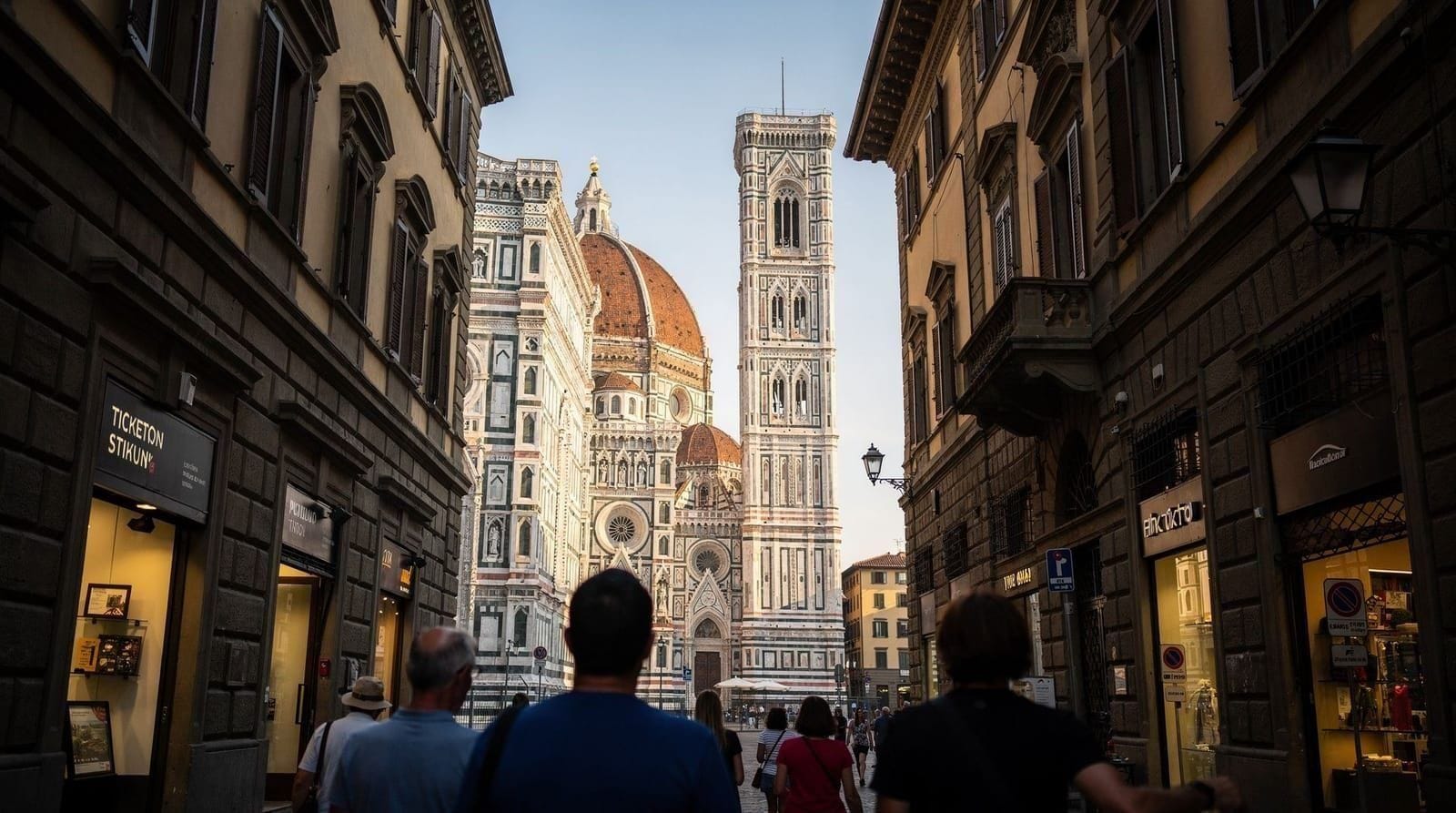
Florence is a medieval city. Its streets were laid out for pedestrians and horses in the 14th and 15th centuries, then paved with san pietrino — rounded cobblestones — that have remained ever since. For wheelchair users, visitors with mobility impairments, and people using walking frames or rollators, this creates a genuine practical challenge.
This guide does not minimise that challenge. But it also does not overstate it. Florence has made real progress in accessibility at its major attractions. With advance planning and honest expectations, visitors with a wide range of disabilities can have a genuinely rewarding experience in the city. If this is your first visit, pair this guide with the general first-time Florence guide and Florence travel tips for the wider planning picture.
| Biggest obstacle | San pietrino cobblestones across the historic centre |
| Most accessible transport | Trams T1/T2 (level boarding, wheelchair spaces) |
| Best smooth routes | Via Calzaiuoli, Via dei Tornabuoni, the Lungarno |
| Not accessible at all | Brunelleschi’s Dome and Giotto’s Bell Tower climbs |
| Free entry | Disabled visitors + 1 companion at state museums (ISEE or EU equivalent) |
The cobblestone question
San pietrino covers the majority of Florence’s historic streets. These rounded, uneven cobblestones present:
- Wheelchair challenges: Significant vibration and resistance for manual chairs; rough but manageable for powered chairs. The unevenness creates strain on wrists and arms for manual self-propulsion. An electric chair handles this terrain considerably better.
- Walking frame / rollator users: Difficult. Wheels catch in the gaps between stones. Forward progress is possible but slow and tiring.
- Reduced mobility (walking with sticks or limited endurance): San pietrino is uneven and can destabilise. Wearing very good supportive shoes reduces risk significantly.
- Partially accessible alternative routes: Several main pedestrian arteries have been resurfaced with smooth stone or asphalt: Via Calzaiuoli (between Piazza del Duomo and Piazza della Signoria), Via dei Tornabuoni, and some sections near the major museums have smooth approaches.
Practical strategies:
- Plan routes along major pedestrian streets rather than small medieval alleys
- Download a map and identify the smoothest routes between attractions in advance
- Consider a powered mobility scooter or electric wheelchair if you don’t already use one — rental is available in Florence (see resources below)
- Accept that some areas (tight medieval alleys, steep slopes toward San Miniato) are not realistic targets
Museum accessibility: attraction by attraction
Uffizi Gallery
The Uffizi has substantially improved accessibility over the past decade. The main entrance has a level access route. A lift serves the upper gallery floors. Most rooms are accessible, though a small number of connecting corridors are narrow. Disabled visitors (with ISEE disability certificate or equivalent EU documentation) and one accompanying person enter free.
Before visiting: Email or call the Uffizi accessibility office (accessibilita@uffizi.it) to confirm current routes and request any special assistance. This is advisable rather than merely optional, as internal routes change during renovation phases.
Accademia Gallery (David)
The Accademia has a dedicated accessible entrance and lift access to the main Tribuna where David stands. The approach from the street involves a short ramp section. Most of the permanent collection is on accessible levels. Free entry for disabled visitors and one companion (ISEE or equivalent documentation).
Duomo complex
The dome climb: not accessible. The 463 steps of Brunelleschi’s Dome and the 414 steps of Giotto’s Bell Tower are spiral staircases with no lift. Neither is accessible for wheelchair users or those with significant mobility limitations. Full ticket detail for the complex is in the Duomo complex tickets guide.
The Duomo interior (the cathedral itself): fully accessible. The floor is flat; the entrance has level or ramped access. The Baptistery interior is accessible via its main entrance — see the Florence Baptistery guide for what’s inside.
Opera del Duomo Museum: partially accessible. The ground floor and first floor are accessible by lift. The original Ghiberti Baptistery doors, Michelangelo’s Pietà, and the major sculptural works are on accessible floors.
Pitti Palace and Boboli Gardens
The Palatine Gallery (Pitti’s main floor, see the Palazzo Pitti galleries guide) is accessible by lift from the courtyard entrance. The Royal Apartments and other galleries vary — confirm specific access when booking.
Boboli Gardens: The main garden paths are gravel and relatively smooth for much of their length, but the terrain is significantly sloped. The main terrace level and Amphitheatre are accessible; outlying areas of the garden involve slopes and uneven paths. See the Boboli Gardens guide for a full layout.
Santa Croce Basilica
A well-maintained flat floor and accessible entrance make Santa Croce one of the more accessible large churches in Florence. The tombs of Michelangelo, Galileo, and Machiavelli are all on the ground level.
Medici Chapels
Accessible via a level entrance (book the accessible route in advance — the standard tourist route involves steps). The Chapel of the Princes (main decorated dome space) and the Sagrestia Nuova (Michelangelo’s sculptures) are reachable by lift. Contact the Medici Chapels (bargellomusei.it) in advance.
Bargello Museum
Less accessible than the major museums — an older building with limited lift provision. Some rooms require stairs. Check current accessibility before planning a visit; see the Bargello Museum guide for what’s inside if you can manage the stairs.
San Marco Museum
Ground floor Fra Angelico frescoes are generally accessible. Upper-floor cells (where individual monks’ frescoes are painted) require stairs and are not accessible. Details in the San Marco Museum guide.
Palazzo Vecchio
The main courtyard and ground floor are accessible. The upper Hall of the Five Hundred (the major painted hall) is accessible by lift. The tower climb is not accessible. See the Palazzo Vecchio guide for the full visit.
Accessibility at a glance
| Attraction | Ground floor | Upper floors | Notes |
|---|---|---|---|
| Uffizi | Accessible | Lift | Some narrow connecting corridors |
| Accademia | Accessible | Lift | Short ramp at entrance |
| Duomo cathedral | Accessible | — | Dome climb not accessible |
| Santa Croce | Accessible | — | Flat floor throughout |
| Medici Chapels | Accessible | Lift | Book accessible route in advance |
| Bargello | Limited | Stairs only | Older building, check ahead |
| Palazzo Vecchio | Accessible | Lift (Hall of 500) | Tower not accessible |
Getting around Florence: accessible transport
Trams
Florence’s modern tram lines (T1 from Careggi to Scandicci, and T2 from the airport to the city centre) are fully accessible with low platforms, level boarding, and designated wheelchair spaces. This is the most accessible form of public transport in the city — see the getting around Florence guide for the full network. T2 from FLR airport to Santa Maria Novella is an excellent accessible airport transfer; more on that route in the Florence airport to city guide.
Buses
ATAF buses in Florence include a fleet of low-floor accessible vehicles. Routes are not uniformly accessible at every run — some older vehicles on the same route are not low-floor. The main useful accessible routes:
- Bus 13: Uffizi/centre to Piazzale Michelangelo (some runs accessible)
- Bus 7: Piazza San Marco to Fiesole (some runs accessible)
Check the ATAF website or use the Moovit/Google Maps app to filter for accessible services.
Taxis
Official Florence taxis can accommodate folding wheelchairs in standard vehicles. For larger powered wheelchairs or scooters, you need to book a taxi with a specially equipped vehicle in advance — call the Radiotaxi Firenze (055 4390 or 055 4242) and specify your requirements. The hotel concierge can arrange this.
Car
Disabled badge holders (with appropriate Blue Badge or Italian disabled parking permit) can access some ZTL-restricted areas; this requires registration in advance with the Florence municipality. Contact Comune di Firenze (055 055) for current procedures. Parking is available with blue badge in designated disabled spaces throughout the city.
Train to Florence (Santa Maria Novella)
Trenitalia’s Sala Blu service provides free assistance for disabled travellers at major stations including Santa Maria Novella. Book this 24 hours ahead (trenitalia.com/sala-blu). Assistance includes meeting you at the platform, helping with the train, and accompanying you to the taxi rank or tram stop.
Resources and contacts for accessible Florence
Florence Municipality Accessibility Office The Comune di Firenze website (comune.fi.it) publishes an accessibility map of the historic centre showing smooth pavement routes, accessible entrances, and barrier-free paths.
Mobility scooter and wheelchair rental Several operators in Florence hire out powered mobility scooters and electric wheelchairs: check with your hotel concierge or search “noleggio carrozzella Firenze” for current providers. Expect to pay €40–80 per day for a powered scooter.
Museum accessibility contacts
- Uffizi: accessibilita@uffizi.it
- Accademia and Bargello: bargellomusei.it, accessibility section
- Duomo complex: museumflorence.com
Planning your accessible Florence visit
What is genuinely accessible
- All major museum interiors (Uffizi, Accademia, Pitti, Santa Croce) — with advance planning
- The smooth pedestrian routes through the centre (Via Calzaiuoli, Via dei Tornabuoni, Lungarno)
- Piazzale Michelangelo (accessible by taxi, private car, or bus 13)
- Florence’s modern trams (T1, T2)
- Most indoor restaurants, cafés, and shops in the centre
- Santa Maria Novella station (Sala Blu service)
What is difficult but possible
- Cobblestone streets in the historic centre — manageable with powered wheelchair or with significant physical effort on manual chair; challenging for rollators
- Boboli Gardens main areas — some slope but main paths navigable
- Main bus routes — not universally accessible but many runs are
What is not accessible
- Brunelleschi’s Dome climb (463 steps, no lift)
- Giotto’s Bell Tower (414 steps, no lift)
- Piazzale Michelangelo on foot via the traditional staircase route — accessible only by vehicle
- San Miniato al Monte — the approach involves slopes and uneven terrain
- Most Florentine alley streets (vicoli) — too narrow and uneven
Visiting with visual or hearing impairments
Visual impairment
The Uffizi offers tactile reproductions of key artworks in a dedicated room that can be visited free of charge by blind and partially sighted visitors with a companion. Contact the accessibility office (accessibilita@uffizi.it) at least 24 hours before your visit to arrange access. Audio guides in multiple languages are available for standard visitors and are particularly valuable for those with visual impairments. Several of Florence’s guided tours also offer detailed verbal description orientation — Context Travel offers tailored tours for visitors with visual impairments.
Hearing impairment
The major museums have written content at all display points. The Uffizi and Accademia offer audio guide content in written format via the official apps. Some guided walking tours provide written text or BSL/ISL-interpreted services — enquire directly with tour operators.
Florence with limited energy or chronic illness
Florence demands significant physical energy from able-bodied visitors: thousands of steps, cobblestones, museum standing time, heat (in summer). For visitors managing chronic illness, ME/CFS, fibromyalgia, heart conditions, or other energy-limiting conditions, the challenges compound.
Practical strategies for pacing in Florence:
Prioritise ruthlessly. One major attraction per half-day is a reasonable target. The Uffizi alone — done carefully with an audio guide — can take 2.5 hours. Trying to do Uffizi in the morning and Accademia in the afternoon is a full day’s programme for a healthy visitor; for someone managing energy, it is two separate days.
Use taxis between attractions. Within the historic centre, taxi rides are short (5–8 minutes, €8–12). For visitors who cannot walk 15 minutes between museums without significant fatigue, using taxis between the Uffizi and Accademia, or between the Duomo complex and Piazza della Signoria, reduces physical load substantially.
Choose accommodation with a lift. Not all Florence hotels — especially those in medieval buildings — have lifts. Confirm before booking if lift access is required. Most 4-star and above properties have them; many 3-star and B&B properties in historic buildings do not.
Rest in museums. Both the Uffizi and Accademia have seating in most rooms. Take breaks. The Uffizi’s rooftop café is an excellent rest point mid-visit. Sitting in the Botticelli Room for 20 minutes is not wasted time.
Plan around museum queues. Even with pre-booking, standing in a queue to enter (10–15 minutes even with timed entry at peak times) can be exhausting. Arrive at the very beginning of your timed entry slot and ask staff at the entrance if there is a way to reduce wait time — accessible entrance lanes often have shorter queues.
Visiting with cognitive or neurodivergent needs
Florence’s museums can be overwhelming — high sensory input, large crowds, complex spatial layouts. Strategies:
- Visit at opening time when crowds are minimal and noise levels lower
- Plan shorter visits — 90 minutes in the Uffizi for a focused selection rather than 3 hours of full gallery
- Pre-download museum maps so that navigation is known before arrival
- The quieter museums — San Marco, Bargello, Museo Galileo — have less visitor density than the Uffizi and Accademia and may be more comfortable starting points
Frequently asked questions about accessible Florence
Can wheelchair users enjoy Florence?
Yes, with realistic planning. The major museums are accessible, several key streets are smooth, and transport via tram and taxi is accessible. The cobblestoned medieval streets require either a powered wheelchair or acceptance of a more effortful manual chair experience. Florence is more accessible than Venice (which has steps and boats as the main navigation challenge) but less accessible than a flat modern city.
Is the Firenzecard worth it for disabled visitors?
Potentially yes. Disabled visitors and one companion already receive free entry to state museums. The Firenzecard’s value is primarily the skip-the-queue function. If managing queues is difficult, the Firenzecard provides access to an accessible entrance with significantly reduced waiting. However, advance individual museum booking achieves the same outcome for less money.
Are Florentine restaurants accessible?
Varies significantly. Traditional trattorias in medieval buildings often have steps at the entrance and narrow interiors. Modern restaurants and those in newer buildings tend to be step-free. Calling ahead to confirm accessibility is the most reliable approach. Outdoor seating (available from April–October at most restaurants) is generally more accessible than indoor seating.
Are there accessible accommodation options?
Hotels classified as 4-star and above in Florence typically have lifts and accessible room options. Many smaller hotels and B&Bs in historic buildings do not have lifts — check carefully before booking. Accessibility information should be in the booking listing but verify directly with the property, specifying whether you require a roll-in shower, turning space, or other specific features.
How many days should I plan for an accessible Florence visit?
More than for a standard trip. Because pacing and rest matter more, plan one major attraction per half-day rather than stacking two or three — see how many days in Florence for a baseline, then add a buffer day. A relaxed four- or five-day visit lets you see the Uffizi, Accademia, and Duomo complex without the fatigue of a compressed itinerary.
Top experiences
Bookable activities with verified prices and instant confirmation on GetYourGuide.

Florence: hop-on hop-off tour — 1 or 2 day ticket
- Free cancellation
- Mobile ticket
Florence: walking tour
- Free cancellation
- Instant confirmation
Florence: main sights guided walking tour
- Free cancellation
- Instant confirmation
Florence: Duomo guided tour with optional dome climb
- Skip the line
- Free cancellation