Palazzo Vecchio: Florence's fortified town hall and its secrets
Florence: Palazzo Vecchio and battlements guided tour
- Small group
- Free cancellation
What is inside Palazzo Vecchio in Florence?
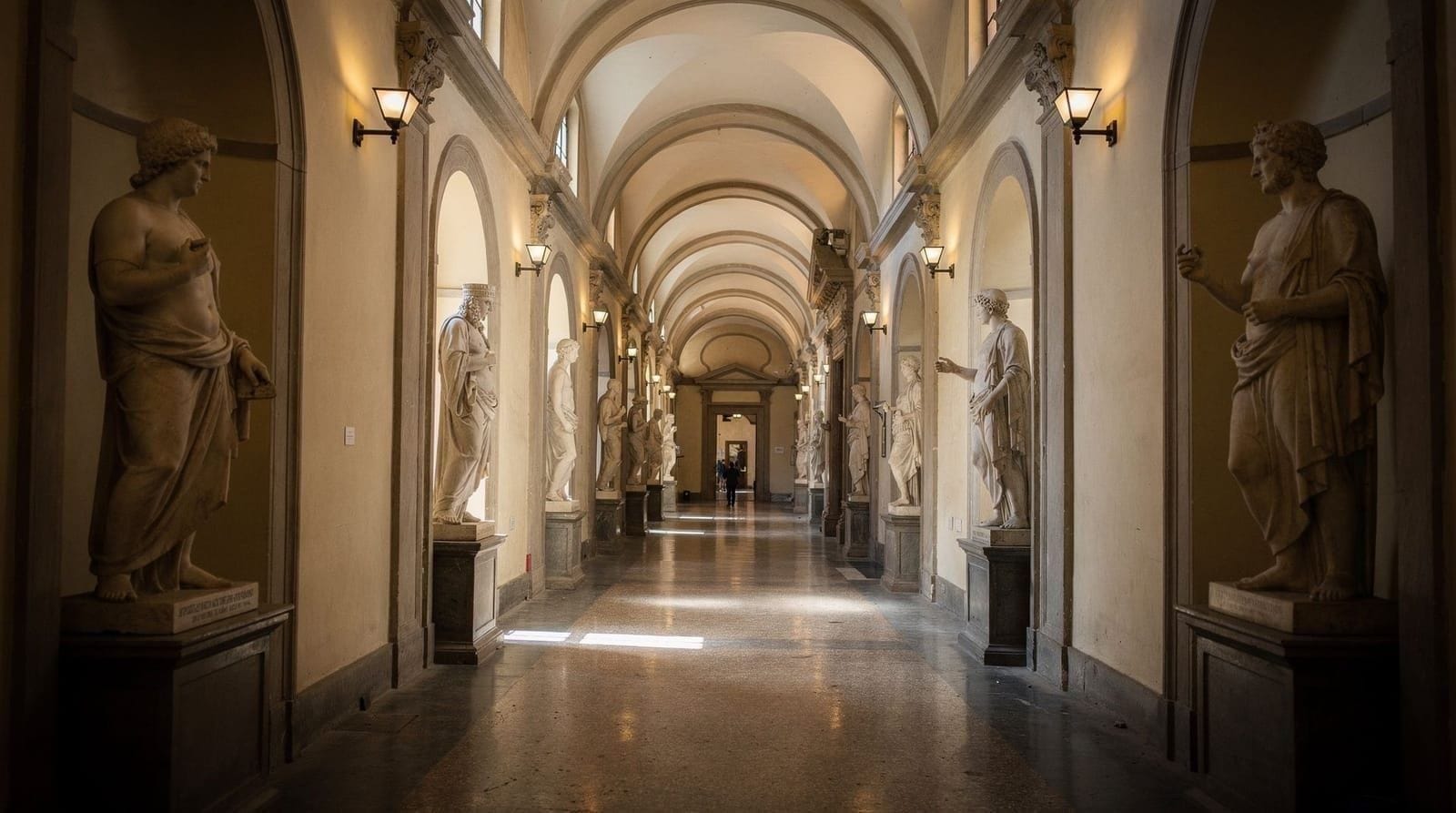
Palazzo Vecchio is Florence's 13th-century fortified town hall, still used as the city's seat of government. Visitors can tour the Salone dei Cinquecento (a vast frescoed hall), the private apartments of Eleanor of Toledo, the Studiolo of Francesco I, secret passages, and climb the Torre dell'Arnolfo for panoramic views over Florence.
Palazzo Vecchio has a unique distinction among Florence’s major monuments: it’s still a working government building. The Comune di Firenze — Florence’s city council — meets here. Municipal offices occupy the upper floors. And yet the ground and first floors are fully open to visitors, revealing one of the most extraordinary interiors in Italy.
The Palazzo Vecchio is older than the Uffizi, grander than the Bargello, and architecturally more characterful than almost anything in the city. Its crenellated tower — 95 metres of medieval stone — dominates the Piazza della Signoria. Inside, the state rooms commissioned by Cosimo I de’ Medici in the mid-16th century represent one of the most ambitious interior decoration programs in Renaissance history.
| Where | Piazza della Signoria, 2 min from the Uffizi |
| Cost | Around €12.50 + €3 booking fee; tower climb extra |
| Time needed | 60–90 min minimum; 2+ hours with tower and secret passages |
| Getting there | Central, walkable from anywhere in the historic centre; ZTL zone |
| Best time | Weekday evening (open late) for fewer crowds |
Essential visitor information
| Detail | Information |
|---|---|
| Address | Piazza della Signoria, Florence — 2 minutes from the Uffizi, opposite the Loggia dei Lanzi |
| Hours | Saturday–Wednesday 9:00 am – 11:00 pm; Thursday 9:00 am – 2:00 pm (hours vary seasonally — check musefirenze.it) |
| Tickets | Standard museum entry around €12.50 + €3 booking fee; tower extra; combined options available |
| Time needed | 60–90 minutes minimum; 2+ hours with tower and/or secret passages |
| Getting there | Central location in Piazza della Signoria; ZTL zone applies |
Note: the Palazzo Vecchio has unusually late hours compared to most Florence museums. This makes it an excellent option for an evening visit in summer, when the frescoed halls are lit dramatically and visitor numbers drop significantly.
The architecture
The palazzo was begun in 1299 by Arnolfo di Cambio as the seat of the Signoria — Florence’s merchant-dominated city government. The design is deliberately asymmetrical (the tower is off-centre) because it was built over an existing tower belonging to the Foraboschi family, which couldn’t be demolished.
The exterior — massive rusticated stone with medieval battlements, the projecting loggia at the top of the tower, the clock — represents the Florentine Republican aesthetic: civic power expressed as a fortified stronghold, immovable and permanent. The building communicates: this is the city’s, and it will endure.
When Cosimo I de’ Medici made Florence a duchy in 1537 and moved his court from the Medici Palace to the Palazzo Vecchio, he commissioned Giorgio Vasari to transform the interior into a ducal palace worthy of his new status. The result is what visitors see today.
The Salone dei Cinquecento
The Hall of the Five Hundred is one of the most impressive interior spaces in Italy. Built in 1494 for the Great Council of the Florentine Republic (literally designed to hold 500 citizens), it was later appropriated by Cosimo I and decorated by Vasari with an extensive cycle of battle frescoes celebrating Florentine military victories over Siena and Pisa.
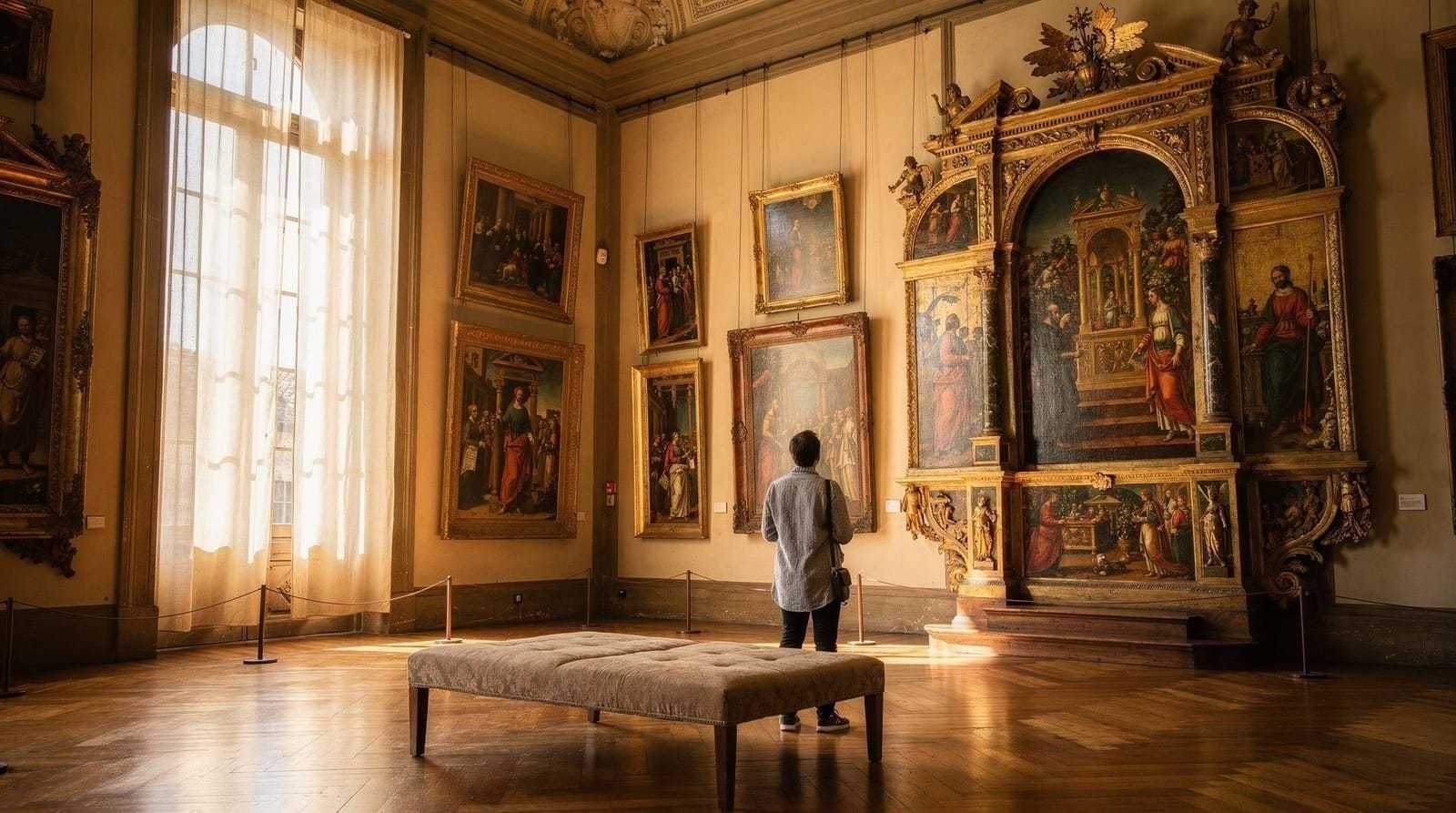
The paintings are enormous — each battle scene covers an entire wall section, 8–10 metres high. The painted coffered ceiling (1563–1565) by Vasari and his workshop is a tour de force of illusionistic painting depicting the apotheosis of Cosimo I.
The lost Leonardo
The Salone dei Cinquecento contains one of art history’s great mysteries. In 1503, Leonardo da Vinci was commissioned to paint the Battle of Anghiari on the east wall — a companion to Michelangelo’s Battle of Cascina on the opposite wall (neither was completed). Leonardo began the work using an experimental encaustic technique that failed; he abandoned it and left Florence.
When Vasari painted his battle frescoes over the east wall in the 1560s, he might have plastered over the remnants of Leonardo’s unfinished work — or he might have deliberately left a protective gap. In the early 21st century, art historian Maurizio Seracini led a project using radar and sampling tools to test whether Leonardo’s original survives behind Vasari’s panel. The investigation was inconclusive and politically complicated. The question remains open.
Vasari reportedly added the words “Cerca, trova” (seek and find) in tiny letters into one of his battle scenes. This detail, visible only on close inspection, is widely interpreted as a clue pointing to the hidden Leonardo.
Michelangelo’s Genius of Victory
On the north wall of the Salone stands Michelangelo’s Genius of Victory — a massive marble group intended for the tomb of Pope Julius II and never installed there. The twisted figure of the victor over a crouching, bearded older man is one of Michelangelo’s most powerful mature works, and it stands here somewhat accidentally, given to the city by Michelangelo’s nephew after the sculptor’s death.
The Studiolo of Francesco I
This tiny, entirely windowless room off the Salone is one of the most extraordinary spaces in the Renaissance. Built as a private study for Francesco I de’ Medici (Cosimo’s son) in 1570–1575, it is completely covered — walls, ceiling, even the hidden storage cabinets behind the paintings — in allegorical paintings by Vasari and his collaborators.
The room measures approximately 3 by 7 metres. Every surface is painted. The cabinet doors conceal storage for Francesco’s private collection of scientific curiosities, natural wonders, and gems. The iconographic programme involves the four elements (earth, water, air, fire) and their relationship to alchemy and natural philosophy.
The Studiolo is one of the great examples of Mannerist interior design — dense, erudite, somewhat claustrophobic, and magnificent. Because it’s tucked off the main Salone route and unmarked from outside, many visitors on a first, unguided visit miss it entirely — it’s worth actively looking for the discreet doorway rather than assuming the Salone is the whole tour.
The apartments of Eleanor of Toledo
Eleanor of Toledo, wife of Cosimo I, had her private apartments in the palazzo. These rooms — the Green Room, the Chapel of Eleanor, the Ercole Room, and others — are among the most lavishly decorated in the building.
The Chapel of Eleanor (c. 1540–1545) was painted by Agnolo Bronzino with scenes from the life of Moses in his characteristic cold, perfect, almost eerie style. The polished figures, pale flesh, and metallic drapery make Bronzino’s work immediately recognizable and somewhat alien to modern eyes — art historical shorthand for the anxiety underlying the perfection of Mannerism.
The Map Room (Sala delle Carte Geografiche)
One of the strangest and most fascinating rooms in the building. Built for Cosimo I in 1563, the room is lined with 53 large painted maps — one for each identifiable part of the world as known at the time, including speculative maps of the polar regions and the American interior. The maps were painted by the Dominican friar Egnazio Danti, the foremost cosmographer of his age.
A massive astronomical sphere in the centre of the room was designed so that it could function as a cosmological model. The room was conceived as a literal world map that you could stand inside — a Renaissance library of global knowledge made physical.
The Map Room is easy to walk past quickly, since it lacks the immediate visual drama of the Salone or the Studiolo’s density, but it repays a slow look: individual maps show the Americas still being sketched in with speculative coastlines, and comparing the confident detail of the Mediterranean against the vague blanks further west is a striking way to see how European geographic knowledge actually expanded during the 16th century.
The Torre dell’Arnolfo
The 95-metre tower is climbable via approximately 200 steps. The views from the top are excellent: the Duomo dome, the surrounding hills, and — looking straight down — the copy of Michelangelo’s David in the piazza below.
The tower also offers the best view of the architectural logic of the Palazzo Vecchio itself — the asymmetrical facade, the projecting battlements, the relationship between the civic building and the piazza. Allow 30 minutes including the climb and descent.
Note: the tower has a narrow staircase and limited space at the top. Not suitable for visitors with mobility limitations or significant claustrophobia.
Secret passages and hidden tours
The palazzo’s thick medieval walls contain a network of hidden passageways, service staircases, and concealed rooms that enabled the Medici dukes to move through the building unseen. Separate guided “Secret Routes” tours explore these spaces, including:
- A hidden staircase behind a fireplace
- The narrow passage above the Salone dei Cinquecento’s decorated ceiling
- Access points to roof spaces with views
These tours must be booked separately and are particularly popular with children and visitors interested in architecture and political history. Duration approximately 60 minutes; small groups only.
Evening visits
The Palazzo Vecchio’s late hours (until 11:00 pm most evenings) make it one of the best options for an atmospheric evening visit in Florence. The state rooms lit at night, with fewer crowds, have a quality quite different from a daytime visit. The adjacent Piazza della Signoria is also one of the most beautiful and animated public spaces in Italy on a summer evening.
After the Palazzo Vecchio
The Piazza della Signoria location means you are essentially surrounded by other major attractions:
- The Uffizi Gallery: directly adjacent to the south
- Loggia dei Lanzi: under the open arches of the piazza, with original sculptures including Cellini’s Perseus and Giambologna’s Rape of the Sabine Women (free to view)
- Bargello Museum: 5-minute walk
- Piazza della Repubblica: 5-minute walk north
The Bargello in particular pairs naturally with Palazzo Vecchio: both are civic buildings turned museums, both hold major Donatello and Michelangelo works, and both are consistently far quieter than the Uffizi. Visitors doing a sculpture-focused day sometimes prefer this pairing to the painting-heavy Uffizi altogether.
Photographing the interior
Photography without flash is generally permitted in the Salone dei Cinquecento and most of the state rooms, though rules can vary by exhibition. Flash is discouraged throughout to protect the frescoes and paintings. The Salone’s scale makes a wide-angle lens useful if you have one; otherwise, standing near the entrance doorway gives the best full-room perspective of Vasari’s ceiling. The Studiolo is small and often crowded — be patient and courteous with other visitors trying to see the same walls.
Related guides
- Uffizi Gallery: complete visitor guide
- Bargello Museum guide
- Best museums in Florence
- Is the Firenzecard worth it?
- Skip-the-line guide for Florence
Frequently asked questions about Palazzo Vecchio
Is Palazzo Vecchio free to visit?
The exterior and the adjacent Loggia dei Lanzi are free. Museum admission to the interior is €12.50 (plus booking fee online). The Torre dell’Arnolfo climb costs extra (approximately €4). Firenzecard holders enter free.
Is Palazzo Vecchio the same as Palazzo della Signoria?
Yes. The building has had several names over its history. It was originally the Palazzo della Signoria (referring to the civic government). It became the Palazzo Ducale when Cosimo I moved in. It was renamed Palazzo Vecchio (Old Palace) when the Medici moved to the Pitti Palace across the river, leaving this the old, or previous, residence.
Does Palazzo Vecchio have a restaurant?
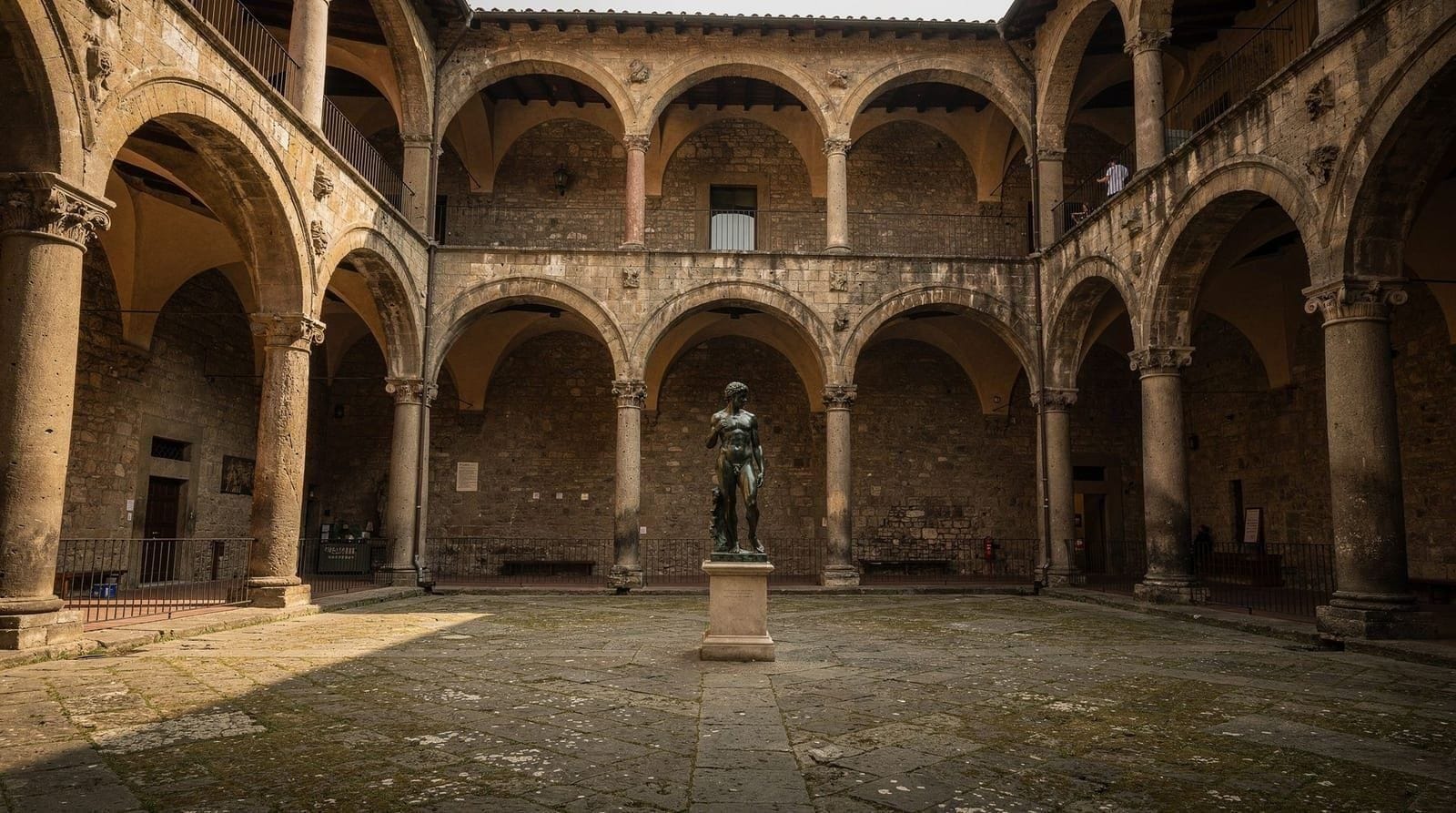
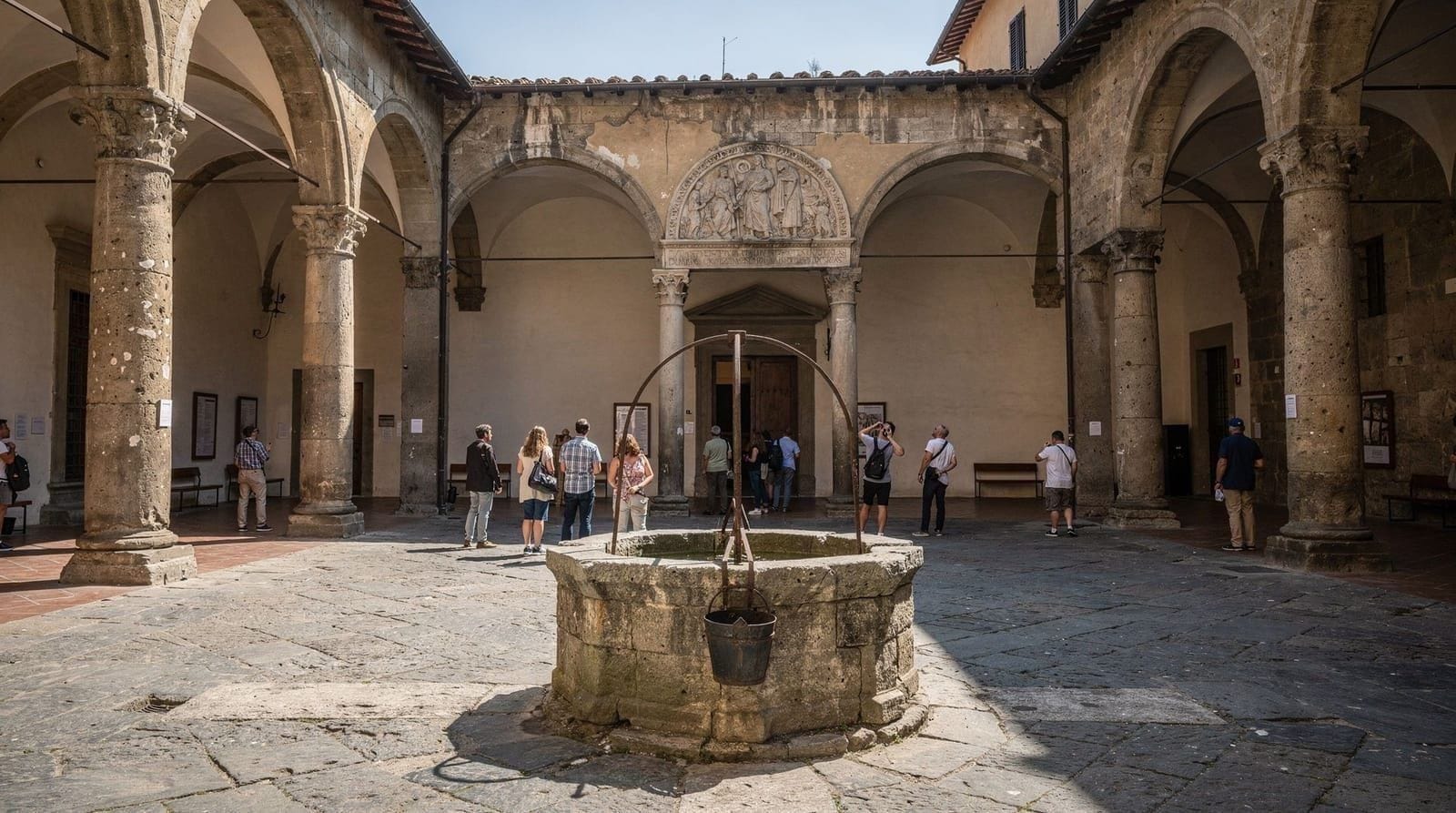
There is a café inside the courtyard that is open during museum hours. The courtyard itself — a beautifully arcaded 15th-century space with a porphyry fountain in the centre — is one of the more pleasant places in central Florence for a coffee.
What is the Arnolfian tower’s historical significance?
The Torre dell’Arnolfo (named after the building’s architect Arnolfo di Cambio) was built as a civic clock and bell tower. Its bells marked civic time for centuries. The original bells were melted down and recast multiple times. The current bell is a 19th-century replacement.
The political context: what Palazzo Vecchio represents
Understanding the Palazzo Vecchio’s significance requires understanding what it was built for and what it became — the gap between these two purposes is the central tension that gives the building its character.
The Republican building (1299–1537): Arnolfo di Cambio designed the Palazzo della Signoria as the seat of the Priori delle Arti — the nine rotating magistrates who governed Florence in two-month terms. The building was specifically designed as a civic fortress: the massive walls, the projecting battlements, the deliberately asymmetrical tower all communicated strength, permanence, and collective authority. No single family was supposed to dominate this space. The asymmetry of the tower was partly structural (built over existing foundations) but also deliberately symbolic — a rejection of dynastic architecture’s bilateral perfection.
For nearly 250 years, the Palazzo della Signoria functioned as this Republican civic ideal imagined: a rotating magistracy served here, debated here, voted here. The large halls were designed for collective governance. The architecture embodied a specific political theory: that Florence was governed by its merchant guilds, not by hereditary aristocracy.
The Ducal takeover (1537 onwards): When Cosimo I de’ Medici became Duke of Florence, he moved into the Palazzo della Signoria and immediately commissioned Vasari to transform it into a ducal palace. The Republican civic spaces became aristocratic show rooms. The Salone dei Cinquecento — literally designed for 500 citizens to deliberate — became a space for military triumphs and ducal glorification. The Map Room collected the world’s knowledge for the Duke’s private viewing. The Studiolo enclosed the Duke’s private scientific collection.
The building’s new name — Palazzo Vecchio, Old Palace — was coined after Cosimo moved to the Pitti Palace in 1549. The name contains the slight contempt of someone who has moved on: this is the old place, the one we used to use.
What you see today is both things simultaneously: the Republican civic building and the Ducal overlay. The tension is legible in every room, which is part of what makes the Palazzo Vecchio more historically interesting than a purely Renaissance aesthetic object.
The Piazza della Signoria: the outdoor museum
The piazza in front of the Palazzo Vecchio is one of the world’s great public art spaces, and it’s free. A complete survey of the piazza and Loggia dei Lanzi:
Neptune Fountain (1565): By Bartolomeo Ammannati, with assistance from Giambologna. The central Neptune figure was widely mocked by Florentines at its unveiling — Michelangelo allegedly said “what beautiful marble you have ruined.” The bronze figures around the base are considerably more successful.
Donatello’s Judith and Holofernes (copy): The outdoor copy of Donatello’s bronze shows Judith raising her sword to sever Holofernes’ head. The composition’s asymmetry — Holofernes slumped below, Judith above — makes it work in the round, equally powerful from any angle.
Michelangelo’s David (copy): See above.
Loggia dei Lanzi: The open arched loggia to the right of the Palazzo Vecchio was built in 1376–1382 for public ceremonies. It now houses a permanent outdoor exhibition of original sculptures:
- Perseus by Cellini (1554, bronze, original): The commission Cosimo I made to prove Florence’s technical superiority. Perseus holds Medusa’s head; blood (cast in bronze) gushes from the neck. The base includes small bronze scenes and portrait heads of mythological figures.
- Rape of the Sabine Women by Giambologna (1583, marble, original): The spiral compositional logic of this group — three figures twisted in three different directions that resolve into coherent from every angle — is a masterpiece of Mannerist sculpture. Carved from a single block of marble.
- Hercules and the Centaur by Giambologna (1599, marble, original): A more aggressive work than the Sabines, showing Hercules crushing Nessus the centaur.
- Various Roman-era sculptures: Lions, reliefs, and portrait busts accumulated over the piazza’s history.
Spend 20 minutes in the Loggia before or after your Palazzo Vecchio visit. These works are accessible with no queue, no ticket, and at any hour.
Evening events and night visits
The Palazzo Vecchio’s late opening hours (until 11:00 pm most evenings) make it unusual among Florence’s major museums. The evening crowds are thinner than daytime, the frescoed rooms are lit differently (artificially, which changes the colour temperature of the paintings), and the piazza outside is at its most animated.
Summer evening events at Palazzo Vecchio have included theatrical performances, special guided tours, and events tied to the museum’s educational programme. Check musefirenze.it for the current programme if you’re visiting in summer.
The combination of an evening museum visit at Palazzo Vecchio followed by dinner in the neighbourhood is one of Florence’s better ways to spend a summer evening when museum days feel too structured.
Palazzo Vecchio vs the other Piazza della Signoria sights
| Sight | Cost | Best for |
|---|---|---|
| Palazzo Vecchio museum | Around €12.50 | Frescoed state rooms, the lost-Leonardo mystery, Medici history |
| Torre dell’Arnolfo climb | Around €10 extra | Panoramic views over the Duomo dome and the piazza |
| Loggia dei Lanzi | Free | Outdoor Renaissance sculpture — Cellini’s Perseus, Giambologna’s Sabines |
| Uffizi Gallery (adjacent) | Separate ticket, book ahead | The definitive Italian painting collection |
For most first-time visitors, the museum plus a look inside the Loggia is enough; the tower is worth adding if you have 30 spare minutes and don’t mind stairs. See the Uffizi Gallery guide for pairing the two in one day, and the skip-the-line guide for booking strategy across both.
Kids and accessibility
The Salone dei Cinquecento’s scale and the secret passages tour tend to hold children’s attention better than a conventional picture gallery — the hidden staircases and the lost-Leonardo story give the visit a treasure-hunt quality. The tower is less suitable for young children or anyone uneasy with narrow, enclosed stairs; skip it with a stroller or if claustrophobia is a concern. The ground-floor courtyard and Salone are step-free, but the upper apartments and tower are not lift-accessible — check current provisions with the museum before visiting if mobility is a concern.
Top experiences
Bookable activities with verified prices and instant confirmation on GetYourGuide.

Florence: Palazzo Vecchio entrance ticket with audioguide
- Instant confirmation
- Mobile ticket
Florence: Palazzo Vecchio museum and tower private tour
- Free cancellation
Florence: Medici's secret path from Palazzo Vecchio to Uffizi
- Small group
- Free cancellation
Florence: walking tour
- Free cancellation
- Instant confirmation