How to see Michelangelo's David without queuing for hours
| Where | Galleria dell’Accademia, Via Ricasoli, Florence |
| Time needed | 60–90 minutes for the museum |
| Cost | Around €24 direct booking; €55–90 for a guided skip-the-line tour |
| Getting there | 10-minute walk from the Duomo |
| Best time | The first slot of the day, around 9am |
The queue situation at the Accademia is genuine
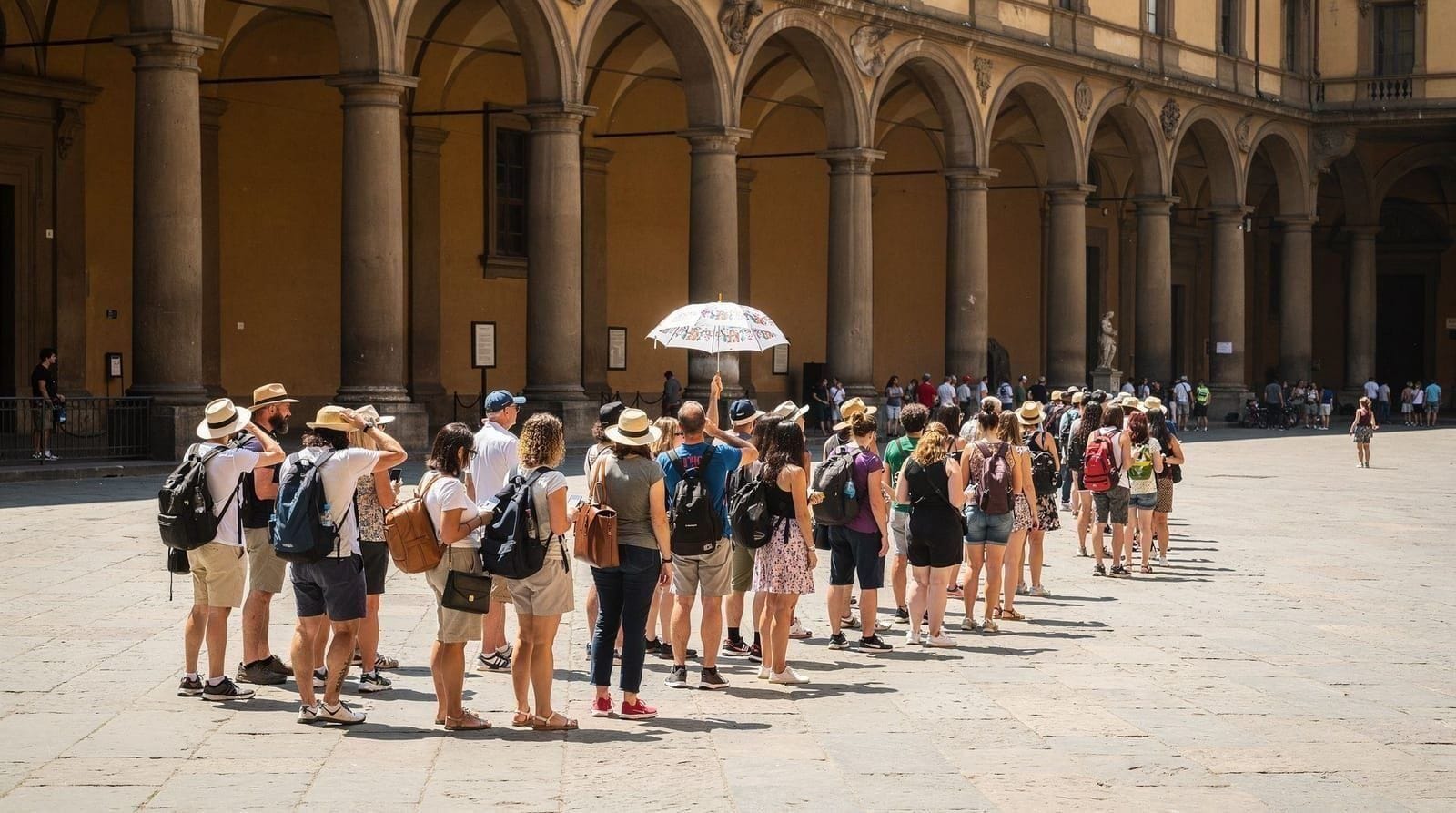
Let’s begin with the honest reality: the Galleria dell’Accademia in Florence attracts more than 1.7 million visitors per year, and the entrance is a single narrow doorway on Via Ricasoli. Without a pre-booked timed-entry ticket, you’re joining a queue that regularly runs two to three hours in peak season (April through October), and sometimes longer on weekends or Italian public holidays.
I’ve done it both ways. Once, early in my Florence visits, I stood in that queue for two hours and forty minutes on a Tuesday morning in July. When I finally walked in, I was sunburned, hungry, and so frustrated that it took a full five minutes standing in front of the David to feel anything other than relief that the waiting was over.
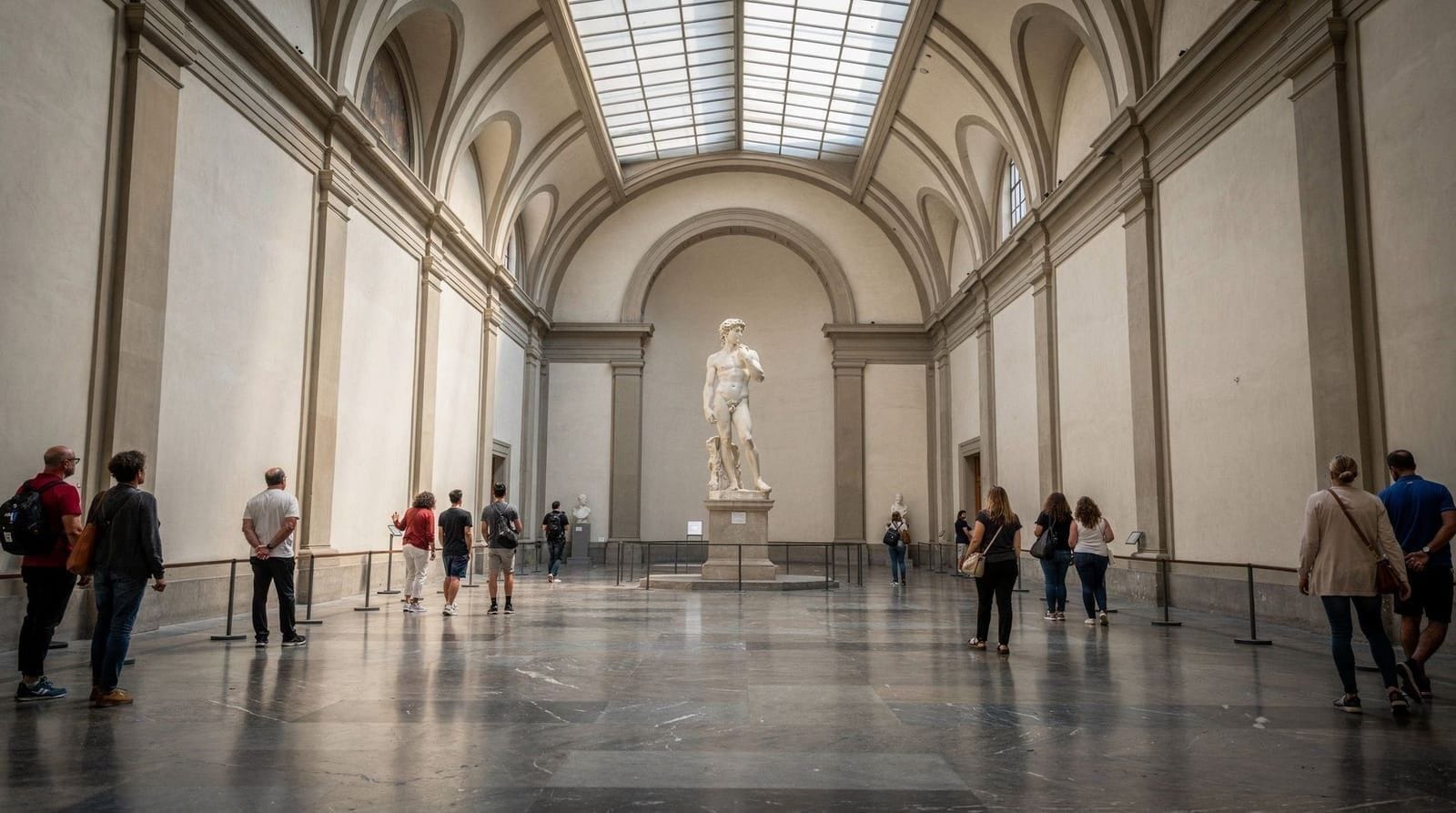
The second time, I booked online three weeks in advance, walked past the queue to a separate entrance, and was standing in front of Michelangelo’s David within four minutes of arriving. That experience is objectively better.
Here is how to replicate it.
Option 1: Book directly through the official Accademia website
The cheapest and most straightforward option. The Accademia sells timed-entry tickets through its official booking site for €20 (admission) plus a €4 advance booking fee, totalling €24 per adult. Children under 18 from EU member states are admitted free; under-18s from outside the EU pay €2.
Go to: uffizi.it — the Uffizi manages booking for both museums.
Timeslots run every fifteen minutes throughout the day. In high season, slots sell out weeks in advance; I’ve seen the full month of July gone by the beginning of June. In shoulder season (November through February), booking a week in advance is usually sufficient. In spring and early autumn, aim for two to three weeks.
Tips for the official site:
- Book at least one month ahead for June, July, August, and September.
- The 9 a.m. slot is the least crowded of the day; the period between 10:30 a.m. and 1 p.m. is the busiest.
- Have your payment card ready before you start — slots can disappear mid-transaction.
- The confirmation email is your ticket; you’ll need it on your phone or printed.
Option 2: Skip-the-line ticket with audio guide
Several reputable operators sell pre-booked timed-entry tickets that include an audio app or audio guide, at a modest premium over the direct booking price. These run €28–35 and are useful if you want more context than the limited museum signage provides — the Accademia has surprisingly sparse interpretation given the quality of the collection.
This works exactly the same as the direct booking in terms of queue-skipping: you arrive at the designated time, present your confirmation, and enter through the fast-track lane. The difference is you’ll have a device or app providing commentary as you move through the museum.
Option 3: Small-group guided tour with skip-the-line entry
The most expensive but arguably most rewarding option, especially on a first visit. A small-group guided tour (typically six to twelve people) includes pre-booked entry, a specialist guide, and usually around 90 minutes to two hours inside the museum with expert commentary.
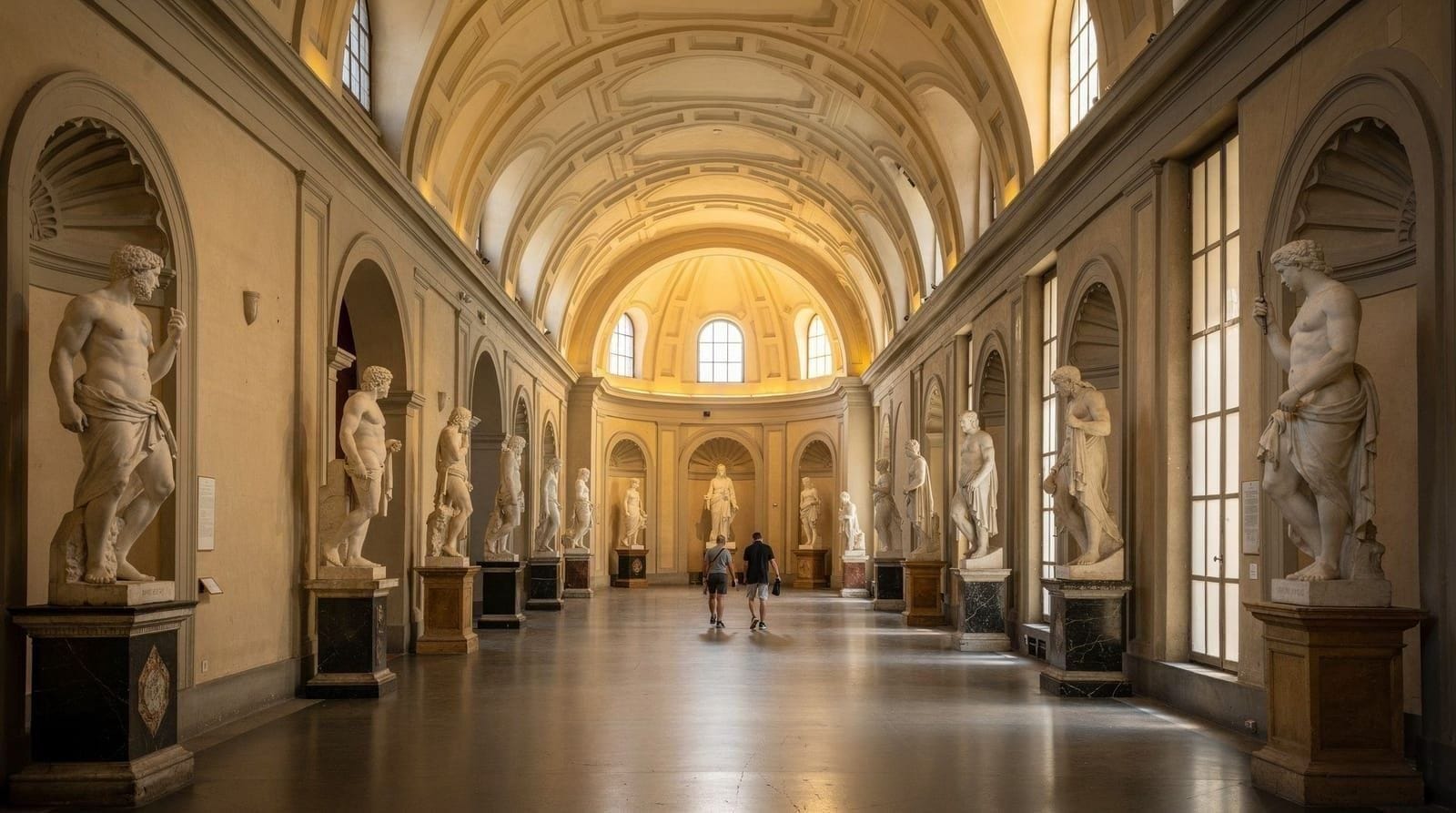
A good guide changes the Accademia experience significantly. The David is the obvious centrepiece, but the museum also contains Michelangelo’s unfinished Prisoners (the four enslaved figures caught in various states of emergence from the stone), a collection of Renaissance panel paintings including Botticelli, and medieval Byzantine works that provide context for what the Renaissance was reacting against.
Without guidance, most visitors spend 20–30 minutes in the Accademia, see the David, and leave. With a guide, the same visit takes 90 minutes and you understand far more about why Michelangelo’s approach to sculpture was historically radical.
Guided tours from reputable operators run €55–90 per person including entry.
Option 4: Combined Uffizi and Accademia tours
If you’re planning to visit both major museums, combined day tours are available that cover both the Uffizi in the morning and the Accademia in the afternoon (or vice versa) with a guide and skip-the-line entry to both. These run €80–130 per person and are excellent value compared to booking each separately, particularly if you want guided context for both.
The Uffizi vs Accademia guide covers the case for prioritising one over the other if time is short — the Uffizi is the larger and (most would argue) more significant collection, but the David is the more iconic single object. Most first-time visitors to Florence should see both if possible.
What to see beyond the David
The David is the reason most people visit. Michelangelo completed it in 1504, when he was 29 years old, and it stood in Piazza della Signoria until 1873 when it was moved to the Accademia for protection. The outdoor replica in the piazza is what you see today; the original is here.
The statistics are almost meaninglessly large: 5.17 metres tall, 5,660 kilograms, carved from a single block of Carrara marble that another sculptor had already partially worked on and abandoned. What those numbers don’t convey is the veins in his hands, the tension in the neck, the slight leftward turn of his gaze. You can see the marks of Michelangelo’s tools in the marble. That proximity is the point.
Beyond the David, spend time with:
The Prisoners (or Slaves): Four unfinished figures intended for the tomb of Pope Julius II. Michelangelo left them in various states of emergence — you can see a shoulder, a torso, a knee still half-submerged in stone. Some argue these were deliberately unfinished as an artistic statement; others believe they were simply never completed. Either way, they’re among the most philosophically interesting things in any museum anywhere.
The Colossus of Giambologna: A large plaster cast of the figure that later became the marble Appennino in the garden at Pratolino. Less discussed than the Michelangelos, but fascinating for anyone interested in Mannerist sculpture.
The San Marco room: A collection of 14th-century Byzantine-style altarpieces and panel paintings. Comparing these to the works Florentine artists made a century later illustrates the Renaissance revolution more clearly than any textbook description.
Practical details for the visit
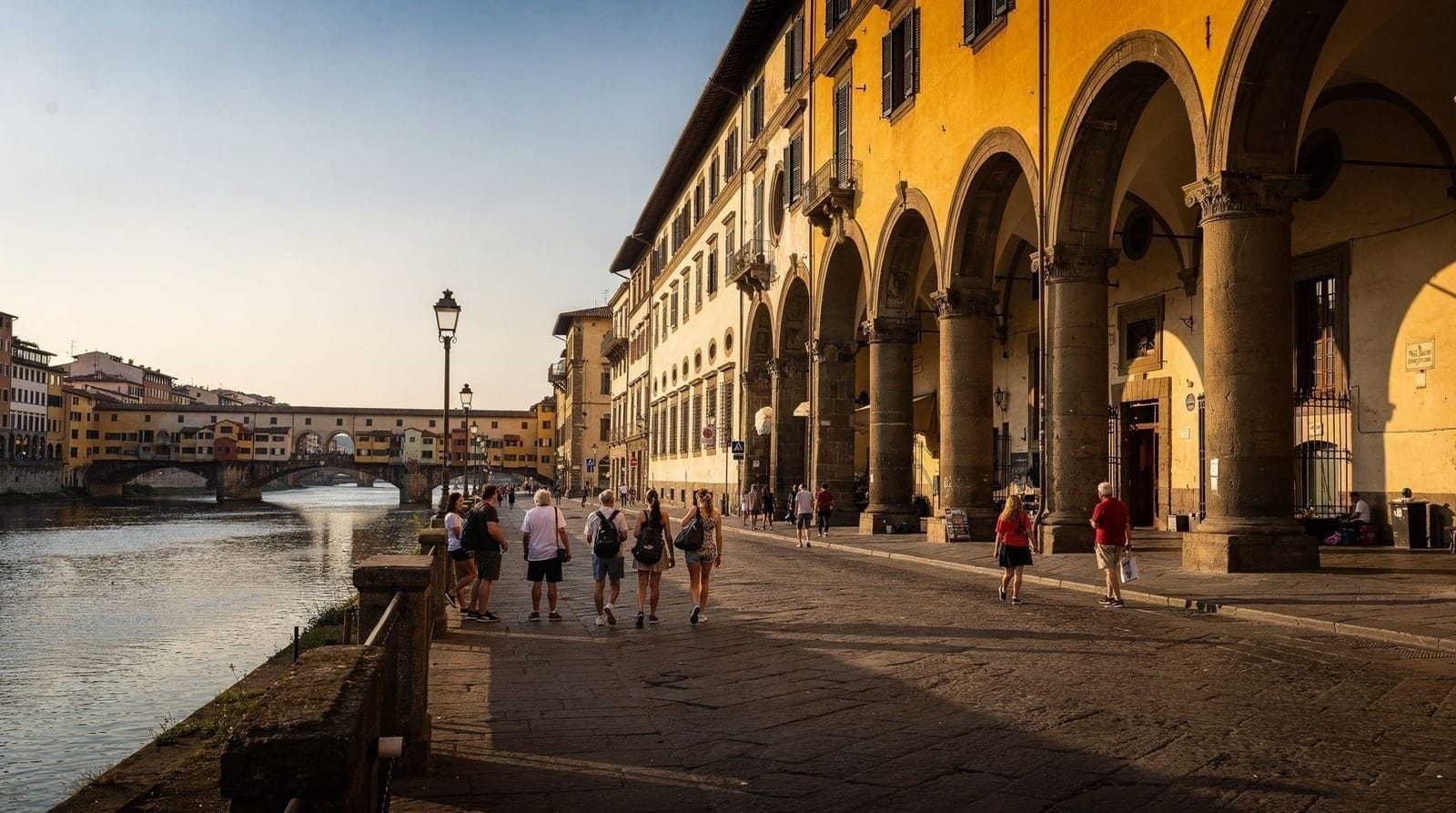
The Accademia is on Via Ricasoli, a straight street running north from the Duomo to Piazza della Santissima Annunziata. It’s about a 10-minute walk from the Duomo and eight minutes from the train station.
- Opening hours: 8:15 a.m. – 6:50 p.m., Tuesday through Sunday. Closed Monday.
- The Accademia is closed on 1 January, 25 December, and the first Sunday of every month (which is otherwise free entry day — long queues, avoid unless you’re committed).
- Photography is permitted without flash. Selfie sticks are not allowed.
- The museum has a cloakroom for large bags and backpacks; these must be left before entering the gallery.
- The gift shop at the exit is genuinely good — Accademia-licensed reproductions of works and a well-curated selection of art history books.
What not to do
Do not try to buy tickets at the door. The walk-in queue in summer is brutal and genuinely miserable. Two to three hours of standing in the sun on a narrow pavement, moving six inches at a time, with no shade and no guarantee of entry before closing time, is not how you want to spend a morning in Florence.
Do not confuse the Accademia with any of the other institutions that use the word “academia” in their name. There are at least two other organisations in Florence with similar names. You want the Galleria dell’Accademia on Via Ricasoli 58–60.
Do not rush. The temptation, after queuing or even after a fast-track entry, is to beeline for the David, look at it for ten minutes, and leave. Budget at least ninety minutes. If you have a guide, follow them through the rooms in sequence — the museum is designed to build toward the David’s gallery as a culmination.
How to combine the Accademia with the rest of the day
The Accademia is compact and most visits run 60–90 minutes. A logical day: start at the Accademia at 9 a.m. (first slot, quietest time), finish by 10:30, walk to the Duomo and Baptistery for the exterior and the free interior, lunch in the Sant’Ambrogio market neighbourhood (20 minutes’ walk from both), and use the afternoon for the Uffizi if you’ve pre-booked it.
The how many days in Florence guide and the skip-the-line guide both cover how to sequence the major museums across a multi-day visit. The Accademia full guide covers the collection in more depth.
Frequently asked questions about visiting the Accademia
How much do Accademia tickets cost?
The admission price is €20 for adults, with a €4 online booking fee bringing the total to €24. Under-18s from EU countries enter free. Under-18s from outside the EU pay €2. There are reduced rates for certain EU citizens aged 18–25.
How long does a visit to the Accademia take?
Without a guide: 45–75 minutes is typical for most visitors. With a guided tour: 90–120 minutes. The museum is not large; it’s the depth of engagement with individual works that determines the length.
Is the Accademia or the Uffizi more important?
Different things. The Accademia has the David, the Prisoners, and a focused Renaissance and medieval collection. The Uffizi has the world’s greatest collection of Italian Renaissance painting — Botticelli, Leonardo, Raphael, Titian, Giotto, Michelangelo’s only panel painting — across 50,000 square metres. If you can only choose one: the Uffizi. If you can do both: do both.
Can I bring a baby or young children?
Yes. The Accademia is pram-accessible. Young children find the David impressive in the way that genuinely enormous things are impressive to people who are not yet jaded by enormous things. The museum is not huge, which keeps the visit manageable for children.
Is the walk-in queue ever worth risking instead of booking ahead?
Rarely. Even in shoulder season, a walk-in wait of 45–90 minutes is common, and in peak months it regularly stretches past two hours. Booking a timed slot online costs a small fee but removes the single biggest source of wasted time and frustration in a Florence itinerary. The only scenario where a walk-in might make sense is a spontaneous visit on a quiet weekday in deep winter, and even then it’s a gamble.
What happens if I arrive late for my timed-entry slot?
Most tickets allow a grace period of around 15–30 minutes after the printed time, but arriving significantly late risks being turned away or pushed to a later, less convenient slot if space allows. Aim to arrive 10–15 minutes before your slot rather than exactly on time, since there’s often a short wait even with a booking.
Comparing your four booking options
| Option | Cost per person | Best for |
|---|---|---|
| Official Accademia website | ~€24 | Budget-conscious visitors who don’t need context |
| Skip-the-line ticket with audio guide | €28–35 | Independent visitors who want commentary |
| Small-group guided tour | €55–90 | First-timers who want expert context on the collection |
| Combined Uffizi and Accademia tour | €80–130 | Visitors seeing both museums in one day |
For most first-time visitors, the small-group guided tour offers the best balance of cost and depth — it converts a 20-minute walk-past into a 90-minute experience that actually explains why the Prisoners and the David matter. Budget travellers who’ve done some reading beforehand do perfectly well with the direct-booking option.
Top experiences
Bookable activities with verified prices and instant confirmation on GetYourGuide.