Arezzo
Arezzo: Piero della Francesca's Legend of the True Cross, antique market, Piazza Grande and medieval jousting. 40 minutes by train from Florence. Full
Florence: Siena, San Gimignano and Chianti day trip
- Free cancellation
- Hotel pickup
Quick facts
- Distance from Florence
- 80 km / 40-50 min by train
- Train cost
- €9-14 one-way
- Best for
- Piero della Francesca frescoes, antiques, Piazza Grande
- Budget
- €30-60/day
Piero della Francesca’s masterwork, 40 minutes from Florence
Arezzo is one of those Tuscan cities that earns its place on your itinerary through one undeniable attraction and then rewards you with several secondary ones. The primary attraction is the cycle of frescoes by Piero della Francesca in the Basilica of San Francesco — the Legend of the True Cross (1452-1466) — which many art historians consider the greatest fresco cycle of the Italian 15th century. Roberto Longhi, the critical intelligence who more than anyone re-established Piero’s reputation in the 20th century, wrote that Piero’s painting was so unlike anything else that it constituted its own category. The frescoes are extraordinary: geometric in organisation, luminous in colour, strange in emotional register, technically innovative in their handling of natural light.
Secondary attractions: the Piazza Grande, a sloping asymmetric medieval square flanked by Vasari’s loggia and the apse of the Pieve di Santa Maria; an excellent antique market on the first weekend of each month; Roman ruins; the Casa del Vasari (Giorgio Vasari, author of the Lives of the Artists, was Aretino-born); and the annual Giostra del Saracino (Jousting of the Saracen), a medieval tournament with genuine historical roots in the 13th century.
| Where | Arezzo, 80km southeast of Florence, eastern Tuscany |
| Cost | Around €30-60/day; Piero frescoes €12-15, other sights €4-6 each |
| Time needed | Full day (half-day if only the frescoes matter) |
| Getting there | Train 40-50 min (€9-14 one-way) or car ~55-60 min via A1 |
| Best time | April-October; first weekend of the month for the antique market |
Getting there from Florence
By train (recommended): Regular intercity and regional trains run from Florence Santa Maria Novella to Arezzo. Journey time: 40-50 minutes by intercity train (IC or Frecciabianca), 55-65 minutes by regional train. Cost: approximately €9-14 one-way depending on service type. Frequency: approximately every 30-45 minutes. Arezzo station is at the base of the historic centre; most sights are walkable from the station in 10-15 minutes.
By car: Take the A1 Autostrada south from Florence and exit at Arezzo. Journey approximately 55-60 minutes. Parking is available on the edge of the historic centre.
The Legend of the True Cross (Piero della Francesca)
Located in the Cappella Bacci of the Basilica of San Francesco (Piazza San Francesco, central Arezzo). The fresco cycle depicts episodes from the legend of the True Cross — the timber used for the cross — across 12 narrative scenes arranged on three walls of the chapel: the burial of Adam, the transfer of the wood that will become the cross, the queen of Sheba’s recognition of the sacred wood, the discovery of the cross by St Helena, the battle between Constantine and Maxentius.
The frescoes are unusual in Italian Renaissance painting for their muted palette (pale greens, ochres, soft blues, rather than the saturated colours typical of contemporaries), their interest in depicting natural light at specific times of day (dawn, noon, night), and the strange, slightly otherworldly stillness of Piero’s figures. They date to 1452-1466 and show signs of multiple campaigns and possible assistants, but the overall vision is unmistakably unified.
Visiting logistics: Entry to the chapel is by timed ticket and numbers are strictly limited. Booking in advance is required, particularly in summer and on weekends. Book online at pierodellafrancesca.it or at the basilica ticket office. Tickets approximately €12-15; unbooked visitors may find no availability on the day. The time-limited nature of the visit (approximately 30 minutes per group in the chapel) is appropriate — the frescoes demand sustained looking.
Piazza Grande
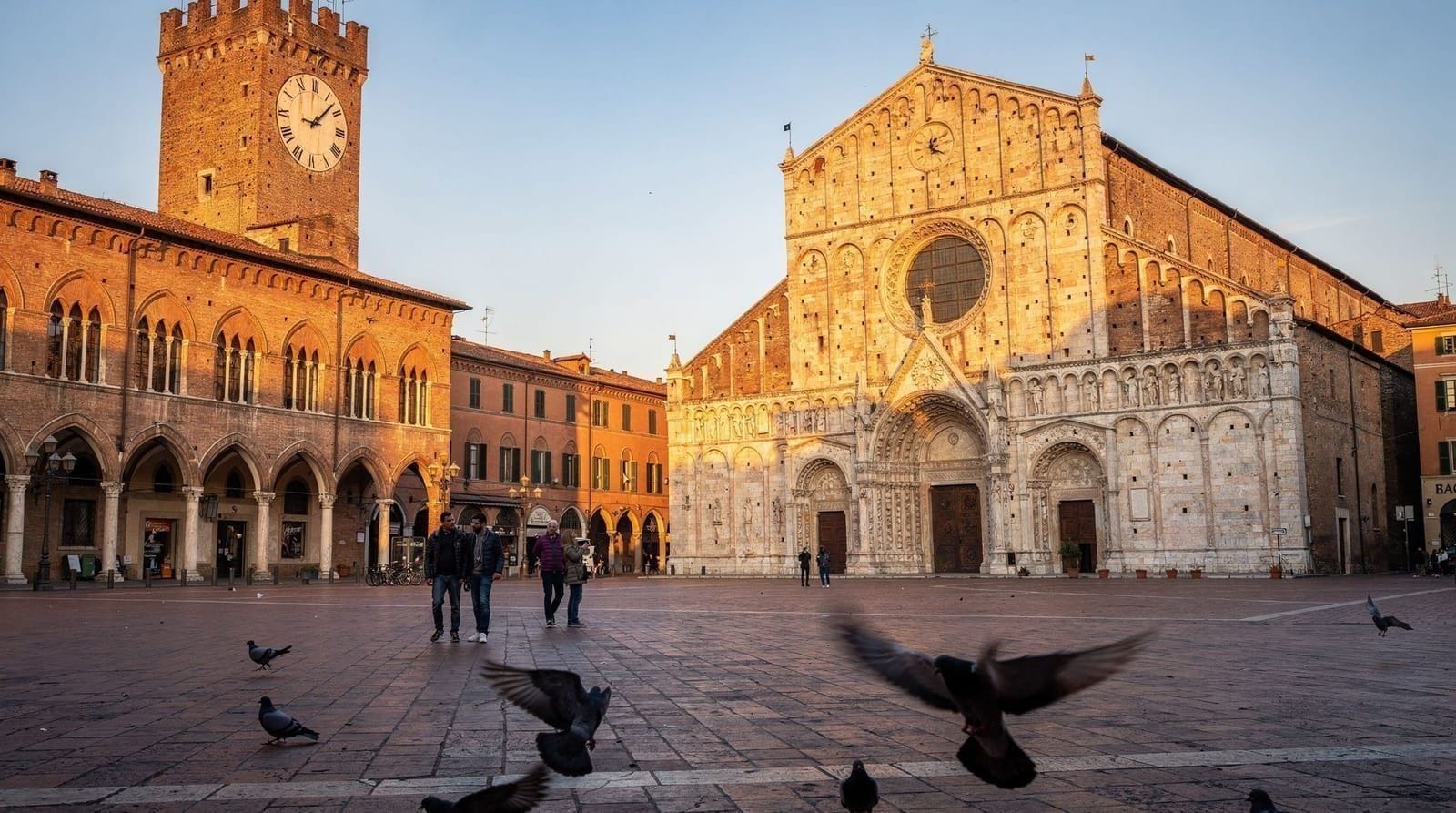
Arezzo’s main square is architecturally remarkable for its slope and its asymmetry — the conventions of flat, symmetrical Italian piazze are entirely absent. The piazza descends noticeably from west to east, framed by buildings of different periods: Vasari’s loggia on one side (1573, incorporating medieval tower bases), the apse and bell tower of the Pieve di Santa Maria on another (12th-13th centuries), the Palazzo della Fraternita dei Laici in the middle ages Gothic and Renaissance hybrid style, and the Palazzo del Comune with its medieval tower.
The Pieve di Santa Maria itself is one of the finest examples of Romanesque-Pisan architecture in Tuscany, with an elaborate blind arcade façade and an interior containing Lorenzetti’s polyptych of the Annunciation (1320). The bell tower, known as “the Tower of the Hundred Holes” (Torre delle Cento Buche) for its double-lancet windows, is one of Arezzo’s signatures.
The antique market (Fiera Antiquaria)
On the first Sunday and the Saturday preceding it of each month, the Piazza Grande fills with one of Italy’s largest and best antique markets — approximately 600 dealers from across Italy displaying furniture, paintings, ceramics, books, jewellery, objects and collectibles. The market has operated since 1968. Quality ranges from genuine antiques to collectible bric-a-brac; serious buyers come from across Europe. For non-buyers, it is one of the most interesting spectacles in Tuscany.
If timing a visit to Arezzo, the antique market weekend significantly enhances the experience. The piazza is transformed, and even casual browsers will find the variety and quantity extraordinary.
Casa Vasari
Giorgio Vasari (1511-1574), the Aretino painter, architect and author of the Lives of the Most Excellent Painters, Sculptors and Architects (the foundational text of art historical writing) was born in Arezzo and designed his own house here. The Casa del Vasari (Via XX Settembre 55) was decorated by Vasari himself with mythological and allegorical frescoes, and the rooms give an exceptional picture of how a successful 16th-century artist lived and thought. Admission approximately €4. Open mornings only (check current hours). A visit takes 30-45 minutes and is recommended for anyone with interest in Renaissance art culture.
Museo Nazionale d’Arte Medievale e Moderna
This museum in the Palazzo Bruni-Ciocchi holds a significant collection of medieval and Renaissance works including several more Piero della Francesca pieces (a polyptych of the Madonna), Spinello Aretino’s frescoes, and works by Signorelli, Vasari and others. A useful complement to the San Francesco chapel visit. Admission approximately €6; closed Mondays.
The Roman Amphitheatre and Museo Nazionale Archeologico
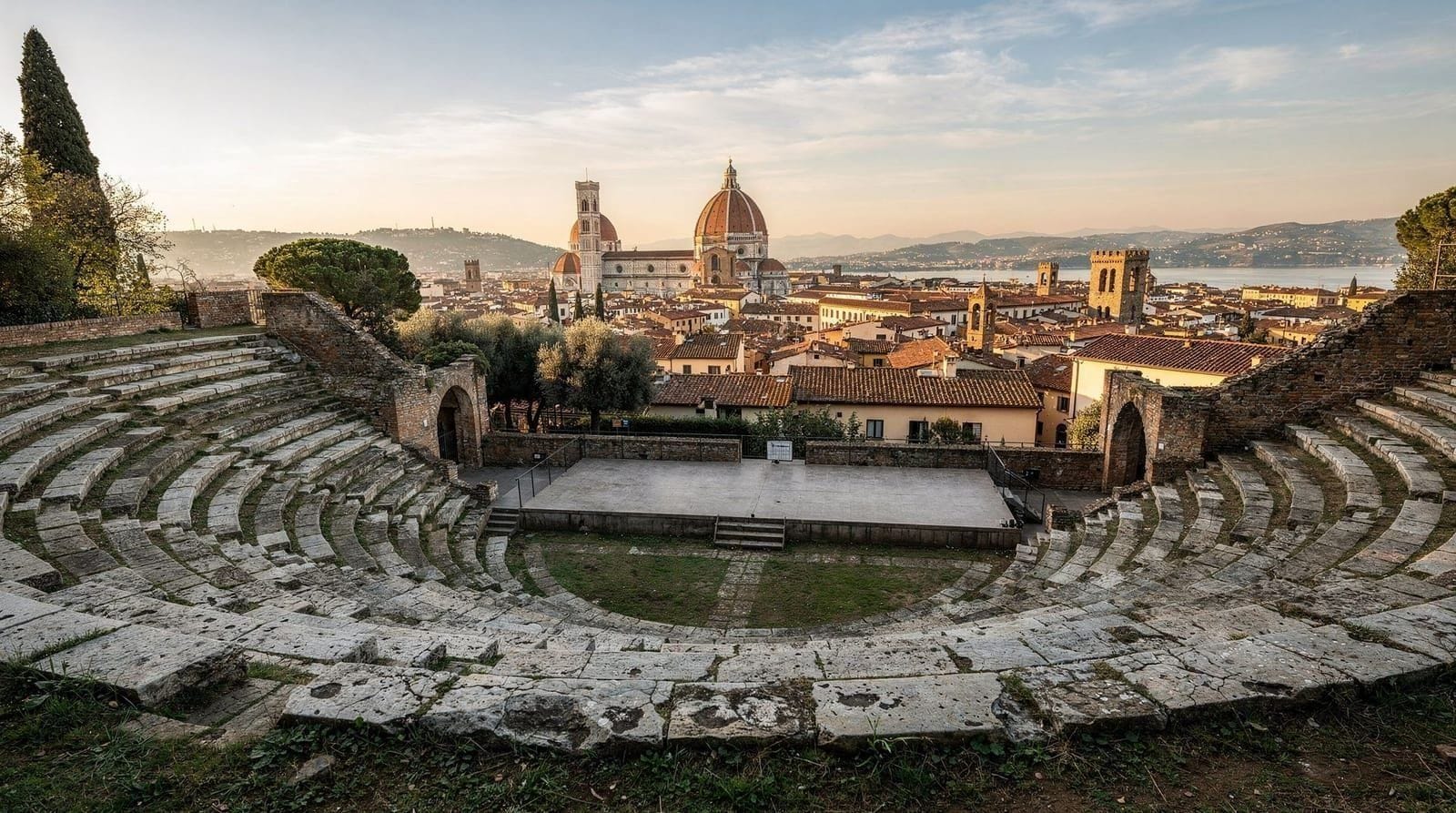
Arezzo was the Roman city of Arretium and a major centre of production for Arretine ware — red-gloss ceramic pottery with relief decoration that was the standard tableware of the Roman Empire at its height. The museum (adjacent to the Roman amphitheatre) has a good collection of Arretine ware and general archaeological material from the area. The amphitheatre itself, partially excavated, gives a sense of Arezzo’s Roman scale.
The Giostra del Saracino
Held on the third Saturday of June and the first Saturday of September in the Piazza Grande, the Giostra del Saracino is Arezzo’s medieval jousting tournament. Knights in full armour on horseback charge a rotating effigy of a Saracen warrior; they score points for hitting the shield and lose points if the figure’s flail strikes the departing knight. Four neighbourhoods of Arezzo compete; the atmosphere is intensely partisan and the pageantry (costumes, drums, flag-throwers, medieval music) is elaborately authentic. The September Giostra is traditionally the more important of the two. If your dates coincide, this is one of the better medieval festivals in Tuscany.
Practical day-trip planning
Arezzo is busy enough to fill a full day but compact enough that a half-day (with the Piero frescoes as the sole priority) is also feasible.
Recommended full-day programme:
- 9:00: Arrive Arezzo, walk up to San Francesco for timed entry to Piero frescoes
- 10:30: Piazza Grande and Pieve di Santa Maria
- 12:00: Casa Vasari (if open in the morning session)
- 13:00: Lunch (see below)
- 14:30: Museo Nazionale d’Arte Medievale e Moderna
- 16:00: Roman amphitheatre and Museo Archeologico
- 18:00: Return train to Florence
Combining Arezzo with Cortona: Cortona is 30 kilometres south of Arezzo (30 minutes by regional train or car). The two towns make a natural pairing for a full day — morning in Arezzo for the Piero frescoes, afternoon in Cortona for the hillside town and Signorelli museum. See our Cortona guide and our dedicated Arezzo and Cortona combined guide for a suggested schedule and transport options between the two.
How Arezzo compares to other Tuscan day trips
Arezzo is one of several classic day trips from Florence, and it is worth being clear about what it does and does not offer relative to the others before committing a full day to it.
| Destination | Signature draw | Time from Florence | Best for |
|---|---|---|---|
| Arezzo | Piero della Francesca frescoes, antique market | 40-50 min train | Serious art lovers, antique hunters |
| Siena | Il Campo, Duomo complex, Palio history | ~1hr15 train/coach | Most complete medieval city experience |
| Cortona | Hillside setting, Etruscan and Signorelli museums | 30 min from Arezzo | Pairing with Arezzo, slower pace |
| San Gimignano | Medieval towers, skyline | ~1hr15-1hr30 | Photogenic profile, shorter visits |
If you have to choose one art-focused day trip and the Piero della Francesca frescoes matter to you, Arezzo is the least crowded of this group and the most rewarding for a focused visit; see our best day trips from Florence guide for how it stacks up against the full roster of options, and the Chianti day trip guide if wine and countryside interest you more than frescoes.
Eating in Arezzo
Ristorante Buca di San Francesco (Via San Francesco): Adjacent to the basilica, one of Arezzo’s most respected traditional restaurants. Pappardelle with wild boar, ribollita, bistecca. Expect €35-50 per person.
Osteria del Cinghiale (Via Mazzini): Smaller, more casual. Good pici pasta and generous portions at fair prices. €20-30.
Mercato Coperto (Piazza Sant’Agostino): Covered food market for a quick and cheap lunch option, with fresh produce, deli counters and sandwich bars.
Frequently asked questions about Arezzo
Do I need to book the Piero della Francesca frescoes in advance?
Yes, strongly recommended. The Cappella Bacci has strict capacity limits (timed entry, 30 minutes per group) and popular time slots sell out, especially on weekends and in summer. Book online at pierodellafrancesca.it. Walk-in availability on the day is limited and unreliable.
How long does Arezzo take for a day trip?
A full day (8-9 hours) is comfortable for seeing the frescoes, Piazza Grande, Casa Vasari and a museum. A half-day (4-5 hours) suffices if the Piero chapel is the primary goal. The antique market on the first weekend of the month warrants a full day if you are interested in antiques.
Is the antique market always on the first weekend?
The Fiera Antiquaria runs on the first Sunday of the month and the preceding Saturday. It does not operate in the same way on other weekends. Check the official dates at fieraantiquaria.org before planning your visit around it.
What is the Giostra del Saracino?
A traditional medieval jousting tournament held twice a year (June and September) in the Piazza Grande. Knights from Arezzo’s four historic neighbourhoods compete on horseback against a rotating Saracen figure. One of the most authentic and atmospheric medieval tournaments in Tuscany; worth attending if your dates coincide.
How does Arezzo compare to Siena for art and history?
Siena has a larger and more famous historic centre with the extraordinary Duomo complex and the Campo. Arezzo has the single most important 15th-century fresco cycle in Italy (the Piero della Francesca chapel) plus a more relaxed, less touristy atmosphere. For art specialists, Arezzo for Piero; for the most complete medieval Tuscan city experience, Siena.
Can I visit Arezzo without a car or organised tour?
Yes, easily — Arezzo is one of the simplest Tuscan day trips to do independently by train. Regular services run from Florence Santa Maria Novella, the station sits at the edge of the historic centre, and everything worth seeing is within a 10-15 minute walk. No car or guided tour is necessary unless you plan to combine Arezzo with Cortona or another countryside stop on the same day.
Is Arezzo worth visiting if I only have one day trip from Florence?
It depends on your priorities. If Renaissance fresco painting or antiques genuinely interest you, Arezzo is one of the best-value day trips in Tuscany precisely because it is less crowded than Siena or San Gimignano. If you want the most complete medieval-city experience or classic postcard views, Siena or San Gimignano will satisfy a broader range of interests in a single visit.
Top experiences
Bookable activities with verified prices and instant confirmation on GetYourGuide.