Cortona
Cortona: Etruscan hilltop city with Signorelli frescoes, Fra Angelico's Annunciation and views over Lake Trasimeno. Logistics from Florence.
Florence: Siena, San Gimignano and Chianti day trip
- Free cancellation
- Hotel pickup
Quick facts
- Distance from Florence
- 100 km / 1 hr 15 min by car
- By train
- To Camucia-Cortona station, then 5 km bus up to town
- Best for
- Etruscan art, medieval streets, views, authentic atmosphere
- Budget
- €25-60/day
Ancient Etruscan city above Lake Trasimeno
Cortona is among the oldest continuously inhabited cities in Italy — the Etruscans fortified this hill above the Valdichiana plain in the 7th century BC, and the walls they built still encircle the upper town. It rose to prominence in the Renaissance as the home of Luca Signorelli (born here circa 1450), one of the most technically inventive painters of the period, and was painted and photographed so frequently in the 20th century that it became, for many writers and travellers, a shorthand for Tuscany itself. Frances Mayes’ Under the Tuscan Sun was set here.
The town has paid a modest price for this visibility — there is tourist infrastructure, and July-August brings visitor numbers that the steep medieval streets absorb with effort. But Cortona retains more genuine local life than comparable Tuscan hill towns. The daily market in Piazza della Repubblica, the locals at aperitivo along Via Nazionale, the archaeological depth of the museum — these are not performances for visitors. The town is real.
For the art visitor, two works make Cortona essential: Fra Angelico’s Annunciation in the Museo Diocesano, and the Signorelli frescoes in the Museo dell’Accademia Etrusca. For the general visitor, Cortona offers a properly steep medieval hill town with Etruscan walls, extraordinary views across the Valdichiana to Lake Trasimeno in Umbria, and a network of streets where it is genuinely possible to get mildly lost.
| Where | Valdichiana, 100km southeast of Florence, near Lake Trasimeno |
| Cost | Around €25-60/day; museums €5-10 each |
| Time needed | Half-day to full day |
| Getting there | Car ~1hr15, or train to Camucia-Cortona + bus |
| Best time | April-October; May-June and September-October ideal |
Getting there from Florence
By car (most flexible): Take the A1 Autostrada south from Florence toward Rome, exit at Valdichiana, follow signs to Cortona (12 km from the exit). Journey approximately 1 hour 15 minutes. Parking is available at the base of the town; driving into the steep historic centre is restricted. A minibus (APM) runs from the lower town to Piazza della Repubblica in 10 minutes.
By train: Regular trains run from Florence SMN to Camucia-Cortona station (approximately 1 hour 15 minutes to 1 hour 30 minutes; €10-15). From the station, which sits 5 kilometres below the town in the valley, an APM local bus (every 20-30 minutes, €1.50) ascends to Cortona town centre in approximately 15 minutes. This option works but adds time and coordination compared to a car.
Combining with Arezzo: Arezzo is 30 kilometres north (30 minutes by car, or regional train). The two towns work well as a combined full-day itinerary. See our Arezzo guide and the guide to visiting Arezzo and Cortona for joint planning.
Museo dell’Accademia Etrusca e della Città di Cortona (MAEC)
Located in the Palazzo Casali on Piazza Signorelli, the MAEC is one of the major provincial Etruscan museums in Italy. The collection includes the celebrated Etruscan lamp (lampadario etrusco) — a bronze chandelier from the 5th century BC, 60 centimetres in diameter, decorated with 16 oil lamps and extraordinary figurative reliefs. It was found near Cortona in the 18th century and is one of the finest surviving pieces of Etruscan metalwork.
Beyond the lamp, the museum holds a significant collection of Etruscan ceramics, bronzes, jewellery and architectural material, and an important Egyptian collection (Cortona had an 18th-century enthusiasm for Egypt that predated Napoleon’s campaigns). The upper floor traces the town’s history from Etruscan through Roman to medieval and Renaissance.
Admission approximately €10. Open Tuesday-Sunday 10:00-19:00 (shorter hours November-March). Allow 1.5-2 hours.
Museo Diocesano: Fra Angelico’s Annunciation
The Museo Diocesano (adjacent to the Duomo) holds Cortona’s most celebrated single work of art: Fra Angelico’s Annunciation, painted circa 1428-1433 and one of three surviving Annunciation panels by the artist. The gold-ground panel — the Virgin kneeling at the moment of the angel’s announcement — is characterised by the stillness, luminosity and precision of spatial description that makes Fra Angelico unique in 15th-century Florentine painting. There is a secondary scene in the predella showing the Expulsion from Paradise, its shadow presence behind the Annunciation.
The museum also holds works by Luca Signorelli (including an altarpiece and two reliquary panels) and other Cortonese and Sienese painters. Admission approximately €5. Open Tuesday-Sunday 10:00-18:00.
Luca Signorelli
Cortona-born Luca Signorelli (circa 1450-1523) is one of the great technical innovators of the Italian Renaissance. His mastery of the human figure in violent action — athletes, warriors, the damned — was studied by Michelangelo before the Sistine ceiling. Signorelli’s most important work is the fresco cycle in Orvieto Cathedral (a day trip from Rome, not Florence), but Cortona holds significant examples. Beyond the Museo Diocesano pieces, the church of San Niccolò has a double-sided standard by Signorelli, and San Domenico has a polyptych.
The historic streets and views
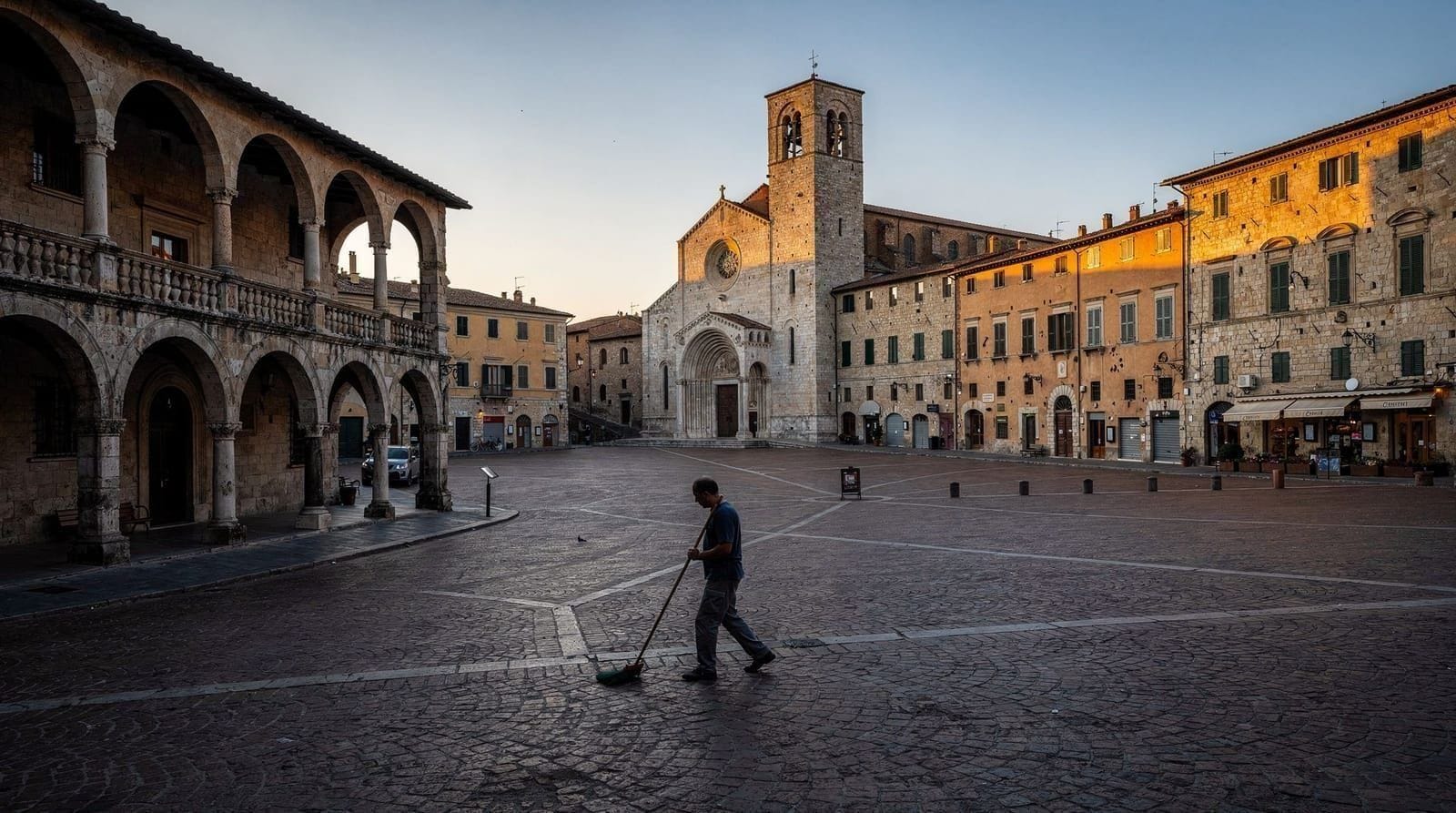
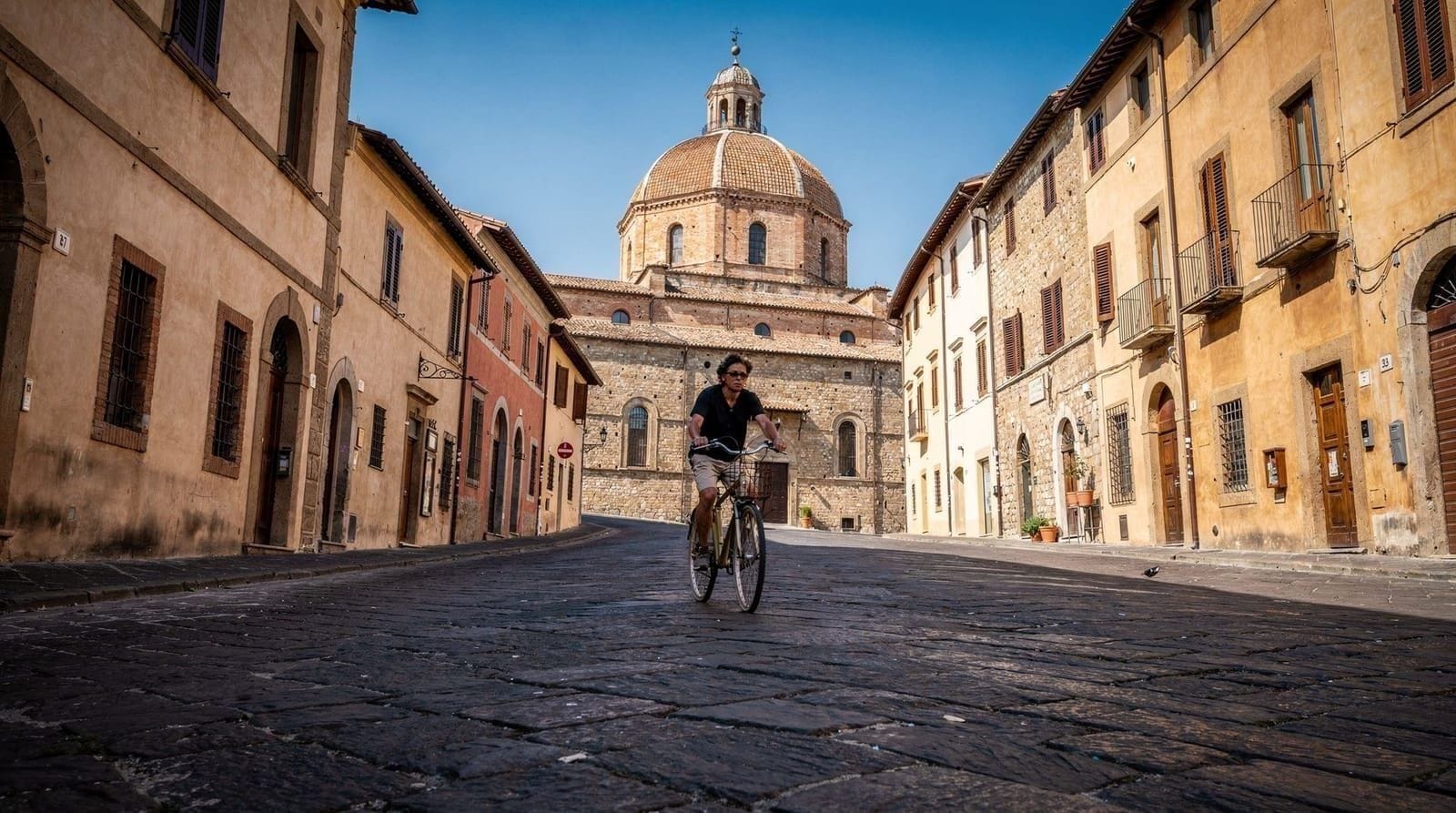
Cortona’s streets are genuinely steep. The town climbs from Piazza della Repubblica (the main civic square) up through lanes of medieval stone houses to the Fortezza del Girifalco at the summit. The climb is rewarding: the views from the upper town across the Valdichiana to Lake Trasimeno (the largest lake in central Italy, visible on clear days as a silver expanse in the distance) and the Umbrian hills beyond are among the finest panoramas in southern Tuscany.
Key streets and spaces:
- Piazza della Repubblica: The main civic square, with the Palazzo Comunale (civic hall) and its external staircase. The morning market operates here.
- Via Nazionale: The only largely flat street in the historic centre, running west from Piazza della Repubblica. The main shopping and café street.
- Piazza Signorelli: The cultural centre, with the MAEC and the Teatro Signorelli (1854, still functioning).
- Via Berrettini: Named for Pietro Berrettini (Pietro da Cortona), the 17th-century Baroque painter born here. Leads upward past several medieval buildings.
- Santa Margherita: The Sanctuary of Santa Margherita, patron of Cortona, near the top of the town. Gothic church remodelled in the 19th century; pilgrimage site with the saint’s relics. The walk up is steep but the views reward it.
- Fortezza del Girifalco: At the very top, the Medici fortress (16th century). Admission approximately €3. The views from the tower are the highest available point in Cortona.
The Etruscan walls
Cortona’s Etruscan city walls, built in the 4th-3rd centuries BC, survive in long sections around the upper perimeter of the town. The massive irregular limestone blocks, some weighing several tonnes, are the foundation on which the medieval and modern city sits. The best section to walk is the stretch from Porta Colonia in the north to the area near Piazza Garibaldi — partly through gardens and olive groves, partly along the lanes of the upper town. Free to walk.
Cortona municipality has been excavating a large Etruscan tomb complex (Tumulo II del Sodo) on the hill below the town, with remarkable finds including a sacrificial altar carved with figures. The excavations are not regularly open to the public but Cortona Duemila (the local cultural foundation) runs occasional guided visits.
Food and restaurants
Osteria del Teatro (Via Maffei 2): Long-established and consistently reliable, with classic Tuscan cooking and good Cortona-area wines. Expect €35-50 per person. Booking advised.
Trattoria Dardano (Via Dardano 24): Simpler, unpretentious, popular with locals. Good pasta and daily specials. €20-30 per person.
La Saletta (Via Nazionale 26): Wine bar and small plates. Good for an aperitivo or a light lunch.
Cortona Cooking Festival: Held in September, a relatively low-key food festival celebrating local products.
Cortona compared to other Tuscan hill towns
| Town | Signature draw | Distance from Florence | Character |
|---|---|---|---|
| Cortona | Fra Angelico, Etruscan walls, authentic daily life | ~1hr15 by car | Steep, historically deep, less crowded |
| San Gimignano | Medieval tower skyline | ~1hr15-1hr30 | Highly photogenic, busier |
| Montepulciano | Vino Nobile wine, Renaissance streets | ~1hr30 | Wine-focused, dramatic hilltop |
| Arezzo | Piero della Francesca frescoes | ~40-50 min train | Art-focused, flatter town centre |
Cortona’s edge over San Gimignano and Montepulciano is authenticity — locals still shop in the Piazza della Repubblica market and drink at the Via Nazionale bars rather than the streets existing purely for visitors. See our best day trips from Florence guide for how it fits the wider roster of options.
Practical notes
Best time: May-June and September-October for ideal weather and manageable visitor numbers. The Giostra dell’Archidado (medieval crossbow tournament, May) is Cortona’s major annual festival.
Combining with Arezzo and Val d’Orcia: Cortona sits at the geographic junction between the Tuscan and Umbrian reaches of the Valdichiana valley. From Cortona, Arezzo is 30 km north, Montepulciano is 25 km west, and you are effectively on the edge of the Val d’Orcia zone. This makes Cortona a natural stop on any southern Tuscany road trip. See our Val d’Orcia guide for onward routing, and our Tuscany hill towns road trip itinerary for a multi-day route that includes Cortona alongside San Gimignano and Montepulciano.
Frequently asked questions about Cortona
Is Cortona worth a day trip from Florence?
Yes, particularly for art enthusiasts (Fra Angelico, Signorelli, Etruscan heritage) and those who want a genuinely steep, authentic hilltop town with views. It is less architecturally spectacular in its skyline than San Gimignano or more dramatic than Montepulciano, but it has more historical depth and less tourist saturation.
What is the most important thing to see in Cortona?
Fra Angelico’s Annunciation in the Museo Diocesano is the single most important work, followed by the Etruscan lamp in the MAEC. The Etruscan city walls and the summit views are the complementary context.
How steep is Cortona?
Very. The town climbs approximately 200 metres from the lower parking areas to the Fortezza at the summit, on cobbled streets. People with mobility difficulties will find some areas challenging. A minibus runs from the lower town to the main piazza and is useful for the initial ascent.
Can I combine Cortona with Arezzo in one day?
Yes, comfortably. Cortona for morning (4-5 hours including the two museums), drive north 30 minutes to Arezzo for afternoon (Piero frescoes, Piazza Grande). Return to Florence by early evening. See our combined guide at Arezzo and Cortona.
Who is Luca Signorelli and why does he matter for Cortona?
Signorelli (circa 1450-1523) was born in Cortona and became one of the most influential Italian Renaissance painters. His mastery of the human figure in extreme physical and emotional states — battle, damnation, resurrection — was studied by Michelangelo before the Sistine Chapel. Several works are in Cortona’s museums; his major commission (the fresco cycle in Orvieto Cathedral) requires a separate trip.
Is Cortona better than San Gimignano for a first Tuscan hill town visit?
It depends on priorities. San Gimignano has the more instantly recognisable skyline and is easier logistically for a quick photo-focused stop, while Cortona rewards visitors with more time and an interest in art and Etruscan history, and feels considerably less like a tourist set piece. For a first, short visit prioritising the classic postcard image, choose San Gimignano; for a deeper, quieter experience, Cortona.
Top experiences
Bookable activities with verified prices and instant confirmation on GetYourGuide.