Florence coffee culture: how to order and where to go
Florence: old city street food tour and guided sightseeing
- Free cancellation
- Small group
How do Florentines drink coffee?
Standing at the bar counter (banco), paying first or immediately after, drinking a single espresso in 2–3 sips. A coffee at the bar costs €1.10–1.30. Cappuccino is a morning drink only — ordering one after lunch is considered socially odd.
Coffee as social ritual
Italian coffee culture is not about the quality of the beans in isolation — though that matters. It’s about a set of social rituals around an essentially simple product: a small, concentrated espresso, consumed quickly at a counter, embedded in the structure of the day.
In Florence, as elsewhere in Italy, the coffee bar (bar) is a neighbourhood institution. It is where people start the morning, pause mid-morning, stop briefly after lunch, and sometimes again at 17:00. Each visit lasts two to four minutes. You stand at the counter. You drink your coffee. You leave.
Understanding this ritual — and the explicit and implicit rules around it — makes you a more confident coffee drinker in Florence and means you won’t be the person sitting at a terrace table paying €4.50 for something a Florentine bought standing up for €1.20.
| Where | Any bar (bar) counter — no reservation, walk in |
| Cost | Around €1.10–1.60 standing; €3–8 seated at a piazza table |
| Time needed | 2–4 minutes standing; 20–30 minutes seated |
| When cappuccino stops | Around 10:30am — espresso or macchiato after that |
| Best areas | San Lorenzo (Sant’Ambrogio), Oltrarno, Piazza della Repubblica for historic caffè |
The coffee menu explained
Un caffè (espresso)
The base unit of Italian coffee consumption. A single espresso in a pre-warmed demitasse cup — about 25ml of concentrated, slightly bitter coffee with a thin layer of golden crema on top. Drunk in 2–3 sips, usually with one sugar packet stirred in, sometimes without.
Price at the counter: €1.10–1.40. Non-negotiable.
Cappuccino
Espresso, steamed milk, and milk foam in roughly equal thirds, served in a 150–180ml cup. Florentines drink cappuccino in the morning — before 10:30, as a general rule. Ordering a cappuccino after a meal (especially after lunch or dinner) is unusual enough to attract mild bemusement from the barista and any Florentine overhearing the order. This is not a rule enforced by law; it’s a social convention based on the Italian belief that milk-based drinks inhibit digestion after eating.
Price at the counter: €1.30–1.60.
Caffè macchiato
Espresso with a small splash of frothed milk. Slightly softer in flavour than a pure espresso. A popular morning alternative for people who find espresso too harsh but find a full cappuccino too filling.
Price: €1.20–1.50.
Caffè latte
A large milk-forward coffee — espresso in a glass or large cup, topped with a generous amount of steamed milk. Less foam than a cappuccino; closer in volume to a large milk coffee. Also a morning drink only. Note: ordering “a latte” without the caffè prefix will get you a glass of cold milk, which is technically correct Italian but usually not what the visitor intended.
Price: €1.50–2.
Caffè lungo
A “long” espresso — the same amount of coffee grounds extracted with more water, resulting in a larger and slightly weaker shot. Not filter coffee; still espresso in extraction method. A reasonable compromise for those who find espresso too concentrated.
Caffè ristretto
The opposite of lungo — a “restricted” extraction that is smaller than a standard espresso, more concentrated. Very bitter, very small. Reserved for serious coffee drinkers or those who’ve spent a long time in Italy.
Caffè corretto
Espresso “corrected” with a small shot of grappa, sambuca, or another spirit. A working-class morning tradition in Tuscany — the agricultural workers who built it didn’t see it as drinking; it was warming the coffee against the cold. Still ordered at neighbourhood bars but less common than it once was.
Price: €2–3 (espresso + spirit).
Caffè freddo / cappuccino freddo
Iced espresso or iced cappuccino, drunk in summer. The freddo version is shaken with ice and sugar, producing a sweet, cold coffee. Popular from May onwards.
Bar vs. table prices
This is the most practically important coffee fact for visitors:
| Venue type | Espresso at counter | Espresso at table | Cappuccino at counter |
|---|---|---|---|
| Neighbourhood bar | €1.10–1.30 | €2–3 | €1.30–1.60 |
| Central city bar | €1.20–1.50 | €3–5 | €1.50–2 |
| Historic piazza bar | €1.50–2 | €4–7 | €2–3 |
| Hotel bar | €3–5 | €5–8 | €4–7 |
The sit-down price at a tourist-area bar — Caffè Rivoire on Piazza della Signoria, the tables at Caffè Gilli on Piazza della Repubblica — is a premium for the setting and table service, not the coffee quality. The coffee in the cup is often identical to what’s served at the counter for a third the price.
The rule: stand at the counter unless you specifically want the experience of sitting in a historic caffè, in which case factor the terrace price into your budget as the cost of the view.
Paying at Italian bars
The payment ritual at Italian bars is worth knowing because it differs from the norm:
Option 1 (most common): Walk to the counter, order your coffee directly (“un caffè, per favore”), receive it, drink it, then pay as you leave or when it’s convenient. This works because the bar keeps a running tab of what you’ve ordered.
Option 2 (some traditional bars): Pay first at the cassa (cash register) before ordering. You’ll receive a receipt (scontrino) that you take to the counter and present when ordering. This system is less common but still exists at some older bars.
Neither system requires pre-paying on a card — most neighbourhood bars still prefer cash, though cards are increasingly accepted. A €5 or €10 note is adequate for any single coffee visit.
The best historic caffè in Florence
Caffè Gilli (Piazza della Repubblica)
The oldest caffè in Florence (est. 1733, though the current building is 1910s). The interior is Belle Époque with original wood panelling, glass cases of pasticceria, and a long marble counter. Excellent cornetti (Italian croissants), good espresso, extraordinary setting. Standing at the counter: €1.40. Sitting at the piazza table: €5–7 per coffee. Worth it for a single occasion; too expensive for daily use.
Caffè Paszkowski (Piazza della Repubblica)
Next to Gilli, similar history and aesthetic. Known for live music in the evenings. The pastry selection here is among the best in the city — try the croissant sfogliato (layered croissant with better flakiness than the typical Italian version). Standing price €1.40; sitting €5+.
Caffè Rivoire (Piazza della Signoria)
Directly facing Palazzo Vecchio, the best terrace view in Florence. The drinking chocolate here is legendary — thick, dark, Tuscan-winter appropriate. The espresso is good. Terrace prices are €6–8 for a coffee — you are paying for the front-row seat on the Piazza della Signoria, which is genuinely spectacular.
Caffè Giacosa / Caffè Roberto Cavalli (Via della Vigna Nuova)
Home of the Negroni’s invention (covered in the aperitivo guide). Now under the Roberto Cavalli brand but still making competent cocktails and a good espresso. More relevant for its aperitivo credentials than its coffee, but worth a morning visit for the historical connection. €1.50–2 at the counter.
Best neighbourhood coffee bars
Caffè Sant’Ambrogio (near Piazza Sant’Ambrogio)
The local bar for the market neighbourhood. Open from 06:30 for pre-market workers; the espresso is reliable, the cornetti fresh, and the atmosphere is 100% neighbourhood Florentine. €1.20 at the counter.
Caffè degli Artigiani (Via dello Sprone, Oltrarno)
Covered in the Oltrarno guide. The artisan quarter’s coffee bar — a genuine neighbourhood institution. €1.20 at the counter.
Gran Caffè San Marco (Piazza San Marco)
Near the Accademia. Good quality espresso, decent selection of pastry, and a terrace that isn’t overpriced because it faces a piazza rather than a landmark. A better choice than many Duomo-area alternatives if you’re visiting the museum quarter. €1.30 at counter; €3–4 at table.
The cornetto: the morning complement
Coffee at an Italian bar is almost always paired with a cornetto — Italy’s version of a croissant. Lighter and less buttery than the French original, typically filled with crema pasticciera (pastry cream), jam, or Nutella. Served warm from the oven in the early morning; room temperature by 10:00.
Price: €1–1.50 each. A coffee and cornetto breakfast standing at the bar costs €2.20–3. This is the least expensive and one of the most pleasurable breakfasts in Florence.
Quality variations: The best cornetti are made with laminated pastry dough and have visible layers when broken. Poor versions are bread-dough based (soft, not flaky) and filled with an indeterminate sweet paste. The good version is obvious as soon as you bite in.
Decaffeinated coffee
Un caffè decaffeinato or un deca is widely available at Italian bars. Usually served as a pre-made decaf option (Hag brand is the ubiquitous reference), though better bars will pull a proper decaf espresso. Price: €1.20–1.60.
Takeaway coffee
Italy has been slow to adopt the coffee-to-go culture. Takeaway cups exist at some bars (particularly tourist-oriented ones) but they’re not universal and many older baristi find the concept mildly inappropriate — coffee should be drunk immediately at the bar, not carried around the street.
Increasingly, bars near the Uffizi, the Duomo, and Santa Maria Novella station offer takeaway cups. Outside the immediate tourist areas, expect to drink at the counter.
The rise of specialty coffee in Florence
Alongside the traditional bar scene, a small but growing specialty coffee movement has taken hold in Florence over the past decade, concentrated in the Santa Croce district and the Oltrarno. These bars roast single-origin beans, offer lighter roasts, and often serve filter or pour-over alongside standard espresso — a real departure from the traditional bar model. Expect to pay €3–5 for a filter coffee, closer to specialty-coffee prices elsewhere in Europe than to the €1.20 counter espresso. They are worth seeking out if you find traditional Italian espresso too dark or too bitter, but they are not where most Florentines drink their daily coffee — for that, stick to the neighbourhood bars covered above.
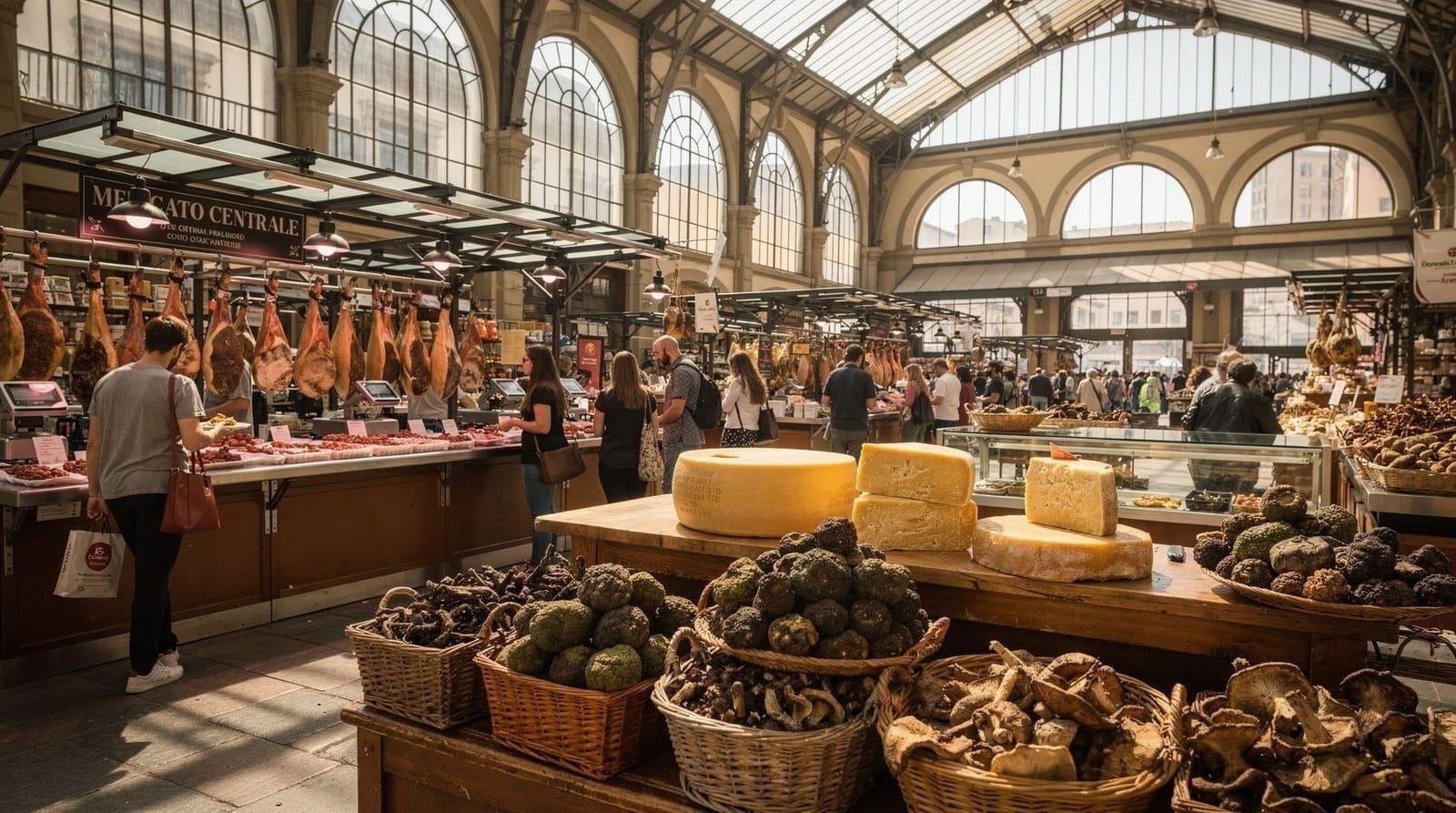
Combining a coffee crawl with a visit to the Mercato di Sant’Ambrogio or the wider Florence food markets makes a natural morning: market first, while the produce is freshest, then a stand-up espresso to close the loop before the crowds arrive.
Coffee and the rest of the day
Coffee threads through Florentine dining in ways that surprise first-time visitors. A caffè corretto often closes a heavy Tuscan lunch instead of a dessert. Espresso appears again after dinner, though rarely with milk, and almost never with the aperitivo itself — coffee and alcohol occupy separate, non-overlapping rituals in the Florentine day rather than blending into each other. If you’re building a food-focused day around the San Lorenzo market and its surrounding streets, treat coffee stops as short punctuation marks rather than sit-down breaks, and save the seated, unhurried coffee for a specific historic caffè you actually want to linger in.
Frequently asked questions about coffee in Florence
Can I order a flat white or an Americano in Florence?
Americano (espresso with added hot water) is available at most bars, though the term is increasingly understood. A flat white is not a traditional Italian coffee — some tourist-oriented bars offer it, but most neighbourhood bars will look puzzled. Caffè lungo (long espresso) is the closest Italian equivalent.
Is coffee in Florence good quality?
Generally yes. The base espresso at a neighbourhood bar is reliably made and the espresso machine quality in Italy is broadly higher than elsewhere. The difference between a good and bad bar is more about consistency and freshness of the beans than technique.
How do I ask for coffee without milk?
Just order “un caffè” — a plain espresso has no milk. If you want milk on the side (cold milk to add yourself), ask for “latte freddo a parte”.
Why is Italian coffee sometimes darker than I expect?
Italian espresso beans are traditionally roasted darker than Scandinavian or American specialty coffee. This produces the characteristic bittersweet, low-acid flavour profile. If you prefer lighter roasts, look for bars that advertise specialty coffee — these are growing in Florence, particularly in the Santa Croce and Oltrarno areas.
Should I tip at a coffee bar?
Tipping is not expected at an Italian bar counter. Leaving small change (the 10–20 cents from your change) in the dish on the counter is a common gesture of appreciation but entirely optional. At a sit-down table, the table surcharge already includes service.
Top experiences
Bookable activities with verified prices and instant confirmation on GetYourGuide.