Florence events calendar
Florence: walking tour
- Free cancellation
- Instant confirmation
What are the best events in Florence throughout the year?
Scoppio del Carro (Easter Sunday), Calcio Storico (June), Festa della Rificolona (7 September), and the Christmas markets (December) are the standout local events. The Maggio Musicale Fiorentino classical festival (April–June) is the major cultural event of the year.
Florence’s annual events cycle
Florence has been holding its major festivals in the same locations — many in the same piazzas, under the same medieval sky — for hundreds of years. The Scoppio del Carro dates to the fifteenth century. Calcio Storico is older still, played in its current form since the sixteenth century. These are not tourist performances. They are living traditions that the city continues to take seriously, which is what makes them worth timing a visit around.
This calendar covers every significant event from January through December, with practical information for each.
| Where | Citywide — main events in Piazza del Duomo, Piazza Santa Croce, the Lungarni |
| Cost | Most local festivals are free; Calcio Storico and Maggio Musicale need tickets |
| Booking | Calcio Storico tickets released in May; Maggio Musicale in Jan–Feb |
| Busiest windows | Easter week, June 24, and Christmas–New Year |
| Best planning tool | Pair this calendar with the best time to visit Florence guide |
January and February
January: the quietest month of the year. No major events. The Epifania (Epiphany) on January 6 is a national holiday with children’s traditions (the witch Befana brings gifts to good children, coal to bad ones). Some neighbourhood street markets set up on January 6. The day is a public holiday.
February — Carnevale: Florence’s Carnevale is modest compared to Venice or Viareggio but it exists. The last week before Lent (moveable depending on Easter, typically February–early March) brings children in costume, street stalls selling fritelle (fried dough balls with raisins), and a small parade through the historic centre. Carnevale is primarily a family event, pleasant background activity rather than the centrepiece of a trip.
March and early April
March and early April are the run-up to Easter. The city begins to fill from the second week of March. Pre-Easter weeks see art exhibitions opening, the Maggio Musicale warming up, and the first outdoor aperitivo of the season as temperatures climb.
Florentine Antique Market: the Mercato dell’Antiquariato fills Piazza dei Ciompi (and occasionally Piazza Santo Spirito) on the last Sunday of each month, year-round. Worth noting as an anchor for any month.
April
Scoppio del Carro — Easter Sunday: the single most dramatic local event of the year. The ceremony in full:
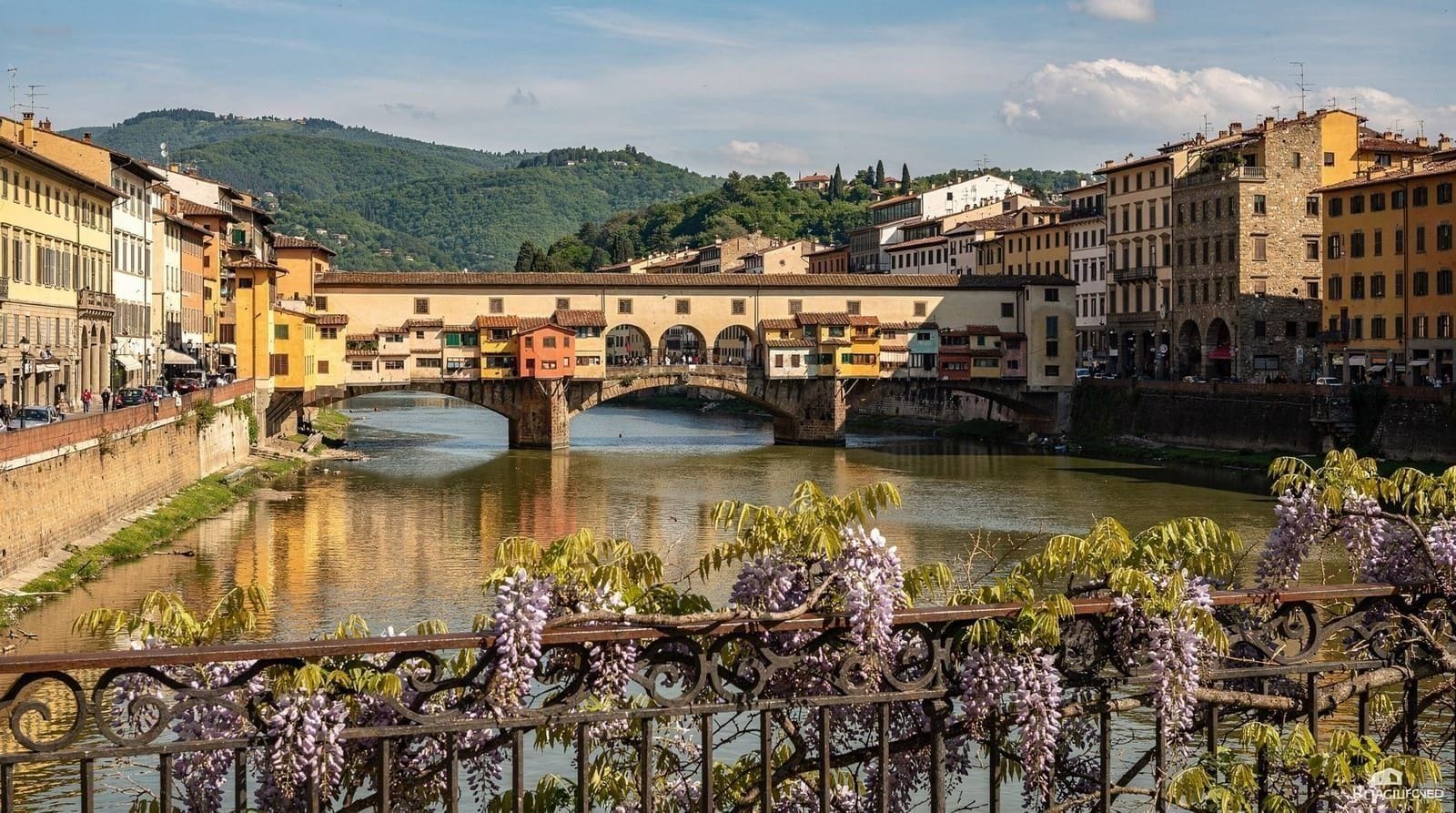
A gilded Renaissance cart (il Brindellone) is pulled from the church of Santi Apostoli, where the first crusaders’ flints that reportedly lit the original fire are kept, through the Ponte Vecchio and up Via dei Servi to Piazza del Duomo. Two enormous white oxen with gilded horns and flower garlands pull the cart. It arrives in the piazza and is positioned between the Duomo and the Baptistery.
At the moment of the Gloria during Easter Mass (approximately 11am), the Archbishop of Florence ignites a wire attached to a mechanical dove (la colombina) at the main altar. The dove travels along the wire, through the doors of the cathedral, and ignites the cart — which explodes in an extended fireworks display. If the dove successfully completes its return journey to the altar (an omen for the harvest), the crowds cheer. If it fails, there is collective concern.
Arriving before 9am is necessary for a reasonable viewing position. The barriers are free to stand behind. The experience of the crowd, the white oxen, and the fireworks in a Renaissance piazza is genuinely extraordinary.
Maggio Musicale Fiorentino (April–June): one of Italy’s oldest and most prestigious classical music and opera festivals, founded in 1933. The main venue is the Teatro del Maggio Musicale Fiorentino beside the Cascine park. Tickets from approximately €20 for concerto serale to €100+ for opera productions. Book through the opera house website; most productions sell out weeks in advance for principal performances.
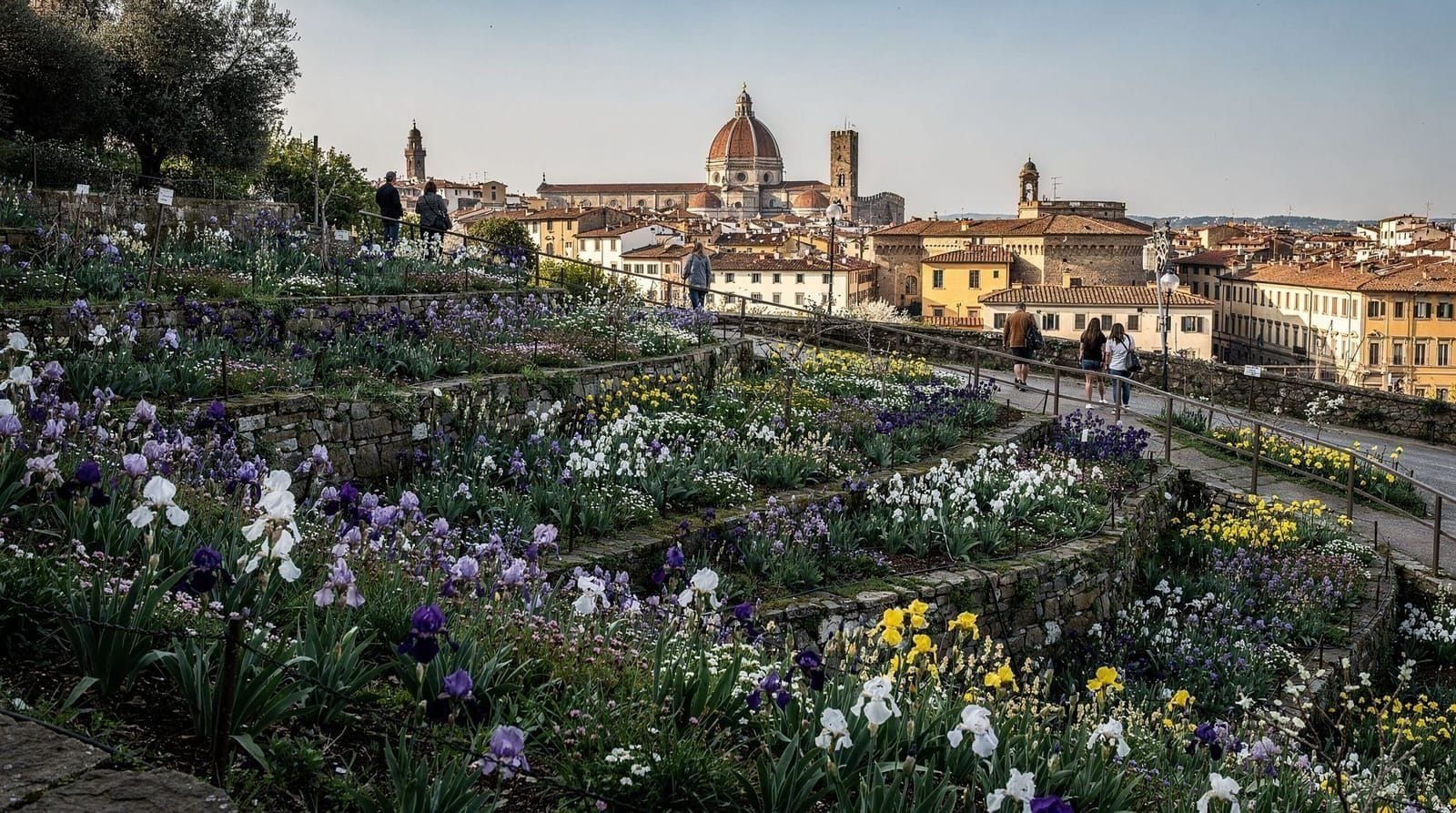
Iris Garden competition (early–mid May, occasionally late April): the Giardino dell’Iris, accessible from the Piazzale Michelangelo hillside, holds hundreds of iris varieties and hosts an international competition. Free entry during the festival period. Practically unknown to most visitors and absolutely worth the five-minute detour.
May
Maggio Musicale Fiorentino continues through May — the peak months for the festival.
Artisan markets: the spring Sunday markets intensify from May, with Piazzale Michelangelo hosting weekend artisan fairs and the Santo Spirito neighbourhood hosting its own smaller markets.
Vespa Florence: the first weekend of May sometimes sees vintage Vespa gatherings in the Parco delle Cascine — a photogenic and entirely Florentine scene.
June
Calcio Storico Fiorentino: Florence’s most distinctive event and one of the most unusual sporting spectacles in Europe. The game traces its roots to the sixteenth century, when Florentine nobles played it — there is a famous match played during the siege of 1530, while the city was under attack, as an act of defiance.
The modern Calcio Storico has four teams corresponding to the four historic districts of Florence:
- Bianchi (Whites): Santo Spirito
- Azzurri (Blues): Santa Croce
- Rossi (Reds): Santa Maria Novella
- Verdi (Greens): San Giovanni
Two semifinal matches and a final are played in June, typically on three dates: two Saturdays in mid-June and June 24 (the feast of San Giovanni, Florence’s patron saint) for the final. The sand pitch is laid in Piazza Santa Croce. Each match lasts 50 minutes with virtually no rules prohibiting physical contact.
Tickets are required and sell out quickly. They become available through the official city portal and selected ticket agencies in May. Standing positions along the barriers are cheaper than seated tribune places. The atmosphere is extremely partisan.
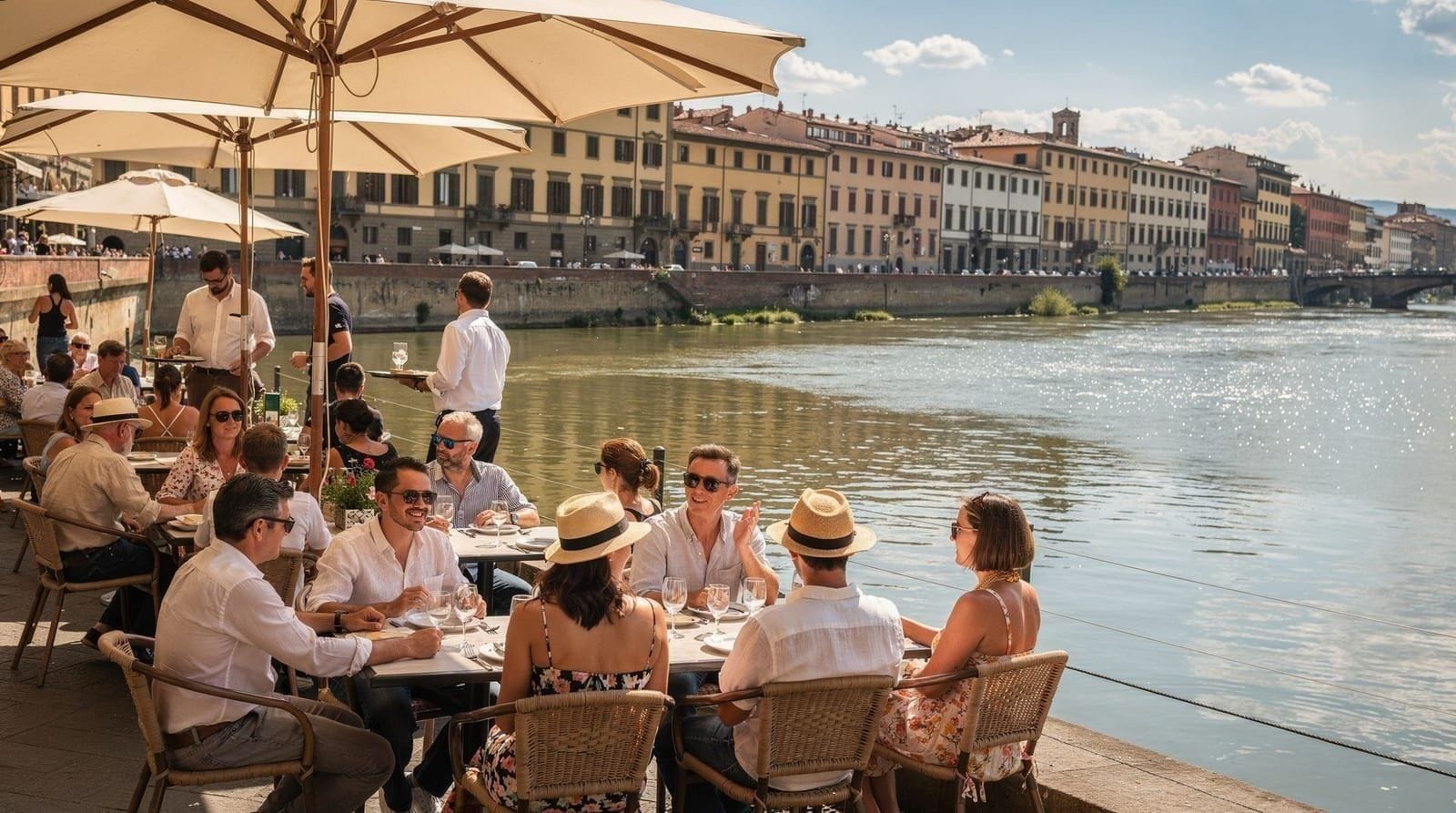
June 24 — Feast of San Giovanni: Florence’s most important civic celebration. Public holiday. The day ends with fireworks over the Arno at 10pm, visible from the Piazzale Michelangelo, Ponte alle Grazie, and the Lungarni. The fireworks typically last 20–25 minutes and the city crowds around the river. The best viewing positions are the Lungarno Corsini, Lungarno Acciaiuoli, and the Ponte Santa Trinita.
Estate Fiesolana begins (June–August): this summer festival takes place at the Roman amphitheatre in Fiesole, on the hill above Florence. Music, dance, and theatre performances in a first-century BC stone amphitheatre with Florence visible in the valley below. Programmes vary annually; tickets through the estate website.
July
Palio di Siena — July 2: the horse race in Siena. Not in Florence, but a day trip from Florence by bus (90 minutes from the SMN terminal) or car. The race takes place at approximately 7:30pm, but being in the Piazza del Campo for the full day, including the dress rehearsal race the afternoon before, is the authentic experience. See the day trips from Florence section for logistics.
Estate Fiesolana continues through July.
Open-air cinema: various outdoor cinema programmes operate in July and August along the Arno and in the Parco delle Cascine. The “Cinema all’Aperto” programme typically shows Italian and international films.
August
Ferragosto — August 15: national holiday. Many businesses close. The museums stay open. The Arno embankments are quieter than usual on August 15 itself, creating a paradoxically pleasant atmosphere in the early morning and late evening.
Palio di Siena — August 16: the second horse race of the year. Same logistics as the July race.
Estate Fiesolana final weeks (through mid-August): performances continue until approximately mid-August, then the festival ends for the season.
September
Festa della Rificolona — 7 September: Florence’s most purely local autumn festival and one of its most atmospheric. The full picture:
The festival marks the eve of the Nativity of the Virgin Mary. In medieval times, pilgrims from the surrounding countryside arrived in Florence carrying lanterns to celebrate at Santissima Annunziata. The rificolone (paper lanterns on bamboo poles, often in fanciful shapes) are now carried by children and adults through the centre.
The main procession assembles near Sant’Ambrogio (Piazza dei Ciompi area) in the early evening and moves through Via Pietrapiana, Piazza Santa Croce, Via del Proconsolo, and the Duomo area, arriving at Piazza della Santissima Annunziata around 9–10pm. A parallel procession of decorated floats travels on the Arno, visible from the Lungarni.
There is also a tradition of children trying to hit others’ lanterns with pea-shooters (fionde). This is somewhat chaotic and entirely charming. The whole event is free, unticketed, and genuinely communal.
Chianti Classico Collection (September): the annual gathering of Chianti Classico producers, with public tastings. The main event is held in Greve in Chianti (the capital of the Chianti zone) usually in the second weekend of September, with affiliated events at individual estates throughout the month.
October
Florence Biennale (biennial, odd-numbered years): a contemporary art fair at the Fortezza da Basso, near the railway station. International contemporary artists exhibit. Tickets required.
Autumn market season: the artisan markets at Piazzale Michelangelo and Santo Spirito continue through October weekends.
Olive oil pressing begins (late October): the first pressing of the new Tuscan olive oil (olio nuovo) begins in the last week of October. Fresh oil appears at the Mercato Centrale and specialist shops — intensely flavourful and genuinely seasonal.
November
Truffle season (November): white truffle season peaks in November. Florentine restaurants add truffle-based dishes to their menus, and the Mercato Centrale has fresh truffle available from specialist vendors. White truffles from the San Miniato area (Pisa province, about 45 minutes from Florence) are among the most prized in Italy.
Festival dei Popoli (November): Florence’s international documentary film festival, one of the oldest in Europe. Italian and international documentaries. Various cinema venues across the city.
December
See the dedicated Florence at Christmas guide for full detail.
The key events:
- Wunderkammer Christmas market at Piazza Santa Croce (early December–January 6)
- Choral Advent concerts at Santa Croce, Santa Maria Novella, and other churches
- Midnight Mass at the Cathedral on Christmas Eve
- New Year’s Eve gathering at Piazzale Michelangelo
Public holidays affecting Florence
| Date | Holiday | Impact |
|---|---|---|
| January 1 | New Year | Museums closed; everything closed |
| January 6 | Epiphany | Public holiday; some closures |
| Easter Sunday | Easter | Scoppio del Carro; mixed closures |
| Easter Monday | Pasquetta | Most museums closed; Florentines picnic |
| April 25 | Liberation Day | Some museum closures |
| May 1 | Labour Day | Most museums closed |
| June 2 | Republic Day | Some closures |
| June 24 | Feast of San Giovanni (Florence only) | Local public holiday; fireworks |
| August 15 | Ferragosto | National holiday; mixed closures |
| November 1 | All Saints’ Day | Some closures |
| December 8 | Immaculate Conception | Public holiday |
| December 25 | Christmas Day | Almost everything closed |
| December 26 | Santo Stefano | Public holiday; some closures |
Building a trip around a single event
If one event is the reason for your trip, plan the rest of your itinerary around it rather than trying to fit it into a standard visit. For Scoppio del Carro, book accommodation within walking distance of the Duomo and arrive in the city the day before, since Easter weekend hotel prices spike sharply and transport in from Pisa or the airport can be crowded on the morning itself. For Calcio Storico, a hotel near Santa Croce lets you walk to the pitch and avoid the June evening crush on the Lungarni. For the Christmas markets, see the dedicated Florence at Christmas guide for a day-by-day plan, and treat this calendar as the reference for which specific week to target.
What locals actually attend versus what tourists attend
Not every listed event draws the same mix of visitors and residents. Scoppio del Carro, Calcio Storico, and the Feast of San Giovanni fireworks are attended overwhelmingly by Florentines alongside visitors, and the atmosphere reflects that — genuine local pride rather than a staged performance. The Christmas markets and some of the artisan fairs, by contrast, skew more toward visitors, which doesn’t make them less enjoyable but does set different expectations for crowd behaviour and pricing. If experiencing Florence through local eyes matters to your trip, prioritise the former group.
Events that pair naturally with day trips
Several of Florence’s calendar highlights connect directly to nearby Tuscany. The Palio di Siena in July and August is the obvious example — a full day away from Florence built around a single race, covered in more detail in the Siena guide. The September Chianti Classico Collection pairs naturally with a Chianti day trip later in the same visit, since the estates hosting the public tastings are the same ones open for regular visits the rest of the month. If your trip spans early autumn, consider anchoring one day around Rificolona in the city and a second day around the Chianti harvest outside it — the two events sit only days apart on the calendar most years.
Frequently asked questions about Florence events
Do I need tickets for the Scoppio del Carro?
No — the public viewing area in Piazza del Duomo is free. You simply need to be there early (before 9am for a good position). Premium tickets for windows or balconies overlooking the piazza exist but are not necessary for a good experience.
How do I get Calcio Storico tickets?
Tickets become available through the Comune di Firenze official portal and through selected official ticket agencies, usually in May. They sell out within hours of going on sale. Prices range from approximately €18–40 depending on position. Follow official city social media channels for the exact release date each year.
Is the Maggio Musicale Fiorentino worth attending?
Yes, for music lovers. The productions are high quality and the Teatro del Maggio is architecturally interesting (designed by Paolo Desideri, opened 2014). Even a single evening performance justifies the effort of booking. Programme and tickets are released in January–February for the April–June season.
What is the Estate Fiesolana and how do I get there?
This summer festival is held at the Roman amphitheatre in Fiesole, accessible from Florence by city bus (line 7 from Piazza San Marco, about 30 minutes) or taxi (about 15 minutes, €15–20). Programmes of music, dance, and theatre take place July–August. Tickets from approximately €15 for concerts. The combination of first-century architecture and the view of Florence below makes even a modest programme memorable.
When is Florence most festival-rich?
April through June is the densest period: Scoppio del Carro at Easter, Maggio Musicale through June, the Iris Garden competition in May, and Calcio Storico building to the June 24 final. September adds the Rificolona and the Chianti harvest. For those who prefer quiet cultural experiences to festivals, October and November are more focused on museums and food.
Top experiences
Bookable activities with verified prices and instant confirmation on GetYourGuide.