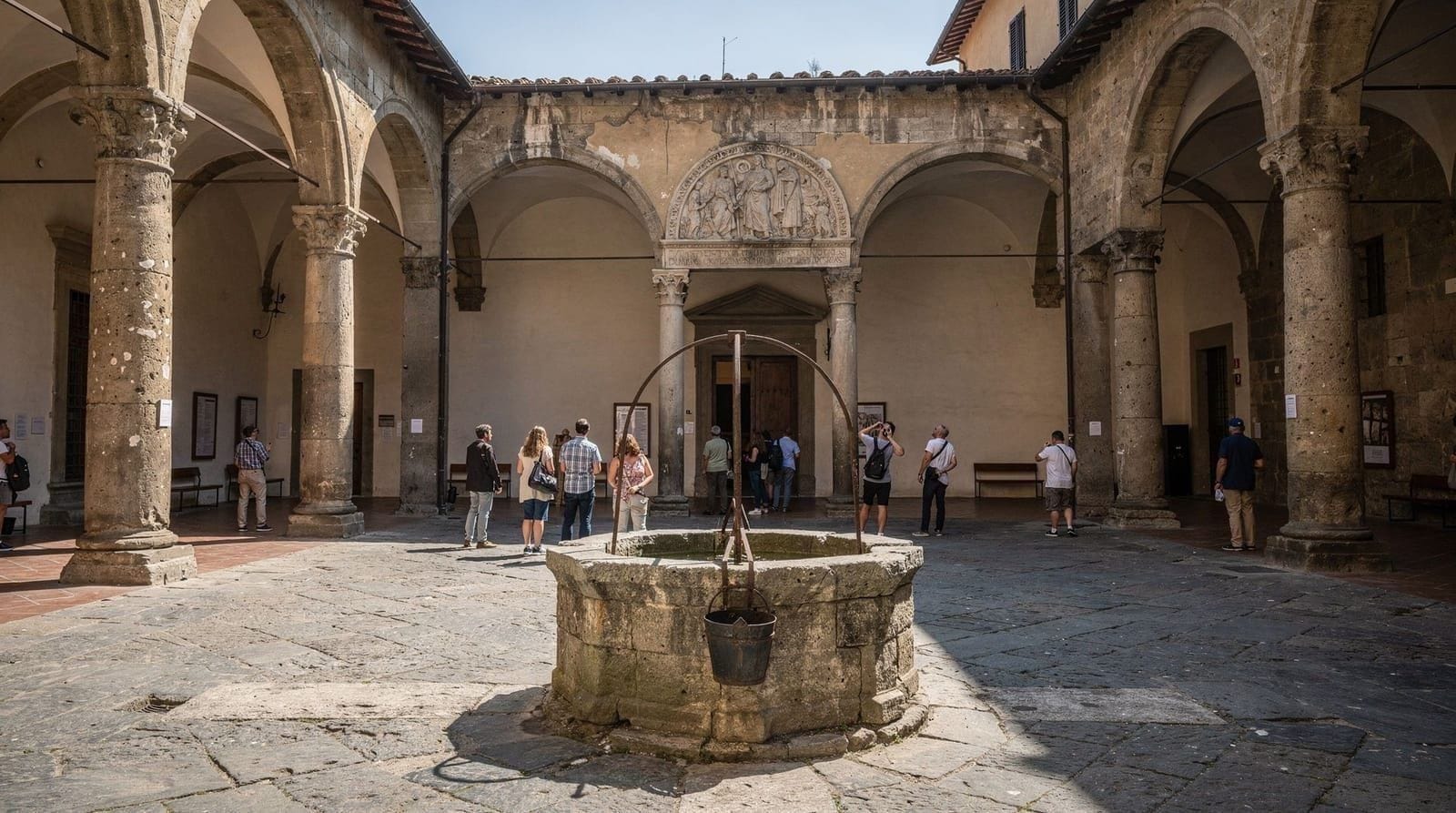
Medici Chapels: Michelangelo's New Sacristy and the Princes' Chapel
Florence: Medici Chapels guided tour
- Skip the line
- Small group
What are the Medici Chapels in Florence?
The Cappelle Medicee (Medici Chapels) are mausoleum chapels attached to the Basilica of San Lorenzo in Florence. They consist of two main spaces: the Cappella dei Principi (Princes' Chapel, decorated in rare stones and marble) and Michelangelo's Sagrestia Nuova (New Sacristy) with his famous tomb sculptures of Dawn, Dusk, Day, and Night. Entry is €9.
The Medici Chapels are attached to the Basilica of San Lorenzo — the Medici family church, where the dynasty is buried in extraordinary marble splendour. The complex is one of the great monuments of the Florentine Renaissance, and Michelangelo’s New Sacristy represents some of his most ambitious and philosophically complex sculptural thinking.
Unlike the David or the Pietà, which are individual masterworks, the New Sacristy is a total architectural and sculptural environment: Michelangelo designed the room, the architectural details, the tombs, and the sculptures as a unified statement about mortality, time, and the Medici dynasty’s relationship with both.
| Where | Piazza Madonna degli Aldobrandini 6, behind San Lorenzo |
| Cost | around €9 + €3 booking fee online |
| Time needed | 45–60 minutes |
| Best time | weekday morning, just after 8:15am opening |
| Booking | advance recommended March–October |
Essential visitor information
Address: Piazza Madonna degli Aldobrandini 6, behind the Basilica of San Lorenzo — 5-minute walk from the Duomo
Hours: Tuesday–Sunday 8:15 am – 4:30 pm; Closed Mondays and some holidays
Tickets: €9 + €3 booking fee online; walk-up usually possible
Time needed: 45–60 minutes
Getting there: 5 minutes from the Duomo, 10 minutes from the Accademia; ZTL zone applies
The entrance to the Medici Chapels is from a separate street behind San Lorenzo — not through the church’s main facade. Many visitors walk in circles looking for it. The entrance is on Piazza Madonna degli Aldobrandini, which runs along the back of the basilica.
The Cappella dei Principi (Princes’ Chapel)
The octagonal Cappella dei Principi was begun in 1604 — a century after most of Florence’s major Renaissance buildings — as the intended mausoleum for the Grand Dukes of Tuscany. The scale is enormous: 59 metres tall, lined entirely in pietra dura (hardstone intarsia) and rare marbles, with a dome rivalling the Duomo for sheer ambition.
The walls are faced in panels of granite, jasper, quartz, and other semi-precious stones assembled in complex geometric patterns — the work of the Opificio delle Pietre Dure, a Medici-founded workshop that still operates in Florence today (its museum, the Museo dell’Opificio delle Pietre Dure, is nearby). The project was never completed — the intended sarcophagi for all the Grand Dukes were planned in the same hardstone but only two were finished; the others are simply empty.
The Princes’ Chapel is opulent to the point of excess — it makes the New Sacristy feel almost austere by comparison, which is probably the intended effect. The Medici Grand Dukes wanted a mausoleum that would outshine anything in Rome; they largely succeeded. Whether you find it beautiful or overwhelming is a personal response.
Michelangelo’s New Sacristy (Sagrestia Nuova)
The Sagrestia Nuova was commissioned from Michelangelo in 1519–1520 by the Medici Pope Leo X and Pope Clement VII (both Medici). It was designed as a symmetrical companion to Brunelleschi’s Old Sacristy (Sagrestia Vecchia) in the same basilica, mirroring its architectural scheme while transforming every detail.
Michelangelo worked on the chapel from 1521 until 1534, when political events forced him to leave Florence permanently. The chapel was completed by assistants and was never fully finished to his vision — several figures were never carved, and the ceiling programme was altered.
The tombs and allegories
Two of the four walls contain the completed tomb monuments:
Tomb of Giuliano de’ Medici (Duke of Nemours): The idealized, armoured figure of Giuliano sits in a niche above two reclining allegorical figures — Day and Night. Day is unfinished on one side (where Michelangelo apparently abandoned it); Night is among the most famous figures in all of Renaissance sculpture, with her heavy, sleep-laden posture and the subtle detail of the owl beneath her leg, the mask, the crown of poppy flowers.
Tomb of Lorenzo de’ Medici (Duke of Urbino): Lorenzo sits in a reflective, somewhat melancholic pose — this is the “Lorenzo il Pensive,” the image that inspired Longfellow’s famous poem. Above the paired figures of Dawn and Dusk. Dawn (Aurora) is the most emotionally readable: a woman lifting herself from sleep with an expression of sorrowful reluctance, as if waking into grief.
The Madonna and Child: On the third wall, opposite the door, Michelangelo’s unfinished Madonna and Child with saints Cosmas and Damian (completed by assistants) faces the two tombs. This wall was originally intended to house the tomb of Lorenzo the Magnificent (the most significant Medici) and his brother — but it was never completed.
The philosophy of Time
The four allegories — Dawn, Dusk, Day, Night — represent the times of day and by extension the passage of time itself. Placed on funerary monuments, they meditate on the inexorable nature of mortality: time passes, the light changes, night comes. A contemporary Florentine poet composed a verse imagining Night saying: “I am glad to be sleeping, gladder still to be of stone: while harm and shame remain in the world, not to see, not to feel, is my great fortune.”
The architectural environment
The New Sacristy’s architectural brilliance is inseparable from the sculptures. Michelangelo designed the space with tall blind niches, a double-register wall treatment, and pietra serena grey stone detailing against white plaster — exactly the Brunelleschian vocabulary, but pushed toward tension. The room feels energised in a way the Old Sacristy doesn’t.
Spend time looking at the architectural details — the unusual tabernacles, the way the drum rises above the pendentives, the quality of light from the lantern above. This is Michelangelo thinking through architecture the same way he thinks through sculpture.
Michelangelo’s secret room
In 1975, during restoration work below the New Sacristy, workers broke through a wall and discovered a hidden space measuring roughly 7 by 12 metres, about 3 metres tall. The walls were covered in charcoal drawings — roughly 50 separate sketches attributed to Michelangelo himself.
According to this theory, Michelangelo hid in the space for three months in 1530, after the Medici returned to power following a failed Florentine republican uprising (which Michelangelo had supported). He sketched on the walls while waiting for political developments to clarify his situation before eventually negotiating safe passage.
The drawings include studies of figures that appear related to his contemporaneous works, as well as compositional sketches. Access to the room is granted through periodic special tours — check the museum’s website for availability. The space is only accessible to very small groups.
San Lorenzo: the church behind the chapels
A visit to the Medici Chapels is well complemented by a visit to the adjacent Basilica of San Lorenzo (separate entry, approximately €6). The church contains:
- Brunelleschi’s Old Sacristy (Sagrestia Vecchia) — the architectural model Michelangelo was responding to
- Two bronze pulpits by Donatello, his last works
- Frescoes by Pontormo and Bronzino in the Cappella dei Principi
- Medici tombs across the floor
The adjacent Biblioteca Medicea Laurenziana (Laurentian Library), designed by Michelangelo, is accessible from the church cloister — a stunning example of Mannerist architecture, with Michelangelo’s famous staircase in the vestibule.
Related guides
- San Marco Museum guide
- Accademia Gallery guide
- Bargello Museum guide
- Best museums in Florence
- Is the Firenzecard worth it?
Frequently asked questions about the Medici Chapels
Is the Medici Chapels visit included in the Firenzecard?
Yes. The Medici Chapels (Cappelle Medicee) are included in the Firenzecard. Entry is free for cardholders.
Can I visit San Lorenzo Basilica with the same ticket as the Medici Chapels?
No. The Medici Chapels and the Basilica of San Lorenzo are managed separately and require separate entry fees. However, they are directly adjacent and a combined visit to both takes 90–120 minutes total.
How is Michelangelo’s room in the Medici Chapels different from his secret passages at Palazzo Vecchio?
These are entirely different sites. The “secret room” at the Medici Chapels is the discovered hiding space beneath the New Sacristy with charcoal drawings. The Palazzo Vecchio has its own secret passages built into the walls as service and security routes. Both are interesting; neither is routinely open to general visitors without special booking.
Who was Giuliano de’ Medici?
The Giuliano buried in Michelangelo’s New Sacristy is Giuliano di Lorenzo de’ Medici, Duke of Nemours (1479–1516), son of Lorenzo the Magnificent and brother of Pope Leo X. He is not to be confused with an earlier Giuliano de’ Medici who was stabbed to death in the Pazzi Conspiracy of 1478 — that Giuliano is commemorated differently.
The Medici: why this dynasty matters
A visit to the Medici Chapels is considerably richer with some background on the family buried here. The Medici were the most influential private family in the history of Western art — not because they were artists themselves (though several had artistic gifts) but because they spent extraordinary wealth on patronage for over 150 years.
Cosimo de’ Medici (1389–1464): The founding patriarch of Medici power. Made his fortune in banking (the Medici Bank was the largest in Europe for decades) and used it systematically to accumulate political influence and cultural capital. He funded Brunelleschi’s rebuilding of San Lorenzo, commissioned Donatello’s sculptures, and supported Fra Angelico at San Marco. He was the first person in Florence since antiquity to commission art primarily for secular display rather than religious devotion.
Piero de’ Medici (1416–1469): “Piero il Gottoso” (Piero the Gouty) — largely remembered for his physical limitations and his patronage of the young Botticelli.
Lorenzo de’ Medici (1449–1492): “Lorenzo il Magnifico” — the pinnacle of the dynasty’s cultural influence. A poet, humanist philosopher, and political genius who effectively governed Florence without holding formal office. He supported Botticelli, employed the young Michelangelo, protected Leonardo da Vinci until he left for Milan. He also made a critical error in supporting the Pazzi Conspiracy assassination attempt on his brother Giuliano, which resulted in Giuliano’s death and Lorenzo’s increased authoritarian control of the city.
Pope Leo X (1475–1521): Lorenzo’s son Giovanni became the first Florentine pope. His papacy coincided with the emergence of Martin Luther — Leo’s response to the Protestant challenge was initially dismissive, a miscalculation with enormous historical consequences. He commissioned Raphael’s Stanze in the Vatican and Michelangelo’s work on San Lorenzo.
Pope Clement VII (1478–1534): Another Medici pope (Giulio de’ Medici). His papacy included the catastrophic Sack of Rome in 1527, when Charles V’s troops (including many Lutherans) occupied and looted the city. It was Clement who commissioned Michelangelo’s New Sacristy, though political upheaval repeatedly delayed the project.
The New Sacristy’s sculptures — Dawn, Dusk, Day, Night — were intended to honour members of this family. The fact that they are not realistic portraits (historians debate whether the armoured figure of Giuliano resembles the real person) but idealised types was apparently a deliberate choice. Michelangelo reportedly said that in a thousand years no one would care whether the figures resembled their subjects.
The Laurentian Library: Michelangelo’s architecture next door
Visitors to the Medici Chapels often miss the Biblioteca Medicea Laurenziana — the Laurentian Library — accessible via the cloister of San Lorenzo (separate entry required). This was Michelangelo’s most important architectural project: the entrance vestibule and its famous three-flight staircase, plus the reading room, were designed in the 1520s–1530s.
The vestibule staircase is one of the strangest and most influential architectural spaces of the Renaissance. Michelangelo used architectural elements in unorthodox ways — columns set into the wall rather than projecting from it, brackets that support nothing, a staircase whose three branches converge into one like flowing lava (Vasari’s description) — that appear to violate every rule of classical architecture. This is Mannerism in its pure architectural form: using the classical vocabulary while deliberately misapplying its rules.
The library above the vestibule is serene by contrast: a long room with 88 identical wooden reading desks (designed by Michelangelo), a terracotta floor, and windows that flood the room with even northern light. It houses over 11,000 manuscripts and rare books, including the Virgil that Petrarch annotated and the Codex Amiatinus, one of the oldest surviving Latin Bibles.
The library has specific hours (typically mornings only) and separate admission from both the church and the Medici Chapels. Check the museum website for current opening times before planning to include it.
The San Lorenzo neighbourhood
The area around the Medici Chapels is one of Florence’s most densely layered historically. Within a 5-minute radius:
Mercato Centrale: Florence’s principal covered food market, now with a good upstairs food hall added in 2014. A short walk north from the Medici Chapels; excellent for lunch before or after your museum visit.
San Lorenzo street market: The outdoor market around the church is the largest street market in central Florence, selling leather goods, clothing, and textiles. Fair warning: the leather goods here include substantial quantities of low-quality items not made in Italy despite “Genuine Italian leather” labelling. If you want actual Florentine leather, seek out specialist shops in the Oltrarno rather than the market stalls.
Palazzo Medici Riccardi: Lorenzo the Magnificent’s actual home (300 metres east on Via Cavour) — the building Michelozzo designed for Cosimo in the 1440s. The Cappella dei Magi inside has frescoes by Benozzo Gozzoli showing the Three Kings in an elaborate Florentine landscape, with portraits of the Medici family painted into the procession. €7 entry; usually uncrowded.
Piazza della Repubblica: 10 minutes south-east — the historic centre of medieval Florence, now an elegant 19th-century piazza with famous cafés including Caffè Gilli and Caffè Paszkowski.
Best time to visit and how to skip the queue
The New Sacristy is one of the most popular timed-entry sites in Florence, and its capacity is genuinely small — the room only holds a limited number of visitors comfortably, so tour groups and independent visitors are managed in waves. Arriving at or just after the 8:15am opening is consistently the quietest window; by mid-morning in high season the entrance courtyard on Piazza Madonna degli Aldobrandini can have a real queue, even with a booked ticket, because the door only opens on a schedule.
Late afternoon (after 3:30pm) is the second-best window — most tour groups have moved on to the Uffizi or Accademia by then, and the museum’s last entry at 4:30pm means the final hour is usually calm. Avoid Saturday mornings between April and June, when the Medici Chapels frequently appear on multi-stop guided itineraries alongside San Lorenzo and Mercato Centrale.
Booking online a few days ahead is worth the small fee, especially March through October. In the depths of winter (November–February, excluding the Christmas week), walk-up entry without a wait is common even at midday.
Weather rarely affects the decision either way, since the whole visit is indoors — this makes the Medici Chapels a reliable rainy-day option when the Boboli Gardens or a Piazzale Michelangelo sunset walk are off the table. If you’re building a wet-weather itinerary, pair it with the Opera del Duomo Museum or Museo Galileo, both a short walk away and similarly uncrowded.
Families visiting with children often underestimate how well this site works for younger visitors — the secret room story, the outsized scale of the Princes’ Chapel, and the sheer strangeness of the New Sacristy’s allegorical figures tend to hold attention better than a conventional painting gallery. Framing the visit as “the room where Michelangelo hid” before mentioning the art history tends to work well with reluctant young museum-goers.
Should you pair it with a guided tour?
Independent visits work well if you read up beforehand — the iconographic program of Dawn, Dusk, Day and Night rewards preparation, but the museum’s own labelling is fairly minimal. A guided tour (private or small-group) adds real value here specifically because the room is small and the story dense: guides typically walk you through the allegorical figures one at a time and explain the political context of the Pazzi Conspiracy and the 1530 siege that shapes the whole space. For visitors who prefer to move at their own pace, a well-prepared self-guided visit with this page open is entirely sufficient — the New Sacristy itself takes only 20–25 minutes to see properly, so over-scheduling it is easy to avoid.
Top experiences
Bookable activities with verified prices and instant confirmation on GetYourGuide.

Florence: reserved entry ticket to Medici Chapels
- Skip the line
- Instant confirmation
Florence: Medici Chapels private tour
- Free cancellation
Florence: skip-the-line Medici Chapels and Medici family heritage tour
- Skip the line
- Free cancellation
Florence: Medici Chapels tour with Michelangelo's secret room
- Small group
- Free cancellation
Florence: guided tour of the Medici with ticket to the Medici Chapels
- Skip the line
- Small group
Florence: guided tour of Medici family secrets and chapels
- Small group
- Free cancellation