San Marco Museum: Fra Angelico's frescoed convent
Florence: Renaissance and Medici walking tour
- Free cancellation
- Small group
What is in the San Marco Museum in Florence?
The Museo di San Marco is a 15th-century Dominican convent where Fra Angelico (Beato Angelico) painted frescoes in the chapter house, cloister, and each of 44 monks' cells. The museum also contains Fra Angelico's panel paintings and altarpieces, and preserves Savonarola's cell where he lived before his execution. Entry is €8.
The Museo di San Marco is one of Florence’s most quietly powerful museums — not spectacular in the Uffizi’s overwhelming way, but deeply affecting. The experience of walking through the corridors of a working 15th-century convent, entering each small cell to find a fresco painted directly on the plaster wall, is unlike anything in Italy’s larger, more famous institutions.
Fra Angelico painted approximately 44 individual frescoes in the monks’ cells of the Convent of San Marco between 1438 and 1445 — one per cell, each depicting a scene from the Passion or a moment of sacred history, each designed as a private aid to meditation for the monk who lived in that cell. The frescoes are not grand public statements. They are intimate, personal, and extraordinarily moving in their context.
Essential visitor information
| Where | Piazza San Marco 3, 3 minutes from the Accademia Gallery |
| Cost | around €8 + booking fee |
| Time needed | 60–90 minutes |
| Getting there | 10 minutes from the Duomo; ZTL zone applies |
| Best time | weekday mornings; check the short Tue–Fri afternoon closure below |
Hours: Tuesday–Friday 8:15 am – 1:30 pm; Saturday–Sunday 8:15 am – 4:45 pm; Closed Mondays and some holidays
Tickets: €8 + booking fee; walk-up usually possible
Getting there: 10 minutes from the Duomo; 3 minutes from the Accademia; ZTL zone applies
Note: the San Marco Museum has shorter hours than most Florence museums — the Tuesday–Friday afternoon closure catches many visitors off-guard. Check the schedule carefully before planning your visit.
History: the convent and its patrons
The Convent of San Marco was a dilapidated structure when Cosimo de’ Medici the Elder (Cosimo il Vecchio) paid for its complete reconstruction beginning in 1437. The architect was Michelozzo, who also designed the Medici Palace. Cosimo funded the new convent out of guilt for wealth accumulated through usury — or so the Dominican friars encouraged him to believe — and spent enormous sums on both the building and its decoration.
Fra Angelico, already a renowned painter, was a member of the Dominican order and was commissioned to paint the frescoes. He worked with a small team of assistants, though the most important cells were painted entirely by his own hand.
The convent remained active until the Napoleonic suppression of religious orders in 1808, when it was converted into a state museum. The monks were expelled; their cells became exhibit rooms.
What to see
The Cloister of Sant’Antonino
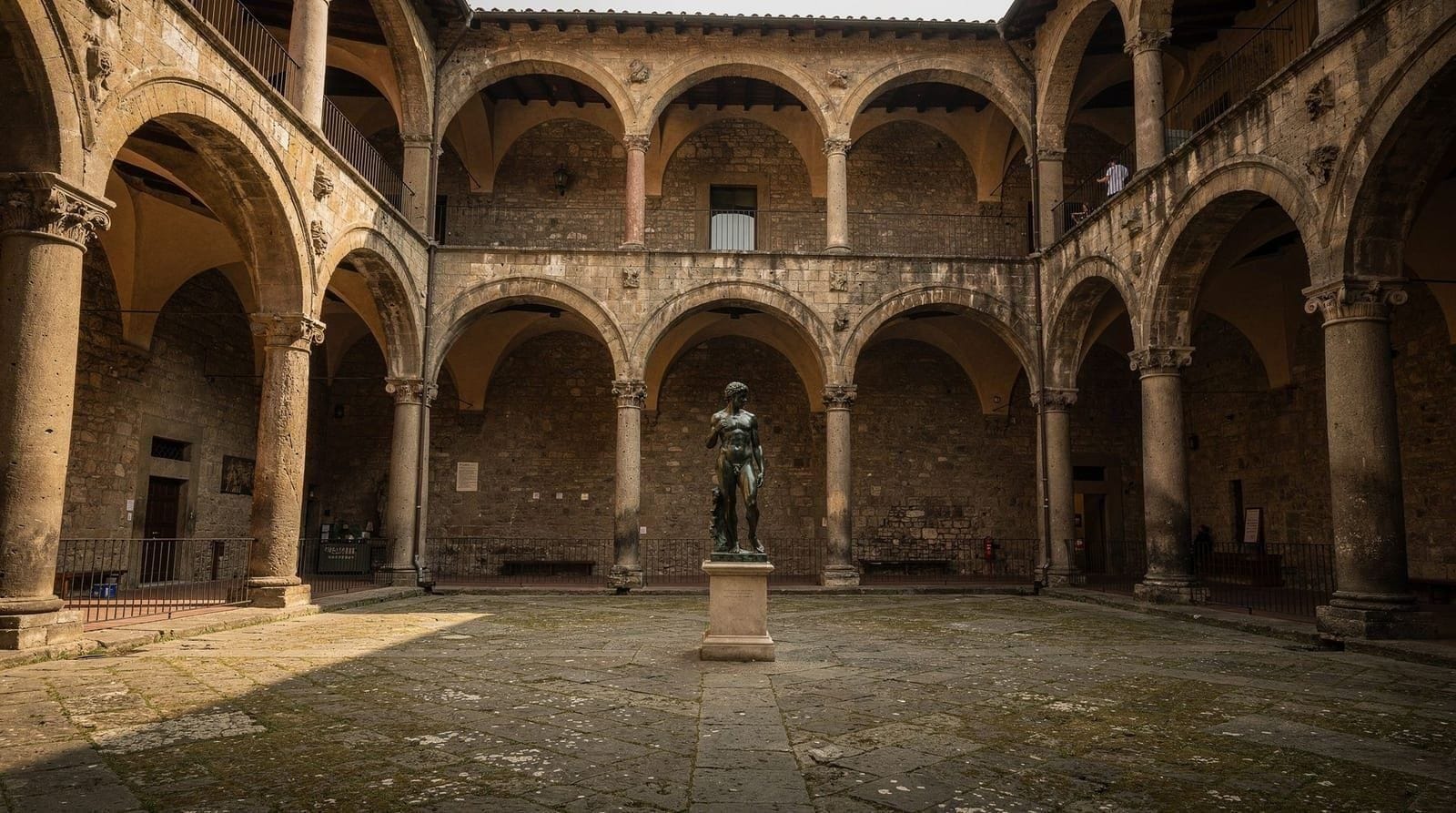
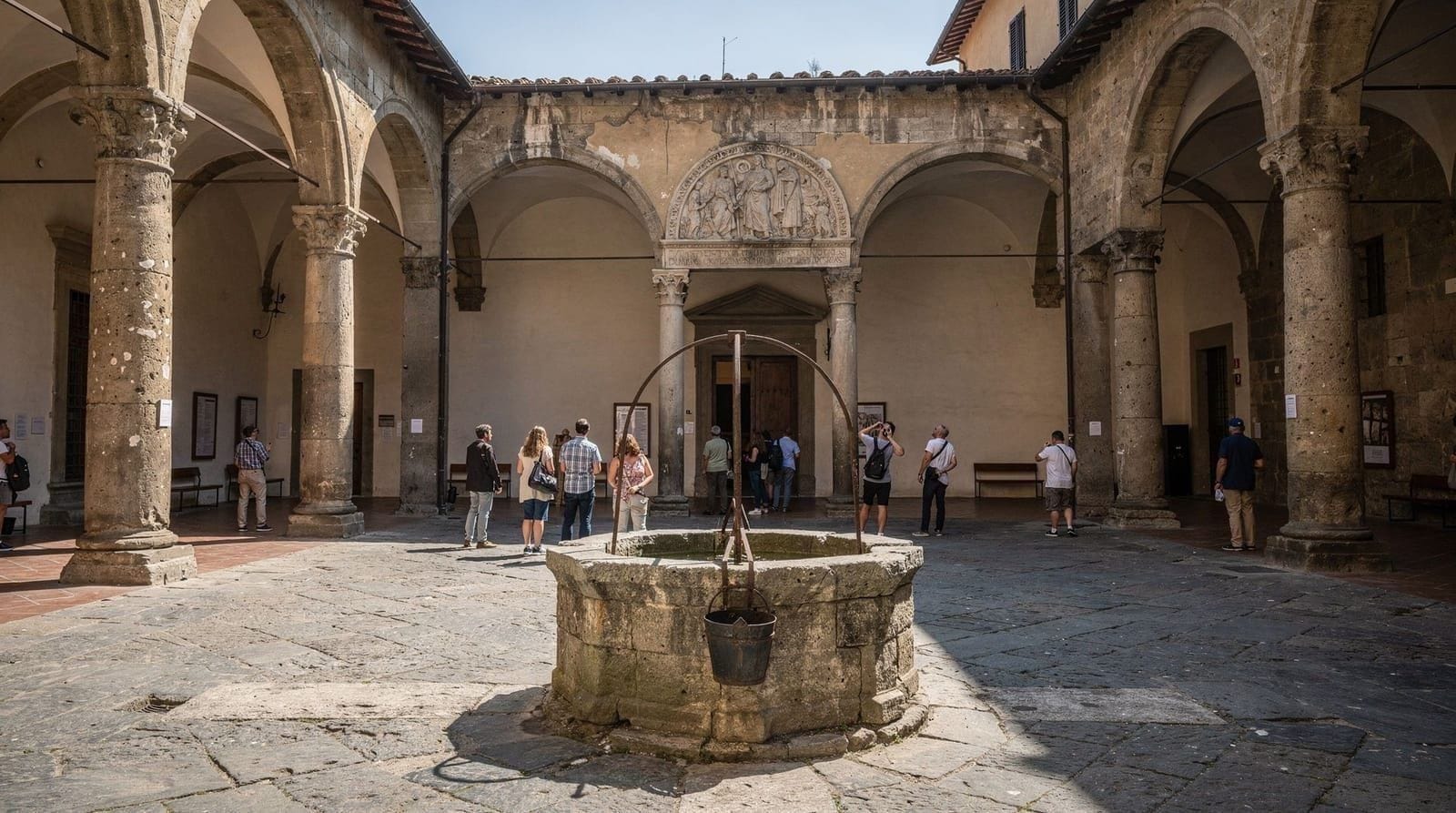
The entrance opens into a large cloister with several lunette frescoes by Fra Angelico and his workshop. The double-arched loggia was designed by Michelozzo and is one of the most elegant Renaissance cloister spaces in Tuscany. The well in the centre, the green garden, and the stone arcade create a contemplative environment that prepares you for what’s inside.
The Chapter House and Refectory
The Chapter House (ground floor, left) contains Fra Angelico’s large Crucifixion fresco — one of the most important works in the convent. The figures of the Virgin, John the Evangelist, and a crowd of saints and Dominican friars witness the Crucifixion; the composition is one of the most psychologically complex of Fra Angelico’s works, with grief in every face.
The old Refectory (dining hall) contains a large Last Supper fresco and other works.
The Annunciation (top of the staircase)
The single most reproduced image in the San Marco Museum is the Annunciation fresco at the top of the stairs leading to the monks’ cells. Fra Angelico painted this large fresco (230 x 321 cm) on the landing as a reminder, for every monk ascending to the dormitory, of the moment of the Incarnation. The figure of the Angel Gabriel and the Virgin Mary in a simple loggia, the clarity of the architecture, the softness of the colour — this is Fra Angelico at his most characteristic.
The monks’ cells (dormitory)
The 44 cells on the first floor are the heart of the museum. Each is a small whitewashed room with a vaulted ceiling, a single high window, and a fresco on the entrance wall. The quality varies — Fra Angelico himself painted the most important cells; assistants painted others — but even the workshop cells are striking in their original context.
Key cells:
Cell 1: The Annunciation (Fra Angelico’s own hand, considered the finest of the cell paintings)
Cell 3: Annunciation with Saint Peter Martyr
Cell 6: Transfiguration — the white-clad Christ floating between Elijah and Moses
Cell 9: Coronation of the Virgin
Cells 38–39: Cosimo de’ Medici’s private cells — he stayed here during retreats at the convent, and his cells are larger than the monks’
Savonarola’s cell
The cell of Girolamo Savonarola (Cells 12–14) is preserved as it was when the reforming Dominican friar lived here in the late 15th century. Savonarola was the Prior of San Marco before his famous campaign against Florentine luxury, his “Bonfire of the Vanities” (when Florentine citizens burned books, art, and luxury goods in the Piazza della Signoria), and his eventual trial and execution by burning in the same piazza in 1498.
The cells preserve his portrait, his habit, and documents related to his trial. It is a sobering complement to the serenity of Fra Angelico’s frescoes elsewhere in the building.
The library
Michelozzo designed the convent library as one of the first public libraries in Europe — Cosimo opened it to scholars outside the monastic community, creating a prototype for the accessible library as a civic institution. The long barrel-vaulted room with classical columns is a masterpiece of early Renaissance architecture and is still used for exhibitions.
San Marco versus the Accademia and the Uffizi
Visitors with limited time in Florence often ask whether San Marco is worth adding alongside the Accademia and the Uffizi, and the honest answer depends on what you’re looking for.
| San Marco Museum | Accademia Gallery | Uffizi | |
|---|---|---|---|
| Typical visit length | 60–90 min | 45–60 min | 2–3 hours |
| Crowds | light to moderate | heavy, timed entry essential | very heavy |
| Character | intimate, contemplative | one iconic statue plus musical instruments | vast encyclopaedic collection |
| Best for | slow lovers of quiet art | first-time visitors, must-see checklist | serious art interest, full day |
San Marco rewards visitors who already have their “must-see” boxes ticked and want something quieter and more personal. It is not a substitute for the Accademia or the Uffizi — see our best museums in Florence guide for how to prioritise if you only have one or two museum slots in your itinerary, and check whether the Firenzecard is worth it if you plan to visit several museums including San Marco and the Medici Chapels.
Combining with nearby attractions
The San Marco Museum’s location makes it easy to combine with:
- Accademia Gallery: 3-minute walk (book in advance)
- Piazza Santissima Annunziata: 5-minute walk — the founding hospital of Europe’s first orphanage (Ospedale degli Innocenti) and Brunelleschi’s loggia
- Mercato Centrale: 10-minute walk — good lunch options
- Medici Chapels: 15-minute walk
Related guides
Frequently asked questions about the San Marco Museum
Is the San Marco Museum included in the Firenzecard?
Yes. The Firenzecard covers entry to the San Marco Museum. No separate ticket is needed with a valid Firenzecard.
Are all the frescoes by Fra Angelico himself?
No. Fra Angelico supervised a workshop of assistants, and the cell paintings vary significantly in quality depending on how much of his own hand was involved. The most important cells — the Annunciation at the top of the stairs, the Annunciation in Cell 1, the Crucifixion in the Chapter House — are considered primarily by Fra Angelico. Others were executed by his workshop following his compositions.
Can you visit the church of San Marco separately?
The Basilica di San Marco, directly attached to the museum, is a separate active church with free entry. It contains paintings by Fra Bartolomeo and a tomb monument. It is not part of the museum ticket. You can visit the church for free before or after your museum visit.
Is photography allowed inside the San Marco Museum?
Photography is permitted in most areas. Some cells may have restrictions — signs indicate where photography is not allowed. The intimate scale of the cells and the quality of the natural light through the small windows can make photography challenging in any case.
Understanding Fra Angelico: background for your visit
A visit to San Marco is considerably richer with some understanding of who Fra Angelico was and why the frescoes he painted here are considered among the finest achievements of the early Renaissance.
Guido di Pietro was born around 1395 in the Mugello valley northeast of Florence. He entered the Dominican order as a young man, taking the name Fra Giovanni da Fiesole. The name “Angelico” (and eventually “Beato Angelico” — Blessed Angelico) was a posthumous honour, recognising both his extraordinary artistic gift and his reputation for saintly life. He was formally beatified by Pope John Paul II in 1982.
Fra Angelico was not simply a pious amateur. He was a highly trained painter who fully absorbed the technical innovations of early Renaissance painting — Brunelleschi’s perspective, Masaccio’s use of shadow to model three-dimensional figures, the naturalistic drapery of Ghiberti. His achievement was to apply this technical mastery to devotional subjects with an intensity of spiritual feeling that no contemporary quite matched.
The cell frescoes at San Marco represent a particular phase of his work: the intimate, contemplative mode versus the grand public altarpieces (like the San Marco altarpiece, now in the museum’s ground floor) that were made for formal display. The cell frescoes were never meant to be seen by the general public. They were private meditations, painted directly on the walls where a friar would spend many hours of his life. Fra Angelico adjusted his scale and intensity accordingly.
Savonarola: the other story in this building
Girolamo Savonarola is one of the most dramatic figures in Florentine history, and his cells at San Marco (Rooms 12–14) connect the museum to a narrative quite different from Fra Angelico’s gentle devotion.
Savonarola was born in Ferrara in 1452 and entered the Dominican order at age 22. He arrived at San Marco in 1490 and quickly became known for his fiery preaching against corruption — in the Church, in the Florentine elite, and in the content of Renaissance art itself. He attracted an enormous following in Florence, particularly among the poorer classes, and his sermons in the Duomo drew audiences of thousands.
After the Medici fled Florence in 1494 (following the French invasion), Savonarola effectively became the city’s moral and political leader. He organised the “Bonfire of the Vanities” in 1497 and 1498 — events in which Florentine citizens, under his influence, burned luxury goods, secular books, cosmetics, artworks, and other items associated with vanity. Some accounts have Botticelli burning his own secular paintings; this is probably a legend, but it captures the atmosphere.
Savonarola’s conflict with Pope Alexander VI (Rodrigo Borgia) was inevitable: he was publicly accusing the papacy of corruption. He was excommunicated in 1497 and arrested in 1498. After a trial that included torture, he was convicted of heresy and sedition, and burned alive in Piazza della Signoria on 23 May 1498 — exactly the site where his own bonfires had burned.
His cell at San Marco preserves his portrait (the ascetic, sharp-featured face familiar from woodcuts), his wooden habit, a fragment of his original trial documents, and the chains from his imprisonment. The space is austere to the point of severity — white walls, no decoration, just the objects and the story. After the beauty of Fra Angelico’s frescoes, Savonarola’s cell hits differently.
The Cosimo de’ Medici connection
The cells at the south end of the dormitory (Rooms 38–39) were designated for Cosimo de’ Medici the Elder, who funded the entire rebuilding of the convent and had a strong relationship with the Dominican prior Fra Antoninus (later Archbishop of Florence and canonized as Saint Antoninus). These cells are larger than the monks’ cells — they needed to accommodate Cosimo’s retinue during his retreat stays — and they open onto a small private loggia.
Cosimo spent considerable time at San Marco on spiritual retreats, and his relationship with Fra Angelico extended beyond patronage. He reportedly asked Fra Angelico to recommend how he could use his considerable wealth in ways that would benefit his soul. Fra Angelico (a Dominican, sworn to poverty) suggested spending money on churches, hospitals, and charitable works — which Cosimo did, in prodigious quantities.
The cell frescoes served as aids to Cosimo’s own meditation, not just the friars’. Several cells near his quarters contain unusual iconographic programmes that seem designed for a wealthy layman rather than a trained theologian.
Tips for a better visit
Go early or go late. The museum opens at 8:15am on all days it operates, and the first 45 minutes are consistently the quietest — you can often have several cells entirely to yourself. On Saturdays and Sundays, when the museum stays open until 4:45pm, the final hour before closing is a similarly good window.
Bring your own light patience. The cells were designed for candlelight and a single high window; several of the frescoes are genuinely dim, especially on overcast days. Let your eyes adjust rather than relying on a phone flashlight, which flattens the fresco’s texture and is discouraged in some rooms.
Read the cell numbers, not just the art. Because the cells are laid out sequentially rather than thematically, it helps to glance at the small numbered plaques by each doorway and cross-reference the highlights list above rather than trying to identify every scene from memory.
Don’t rush the ground floor. Many visitors head straight upstairs to the cells and skip the Chapter House Crucifixion and the Refectory Last Supper on the ground floor — both are major works and take only 10-15 minutes combined.
After the museum: the San Marco neighbourhood
The area around Piazza San Marco is one of Florence’s most rewarding for leisurely exploration. Unlike the Piazza della Signoria area, it serves a primarily local population — Florentine university students (the University of Florence has faculties nearby), residents of the neighbouring streets, and a lower density of mass tourism.
Piazza Santissima Annunziata: 5 minutes east — one of Florence’s most beautiful piazzas, largely unrewarded with tourist attention. The Ospedale degli Innocenti (Hospital of the Innocents, 1419) by Brunelleschi on the eastern side was the first purpose-built orphanage in Europe and the first building to fully apply Renaissance architectural proportions. Its loggia, with Luca della Robbia terracotta roundels of swaddled infants, is one of the great civic architectural statements of the early Renaissance.
Caffè Gilli or Rivoire (if you’re heading toward the Duomo): Not in the immediate neighbourhood, but the walk from San Marco toward the Duomo passes several excellent coffee stops. Caffè San Marco on the piazza itself is the most convenient.
Mercato Centrale: 10 minutes west — Florence’s covered food market, with excellent lunch options upstairs (the upper hall was renovated in 2014 and now has multiple food stalls serving Florentine specialities).
Top experiences
Bookable activities with verified prices and instant confirmation on GetYourGuide.

Florence: walking tour
- Free cancellation
- Instant confirmation
Florence: Medici family private guided walking tour
- Free cancellation
Florence: reserved entry ticket to Medici Chapels
- Skip the line
- Instant confirmation
Florence: Accademia Gallery — David skip-the-line ticket
- Skip the line
- Instant confirmation