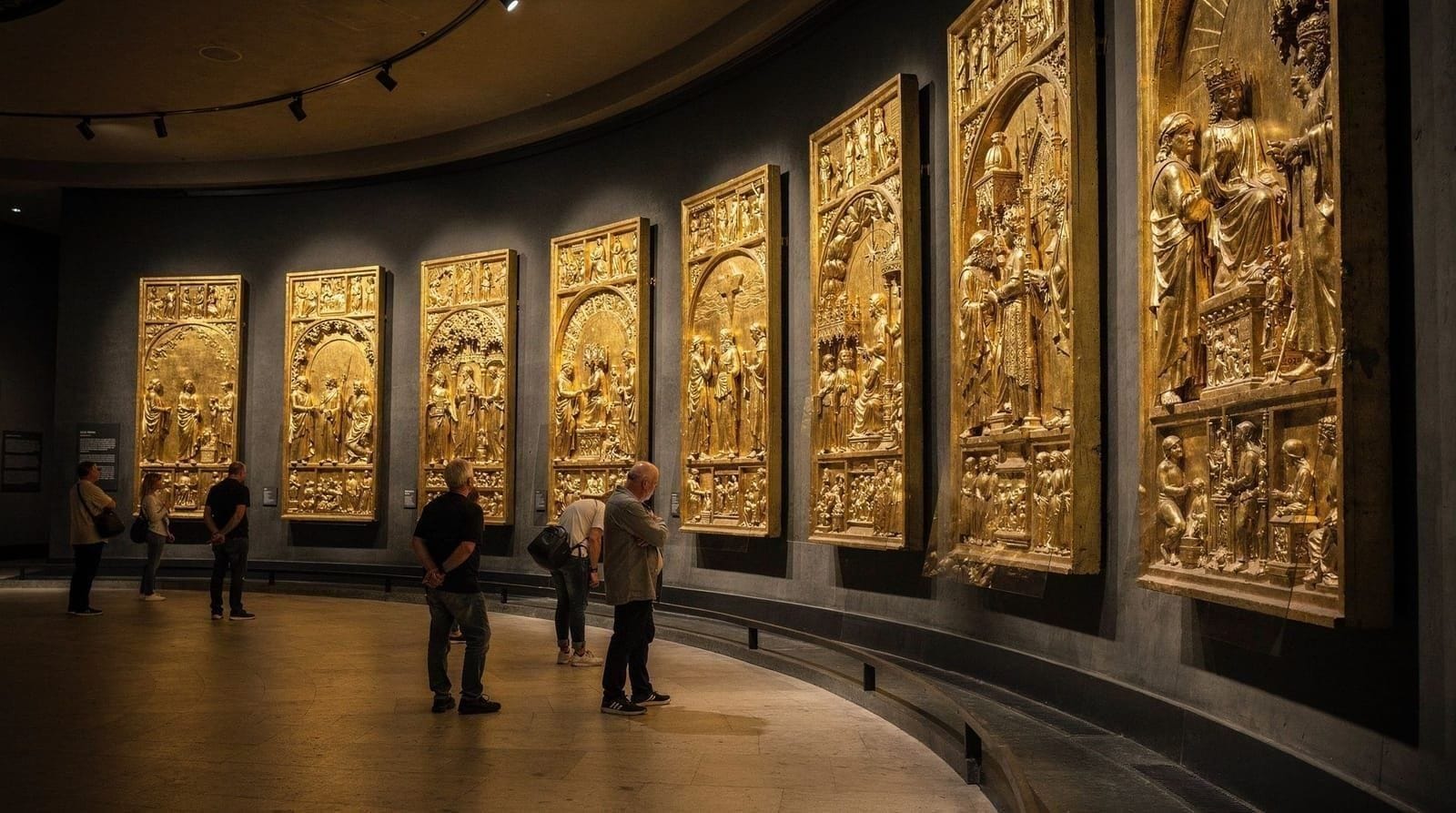
Museo Galileo: Florence's science museum worth your time
Florence: exclusive guided tour of Galileo's Museum
- Small group
- Free cancellation
What is in the Museo Galileo in Florence?
The Museo Galileo di Storia della Scienza houses Galileo Galilei's original telescopes, armillary spheres, astrolabes, Medici scientific instruments, and the preserved middle finger of Galileo himself. Two floors of interactive and display galleries cover astronomy, geography, chemistry, and physics from the 14th to the 19th century. Entry is €10.
Most Florence visitors fill their days with Botticelli, David, and Duomo. The Museo Galileo sits on the Lungarno degli Uffizi — a 2-minute walk from the Uffizi Gallery — and is routinely overlooked by exactly those people. It shouldn’t be.
The museum is small, rarely crowded, and houses one of the world’s most important collections of scientific instruments. For visitors with a shred of interest in how humans figured out the shape of the universe, it is genuinely extraordinary. For families with curious children, it is among the best things in Florence.
| Where | Piazza dei Giudici 1, on the Arno, 2 minutes from the Uffizi |
| Cost | around €10 + booking fee |
| Time needed | 60–90 minutes |
| Booking | rarely necessary; walk-up almost always possible |
| Best for | families, rainy days, pairing with the Uffizi |
Essential visitor information
Address: Piazza dei Giudici 1 — on the Arno riverfront, 2 minutes from the Uffizi
Hours: Wednesday–Monday 9:30 am – 6:00 pm; Tuesday 9:30 am – 1:00 pm
Tickets: €10 + booking fee; walk-up almost always possible
Time needed: 60–90 minutes
Getting there: Walking distance from all central Florence sites; ZTL zone, do not drive
What the museum actually is
The Istituto e Museo di Storia della Scienza (now rebranded Museo Galileo) was founded in 1930 in the Palazzo Castellani, a 12th-century palazzo on the Arno. Its collection incorporates the scientific instruments accumulated by the Medici and Lorraine dynasties over 400 years, plus objects associated directly with Galileo Galilei.
The Medici were not only art patrons — they were scientific patrons of equal ambition. Cosimo I founded the Accademia del Disegno and established Florence as a centre of both art and natural philosophy. His descendants maintained collections of scientific instruments that were simultaneously functional tools, luxury objects, and demonstrations of dynastic learning.
Room-by-room guide
Room 1: Medici mathematical instruments
Armillary spheres, astrolabes, celestial globes, quadrants, and surveying instruments from the 16th and 17th centuries. These aren’t reproductions — many were made for the Medici court by the finest instrument-makers of the era. The armillary spheres, showing the Earth at the centre of nested celestial rings, are objects of extraordinary beauty regardless of their now-incorrect cosmology.
Room 2: Compass and mathematical instruments
The Medici collection includes some of the earliest known proportional compasses (instruments for calculating relationships between measurements), used by Galileo himself for military and engineering calculations. Galileo made his early reputation partly through the design of an improved proportional compass, which he sold commercially.
Rooms 3–5: Astronomy and cosmology
Telescopes, models of the solar system (from Ptolemaic geocentric to Copernican heliocentric), star charts, and planispheres. The progression from instruments designed to map an Earth-centred universe to those observing a sun-centred one mirrors the intellectual revolution of the 16th and 17th centuries.
Room 7: Galileo’s instruments
This room contains the most important objects in the museum. Two original Galileo telescopes survive here — among only three known to exist anywhere. Galileo did not invent the telescope (that was a Dutch optician named Hans Lippershey) but he was the first to turn it systematically on the sky and record what he saw. His observations of the moons of Jupiter, the phases of Venus, and the surface of the Moon were among the key empirical challenges to the Church’s cosmological doctrine.
The telescopes are small — much smaller than modern visitors expect. They look, frankly, like wooden rods. The idea that these objects changed humanity’s understanding of the universe is both obvious (once you know the story) and somehow startling when the objects themselves are so modest.
Galileo’s middle finger: In the same room, displayed in a glass reliquary, is the preserved middle finger of Galileo’s right hand. The finger was removed during an exhumation in 1737 and treated as a relic — which is, historically, exactly what it was, in the same tradition of preserving parts of saints’ bodies that the Catholic Church had practised for centuries. Galileo, condemned by the Inquisition for heresy, had acquired a status approaching secular sainthood within a generation of his death. The finger is extraordinary to see, if you’re not squeamish. It raises precisely the questions about science, religion, and cultural memory that the Museo Galileo as a whole invites.
Rooms 8–11: Navigation and cartography
Instruments for celestial navigation, maps and globes from the age of exploration, portolan charts, and the tools of early oceanography. The collection is particularly strong in 15th and 16th century cartography — a period when the known world expanded faster than any generation before had experienced.
Room 12: Clocks and measuring time
The history of mechanical timekeeping. Galileo’s observation that a pendulum swings at a constant rate regardless of amplitude — reportedly made by watching the Duomo’s chandelier swing during a service — led directly to the pendulum clock. The room shows the development from water clocks through mechanical clocks to the precision instruments of the 18th century.
Rooms 13–16: Chemistry, physics, electricity
Later rooms cover the 18th and early 19th century development of chemistry and electrical science, including early galvanic and Voltaic cells, chemical apparatus, and instruments used in Florence’s scientific institutions. Less dramatically presented than the astronomy rooms but important for understanding the full arc of the collection.
Guided tours
The museum offers several guided tour options, including an exclusive small-group science tour and a private astronomical tour focused on Galileo’s astronomical instruments. These are led by museum staff with specialist knowledge and are worth the premium for anyone with deep interest in the history of science or astronomy. Book in advance — available through the museum or GetYourGuide.
Is it suitable for children?
The Museo Galileo is one of the best Florence museums for children aged 10 and up. The combination of beautiful mechanical objects, interactive demonstrations in some rooms, and the story of Galileo’s conflict with the Church (including the finger, which most children find simultaneously horrifying and hilarious) makes for a genuinely engaging visit.
The museum is genuinely interactive in places — certain exhibits allow visitors to manipulate reproductions of instruments. Older children and teenagers who have studied physics or astronomy will have strong contextual frameworks for what they’re seeing.
For younger children (under 8), the museum may be less engaging; the Boboli Gardens or a cooking class might be a better choice.
Combining with nearby attractions
The museum’s Lungarno location makes it easy to combine:
- Uffizi Gallery: 2-minute walk (book separately in advance)
- Piazza della Signoria and Palazzo Vecchio: 5-minute walk
- Ponte Vecchio: 5-minute walk west along the Arno
- Santa Croce (where Galileo is buried): 15-minute walk east
Related guides
- Best museums in Florence
- Is the Firenzecard worth it?
- Opera del Duomo Museum guide
- Palazzo Vecchio visitor guide
- Bargello Museum guide
Should you visit with children, and how to time it
Families weighing whether to add the Museo Galileo to an already packed Florence itinerary should think about it as a pressure-release valve rather than an extra obligation. After a morning of Renaissance painting — which asks children to stand still and look — an hour of telescopes, a preserved finger, and hands-on instruments asks something different, and most children respond well to the change of register. The museum’s compact size also means a visit doesn’t have to be a full commitment: even 45 focused minutes on Room 7 (Galileo’s instruments) and the clocks room covers the most memorable material.
The quietest visiting window is the first hour after opening on a weekday, before Uffizi-goers spill over on their way to or from that museum. Late afternoon on a Tuesday (when the museum closes early, at 1:00 pm) is not an option, so plan around that single shortened day if your schedule is tight.
For visitors comparing museum choices on a tight schedule, the Museo Galileo sits in an interesting middle ground between Florence’s headline sights and its genuinely overlooked ones. It gets more visitors than the Bargello or the Opera del Duomo Museum, but nowhere near the volume the Uffizi or Accademia see, which keeps the experience calm even at midday in July. If your itinerary already includes a full museum day at the Uffizi, treat the Museo Galileo as the natural coda rather than a separate outing — the contrast between painting galleries and instrument rooms genuinely refreshes attention rather than adding to museum fatigue, and the short walk between the two buildings makes the sequencing effortless to plan around.
Frequently asked questions about Museo Galileo
Is the Museo Galileo included in the Firenzecard?
Yes. The Museo Galileo is one of the 72+ institutions covered by the Firenzecard. If you already have a card, visiting the Galileo Museum costs nothing extra.
Do I need to pre-book Museo Galileo tickets?
Usually not. The museum rarely has significant queues even in peak season. Walk-up is almost always feasible. Pre-booking is recommended only if you’re planning a specific guided tour, which should be reserved in advance.
Is the middle finger of Galileo on public display?
Yes, the finger has been on display since 2010 when it returned to the museum after a private collector’s family donated it back to the city. It is displayed in room 7 along with Galileo’s telescopes and other instruments. Photography is permitted.
What language are the exhibit labels in?
All labels are in both Italian and English. The audio guide (available in several languages) provides considerably more depth than the wall labels alone and is worth the extra cost for visitors with specific interest in the history of science.
The broader significance of the Medici as scientific patrons
Visiting the Museo Galileo is most rewarding if you arrive with some awareness of why Florence was a centre of scientific as well as artistic activity in the Renaissance and early modern period. The Medici connection is central.
Cosimo I de’ Medici founded the Accademia del Disegno in 1563 — the first professional fine arts academy in Europe — as part of a broader program of intellectual patronage that encompassed natural philosophy alongside art. His successors continued this investment: Cosimo II de’ Medici (1590–1621) appointed Galileo as “First Mathematician and Philosopher to the Grand Duke,” providing him with a salary and the institutional protection that enabled the most productive period of his career.
This was not purely altruistic. Medici patronage of science served the same dynastic purposes as their patronage of art: demonstrating the cultural superiority of Florentine civilization, attracting talented individuals to the city, and accumulating objects that demonstrated knowledge and power. The scientific instruments in the museum’s collection — intricate, gold-decorated, made by master craftsmen — were simultaneously functional tools, luxury goods, and demonstrations of Medici access to the leading scientific minds of the era.
The instruments made for the Medici court were not simply functional. They were made by the same craftsmen who worked for royalty across Europe, using the same quality of materials (gilded brass, ivory, semi-precious stones), and they were displayed as part of the ducal collections alongside paintings and antiquities. Science and art were not separate domains in the Medici world.
Florence and the Inquisition: Galileo’s trial in context
The Museo Galileo presents Galileo’s scientific achievements in full but does not shy from the darker narrative: his condemnation by the Roman Inquisition in 1633 for insisting that the Earth moves around the Sun. Understanding this episode properly requires some context that the museum’s wall panels provide, and that a guided tour can elaborate.
Galileo’s conflict with the Church was not simply a collision between science and religion. Galileo had powerful supporters in the Church throughout his career, including the future Pope Urban VIII (Maffeo Barberini), a Florentine himself. The conflict was partly political — Galileo had made powerful enemies, partly procedural — the conditions of his 1616 warning were arguably ambiguous, and partly about the limits of what the Inquisition could tolerate being said publicly vs. privately.
The result was house arrest in his villa at Arcetri, outside Florence, for the final nine years of his life. He continued working — his Discourses on mechanics, which laid the foundations for Newton’s later work, were written during this period and smuggled out to Amsterdam for publication.
His remains were moved to Santa Croce in 1737, 95 years after his death (the Church had previously refused burial in consecrated ground). The ceremony included the removal of several body parts as relics — a common practice. The finger in Room 7 of the museum was one of these.
The Museo Galileo’s relationship to Florence’s universities and academic institutions
The museum operates in ongoing partnership with the University of Florence and several Italian scientific institutions. It functions not only as a public museum but as a research centre for the history of science. The library (not publicly accessible but visible from the reading rooms) holds thousands of historical scientific documents and rare books, including some of Galileo’s own manuscripts.
This active academic dimension means the museum’s interpretive approach tends to be rigorous rather than simplified — the wall panels assume visitors are interested in understanding things accurately, not just being impressed. If you find that style of presentation engaging, the Museo Galileo rewards close attention.
Planning your visit around the Uffizi
Given its location (2 minutes from the Uffizi, on the Arno embankment), the Museo Galileo is an excellent complementary visit on a day anchored at the Uffizi. After spending 2.5–3 hours with Renaissance painting, an hour in a museum focused on scientific instruments and experimental apparatus provides genuine mental relief.
The sequence: Uffizi (morning, booked in advance) → lunch near Piazza della Signoria → Museo Galileo (early afternoon, no pre-booking needed) → Ponte Vecchio and Oltrarno for the rest of the afternoon. This creates one of the more varied and satisfying full-day Florence itineraries.
The museum is also an excellent rainy-day option when Piazzale Michelangelo and the Boboli Gardens lose their appeal.
Top experiences
Bookable activities with verified prices and instant confirmation on GetYourGuide.