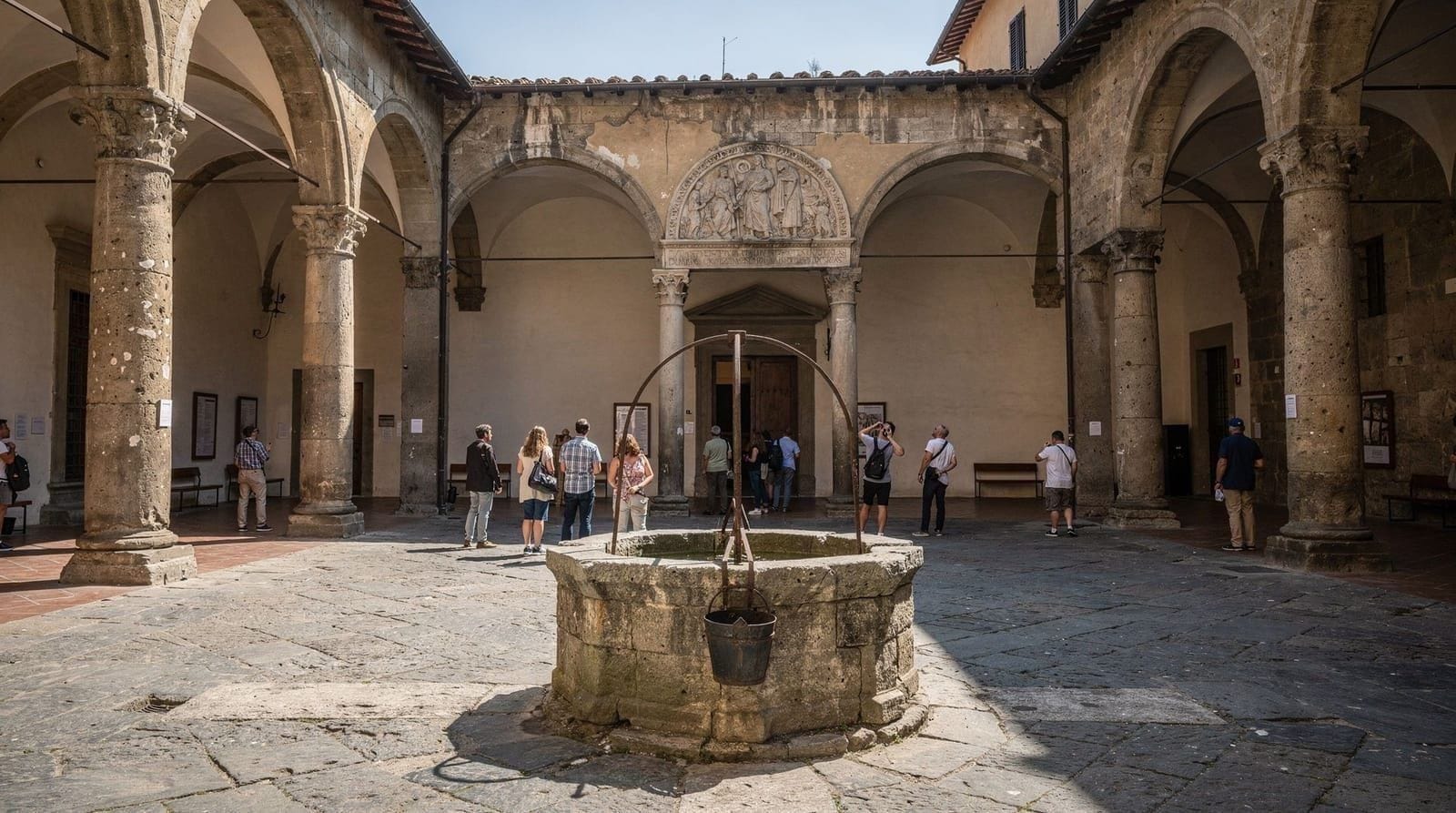
Opera del Duomo Museum: Ghiberti, Donatello, and Michelangelo's Pietà
Florence: Duomo tour with Brunelleschi's Dome climb access
- Skip the line
- Free cancellation
What is in the Opera del Duomo Museum in Florence?
The Museo dell'Opera del Duomo houses the original Gates of Paradise doors by Ghiberti, Michelangelo's Bandini Pietà, Donatello's penitent Mary Magdalene and his Cantoria, Brunelleschi's death mask and architectural models, and hundreds of sculptures removed from the cathedral's exterior for conservation. Entry is included in the €30 Duomo complex pass.
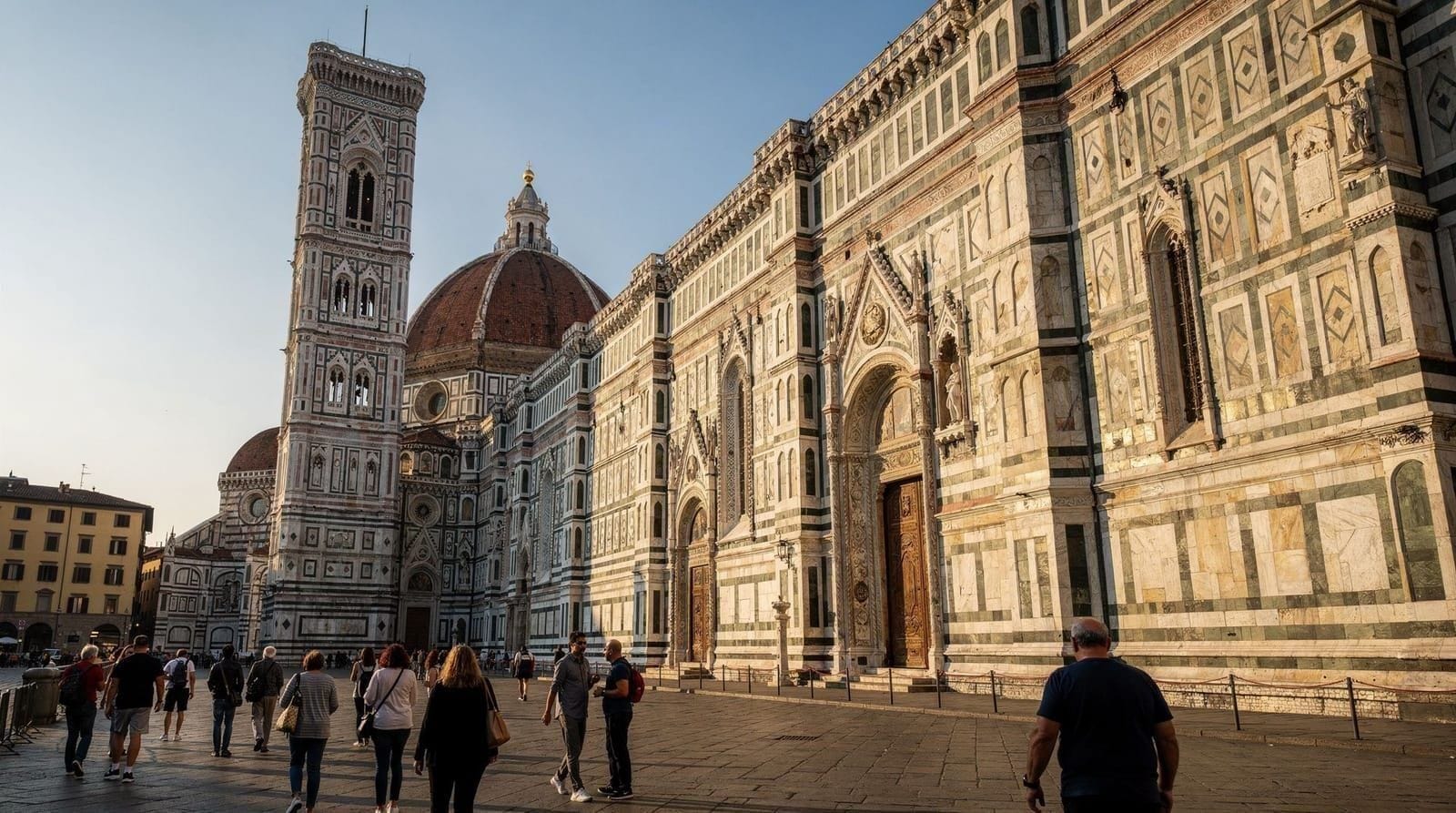
The Museo dell’Opera del Duomo is one of the best-kept secrets in Florence — which is remarkable given that it stands 100 metres from one of the most photographed buildings in the world and houses some of the most important sculptures in Italian art history.
Most visitors to Florence know about the Gates of Paradise (Ghiberti’s famous Baptistery doors) from photographs. Many don’t know the originals are inside the Opera del Duomo Museum, or that the same building houses a Michelangelo Pietà that most art historians consider more emotionally profound than the famous one in Rome.
| Where | Piazza del Duomo 9, behind the cathedral’s apse |
| Cost | included in the around €30 Duomo complex pass |
| Time needed | 60–90 minutes |
| Booking | timed slot needed for the pass, not for the museum itself |
| Best time | 9:00–11:30am for the quietest visit |
Essential visitor information
Address: Piazza del Duomo 9, Florence — directly behind the Duomo’s apse
Hours: Daily 9:00 am – 7:00 pm (last entry 6:30 pm); occasional variations — check museumflorence.com
Tickets: Included in the €30 Duomo complex pass. No standalone entry.
Time needed: 60–90 minutes
Getting there: Facing the east end of the Duomo on Piazza del Duomo; 10-minute walk from Santa Maria Novella station
What the museum covers
The Opera del Duomo (literally “Workshop of the Dome”) was the organization responsible for building and maintaining the Cathedral, Baptistery, Bell Tower, and Dome across seven centuries. It accumulated the most important works created for these buildings, and when sculptures, carvings, and architectural elements needed to be replaced with reproductions (to protect originals from weathering), the originals came here.
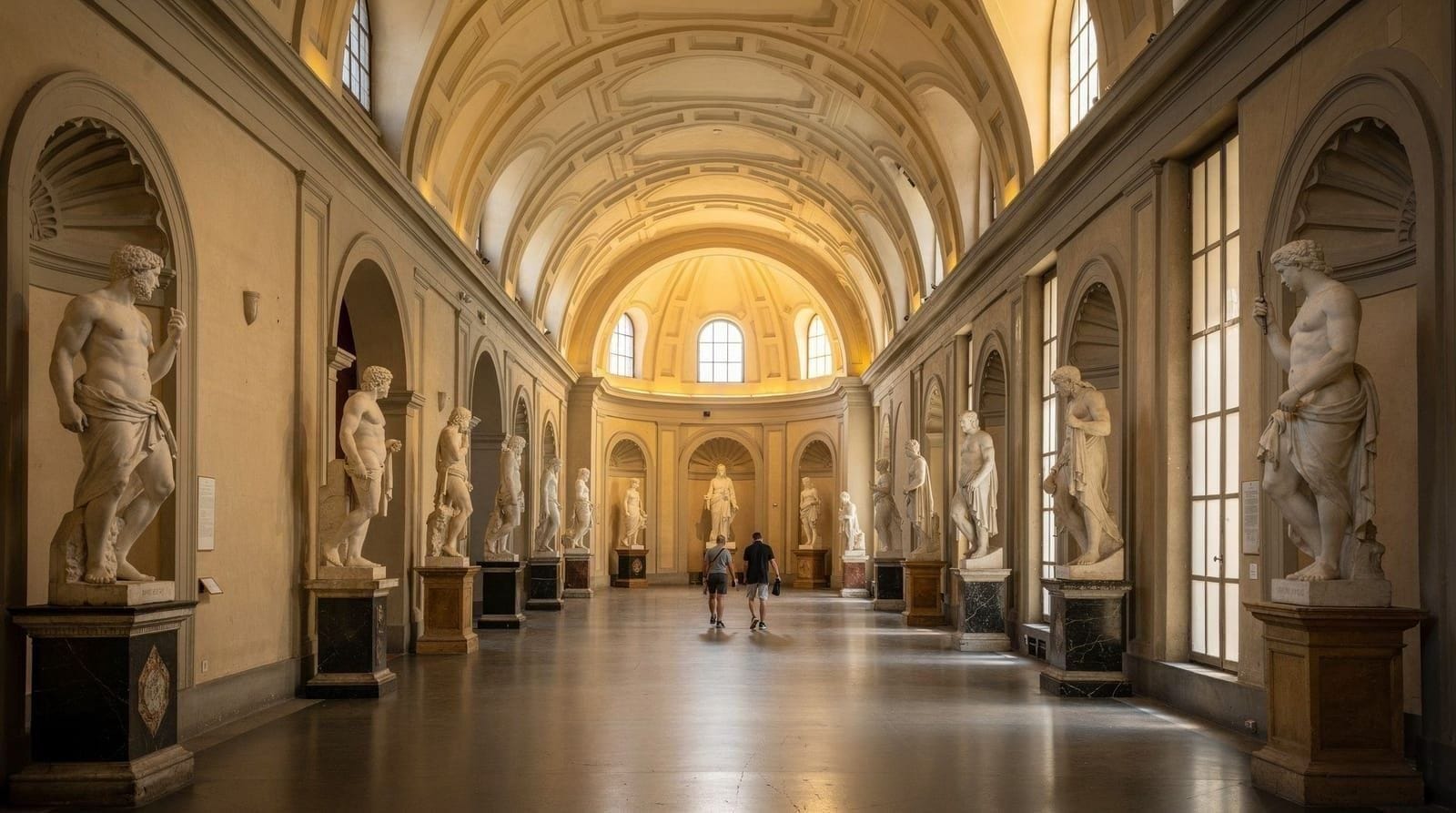
The result is one of the finest collections of medieval and Renaissance sculpture in Italy, in a recently modernised museum specifically designed to show these objects in the best possible light.
Must-see works
The Gates of Paradise
Lorenzo Ghiberti’s East Doors for the Florence Baptistery — known as the Porte del Paradiso, or Gates of Paradise — were created between 1425 and 1452. They represent ten gilded bronze relief panels depicting scenes from the Old Testament, and they were the culmination of Ghiberti’s career and of the first phase of the Renaissance in Florence.
The originals were removed for restoration after the 1966 Arno flood and are now displayed on the ground floor of the museum in a dedicated circular space allowing visitors to view all panels at close range. The originals glow with a warmth the exterior reproductions cannot replicate.
What makes the panels extraordinary beyond their technical mastery is the spatial illusionism — Ghiberti represented deep three-dimensional scenes in metal that is only millimetres thick, using perspective to create the sense of cities receding into the distance. He was applying the new understanding of mathematical perspective (being developed simultaneously by Brunelleschi) to the ancient medium of bronze casting.
Michelangelo’s comment that they were worthy to be the gates of Paradise was not mere flattery — he recognised the panels as a transformation of what the medium could do.
Michelangelo’s Bandini Pietà (Florence Pietà)
Michelangelo began this Pietà in approximately 1547 when he was 72 years old, apparently intending it for his own tomb. He worked on it intermittently for nine years, then in frustration attacked it with a hammer (the damaged sections are still visible). A pupil, Tiberio Calcagni, repaired some of the damage and completed the Magdalene figure.
The sculpture shows the dead Christ being held by the Virgin Mary, Mary Magdalene, and the hooded figure of Nicodemus. The face of Nicodemus is believed to be Michelangelo’s self-portrait — an old man carrying the weight of Christ’s body. The sculpture has a quality of exhaustion and grief that his earlier, more technically brilliant works do not. It is Michelangelo at 70-something, still working stone, making something deeply personal.
The Bandini Pietà receives far fewer visitors than the David, and you can often stand before it for several minutes without other visitors in frame. This is extraordinary good fortune for a work of this significance.
Donatello’s Penitent Mary Magdalene
Carved in polychrome wood (poplar), painted and gilded, this figure of Mary Magdalene as an ancient penitent woman is one of the most emotionally intense works of the Renaissance. Donatello shows the Magdalene as a haggard old woman, emaciated from years of asceticism, with hair hanging loose — a radical departure from the beautiful young woman typically shown in the tradition.
The psychological directness of the work was unprecedented. Donatello created a figure who is simultaneously aesthetically disturbing and spiritually overwhelming. It is one of those works that, once seen, is not easily forgotten.
Donatello’s Cantoria (Singing Gallery)
The marble singing gallery carved for the cathedral’s sacristy, with a frieze of dancing putti (small children) that is one of the most joyful things Donatello ever made — remarkable in contrast to the severity of the Magdalene. The companion Cantoria by Luca della Robbia is displayed alongside it.
Brunelleschi’s architectural models and death mask
A room dedicated to Filippo Brunelleschi contains architectural models of the dome and lantern, tools related to the dome’s construction, and his death mask. The models make the engineering logic of the dome — the herringbone brick laying that allowed the dome to support itself without interior scaffolding — visually comprehensible in a way that looking at the finished exterior cannot.
Original facade sculptures
The medieval and Renaissance sculptural program of the Duomo’s exterior included hundreds of figures, many of which have been brought inside for conservation. The museum’s collection of facade sculptures includes works by Nino Pisano, Andrea Pisano, and others that span two centuries of development in Florentine sculpture.
The museum building
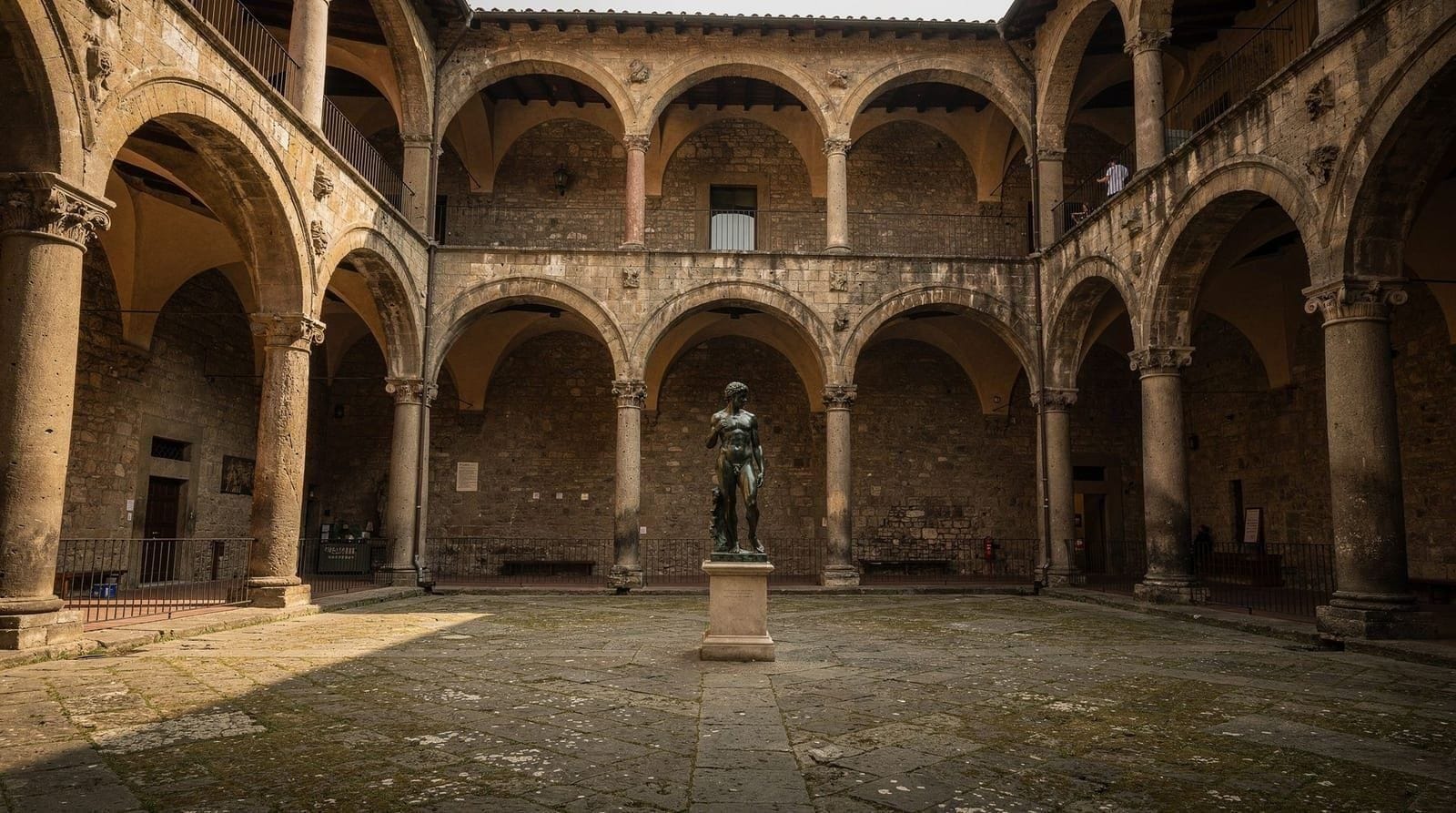
The Museo dell’Opera del Duomo underwent a major expansion in 2015, tripling its exhibition space. The new halls include a full-scale reproduction of the 14th-century Duomo facade (with the original sculptures installed in their original positions) and a monumental space for the Baptistery doors. The architectural intervention is itself worth noticing — the marriage of the new glass and steel elements with the 16th-century palazzo fabric is one of the more successful museum renovations in recent Italian cultural heritage.
Practical planning
The museum is included in the Duomo complex pass but does not require a timed reservation like the dome climb does. You can visit at any time during the opening hours with your pass. If you’re covering the full complex in a single day, this makes the museum a flexible component — fit it in when the dome or bell tower crowds are at their worst.
Recommended sequence for a full complex day: dome climb (8:30 am reserved slot), cathedral (10:00 am), baptistery (10:45 am), museum (11:30 am–1:00 pm), bell tower (2:30 pm or later).
Related guides
- Duomo complex tickets explained
- Bargello Museum guide
- Accademia Gallery guide
- Best museums in Florence
- Is the Firenzecard worth it?
Frequently asked questions about the Opera del Duomo Museum
Is the Opera del Duomo Museum crowded?
Less crowded than the Uffizi or Accademia by a significant margin. Even in peak season, the museum’s capacity and visitor numbers mean that individual works can usually be viewed without intense crowding. The morning session (9:00–11:30 am) is the quietest.
Can children enjoy the Opera del Duomo Museum?
Yes, particularly the Gates of Paradise (visually dramatic relief panels with Old Testament scenes) and the Brunelleschi architectural models (engineering for children is often more engaging than painting). The Donatello Magdalene may be disturbing for very young children. For families, a 45-minute focused visit hitting the key works is probably optimal.
Is the Duomo Museum better than the Bargello?
They serve different purposes. The Bargello focuses on Renaissance sculpture broadly; the Opera del Duomo focuses specifically on works created for Florence’s cathedral complex. Both are excellent; if you’re doing a full Florence museum itinerary, both are worth including. If you can only choose one, the Opera del Duomo Museum’s combination of Ghiberti, Donatello, and Michelangelo’s Pietà is probably the stronger collection for a single visit.
Where is the Opera del Duomo Museum entrance?
The museum entrance is at Piazza del Duomo 9, behind the east end (apse) of the cathedral. It’s a less obvious location than the cathedral facade, which catches most tourists’ attention first — walk around the right side of the cathedral to find it.
The Gates of Paradise: what to look for
Because the Gates of Paradise are the museum’s most celebrated object, it’s worth knowing what to look for when you stand in front of them. The ten gilded bronze panels tell stories from the Old Testament, and Ghiberti spent 27 years on them — from winning the commission in 1425 to their installation in 1452. He considered them the masterwork of his life.
The ten panels, from top-left to bottom-right:
- The Creation / Adam and Eve — multiple narrative scenes combined in a single panel using landscape depth
- Cain and Abel — the first instance of narrative sequence, showing multiple moments in one frame
- Noah and the Flood — the ark, the receding waters, the covenant
- Abraham and Isaac — the near-sacrifice; Ghiberti had depicted this subject in the 1401 competition relief, and the later version is completely rethought
- Jacob and Esau — the most spatially complex panel, with a deep architectural interior rendered in low relief
- Joseph — narrative richness approaching a comic strip
- Moses — Mount Sinai depicted with genuine mountainous depth
- Joshua — military narrative with a crowd scene in deep perspective
- David and Goliath — the youth’s victory; Ghiberti’s bronze Goliath head is a tour de force
- Solomon and the Queen of Sheba — the final panel, showing an elaborate architectural setting and a royal audience scene
What makes the panels technically extraordinary is the depth of relief Ghiberti achieves using the Renaissance technique of schiacciato (squashed) relief — figures in the middle distance rendered in metal that is only millimetres thick. The spatial logic of these scenes, using mathematical perspective to create the illusion of deep space in very shallow material, was revolutionary.
The originals glow with a warmth that reproductions cannot replicate. The careful restoration after the 1966 flood damage brought the gilded surfaces back to something approaching their original condition. Looking at them in the museum’s dedicated circular space, you can see the quality of individual details — hair, drapery, architectural ornament — that the outdoor reproductions can no longer show.
Brunelleschi and the dome: the engineering story
The room dedicated to Filippo Brunelleschi includes architectural models that make the dome’s engineering logic visible in a way that looking at the finished exterior cannot.
Brunelleschi’s essential innovation: he built the dome without the wooden formwork (centering) that all previous large domes had required. The dome’s profile — pointed rather than hemispherical — reduces the outward thrust on the walls. The herringbone brick laying pattern he invented distributes weight as the dome rises, allowing each ring of bricks to support itself before the next ring is added. The double-shell construction (inner and outer shells connected by ribs) reduced weight while maintaining strength.
The result: the largest masonry dome ever built, completed in 1436, still structurally sound nearly 600 years later.
The models in the museum make this comprehensible. Seeing the double-shell structure, the ribs that connect them, and the herringbone brick pattern in a 3D model clarifies what would take several paragraphs to explain in text. If you’re visiting the museum with children interested in engineering, this section justifies the visit on its own terms.
The Bandini Pietà compared to Michelangelo’s other Pietàs
Michelangelo carved three Pietà sculptures across his life, and comparing them illuminates his artistic development in a way that looking at any one alone does not.
Vatican Pietà (c. 1498–1499): Michelangelo was about 23 years old. The work is technically flawless — the drapery management, the smooth beauty of both figures, the way Christ’s dead body is arranged without awkwardness across the Virgin’s lap. It is a young man’s masterpiece: demonstrating what he could do rather than what he felt.
Bandini Pietà (Florence, c. 1547–1555): Michelangelo was in his 70s, working on his own tomb sculpture. The work is unfinished — Michelangelo attacked it in frustration, breaking the left leg of Christ, and the Magdalene figure was completed by his pupil Calcagni. The Nicodemus figure (self-portrait) is hunched and worn. This is not the smooth transcendence of the Vatican work; it is a meditation on mortality by an old man who knows he will soon be the subject, not the artist.
Rondanini Pietà (Milan, unfinished at death in 1564): Started late, worked on until the final days, barely recognisable as figures — a vertical column of two merging forms. The conventional Pietà composition has been entirely abandoned. What’s left is pure feeling: two figures dissolving into each other.
The Florence Pietà in the Opera del Duomo Museum is the middle work — between the technical perfection of Rome and the dissolution of Milan. Standing in front of it, knowing the context, it’s possible to feel the weight of what Michelangelo was carrying in old age.
Fitting the museum into a Duomo complex day
Because entry is bundled into the Duomo complex pass rather than sold separately, the museum is best thought of as one stop among several on a single ticket, not a standalone destination requiring its own planning. The complex pass typically covers the dome climb, cathedral, baptistery, bell tower, and this museum, and only the dome climb requires a specific timed reservation — everything else, including the Opera del Duomo Museum, can be visited in any order during the pass’s validity window (usually a few consecutive days).
This flexibility is worth using deliberately: since the museum rarely gets crowded even when the piazza outside is jammed, it’s the natural stop to save for whenever the queues elsewhere are at their worst — after the dome climb, or as a midday break between the cathedral and bell tower. Visitors doing the whole complex in one day should treat the museum as their pressure valve, not an afterthought squeezed in at closing time.
For visitors spreading the complex pass across two or three days rather than rushing everything into one, the Opera del Duomo Museum is the easiest single stop to save for a separate morning — it needs no timed slot, closes later than most Florence museums (7:00 pm), and rewards a slower, quieter visit more than a rushed add-on at the end of a long sightseeing day. This is particularly worth considering for anyone travelling with children, since the museum’s Brunelleschi engineering models and dramatic Ghiberti panels tend to hold younger attention better toward the start of a day than at the tail end of one.
Comparing this museum with Florence’s other sculpture collections
Florence has three major sculpture-focused museums, and it’s worth knowing how they relate before deciding how to split your time. The Bargello covers Renaissance sculpture broadly — Donatello, Verrocchio, and Michelangelo’s Brutus — across a wider historical range and a different set of patrons. The Accademia is essentially a single-purpose pilgrimage to the David, with the Prisoners as a secondary draw. The Opera del Duomo Museum sits between the two: narrower in scope than the Bargello (everything here was made specifically for the cathedral complex) but broader in ambition than the Accademia, spanning Ghiberti’s bronze doors, Donatello’s wooden Magdalene, and Michelangelo’s late Pietà in one building. For a single Florence trip, all three are worth including if time allows; if forced to choose, this museum’s combination of world-class works and minimal crowds makes it the strongest value per hour spent.
Top experiences
Bookable activities with verified prices and instant confirmation on GetYourGuide.

Florence: dome climb and cathedral 3-day Duomo complex pass
- Skip the line
- Instant confirmation
Florence: skip-the-line Duomo, Baptistery and Giotto Bell Tower
- Skip the line
- Free cancellation
Florence: cathedral terraces and dome skip-the-line tour
- Skip the line
- Small group
Florence: Duomo complex tour
- Small group
- Free cancellation