Piazzale Michelangelo: the complete Florence viewpoint guide
Florence: on e-bike to Piazzale Michelangelo
- Free cancellation
- Small group
What is Piazzale Michelangelo and how do I get there?
Piazzale Michelangelo is a panoramic terrace on the hill south of the Arno, offering the definitive view over Florence — the Duomo, Campanile, Palazzo Vecchio, and Arno all visible in one panorama. Reach it by a 20-minute uphill walk from Ponte Vecchio, by bus (line 12 or 13 from the centre), by electric bike, or by segway tour.
There is a photograph that almost every visitor to Florence takes — the city laid out below a hillside terrace, the Duomo’s dome rising at the centre, the Campanile just to its left, Palazzo Vecchio’s tower breaking the skyline to the right, the Arno threading through it all. That view comes from Piazzale Michelangelo, a broad terrace on the hill of San Miniato, about 80 metres above the river.
| Where | Hill of San Miniato, Oltrarno — 20–25 min walk from Ponte Vecchio |
| Cost | Free; bus ticket around €1.70 if you don’t walk |
| Time needed | 30–45 min at the terrace; add time for the walk up |
| Getting there | Walk via Rampe Poggi, bus 12/13, taxi, or e-bike/segway tour |
| Best time | Sunrise for solitude, golden hour for the classic photo |
Florence’s definitive panorama
The piazzale is not ancient. It was designed by architect Giuseppe Poggi in 1869, part of a grand urban improvement plan commissioned when Florence briefly became the capital of unified Italy (1865–1871). Poggi rerouted roads, carved terraced gardens into the hillside, and designed the monumental staircase (the Rampe Poggi) that connects the Arno embankment to the terrace. He also placed the bronze copies of Michelangelo’s works here as a tribute to the artist, lending the space its name.
What Poggi created has become, 150 years later, the single most visited outdoor spot in Florence.
The view: what you see
Standing at the north-facing parapet:
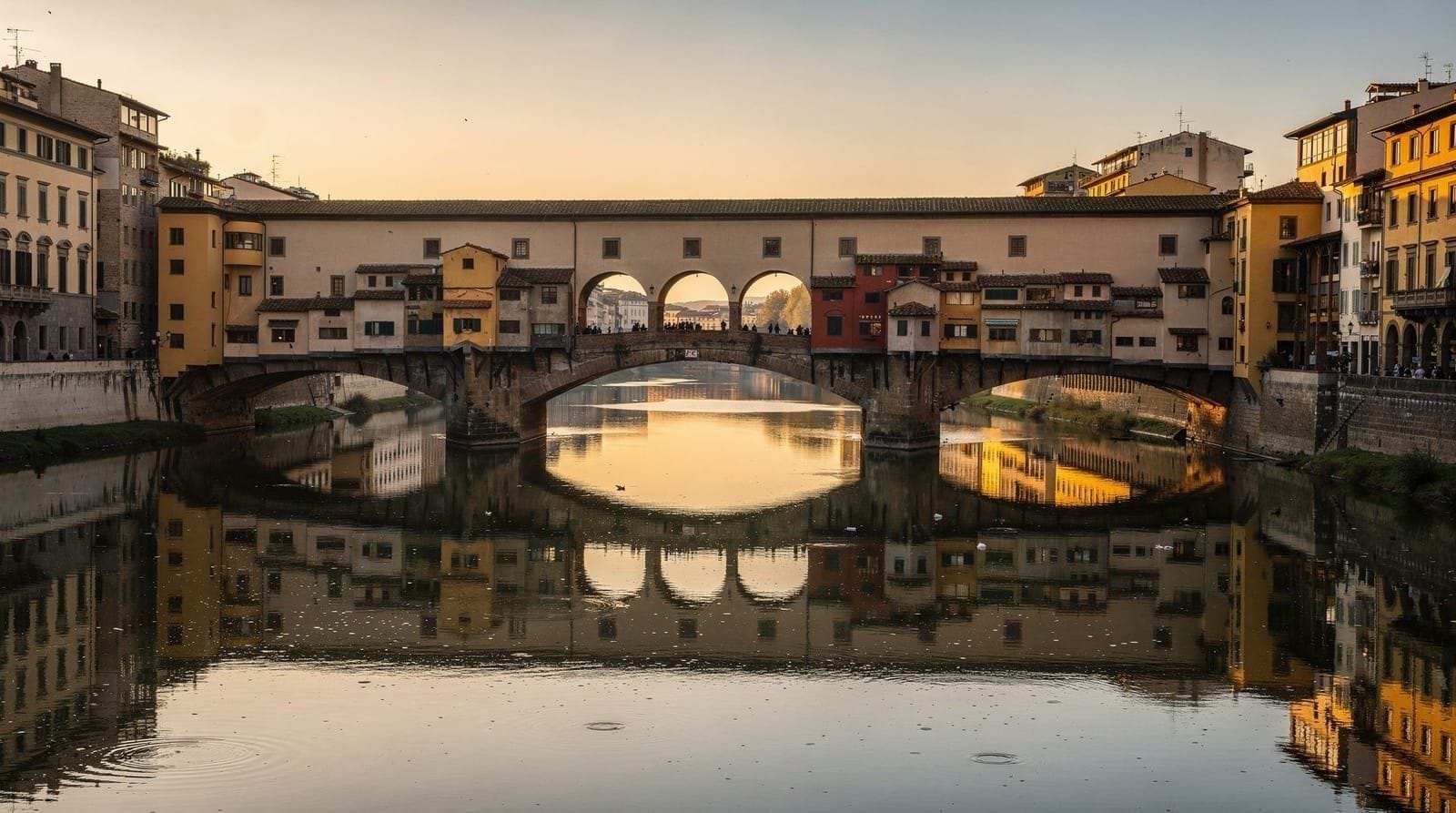
Left to right: Ponte alle Grazie, the curve of the Arno approaching Ponte Vecchio, then Ponte Vecchio itself with its overhanging shops, then Ponte Santa Trinita with its elegant segmental arches. Behind the bridges, the clustered medieval tower-houses of the Oltrarno neighbourhood.
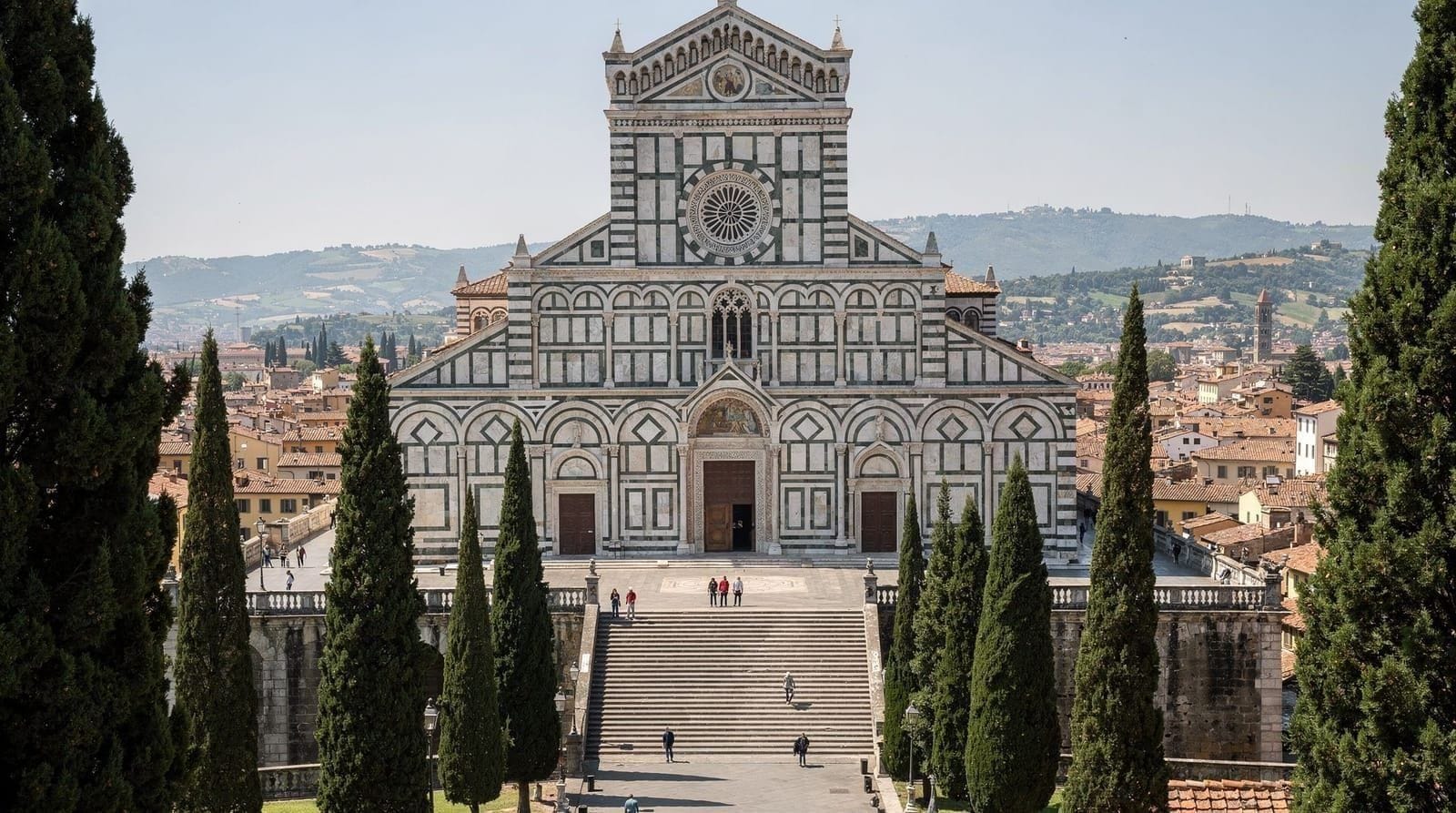
Moving further right: the white marble block of Santa Croce’s facade, the green and white octagon of the Baptistery, Giotto’s Campanile, and dominating all of it, Brunelleschi’s dome — the terracotta lantern catching every shade of light from flat morning grey to deep amber at sunset.
To the right of the dome: the crenellated tower of Palazzo Vecchio, the long facade of the Uffizi disappearing toward the river, and in the far right distance, the hills of Fiesole.
The view changes completely with light conditions:
| Time | Quality | Crowds |
|---|---|---|
| Sunrise (summer) | Soft pink light on the dome | Very low |
| Morning (8:00–10:00) | Clean, cool, good clarity | Low–moderate |
| Midday (11:00–15:00) | Harsh, flat light | High |
| Golden hour (1 hr before sunset) | Warm amber, the dome glows | High–very high |
| After sunset | Blue hour, city lights begin | Moderate |
Photographer’s note: The best camera position for the classic single-frame shot (dome, Campanile, Palazzo Vecchio tower all in frame) is at the far left (west) end of the terrace parapet, shooting north-east at roughly 30 degrees. A wide-angle lens (24mm full-frame equivalent) captures the full skyline without distortion.
Getting there
On foot (recommended)
Via Rampe Poggi (direct route): From Ponte alle Grazie on the Oltrarno bank, follow the signs up the hill. The Rampe Poggi are wide, gracefully curved pedestrian ramps and steps — more architectural promenade than staircase. The climb takes 20–25 minutes at a moderate pace. This is the standard uphill route.
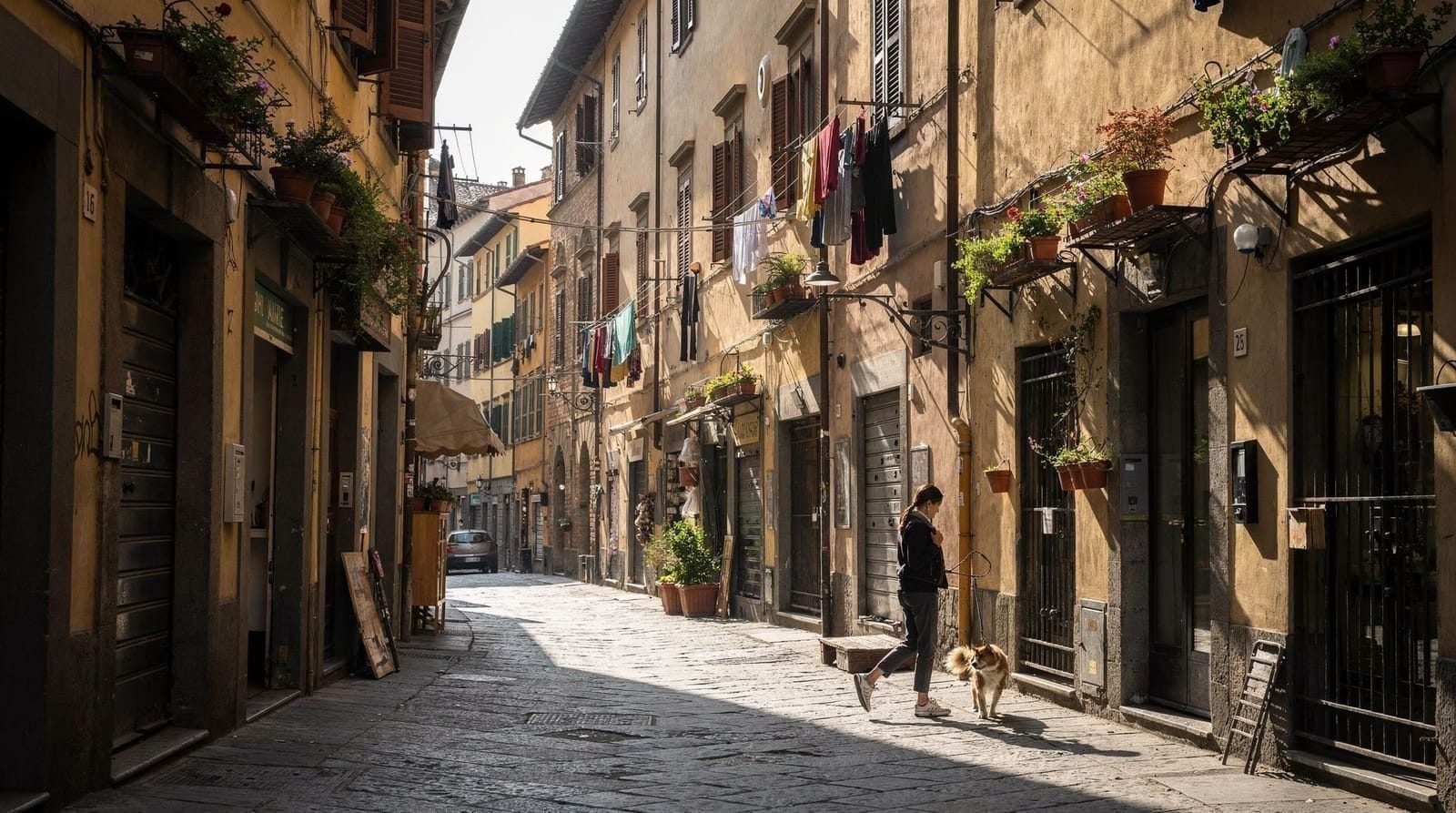
Via Costa San Giorgio and Via San Leonardo (scenic route): From Ponte Vecchio, cross to the Oltrarno and head south via Costa San Giorgio — one of Florence’s most beautiful medieval lanes. Continue past the Forte di Belvedere and San Miniato al Monte to reach the piazzale from the upper side. This route takes 45–60 minutes but passes several of the Oltrarno’s best-kept secrets. See the Oltrarno walking tour guide for details.
By bus
City buses 12 and 13 run from the centre to Piazzale Michelangelo. Line 12 runs from the train station via Piazza Ferrucci (near Ponte San Niccolò); line 13 runs from Santa Maria Novella. Both lines run frequently during the day. Tickets cost €1.70 (90-minute validity, purchased at tabacchi or via the ATAF app).
By taxi or rideshare
Taxis from the centre to Piazzale Michelangelo cost approximately €10–15. This makes sense for one-way only — the walk down is easy and pleasant.
By electric bike or segway
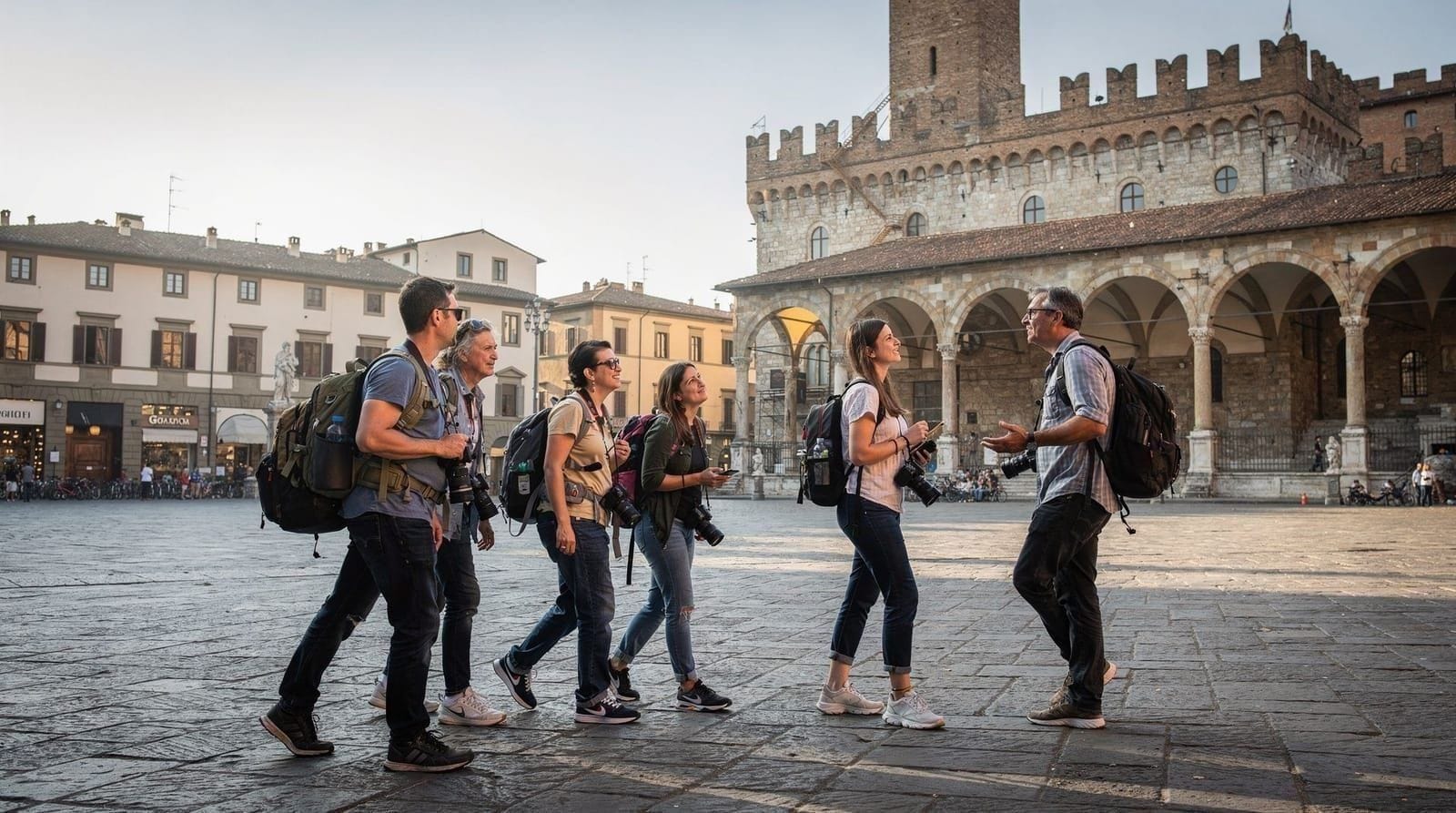
Multiple tour operators offer guided rides from the centre to Piazzale Michelangelo. The e-bike tour combines the hill climb with a scenic loop through the Oltrarno streets. Segway tours are also available and handle the gradient effortlessly — see the tour options above.
The bronze copies of Michelangelo
At the centre of the terrace stands a bronze copy of Michelangelo’s David, placed by Poggi in 1875. Around the base of the pedestal are four bronze copies of the allegorical figures from the Medici Chapel tombs in San Lorenzo — Dawn, Dusk, Night, and Day.
The originals of all four Medici figures are in the New Sacristy of San Lorenzo (5-10 minutes from the Florence centre). The original David is in the Accademia Gallery. The Piazzale copies are exact in scale; the patina of weathered bronze gives them a different character from the marble originals.
Rose Garden and surrounding areas
Giardino delle Rose (Rose Garden): Immediately below the piazzale on the descent toward the Arno, this public garden is Florence’s gift to walkers. Entry is free. In May, when the roses are in bloom, it is exceptional — hundreds of varieties in a terraced hillside garden with views over the city. It also hosts a permanent collection of Japanese iris, sculptures by Belgian artist Jean-Michel Folon, and a small cafe (seasonal).
San Miniato al Monte: 5 minutes uphill from the piazzale, this 11th-century church is one of the finest Romanesque buildings in Tuscany and — crucially — far less visited than the Duomo complex. The facade in white Carrara and green Prato marble is the ancestor of the same pattern on the Duomo and Baptistery. The interior has a remarkable 13th-century mosaic in the apse, Michelozzo’s free-standing tabernacle, a Luca della Robbia glazed terracotta, and the original medieval marble floor. Entry is free. See the full guide at San Miniato al Monte.
Forte di Belvedere: The 16th-century fortress, designed by Buontalenti for Ferdinand I, stands on the ridge between the piazzale and the Oltrarno. Admission is free when temporary exhibitions are on (check seasonal). The terrace offers another, more enclosed panorama over the city and Boboli Gardens.
Practical tips
Shade: There is almost no shade on the piazzale itself. In summer, plan your visit for early morning or evening to avoid the heat. The Rose Garden below has some shade from trees.
Food and drink: Two bar-restaurants sit on the terrace. Prices are moderate (€3–4 for coffee, €5–8 for a sandwich), standard for a tourist viewpoint. Quality is adequate. For a proper meal, descend to the Oltrarno — Via San Miniato and Piazza dei Rossi have several good trattorie.
Safety: The parapet is solid and there is no danger. The routes up and down are well-lit; the Rampe Poggi has lighting for evening visits. Pickpockets are active in the crowds at golden hour — keep bags closed.
Photography: Standard phone cameras can capture the panorama. A small tripod helps for blue-hour and long-exposure shots of the city lights. The iron lampposts along the terrace parapet make useful foreground elements for composition.
Combining with the Oltrarno
Piazzale Michelangelo is the natural high point of any Oltrarno exploration. A complete afternoon itinerary might look like this:
- Cross Ponte Vecchio (see the Ponte Vecchio guide) to the Oltrarno
- Explore Piazza Santo Spirito — the neighbourhood’s living room, with Brunelleschi’s church and local market
- Walk south and uphill via Costa San Giorgio
- Visit San Miniato al Monte (free, extraordinary)
- Arrive at Piazzale Michelangelo for golden-hour views
- Descend via the Rampe Poggi
- Evening dinner in the Oltrarno
See the full Oltrarno walking tour guide and the Florence destination guide for neighbourhood maps and recommendations.
Piazzale Michelangelo vs Florence’s other high viewpoints
| Viewpoint | Height | Crowds | Cost |
|---|---|---|---|
| Piazzale Michelangelo | ~80 m | High at golden hour, quiet at sunrise | Free |
| Duomo dome terrace | 114 m | Very high, timed entry | Ticketed, book ahead |
| Giotto’s Campanile | 84 m | High | Ticketed |
| Forte di Belvedere | Similar to piazzale | Low | Free (exhibition dependent) |
The piazzale wins on ease and cost — no ticket, no queue, no stairs beyond the walk up — while the dome and Campanile give you the closer, more architectural view of the cathedral itself from inside its own structure. Doing both across a trip, rather than choosing one, gives the fullest picture of Florence’s skyline from every angle. See the Florence Duomo guide for booking the dome and Campanile tickets.
Sunrise vs golden hour: which to choose
Both extremes of the day reward the climb, but for different reasons. Sunrise (arriving 20–30 minutes before) gives you the terrace nearly empty, soft directional light on the dome, and a genuinely peaceful start to the day — the trade-off is an early wake-up and, in winter, a cold wait. Golden hour (the hour before sunset) gives the warmest, most photogenic light and the atmosphere of a shared occasion, with buskers, drinks vendors, and a crowd watching the sky together — the trade-off is that you’ll be sharing the parapet with a few hundred other people in peak season.
If you can only do one, sunrise in summer is the underrated choice: the light is nearly as good as sunset’s, and the solitude makes the climb feel worth it in a different way. First-time visitors who only have one evening free should still default to golden hour, since it’s easier to combine with dinner in the Oltrarno afterwards.
Frequently asked questions about Piazzale Michelangelo
Can I drive to Piazzale Michelangelo?
The road to Piazzale Michelangelo is outside the ZTL and technically reachable by car, but parking at the piazzale is extremely limited (about 30 spaces, often full by 9:00). You will almost certainly end up parking lower on the hill and walking anyway. The bus or walk from the centre is consistently faster.
Is Piazzale Michelangelo suitable for children?
Completely. The terrace is flat, there are no hazards, and children enjoy the panoramic view. The walk up the Rampe Poggi steps is suitable for most children over 5. The descent is easy. Avoid midday in summer with very young children.
What other viewpoints are there in Florence?
The dome terrace (114 m) and Campanile top (84 m) are higher than the piazzale (about 80 m) but give more constrained views. Fiesole, the hilltop town 8 km north-east, gives a broad vista from a greater distance. The Fiesole e-bike tour combines both with olive oil tasting.
How crowded is it?
Very crowded at golden hour in summer (June–September), especially on weekends. At sunrise, even in August, you may have the terrace nearly to yourself. The bus journey from the centre at 5:30 on a summer morning is worth it for the experience.
Top experiences
Bookable activities with verified prices and instant confirmation on GetYourGuide.

Florence: segway sunset with climb to Piazzale Michelangelo
- Free cancellation
- Small group
Florence: golden hour walk tour to Piazzale Michelangelo
- Free cancellation
- Small group
Florence: sunset golf cart tour at Michelangelo Square
- Free cancellation
- Small group
Florence: sunset panoramic tour — Fiesole and Michelangelo Square
- Free cancellation
- Small group