San Miniato al Monte Florence: complete guide
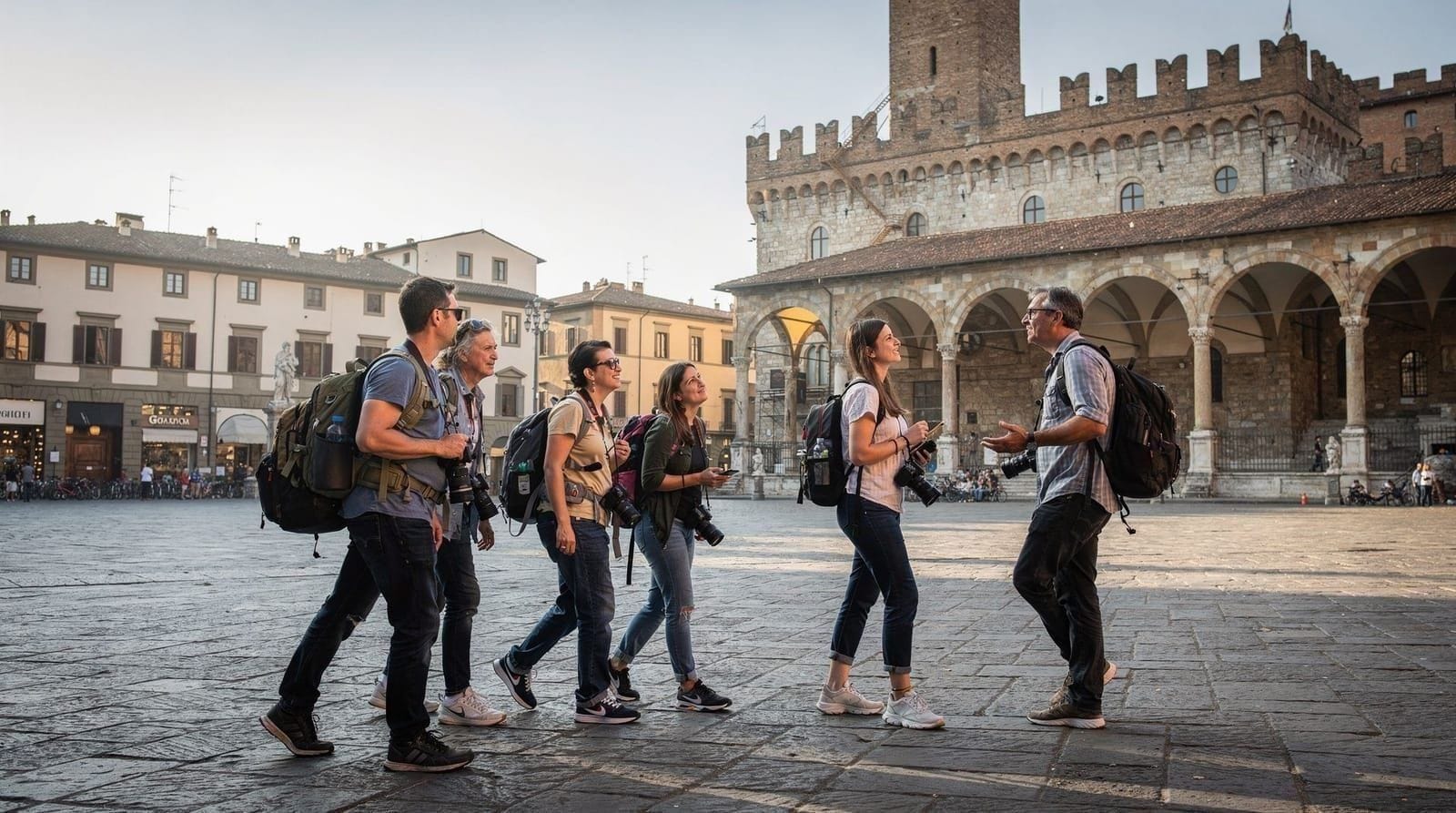
Florence: golden hour walk tour to Piazzale Michelangelo
- Free cancellation
- Small group
Is San Miniato al Monte worth visiting?
Absolutely. San Miniato al Monte is one of the most beautiful Romanesque churches in Italy, free to enter, less crowded than the Duomo, with an extraordinary medieval marble floor, 13th-century mosaic apse, and panoramic views over Florence. It sits 5 minutes above Piazzale Michelangelo.
The church above the city
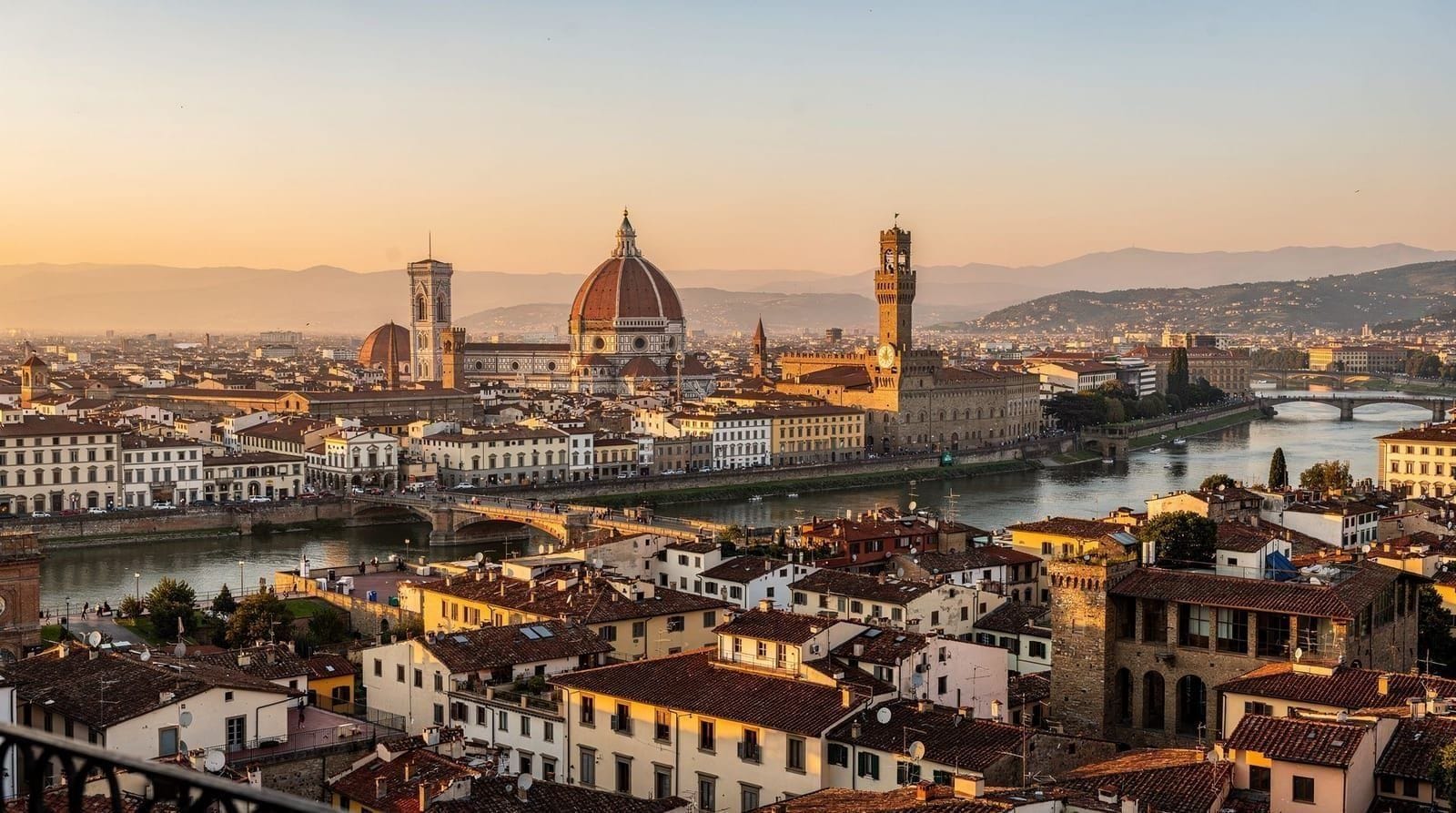
Florence is experienced most intensely from below, at street level, inside its museums and churches. But to understand it properly — to see the city as a whole, set within the bowl of the Arno valley with its encircling hills — you need to climb. Piazzale Michelangelo is the obvious choice. Five minutes further uphill, past the terrace crowds and the tour-bus parking, sits San Miniato al Monte, one of the finest churches in Italy and, by the measure of most visitors who reach it, one of the most rewarding.
It is free to enter, consistently less crowded than anything in the historic centre, and architecturally extraordinary — a 12th-century Romanesque facade in white Carrara and green Prato marble that served as the model for the Baptistery and, indirectly, for the Duomo itself. Inside: a medieval marble floor, a 13th-century mosaic apse, a Michelozzo tabernacle, a chapel by Luca della Robbia, and the Olivetan monks who have served the church since 1373 and still sing Gregorian chant at vespers every evening.
| Where | 5 minutes uphill from Piazzale Michelangelo |
| Cost | free entry |
| Time needed | 45 minutes for the church; longer with the cemetery and vespers |
| Getting there | uphill walk from Piazzale Michelangelo or the Oltrarno |
| Best time | late afternoon, ending with vespers around 17:00–17:30 |
History and the saint
San Miniato (Miniato) was a Christian soldier of Eastern origin who was martyred during the persecution of Emperor Decius around 250 AD. According to tradition, after his beheading on the hill of Mons Florentinus, he picked up his head and carried it up the hill to the site where the church now stands. The tradition is hagiographic rather than historical, but the site was venerated from Late Antiquity onward.
The current building was commissioned by Bishop Ildebrando of Florence and begun in 1013. It was enlarged and completed over the 11th and 12th centuries. The facade — in green and white marble — was added in two phases: the lower arcade in the late 11th century, the upper section with its brilliant 13th-century mosaic around 1260.
The church was managed by the Benedictines until the 14th century, then by the Olivetans (a Benedictine reform congregation) from 1373 to the present — an extraordinary continuity. The monastery continues to produce honey, herbal liqueurs, soap, and other products sold at the church.
The facade
The facade is the finest example of the Florentine Romanesque style and one of the most influential designs in Italian architectural history. It consists of two registers:
Lower arcade: Five semi-circular arches on pilasters, framed in white Carrara and green Prato marble in geometric patterns (marble inlay or intarsia). The decorative vocabulary — the contrast of white and green marble, the geometric intarsia within the blind arches, the proportional balance between arcade width and height — set the model for the Baptistery’s exterior (contemporary) and, three centuries later, for Alberti’s facade on Santa Maria Novella and the lower section of the Duomo’s facing.
Upper section: A triangular gable above a central window with colonnettes, decorated with a large Byzantine-style mosaic (c. 1260–1280) showing Christ Pantocrator enthroned, with the Virgin and St Minias on either side. The gold ground is characteristic of Byzantine mosaics of the period; the figure style bridges Byzantine convention and the new Italian Gothic manner of Cimabue’s generation.
At the apex of the gable: a gilded eagle holding a bale of cloth, symbol of the Calimala Guild (the wool merchants’ guild) that financed the church’s construction from the 12th century onward.
Inside the church
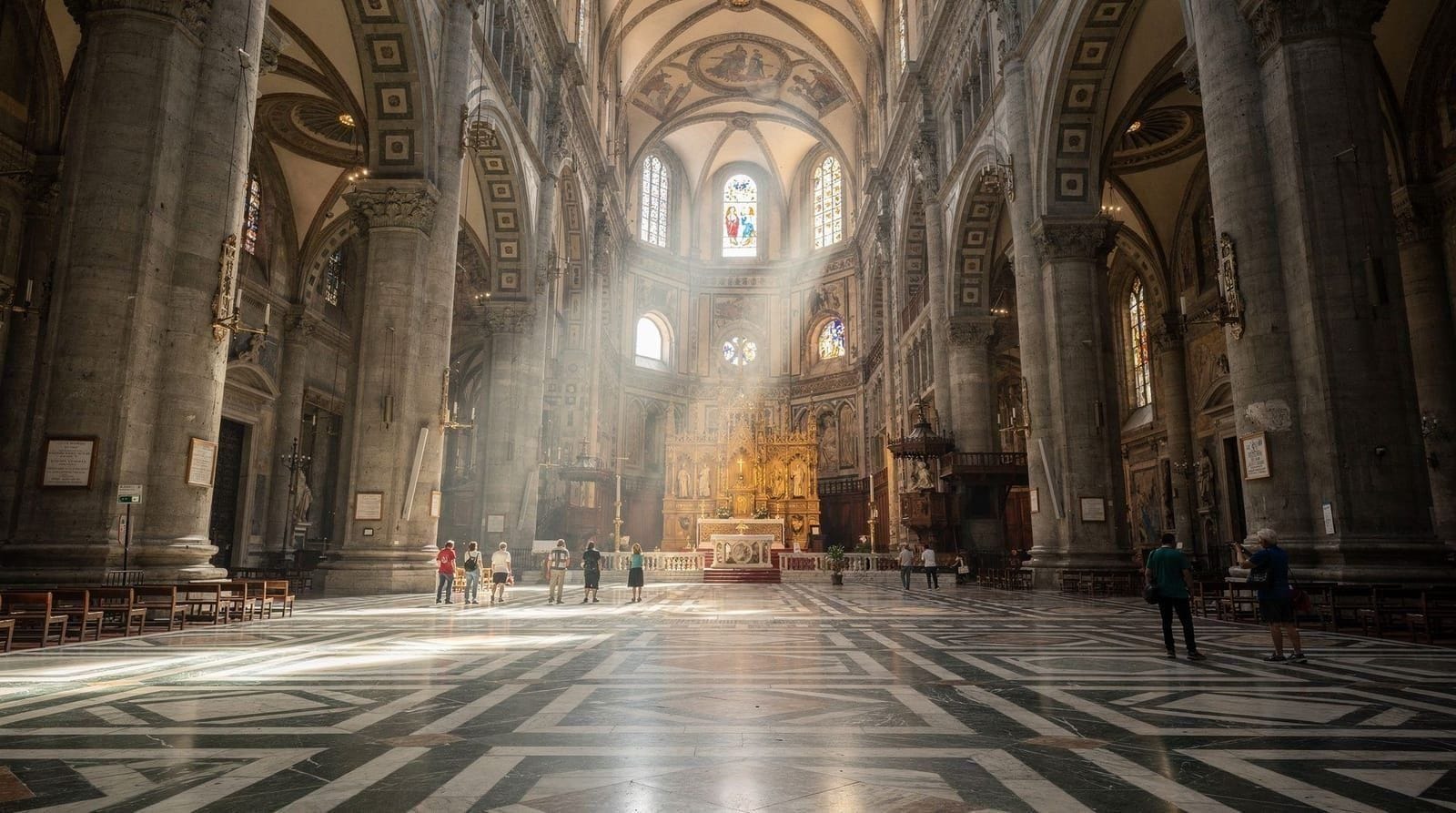
The interior is a three-aisled basilica without transept, approximately 50 metres long. The overall effect is quiet, lucid, and slightly austere — qualities unusual in Tuscan churches of any period.
The nave floor
The intarsia marble floor is dated 1207 by an inscription and is among the oldest and most elaborate medieval floors in Tuscany. It covers the central nave with panels depicting signs of the zodiac, animal combat scenes, dove-and-serpent motifs, and geometric interlace — all in white, black, and green marble. The astrological imagery reflects a calendar interpretation: the floor may have been designed to map the liturgical year or the months of the Christian calendar. Many of the panels are not quite rectangular — the small variations in the marble cutting suggest individual craftsmen working to a shared but not mechanically precise scheme.
The raised choir and crypt
The east end of the church is raised above a crypt on a stone platform — you step up to the choir, which gives a dramatic view back down the nave. The choir itself has an elegant Romanesque marble screen (1207) and wooden choir stalls. The crypt beneath contains the tomb of St Minias and 11th-century columns with varied carved capitals.
The Michelozzo tabernacle
At the base of the raised choir, a freestanding marble tabernacle designed by Michelozzo di Bartolommeo (c. 1448), commissioned by Piero di Cosimo de’ Medici. The base of the tabernacle and its surrounding area contain terracotta elements by Luca della Robbia — the characteristic blue-and-white tin-glazed style that Luca perfected. Inside the tabernacle: a miraculous image of the Virgin.
The Cardinal of Portugal’s Chapel
Off the left aisle, this small chapel (1461–1466) was built for Giacomo di Lussemburgo, Cardinal of Portugal, who died in Florence at 25. The tomb monument is by Antonio Rossellino; the frescoes on the ceiling by Alesso Baldovinetti; the altarpiece (copy in situ, original in the Uffizi) by Antonio del Pollaiolo; the terracotta tondo in the ceiling roundels by Luca della Robbia. The chapel is considered one of the most complete and harmonious ensembles of mid-15th-century Florentine art, all conceived together and executed within a few years by some of the finest craftsmen of the time.
The apse mosaic
The semi-circular apse at the east end contains a large Byzantine-style mosaic (c. 1297) showing Christ enthroned between the Virgin and St Minias, with four evangelist symbols in the corners. The gold ground glitters in the light from the east windows in the morning. The figure style is more advanced than the facade mosaic — the drapery is more volumetric, the faces more individuated, suggesting a late 13th-century date close to the work of Cimabue and the pre-Giotto generation.
Gregorian chant at vespers
The Olivetan monks sing vespers daily. In summer (May–October) the service begins at approximately 17:30; in winter at approximately 17:00. The monks descend from the monastery on the south side of the complex and process into the choir in their white habits. The chant lasts around 30 minutes.
Visitors are welcome to attend, but this is a genuine act of worship, not a tourist performance. Silence, no photography during the service, and appropriate dress are expected. The acoustic of the stone vault and the resonance of plainchant in this space is genuinely moving.
The view and the cemetery
The view from the churchyard: The terrace in front of the church is slightly higher than Piazzale Michelangelo and slightly further from the city — the panorama is broader but the dome appears slightly smaller. The foreground is given by the churchyard wall and the bell tower; the middle distance is the city; the background is the Apennines. It is a quieter view than the piazzale — the crowds do not make it this far.
Cimitero delle Porte Sante: The cemetery that occupies the hillside below the church (entered from the north side) contains the tombs of many significant Florentines: Carlo Collodi (author of Pinocchio), Giuseppe Poggi (designer of Piazzale Michelangelo), Vasco Pratolini, and others. The architectural quality of the 19th-century tombs is high; the hillside setting is beautiful. A small charge applies for the historic section.
Practical information
| Detail | Information |
|---|---|
| Entry | Free |
| Hours | 9:30–13:00 and 14:00–19:30 (summer); 9:30–13:00 and 14:00–18:00 (winter) |
| Vespers | Daily, approx 17:30 (summer) / 17:00 (winter) |
| Dress code | Shoulders and knees covered |
| Photography | Yes, except during services |
| Getting there | Walk from Piazzale Michelangelo (5 min uphill) |
Combining with Piazzale Michelangelo and Oltrarno
San Miniato is the natural continuation of any visit to Piazzale Michelangelo — it sits just above, reached by a 5-minute walk up Via delle Porte Sante from the piazzale car park. A well-planned afternoon combines:
- Cross Ponte Vecchio to the Oltrarno (see the Ponte Vecchio guide)
- Walk uphill via Costa San Giorgio (medieval lanes, Forte di Belvedere)
- Visit San Miniato al Monte — allow 45 minutes
- Descend to Piazzale Michelangelo for the panorama at golden hour
- Return to the Oltrarno for dinner (Piazza Santo Spirito, Borgo San Jacopo)
See the complete Oltrarno walking tour guide and the Piazzale Michelangelo guide for full routing. The Florence destination guide covers transport and accommodation. If sunset over the city is the priority, our sunset at Piazzale Michelangelo piece covers the timing in more detail, and a wider survey of Florence’s best walking tours shows how this route fits alongside other options.
San Miniato versus Piazzale Michelangelo
Most visitors reach Piazzale Michelangelo and stop, assuming they’ve seen the best view Florence has to offer from that side of the river. San Miniato, five minutes further up the hill, is a genuinely different experience rather than more of the same.
| Piazzale Michelangelo | San Miniato al Monte | |
|---|---|---|
| Crowds | heavy, especially at sunset | light even at peak times |
| Cost | free | free |
| What you get | the classic postcard panorama | quieter view plus a major Romanesque church |
| Time needed | 20-30 minutes | 45 minutes minimum |
| Atmosphere | busy viewpoint, street vendors | contemplative, working monastery |
The honest recommendation is to do both in sequence rather than choosing one: the piazzale for the famous wide shot, San Miniato for the church interior and the quieter version of the same panorama. Neither substitutes for the other.
Getting the timing right
Because San Miniato has no timed-entry system and no queue culture, timing is about experience quality rather than access. Arriving mid-morning, after the initial rush of Piazzale Michelangelo visitors but before tour groups discover the church, tends to give the emptiest interior. The hour before vespers — roughly 16:00-17:00 in summer — has excellent light through the east-facing apse windows, since the mosaic catches the afternoon sun directly. Staying for vespers itself changes the character of a visit completely: the building shifts from a museum-like space to an active place of worship, and the plainchant filling the stone vault is worth planning your afternoon around if you have any interest in sacred music or simply want a different register of experience than another gallery.
Frequently asked questions about San Miniato al Monte
Do I need to book San Miniato al Monte in advance?
No. Entry is free and no booking is required. The church is never as crowded as the Duomo or Uffizi. The only consideration is avoiding overlap with vespers if you want quiet time in the church — plan to arrive either well before or just after the service begins.
Is there a shop at San Miniato?
Yes. The Olivetan monks sell their products — honey (several varieties), herbal liqueurs, soaps, and face creams — at a small shop inside the complex. The quality is genuine and the prices are reasonable for what they are. The beeswax products are particularly good.
Can I walk there from the city centre?
Yes. The most pleasant route from Ponte Vecchio is about 40–50 minutes on foot via the Oltrarno and Costa San Giorgio. From Piazzale Michelangelo, it is 5–8 minutes uphill. The route from Piazzale Michelangelo has some steep sections but is paved throughout.
How does San Miniato compare to the Duomo?
They are very different experiences. The Duomo is larger, more complex, more crowded, and requires paid timed-entry tickets. San Miniato is smaller, quieter, free, and architecturally purer — closer in spirit to the Romanesque tradition that preceded the Gothic. The mosaic apse at San Miniato is, in context, more moving than the Vasari frescoes in the Duomo’s dome.
Top experiences
Bookable activities with verified prices and instant confirmation on GetYourGuide.