Santa Maria Novella church Florence: visitor guide
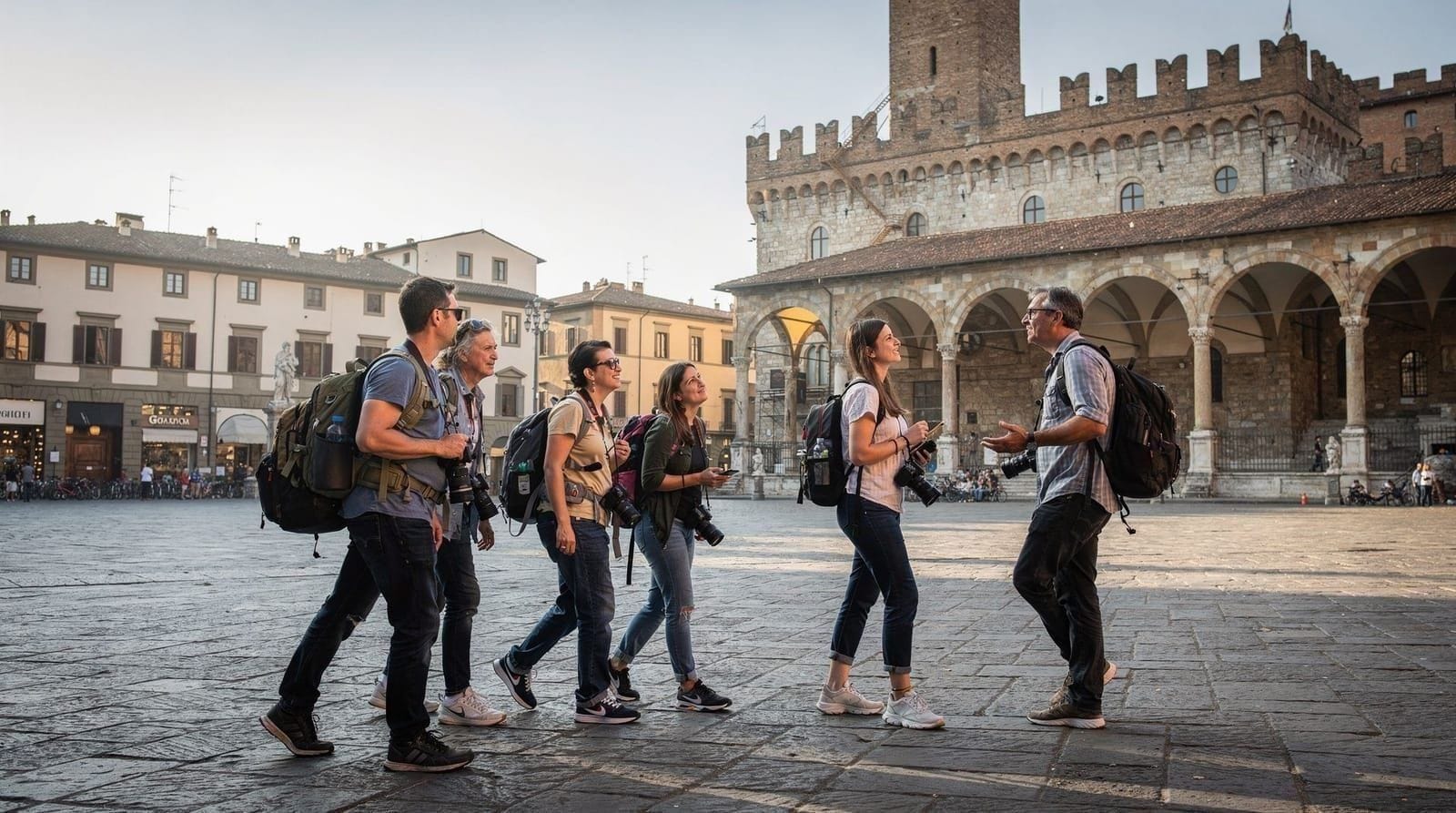
Florence: walking tour and optional fast-track Duomo visit
- Free cancellation
- Small group
What is special about Santa Maria Novella church in Florence?
Santa Maria Novella contains Masaccio's Trinity (c. 1427), the first painting in history to use mathematical perspective, and Domenico Ghirlandaio's frescoes in the Tornabuoni Chapel (1486–1490), which include portrait likenesses of Florence's merchant elite. The complex also includes two beautiful cloisters. Entry costs €7.50.
The church by the station
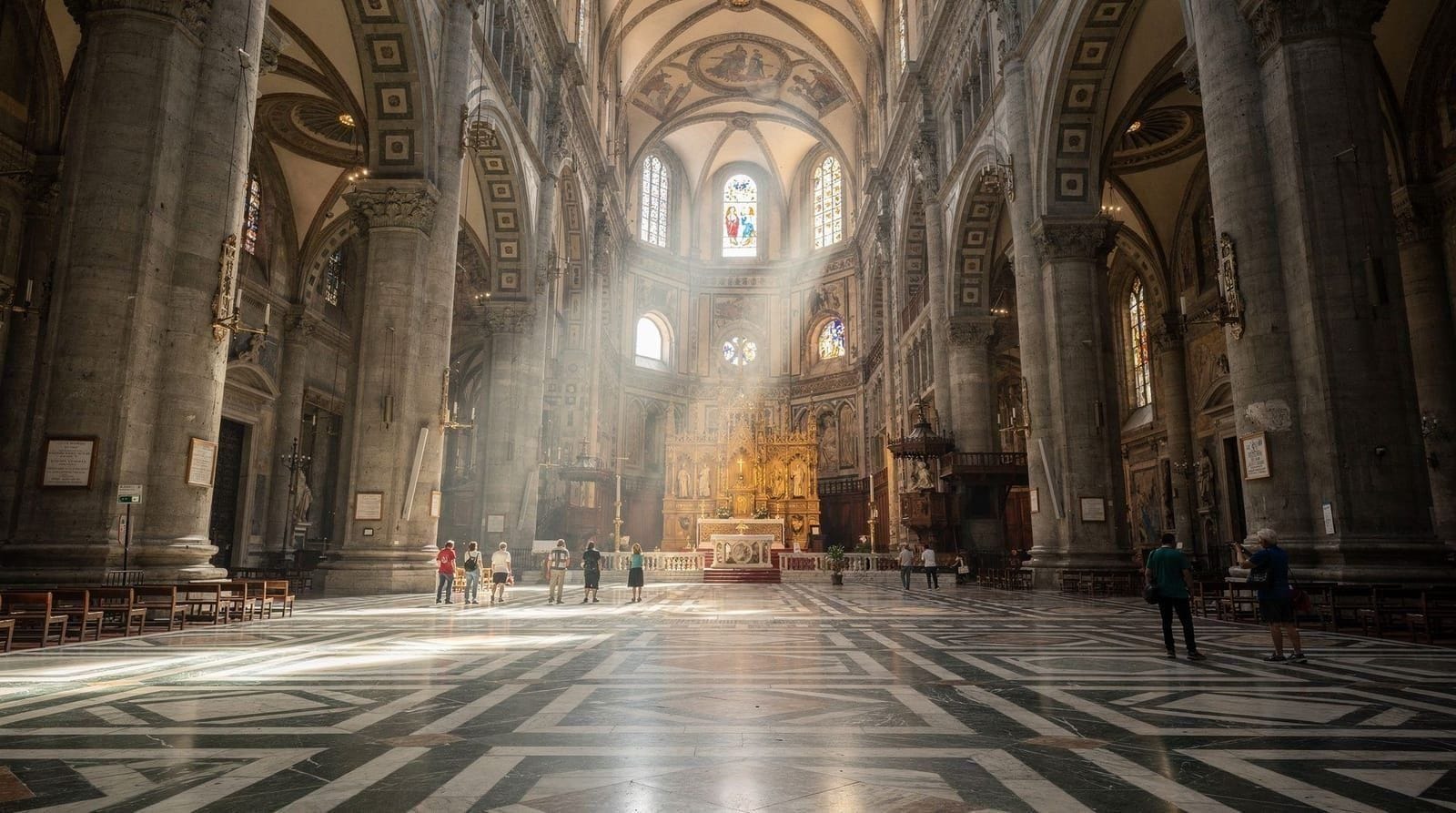
Santa Maria Novella enjoys the most prominent location of any church in Florence — directly opposite the main entrance of Santa Maria Novella train station, which takes its name from it. This proximity means it is often the first significant building visitors see, and frequently it is dismissed as “the church near the station” without a second thought. This is a mistake. Santa Maria Novella contains some of the most important early Renaissance paintings in Italy, a complex of buildings and cloisters that traces Dominican architecture from the 13th century to the 18th, and a museum that is consistently less crowded than the Uffizi or Accademia.
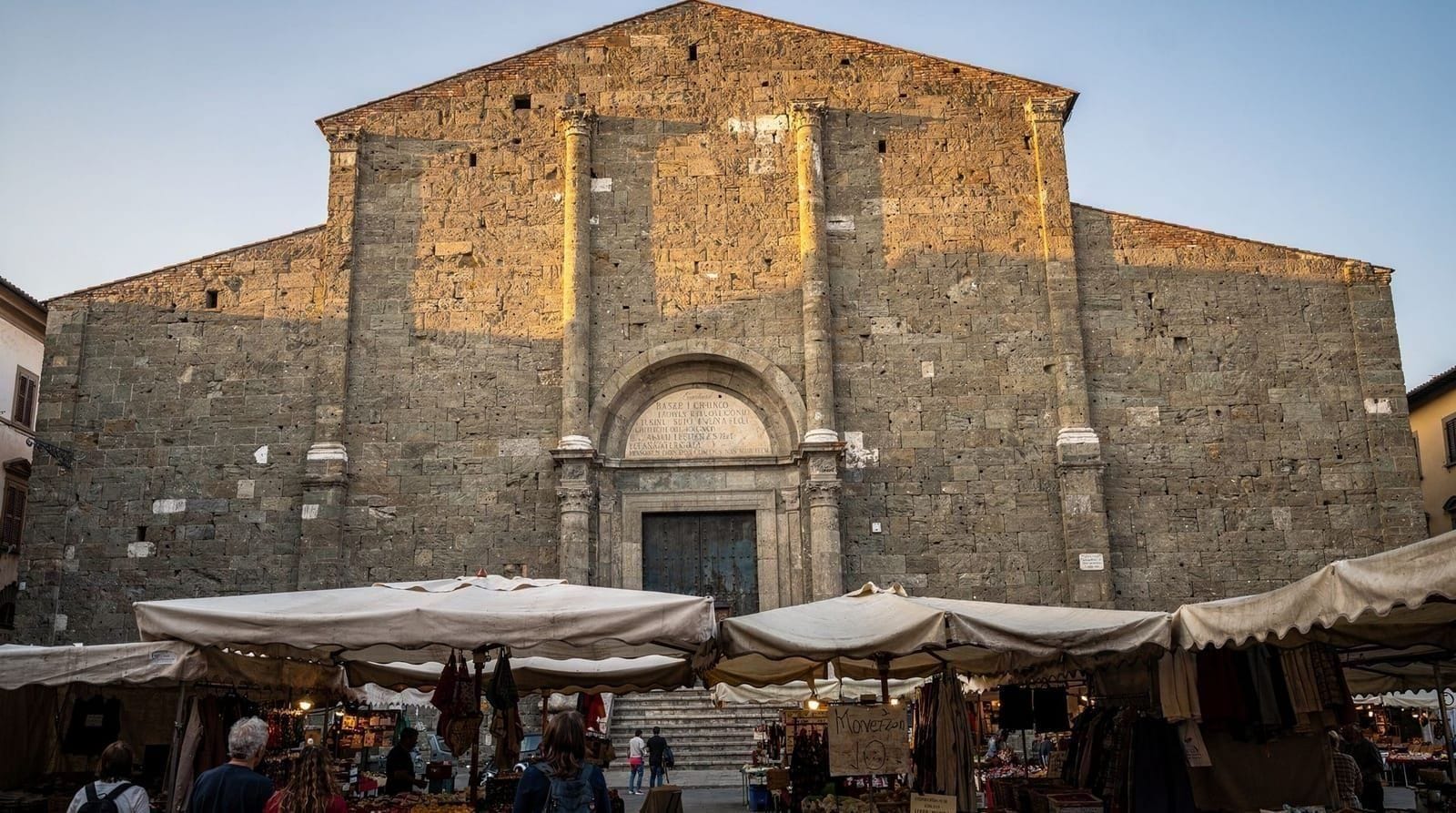
The church was founded in 1221 by Dominican friars and the current building constructed between 1246 and 1360. The green-and-white marble facade — its lower half Romanesque, its upper half completed by Leon Battista Alberti in 1470 — is one of the most carefully studied in Italy; Alberti used a series of embedded proportional relationships (squares within squares) that make it appear simultaneously classical and innovative.
| Where | Piazza Santa Maria Novella, opposite the train station |
| Cost | around €7.50 adults, €5 students 13-18 |
| Time needed | 30-40 min for the Trinity and Tornabuoni Chapel; 60-75 min for the full complex |
| Getting there | directly opposite Santa Maria Novella station |
| Best time | before midday, when light on the Trinity is best |
What to see inside the church
Masaccio’s Trinity
The first thing to find, on the left wall of the nave about one-third of the way toward the altar, is the Trinity. Painted around 1427 by Tommaso di Ser Giovanni di Simone Cassai — known as Masaccio — it is a fresco approximately 6.67 by 3.17 metres.
What makes it historically critical is the use of a precisely calculated vanishing point, placed approximately at the level of the viewer’s eye height. The barrel-vaulted architectural space above the main figures (the Trinity: God the Father holding the Cross with the Holy Spirit dove, flanked by the Virgin and St John, with two donors kneeling outside the illusory space) recedes according to the rules of one-point perspective with mathematical exactitude. The illusion is that the niche containing the figures is real.
Masaccio died in Rome the same year or the year after completing this fresco, at around 26 years old. He effectively invented the visual language of Renaissance painting in approximately four years of work; Michelangelo, Leonardo, and Raphael all studied his frescoes. Stand at the small marker on the floor opposite the Trinity to align yourself with the intended viewing position.
Practical note: Photography without flash is permitted, but the fresco can be difficult to see in low light. Visit before midday when light from the left aisle windows is most direct.
The Tornabuoni Chapel (choir frescoes)
The Tornabuoni Chapel occupies the main choir behind the high altar. Domenico Ghirlandaio and his workshop (including apprentices, among whom the young Michelangelo — around 14–15 years old — is documented) covered the walls with two cycles:
- Left wall: Life of the Virgin (Annunciation, Visitation, Birth of the Virgin, Presentation, Adoration of the Magi)
- Right wall: Life of John the Baptist (Birth of John the Baptist, Zacharias in the Temple, Baptism of Christ, Feast of Herod)
- End wall (behind altar): Coronation of the Virgin and scenes of the Tornabuoni family at prayer
The programme sounds conventionally devotional, but Ghirlandaio embedded contemporary Florence throughout. The Birth of the Virgin scene (left wall, third register) shows the Tornabuoni women in the fashionable dress of 1490 Florence — an extraordinary record of how the Florentine merchant elite looked and dressed. In the Zacharias in the Temple scene, a group of scholars and humanists discusses philosophy in the background, including what are believed to be portraits of Marsilio Ficino, Angelo Poliziano, and other members of the Medici intellectual circle.
Giovanni Tornabuoni, who commissioned the frescoes, was the Medici family’s chief banker. His choice of subject, artist, and iconographic programme reflects the intersection of piety, civic pride, and personal ambition that characterised Florentine patronage at the height of the Renaissance.
The Strozzi Chapel and Filippino Lippi
In the left transept, the Strozzi Chapel contains frescoes by Filippino Lippi (c. 1498–1502) — the last major fresco commission in Florence before the city’s entry into a prolonged political and spiritual crisis. The programme (scenes from the lives of Philip the Apostle and John the Evangelist) is Filippino at his most eclectic and strange: the architectural details are fantasy-Roman, the figures dramatically foreshortened, the overall effect almost hallucinatory compared to Ghirlandaio’s measured classicism.
Also in this chapel: the altarpiece by Nardo di Cione (c. 1357) showing the Last Judgement — one of the most extensive medieval Last Judgement scenes in Tuscany, occupying an entire side wall.
Why the Trinity matters more than its size suggests
It’s worth dwelling on exactly why art historians treat the Trinity as a hinge point rather than simply another good fresco. Before Masaccio, painters approximated depth using intuition and inconsistent scale — figures further away were made smaller by feel rather than by calculation. Masaccio, working with architectural principles that Brunelleschi was developing at the same moment nearby, constructed the illusion using a single vanishing point and measured proportional relationships, so that the painted architecture reads as continuous with the real wall of the church.
Contemporaries reportedly found the effect genuinely disorienting — a flat wall that appeared to open into real space was unprecedented. Every subsequent generation of Renaissance painters, from Masaccio’s direct followers to Leonardo and Raphael a lifetime later, absorbed this technique as a basic tool rather than a novelty, which is precisely why a single fresco in a side aisle carries the historical weight normally reserved for entire museum collections.
Brunelleschi’s Crucifix
In the left aisle, near the Gondi Chapel, hangs a polychrome wooden crucifix by Filippo Brunelleschi — allegedly made in response to a challenge from Donatello, who had criticised Brunelleschi’s version of Christ as “a peasant” and shown him his own crucifix (now in Santa Croce). Brunelleschi is said to have produced this response, which so astonished Donatello that he dropped his shopping in shock. The story is probably apocryphal; the crucifix is genuine and remarkably refined in its anatomical delicacy.
The cloisters and museum
The Chiostro Verde (Green Cloister)
The first cloister, dating from 1332–1350, is named for the characteristic green-earth pigment (terra verde) used in Paolo Uccello’s frescoes on its walls. The scenes depict episodes from Genesis — the Flood, the Sacrifice of Noah, the Drunkenness of Noah — painted between 1430 and 1446. They are damaged (partly by the 1966 flood, partly by earlier deterioration) but the surviving sections show Uccello’s obsession with perspective and foreshortening in full expression. The storage of the originals in the refectory means you see copies; some originals are in the museum.
The Chiostro Grande (Great Cloister)
The large 16th-century cloister is connected to the Spanish Chapel and the Papal Apartments. It is not always accessible; check current opening when you buy your ticket.
The Cappellone degli Spagnoli (Spanish Chapel)
The Dominican chapter house, converted in 1592 into a chapel for the Spanish retinue of Eleonora of Toledo. The walls are covered in extraordinary 14th-century frescoes by Andrea di Bonaiuto (1365–1367) — an elaborate visual encyclopaedia of Dominican theology and the church’s role in salvation. The ceiling shows the Triumph of the Church; the right wall the Via Veritatis (Way of Truth); the left wall the Way of Penance; the entrance wall the Resurrection and Pentecost. These are among the finest and most complete 14th-century fresco cycles in Italy and are consistently under-visited.
Practical information
| Ticket | Price |
|---|---|
| Adults | €7.50 |
| Students 13–18 | €5 |
| Under 12 | Free |
| Hours | Times |
|---|---|
| Monday–Thursday | 10:00–17:30 (last entry 17:00) |
| Friday | 11:00–17:30 |
| Saturday | 9:00–17:30 |
| Sunday | 13:00–17:30 |
Dress code: Shoulders and knees covered. Bare-shouldered visitors are provided with a wrap at the entrance.
Photography: Permitted without flash throughout the complex.
The church is closed on major Catholic feast days and for special services. Verify on the official SMN website before your visit.
Location and context
Santa Maria Novella sits on the piazza of the same name, a 5-minute walk west of the Duomo and directly opposite the train station. The piazza was historically used for races and public events; today it is a pleasant open space with benches, a fountain, and views of the facade.
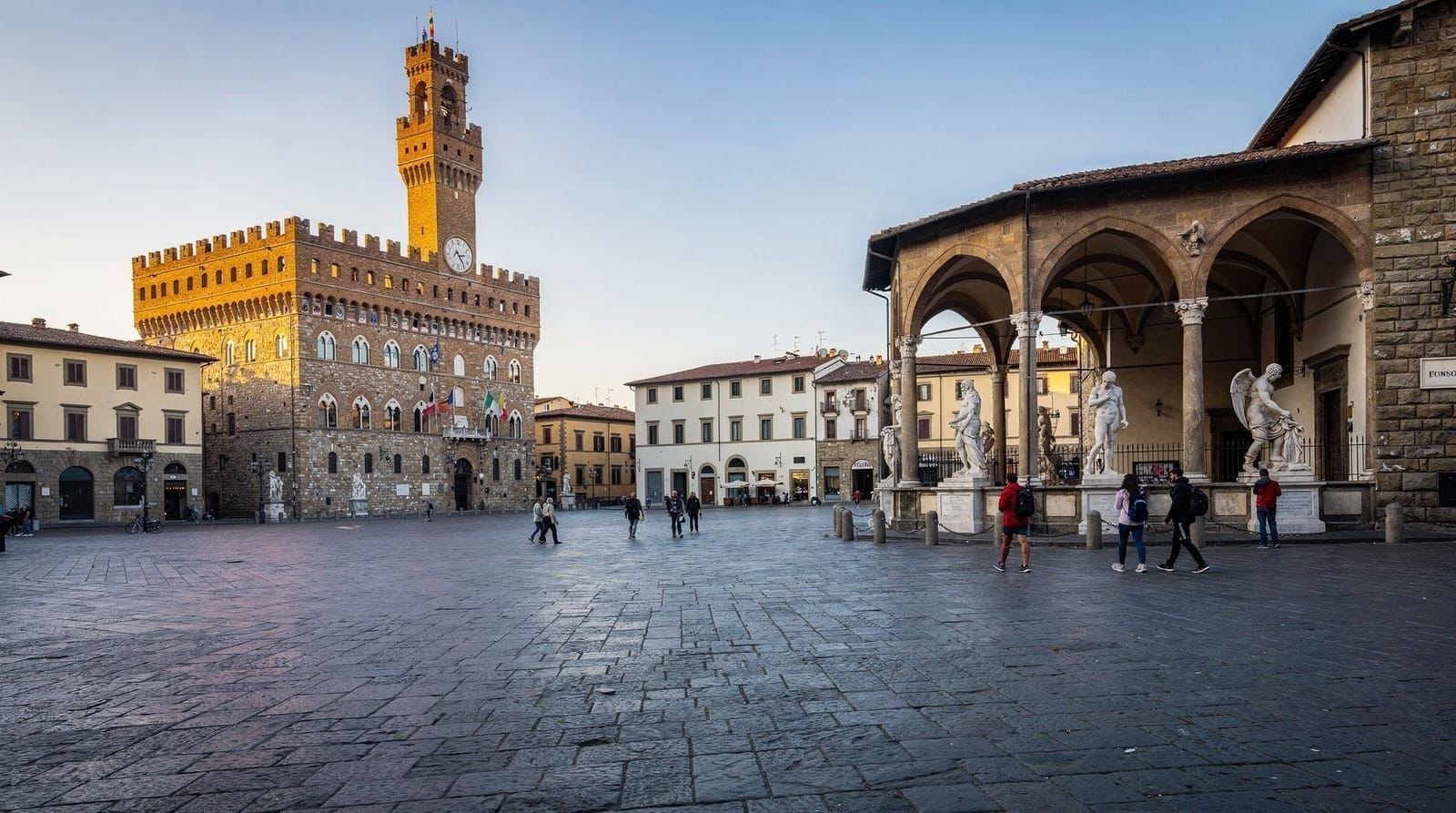
From Santa Maria Novella it is a 12-minute walk east to the Florence Duomo complex, and 18 minutes to Piazza della Signoria. The best walking tours of Florence typically start near the train station or the Duomo and pass Santa Maria Novella.
For the Medici Renaissance tour connection: the Tornabuoni family, who commissioned the choir frescoes, were Medici bankers. The church’s 15th-century patrons form a network with the Medici, Strozzi, and other families whose palaces, chapels, and patronage define the historic centre.
See the Florence destination guide for transport, neighbourhood context, and planning.
Making the most of a short visit
If you only have 30 minutes, a focused route through the church avoids wasting time on backtracking. Enter, go directly to the Trinity on the left wall (5-10 minutes, including the moment to stand at the floor marker and let the perspective illusion click into place), then walk to the Tornabuoni Chapel behind the high altar for the Ghirlandaio cycle (10-15 minutes — look specifically for the Tornabuoni women in 1490s dress and the humanist scholars in the Zacharias scene). If you have another 15 minutes, the Spanish Chapel off the Green Cloister is the most underrated stop in the complex and rarely has more than a handful of other visitors, which makes it worth prioritising over the Strozzi Chapel if your time is genuinely limited.
Frequently asked questions about Santa Maria Novella
Is Santa Maria Novella worth visiting if I have limited time?
Yes, for two things specifically: Masaccio’s Trinity and Ghirlandaio’s Tornabuoni Chapel. Both can be seen in 30–40 minutes combined. The Trinity is in many ways more important to the history of art than anything in the Uffizi (the first use of mathematical perspective); it should not be missed.
Is Santa Maria Novella train station the same as the church?
The station is named after the church, which stands opposite it. The station was built in 1935 and is an important example of Italian Rationalist architecture. The church predates it by 600 years. They are not connected, but the proximity means the church is often the first significant building visitors encounter in Florence.
What is the difference between Santa Maria Novella and Santa Croce?
Both are major medieval mendicant churches — Santa Maria Novella is Dominican; Santa Croce is Franciscan. Santa Croce has more famous tombs (Michelangelo, Galileo); Santa Maria Novella has more important early Renaissance painting (Masaccio, Ghirlandaio, Filippino Lippi). If you can only visit one, the choice depends on your interests: art history points toward Santa Maria Novella; historical tombs and Giotto frescoes point toward Santa Croce.
Top experiences
Bookable activities with verified prices and instant confirmation on GetYourGuide.