Piazza della Signoria Florence: the complete guide
Florence: Palazzo Vecchio and battlements guided tour
- Small group
- Free cancellation
What is in Piazza della Signoria Florence?
Piazza della Signoria is Florence's main civic square, home to Palazzo Vecchio (the medieval town hall), the Loggia dei Lanzi with its outdoor sculpture collection including Perseus by Cellini, and copies of Michelangelo's David and Donatello's Marzocco. The Uffizi Gallery runs along the south side. Entry to the square is free.
Piazza della Signoria has been the political and social centre of Florence for 700 years. It is not the largest square in the city — that is Piazza Santa Croce — but it is the most charged, the most historically dense, and the most publicly spectacular. What distinguishes it from squares elsewhere in Italy is the extraordinary concentration of significant sculpture in open air, free to anyone who walks through.
| Where | Historic centre, 2 min from the Uffizi, 5 min from Ponte Vecchio |
| Cost | Free to enter the square and the Loggia dei Lanzi |
| Time needed | 20–30 min for the sculptures; add museum time for Palazzo Vecchio |
| Getting there | Walkable from anywhere in the centre; ZTL zone, no driving |
| Best time | Early morning or after dinner for fewer crowds |
Florence’s outdoor museum
The square is large (about 190 by 100 metres), paved in grey pietra serena, and framed on three sides by medieval and Renaissance palaces. The fourth side opens toward the Arno via the Uffizi courtyard. Palazzo Vecchio’s battlemented tower rises 94 metres above the cobbles. The loggia to the south holds some of the most important bronze and marble statues made in 16th-century Italy.
Entry to the square is free at all hours.
Palazzo Vecchio
The fortress-palace on the north side of the square was begun in 1299 to designs by Arnolfo di Cambio and served as the seat of the Florentine Republic. It became the Palazzo Vecchio (Old Palace) in 1565 when the Medici moved their residence to the Palazzo Pitti and retained this as their administrative centre, connected to the Uffizi and eventually to the Pitti by the Vasari Corridor.
The exterior
The palazzo’s military character is deliberate — it was designed to project the republic’s authority over the powerful aristocratic families who lived in the fortified towers around the city. The massive rusticated stone base, the battlemented top, and above all the asymmetrically positioned tower (off-centre because it was built over an earlier tower that belonged to a Florentine family whose land was partially underneath the new building) all contribute to the impression of civic power.
The tower (the Torre di Arnolfo) rises 94 metres. It contains a prison cell near the top — Cosimo de’ Medici the Elder, later the great patron of Renaissance arts, was imprisoned here in 1433 before his eventual exile and triumphant return.
Inside the palazzo
The interior is divided broadly between the Republican period rooms and the Medici-era rooms.
Salone dei Cinquecento: The vast state room built in 1495 for the Grand Council of the Florentine Republic, later expanded and decorated by Vasari (1555–1572) with ceiling frescoes celebrating Medici military victories and enormous wall paintings of battles against Pisa and Siena. The walls may conceal a lost fresco by Leonardo da Vinci — the Battle of Anghiari — behind Vasari’s paintings. Technical surveys have detected anomalies consistent with an underlying layer.
Studiolo of Francesco I: A tiny, jewel-box-like private study crammed with paintings by thirty-odd Florentine Mannerist painters — the greatest concentration of late 16th-century Florentine painting in a single room. The programme was designed by Vincenzo Borghini; the room was built between 1570 and 1575. It is easily missed but extraordinary.
The Medici apartments: On the second and third floors, the apartments of Cosimo I and Eleonora of Toledo contain some of the best Bronzino portraits in context (copies; originals are in the Uffizi) and extraordinary Vasari decorative cycles.
The tower: Climb the 223 steps to the battlements for a view over the square and toward the Duomo. The climb passes through the prison where Savonarola was held before his execution in the square below.
| Ticket | Price |
|---|---|
| Palazzo Vecchio museum | €12.50 adults |
| Tower climb | €10 adults |
| Museum + Tower | €17.50 adults |
| Under 6 | Free |
| Under 18 (EU citizens) | Free on first Sunday of month |
The sculptures of the piazza
Loggia dei Lanzi
Built between 1376 and 1382 as an open-air ceremonial space for civic occasions, the Loggia dei Lanzi is now effectively an outdoor sculpture gallery. The name comes from the Lansquenet mercenaries (German infantry) who were garrisoned here in the 16th century.
Perseus with the Head of Medusa (Benvenuto Cellini, 1554): Commissioned by Cosimo I de’ Medici as a political statement — Perseus holding up the severed head of Medusa, displaying dominance over all enemies. The bronze casting was technically extraordinary for its time; Cellini’s autobiography describes a terrifying night when the molten bronze threatened to solidify before the mould was filled, and he threw his pewter plates into the furnace to keep the metal liquid. The bronze is the original; the marble base is original. The base reliefs show scenes from the Perseus myth. The relief panels originally included a self-portrait of Cellini in the central panel — look for the face in the relief at the front.
Rape of the Sabine Women (Giambologna, 1583): Three interlocked figures — the old Sabine man, the young Sabine woman, and the Roman soldier — forming a spiralling composition designed to be seen from every angle, with no single “correct” viewpoint. This was an explicit challenge to the traditional sculpture doctrine. The marble is original. The work was given its name retrospectively — Giambologna reportedly said he was just exploring the formal problem of three interlocked figures.
Hercules and Cacus (Baccio Bandinelli, 1534): To the right of the palazzo entrance, this massive marble group was intended as a pendant to Michelangelo’s David. It is technically proficient but widely mocked at its unveiling — Cellini and other contemporaries were withering about it. Bandinelli included a portrait of his own face on the Hercules figure, reportedly.
Judith and Holofernes (Donatello, c. 1460): On the loggia to the left, a bronze group originally made for the Medici garden and placed in the square after the republic’s restoration in 1495 as a symbol of civic virtue over tyranny. The original is now in Palazzo Vecchio; what you see in the loggia is a copy.
The central sculptures and fountain
Neptune Fountain (Bartolomeo Ammanati, 1565): The large white marble Neptune at the centre of the square’s north side is nicknamed “il Biancone” (the big white one) by Florentines — not always affectionately. Michelangelo is said to have commented that Ammanati had “ruined a fine piece of marble.” The surrounding bronze river gods and sea nymphs by Ammanati and his workshop are more admired than the main figure.
David (copy after Michelangelo): The 19th-century marble copy at the palazzo entrance stands where the original stood from 1504 to 1873. The original is in the Accademia Gallery. Despite being a copy, the placement is historically exact and the scale is correctly proportioned to the piazza.
Marzocco (copy after Donatello): The heraldic lion of Florence, symbol of the republic. Donatello’s original (c. 1420) is in the Bargello. The copy in the square is a 1980s replacement.
Historical resonance: the Savonarola square
In 1494, the Medici were expelled from Florence after the French invasion of Italy. The Florentine Republic was restored under the influence of the Dominican friar Girolamo Savonarola, who organised the “Bonfires of the Vanities” — public burnings of books, mirrors, cosmetics, playing cards, and “immoral” art — in this square in February 1497 and 1498.
A year later, the republic turned against Savonarola. He was arrested, tried for heresy, and executed by hanging and burning in the same piazza on 23 May 1498. A circular bronze disk set into the pavement near the Neptune fountain marks the approximate spot.
The square has been the site of multiple executions, civic celebrations, and political upheavals across seven centuries. It has a weight of history that the outdoor sculptures and tourist crowds can momentarily obscure but never entirely erase.
Getting to Piazza della Signoria
| Starting point | Walking time |
|---|---|
| Duomo | 8 minutes (south along Via dei Calzaiuoli) |
| Ponte Vecchio | 5 minutes (north via Via Por Santa Maria) |
| Uffizi Gallery | 2 minutes (adjacent) |
| Santa Croce | 10 minutes (west) |
| Santa Maria Novella station | 20 minutes |
The square is in the ZTL. Do not drive.
Combining the piazza with other sites
Uffizi Gallery: The museum occupies the long building running south from the square to the Arno. Separate tickets required — see the Uffizi website or GetYourGuide for skip-the-line options.
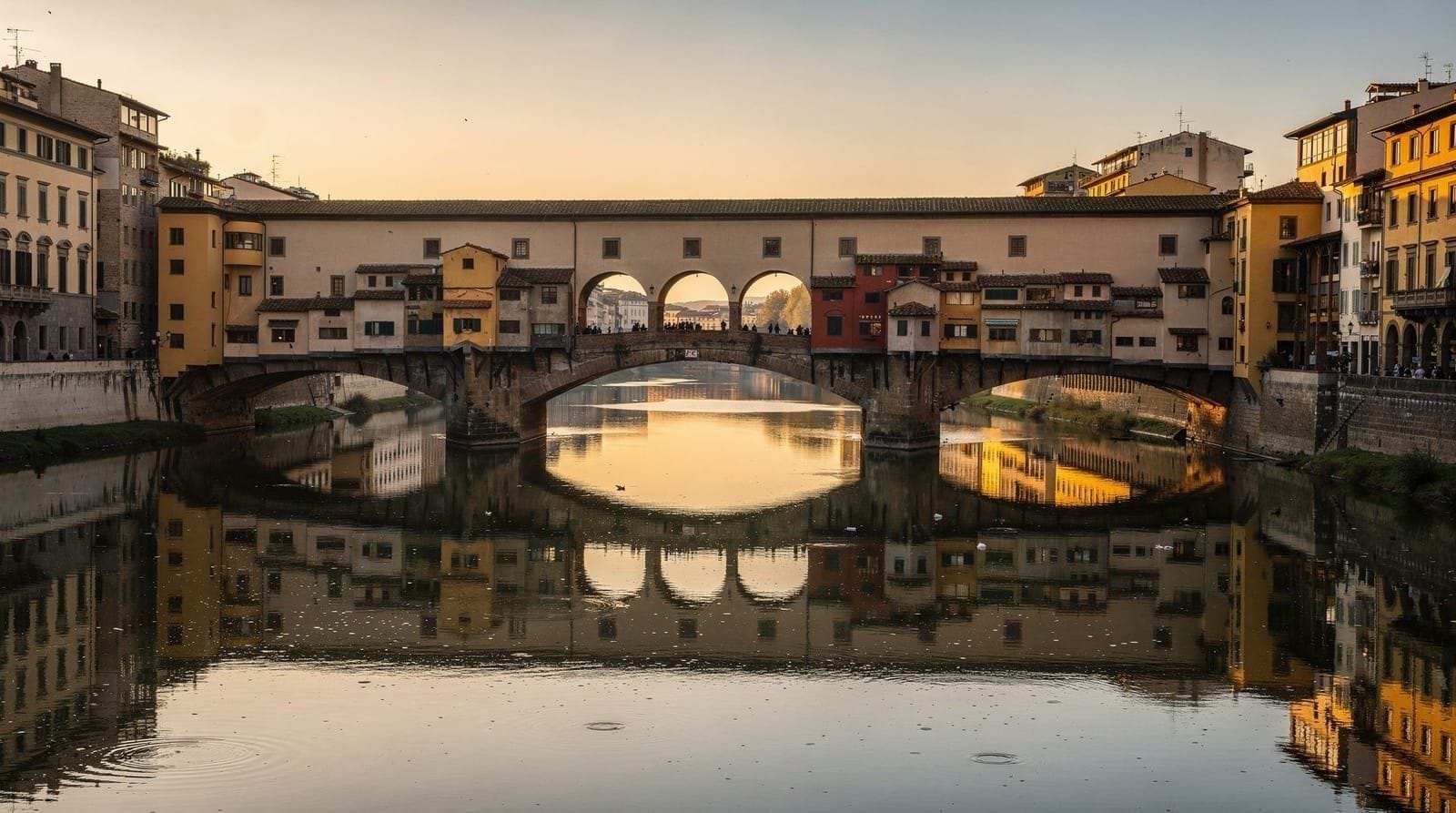
Ponte Vecchio: 5 minutes south, across Via Por Santa Maria and through the medieval streets. See the Ponte Vecchio guide.
Medici history: The square is the starting point for the Medici Renaissance tour, which traces the family’s Florence through Palazzo Vecchio, San Lorenzo, and the Medici Chapels.
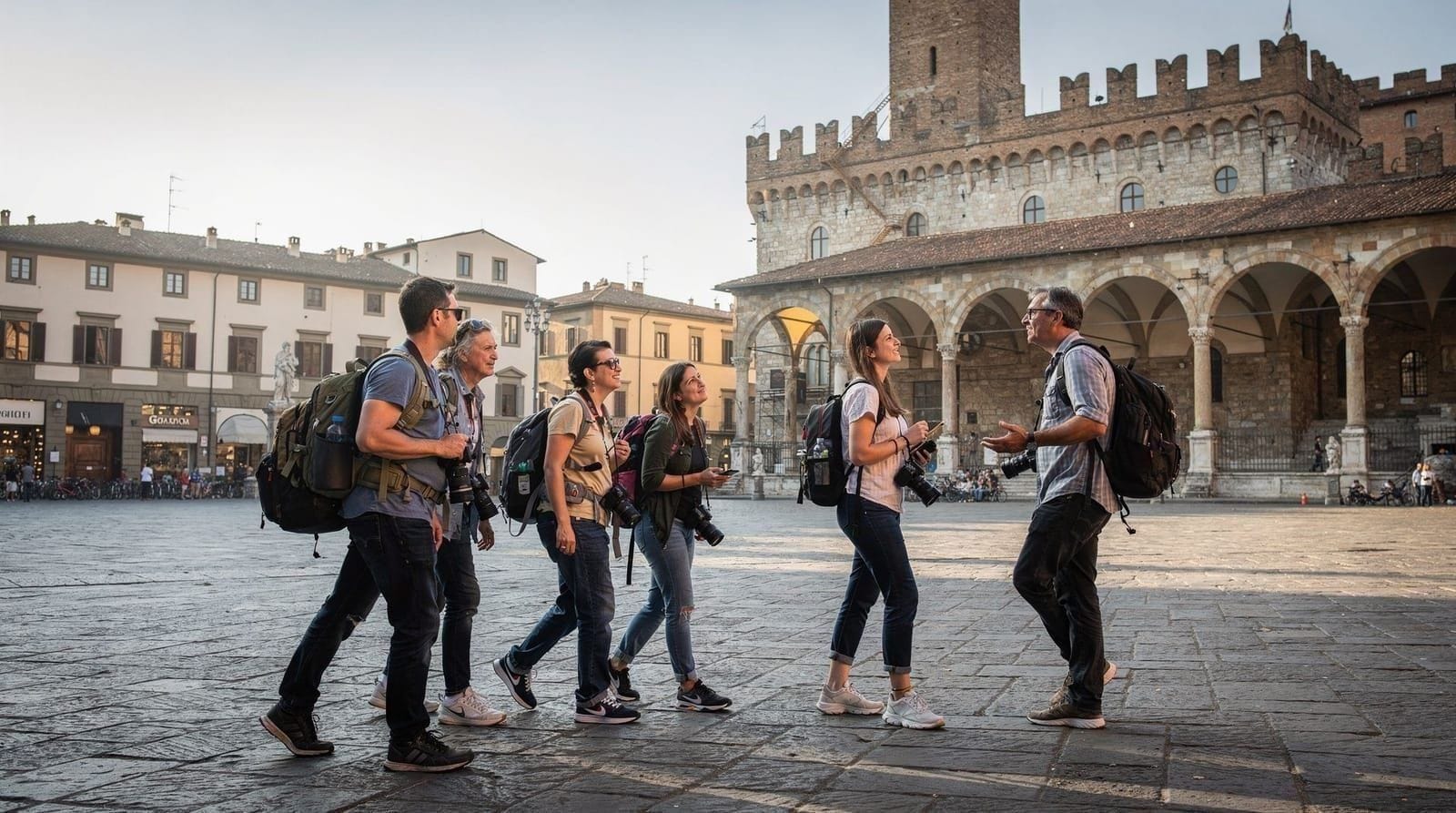
Walking tours: Most Florence walking tours include the piazza. For a focused historical tour, consider the guided Palazzo Vecchio tour — guides who know the palazzo’s interior rooms are essential for unlocking the Medici-era frescoes.
For the full Florence context, see the Florence destination guide and the itinerary planning tools.
Piazza della Signoria vs Florence’s other main squares
| Square | Character | Cost |
|---|---|---|
| Piazza della Signoria | Civic power, sculpture, Palazzo Vecchio | Free |
| Piazza del Duomo | Cathedral, Baptistery, Campanile | Free to view; interiors ticketed |
| Piazza Santa Croce | Largest square, basilica, market atmosphere | Free; basilica ticketed |
| Piazzale Michelangelo | Panoramic viewpoint over the whole city | Free |
Piazza della Signoria is the most sculpture-dense of the four and works well as a short stop rather than a destination in itself — most visitors pass through it several times over a trip rather than visiting once. Pairing it with the Piazzale Michelangelo at sunset for a different, elevated perspective on the same city is a common and rewarding combination.
Best time to visit and what to avoid
Midday in high season is the square at its busiest — tour groups cluster around the Loggia dei Lanzi and the Palazzo Vecchio entrance, and the surrounding cafés fill up. Early morning (before 9:00 am) and evening after dinner both give a genuinely different experience: the sculptures are lit by low sun or floodlights, and it’s possible to stand in front of the Perseus or the Rape of the Sabine Women without a crowd in the frame. If your schedule allows only one repeat visit to the piazza, make it an evening one — the Palazzo Vecchio’s late hours mean the whole area stays animated well after most museums have closed.
Frequently asked questions about Piazza della Signoria
Is the piazza always open?
Yes. The piazza is a public square and is accessible 24 hours a day. The Loggia dei Lanzi is also always open. Palazzo Vecchio has its own hours (approximately 9:00–19:00 daily, to 23:00 on Thursdays).
Is there a tourist trap at Piazza della Signoria?
The restaurants directly on the piazza charge significantly more than the same food served 2 streets away. The quality is not higher. Eat on Via dei Neri, Piazza dei Rossi, or Borgo dei Greci for better value. The square itself is a public attraction and has no entry fee.
Can I touch the sculptures in the Loggia dei Lanzi?
Touching is technically not permitted, though enforcement varies. Photography is unrestricted and free.
What is on the ground near the Neptune fountain?
A small circular bronze disk marks the spot where Savonarola was burned on 23 May 1498. It is set flush with the pavement and easy to miss — look about 20 metres in front of the Neptune fountain toward the palazzo.
Is Piazza della Signoria worth visiting more than once?
Yes, and most visitors end up doing so without planning to — it’s the natural crossing point between the Uffizi, Ponte Vecchio, and the Duomo, so you’ll likely pass through it multiple times over a trip. Each pass at a different time of day shows a different square: busy and photogenic at midday, quiet and atmospheric in early morning or evening.
Do I need to book anything to see the piazza itself?
No. The square, the Loggia dei Lanzi, and all the outdoor sculptures are free and always accessible with no ticket or reservation. Only the Palazzo Vecchio interior and the Uffizi Gallery require separate, bookable tickets.
Top experiences
Bookable activities with verified prices and instant confirmation on GetYourGuide.

Florence: Palazzo Vecchio entrance ticket with audioguide
- Instant confirmation
- Mobile ticket
Florence: Medici's secret path from Palazzo Vecchio to Uffizi
- Small group
- Free cancellation
Florence: Palazzo Vecchio museum and tower private tour
- Free cancellation
Florence: walking tour and optional fast-track Duomo visit
- Free cancellation
- Small group