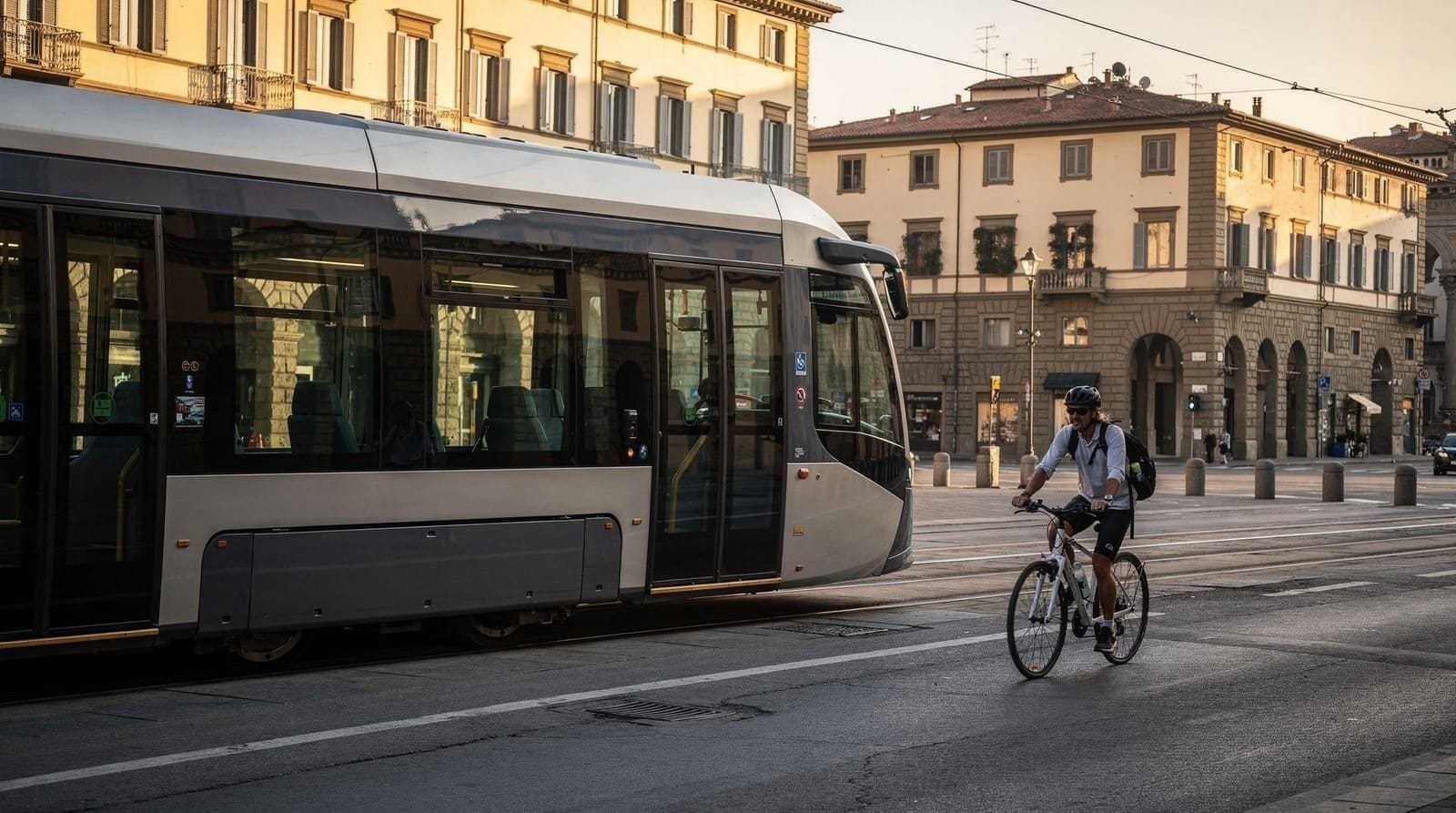
Sunset spots in Florence — where to watch and photograph the golden hour
Where is the best place to watch sunset in Florence?
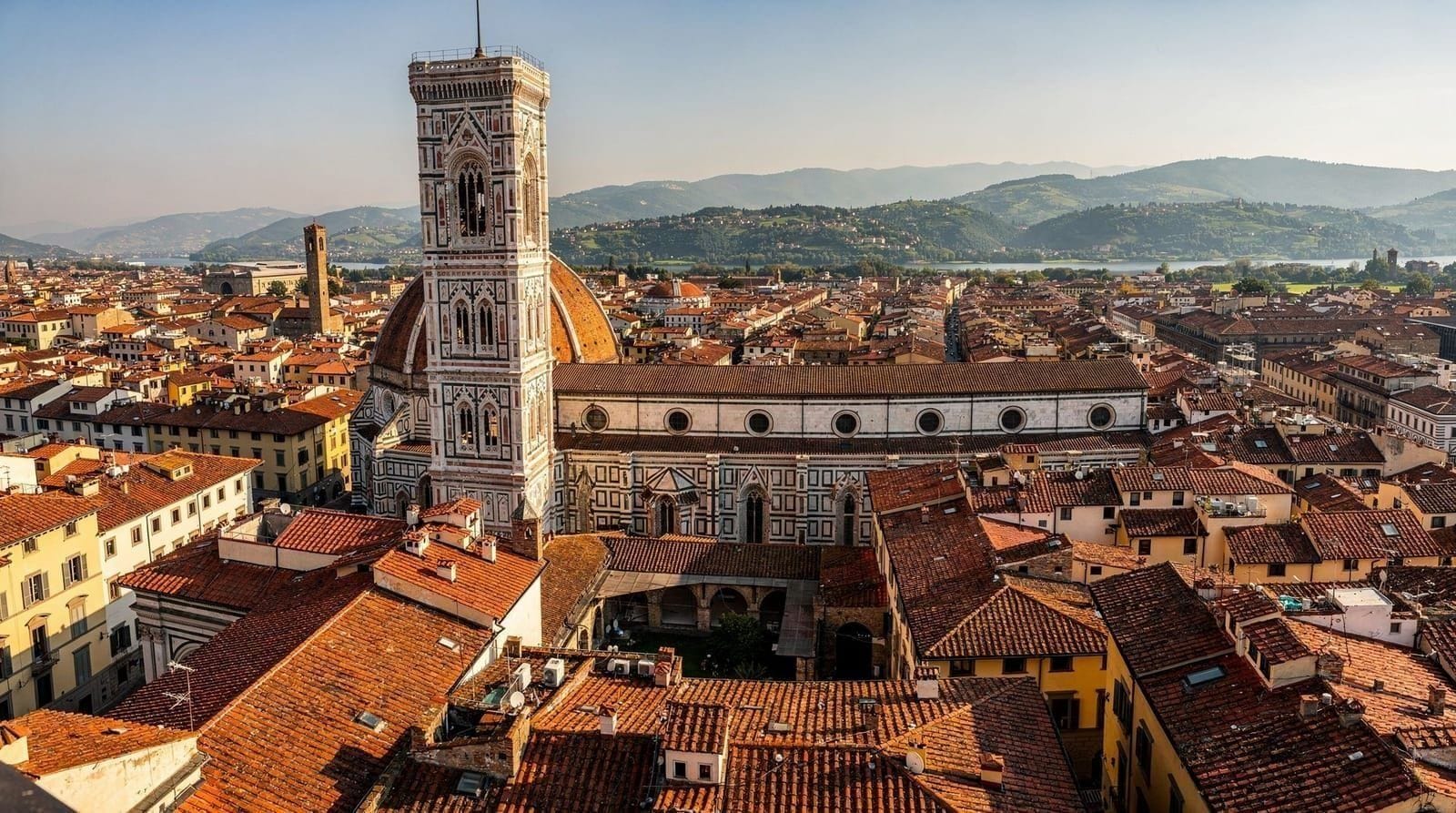
Piazzale Michelangelo is the classic sunset viewpoint — the dome glows in golden light over the rooftops. Arrive 30–45 minutes before sunset in summer. For something quieter, San Miniato al Monte (above Piazzale) or Bardini Garden terrace offer nearly identical views with far fewer people.
| Best spot | Piazzale Michelangelo (classic) or San Miniato al Monte (quieter) |
| Cost | Free at every outdoor spot on this list |
| Getting there | Bus 12/13 from Santa Maria Novella, or 20–40 min walk |
| Arrive by | 30–45 minutes before sunset in summer |
| Best months | May, October, November for dramatic cloud and colour |
Florence at golden hour — why it matters
Florence is one of the few European cities where the golden hour is genuinely transformative. The terracotta rooftops turn the colour of warm copper, the Brunelleschi dome catches the last direct light and glows against the darkening blue sky, and the Arno — when the wind drops — reflects the whole scene in a mirror of still water.
This guide covers every location in Florence where sunset is worth watching, with specific access information, the best positions and honest advice about crowd expectations.
Sunset times by season (Florence)
| Month | Approximate sunset time | Golden hour starts |
|---|---|---|
| December–January | 16:30–17:00 | 15:30–16:00 |
| February | 17:00–17:45 | 16:00–16:45 |
| March | 17:45–18:30 | 16:45–17:30 |
| April | 19:45–20:15 | 18:45–19:15 |
| May | 20:15–20:50 | 19:15–19:50 |
| June–July | 20:45–21:05 | 19:45–20:05 |
| August | 20:15–20:50 | 19:15–19:50 |
| September | 19:00–19:45 | 18:00–18:45 |
| October | 17:50–18:30 | 16:50–17:30 |
| November | 16:45–17:20 | 15:45–16:20 |
For precise daily times, check timeanddate.com or your phone’s weather app for Florence sunset times.
The classic sunset spots
1. Piazzale Michelangelo — the benchmark
Why here: the complete 180-degree panorama of Florence, with the dome catching the final sun and the city spread below. This is the shot everyone knows.
What makes it special at golden hour: the low angle of the light catches the dome’s terracotta lantern and the pale marble of the drum from the side, creating depth and warmth that overhead midday light cannot produce. The rooftops between the dome and your viewpoint glow orange-red.
Getting there for sunset:
- By bus: Bus 12 from Santa Maria Novella station. Take the bus 50–60 minutes before sunset to account for traffic and the 20-minute journey. Return on Bus 13 after sunset (runs until around 22:00).
- On foot: 40-minute walk from the Arno riverbank via Viale dei Colli, or 20 minutes from Porta San Niccolò up the Scalinata del Poggi steps.
- By taxi: approximately €10–12 from central Florence. Taxis can use the access road.
Where to stand: the main railing on the northeast edge of the piazza gives the straight-on view. The left (west) end of the railing shows the Ponte Vecchio in the distance. The right (east) end shows Fiesole and the hills. The centre gives the dome-dominant shot.
Crowd management: in July–August, 200+ people occupy the railing by 30 minutes before sunset. Arrive 45 minutes before. The cafe tables on the piazza provide a raised platform if you arrive late.
After sunset: stay for blue hour (20–30 minutes post-sunset). The city lights turn on and the dome is illuminated — this can be more beautiful than the sunset itself.
2. San Miniato al Monte — the uncrowded alternative
Why here: the same approximate angle as Piazzale Michelangelo but from slightly higher, with the beautiful white marble Romanesque church facade as a compositional element. Crowds are perhaps 20% of what they are at Piazzale.
Getting there: walk up from Piazzale Michelangelo (10 min, signed) or take Bus 12/13 to the San Miniato stop (check current timetable — not all services reach this stop).
Vespers bonus: the Benedictine monks sing Gregorian chant at approximately 18:30 in summer, 17:30 in winter. The church is open to visitors during Vespers — sit in the nave, listen, and experience one of the most serene moments in Florence.
Best position: from the churchyard terrace (free), facing northwest toward Florence. The church portico can frame the dome view if you step back.
After sunset: the church is lit at night and the dark grounds become quiet. Safe to linger but bring a light layer in spring and autumn — it is cooler up here than in the city.
3. Bardini Garden terrace
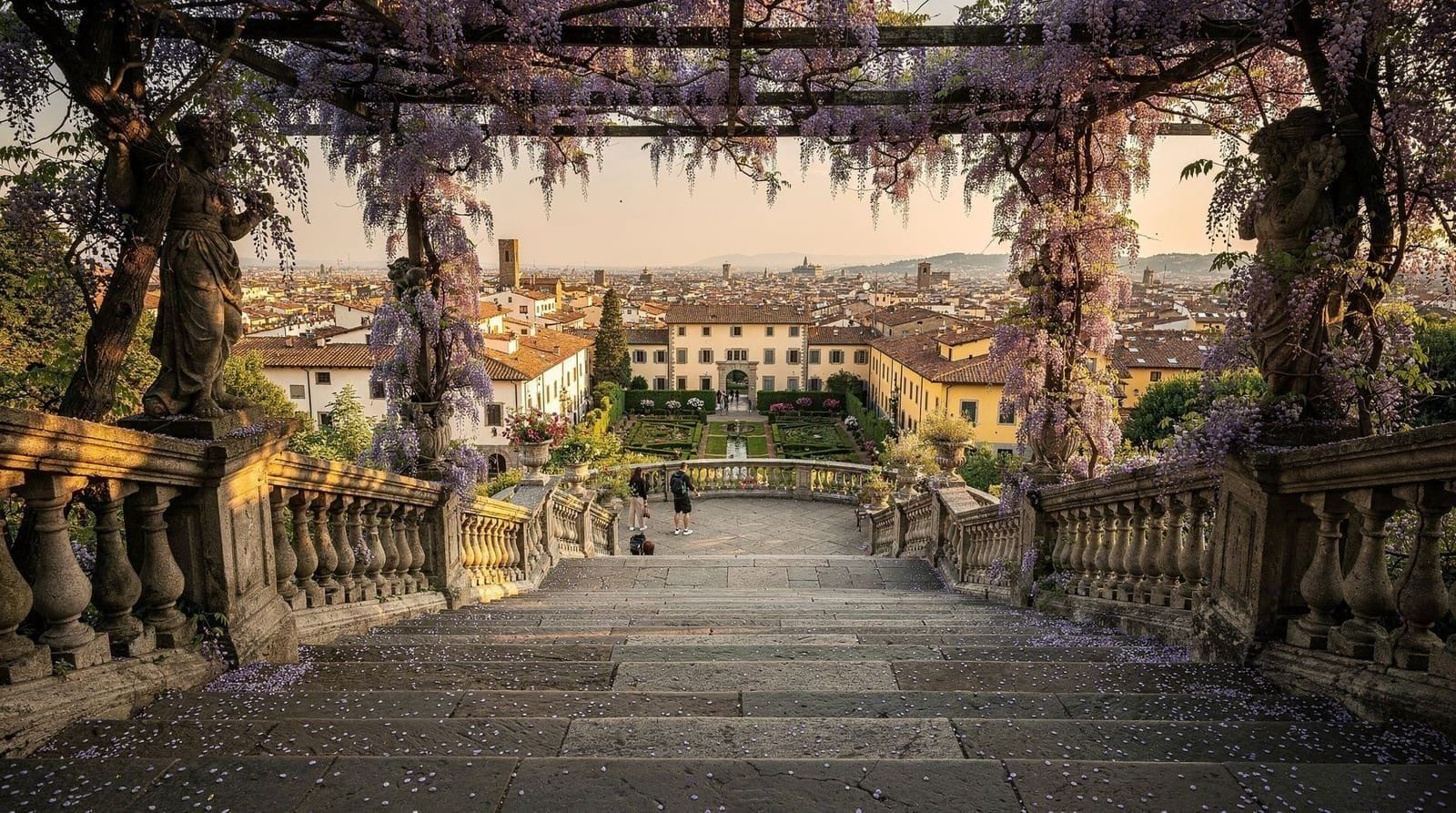
Why here: the rose and wisteria pergola terrace on the Bardini Garden’s upper level gives a framed view toward the dome, with the garden’s historic infrastructure as foreground. Different from Piazzale — more intimate, more colour in spring.
Getting there: entrance on Costa San Giorgio (Oltrarno). Steep uphill walk 15 minutes from Ponte Vecchio. Or from Piazza della Signoria through the Boboli Gardens (requires Boboli ticket).
Opening hours: the Bardini Garden closes at 19:00 in summer (17:30 in winter) — you cannot stay for full sunset in some seasons. Check opening hours before visiting — this is the critical variable.
Best timing: arrive 90 minutes before sunset to explore the garden and be on the terrace for golden hour.
Best period: late April–May for wisteria on the pergola. October for autumn light across the dome. See our full Bardini Garden guide.
Arno bridges at sunset
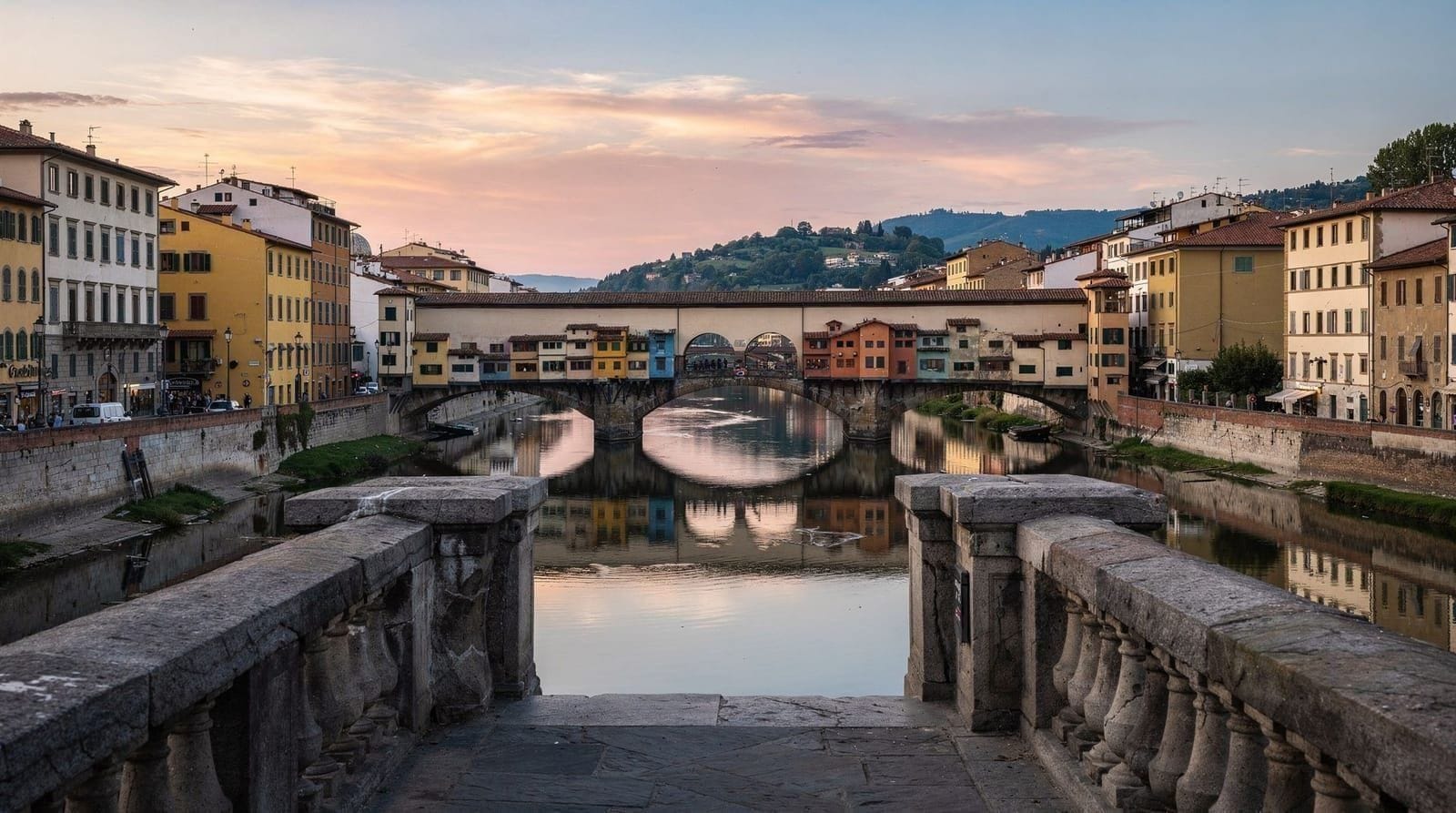
4. Ponte Santa Trinita — Ponte Vecchio in golden light
Why here: standing on Ponte Santa Trinita looking east, you see the Ponte Vecchio directly ahead with the Oltrarno hills behind and the golden light raking across the buildings on the south bank.
Best time: 30–60 minutes before sunset when the light angle is low.
Composition: use the arch of Ponte Santa Trinita as a natural frame with the Ponte Vecchio centered in the gap. Or stand at the south railing and capture the long reflection of the Ponte Vecchio in the Arno.
Access: free, 24 hours. Pedestrian bridge. Most central Florence hotels are within 15 minutes’ walk.
5. Ponte alle Grazie — upstream view
Why here: standing on Ponte alle Grazie and looking west (upstream), you get the Ponte Vecchio, Ponte Santa Trinita and beyond to the Florentine hills in a single layered composition. At sunset, the western sky illuminates this view perfectly.
Best time: 30 minutes before sunset when the sky turns orange and the bridges are lit from the west.
Composition: use a 50–85mm lens to compress the bridges in the distance.
6. Lungarno Serristori — the Arno reflection
Why here: the south bank walkway between Ponte Vecchio and Ponte alle Grazie is the best location for long-exposure Arno reflections at blue hour.
Best time: 20–40 minutes after sunset. Wait for the city lights to reflect on a calm Arno surface.
Technique: tripod essential (bring one, or rest the camera on the railing). Long exposure 4–10 seconds at f/11, ISO 200. Wait for moments when the water is calm between boat wakes.
Less obvious sunset locations
7. Fiesole — sunset and looking back at Florence
Why here: from Fiesole’s panoramic viewpoint on Via Belvedere (below the church), you see Florence lit from the west, with the Arno plain glowing in the late light. The view is the inverse of Piazzale Michelangelo — you see the city from above and from the north.
Getting there: Bus 7 from SMN station (25 min, €1.50). Last bus back from Fiesole is around 21:00 — check the ATAF timetable before going.
Best timing: arrive 60–90 minutes before sunset. Walk the panoramic path above the town.
Sunset dinner option: several restaurants in Fiesole offer outdoor terrace seating with views. Eating here at sunset is one of the most pleasant ways to end a Florence day.
8. Piazza Santo Spirito — Oltrarno aperitivo
Why here: not a panoramic viewpoint, but the square fills with locals at aperitivo hour (18:00–20:00) and the late light on the church facade and the ambient energy of the square create a very different and authentic sunset experience.
Best time: 18:30–20:00 in summer. The square is full, wine is flowing, musicians sometimes play.
For photographers: the church facade (18th-century) is interesting in the oblique evening light. The piazza itself, full of people, makes excellent reportage photography.
9. Fortezza da Basso — city walls at golden hour
Why here: the 16th-century Medicean fortress has accessible external walls with views towards the Apennines and across the northern city. Visited by almost no tourists, it is often quiet even on summer evenings.
Access: free access to the exterior grounds (exhibition events occasionally close the area). Viale Filippo Strozzi.
View: north and northwest — not the dome-dominant view, but the city skyline and distant mountains in the late light.
10. Hotel rooftop bars — sunset with a drink
For visitors who want views without walking, several Florence hotels open their rooftop bars to non-guests:
| Bar | Location | View | Notes |
|---|---|---|---|
| Hotel Continentale Sky Bar | Near Ponte Vecchio | Arno and Ponte Vecchio | Reservations recommended |
| Soprarno Suites terrace | Oltrarno, near Palazzo Pitti | Arno and city | Open to non-guests |
| Grand Hotel roof terrace | SMN area | City panorama | Closed some seasons |
Prices at rooftop bars are significantly higher than standard Florence bars (€12–20 for a cocktail). The view is the service you are paying for.
Guided sunset experiences
Several operators offer guided experiences built around the golden hour:
- Segway sunset tour to Piazzale Michelangelo: reach the viewpoint on an electric segway with a guide who explains the skyline
- E-bike evening tour: cycle to the viewpoint and explore the Oltrarno in the cooling evening air
- Arno river cruise at sunset: see the city from the water level as the light changes — the Ponte Vecchio from the river is extraordinary
Practical tips for sunset in Florence
Weather and light quality
The best sunsets in Florence occur after days with scattered high cloud — these catch the light and turn pink and orange. Clear, cloudless days often produce less dramatic sunsets. The period immediately after a storm or rain shower can give extraordinary atmospheric light.
Best months: May, October, and November often have the most dramatic cloud formations for sunset. July–August tends toward clear skies, which produce reliable but less theatrical golden hours.
What to wear
Summer evenings in Florence are warm until 21:00–22:00 — no jacket needed until well after sunset. September–October cools rapidly after sunset at elevated viewpoints like Piazzale Michelangelo. Bring a light layer.
Transport after sunset
Bus 12/13 from Piazzale Michelangelo runs until approximately 22:00–23:00 but frequency drops after 20:00. Check the ATAF app for the last bus time before heading up. Taxis from Piazzale Michelangelo are available but queue in summer. Walking down takes 25–35 minutes via the Scalinata del Poggi steps.
The golden hour in different seasons — what to expect
Florence’s golden hour changes character dramatically through the year. Understanding the seasonal differences helps you plan for the best photographs or the most beautiful experiences.
Summer golden hour (June–August)
The longest days of the year mean golden hour falls at 19:45–21:00. This is manageable for evening plans — you can eat dinner early (19:00–19:30) and still reach Piazzale Michelangelo in time for sunset.
The summer golden hour has:
- Very warm, orange light (the sun is at a low angle for a long time in northern latitudes)
- Long duration — true golden light lasts 45–60 minutes on clear days
- Significant haze over the city by late summer (particularly August)
- Crowds at all viewpoints, especially weekends
The colours at Piazzale Michelangelo in late June–early July, when the day is longest, are extraordinary: the dome glows for a full 30 minutes in deepening orange before the sun drops. The Arno reflects this light in long golden streaks.
Autumn golden hour (September–October)
September–October golden hours are shorter (sunset at 19:00–20:00) but often more dramatic. The angle of the sun drops faster, creating intense orange light that lasts only 20–30 minutes. The light is “richer” than summer — less haze, more contrast.
October in particular: the autumn light catches the terracotta domes and towers in a copper-red that no other season replicates. The Chianti hills in the distance turn gold with harvest colours.
For photographers, early October is the single best combination of manageable sunset time (around 18:30–19:00), dramatic light, minimal crowds and autumn colour.
Winter golden hour (November–March)
The shortest days create golden hour at 15:30–17:00 — easily achievable without a late night. The challenge is that winter days are frequently overcast in Florence (November and December have the most cloud cover of the year).
When the sky is clear in winter, however, the golden hour is exceptional:
- Very low sun angle creates extreme orange-red light
- Long shadows over the city (the sun barely clears the Apennine ridge)
- Snow on the distant mountains (visible on clear days from Piazzale Michelangelo and Fiesole)
- Empty viewpoints — arrive at 15:30 and have Piazzale Michelangelo to yourself
Combining sunset with Florentine dinner culture
The Florentine dinner hour begins at 19:30–20:00. Golden hour in summer (19:45–21:00) creates a conflict: do you eat first, then watch the sunset, or reverse?
Recommended approach in summer:
- Light early aperitivo (18:30–19:00) in a bar near your hotel — bruschetta, Aperol spritz or Negroni
- Walk or take bus to Piazzale Michelangelo by 19:30
- Watch the sunset and blue hour (until 21:30)
- Return to the Oltrarno or historic centre for dinner (21:00–22:30 — perfectly normal in Italy)
Restaurants in Florence do not typically open for dinner before 19:30, and most fill between 20:00 and 22:00. The 21:00–22:00 dinner after a sunset visit is entirely normal Italian timing.
In the Oltrarno after sunset: the neighbourhood around Piazza Santo Spirito and Borgo San Frediano comes alive in the evening. Several excellent restaurants are within 10–15 minutes’ walk downhill from Piazzale Michelangelo:
- Buca Mario (one of Florence’s oldest restaurants)
- Osteria dell’Enoteca (excellent wine selection, Oltrarno character)
- Trattoria dell’Orto (local clientele, simple Florentine cooking)
What locals do at sunset in Florence
Most Florentines do not make a special trip to Piazzale Michelangelo for sunset — that is tourist behaviour. Local sunset culture in Florence is:
Aperitivo time: from 18:00–19:30, the bars around Piazza Santo Spirito, Piazza della Repubblica, Lungarno Corsini and Via dei Benci fill with locals ordering aperitivo (Aperol spritz, Negroni, Campari Soda, Prosecco) with complimentary snacks.
The Florentine aperitivo is typically more modest than the Milanese all-you-can-eat model — a drink plus small bruschetta or crostini. It is an occasion for conversation, not grazing.
For an authentic sunset experience, skip Piazzale Michelangelo in summer, take an outside table at a Lungarno bar and watch the golden light on the river as the locals chat around you.
The passeggiata: the traditional Italian evening walk is declining in Florence but still exists in some neighbourhoods. Piazza della Signoria and Via dei Tornabuoni see dressed Florentine families walking in the early evening. Ponte Santa Trinita is a favourite spot for watching the light on the Arno.
Sunset spots for different kinds of trip
If you only have one evening in Florence: go straight to Piazzale Michelangelo — it’s the single most reliable payoff for the least planning, and pairs naturally with the best photo spots in Florence guide if photography matters to your trip.
If you’ve already done Piazzale Michelangelo: the Boboli Gardens upper terraces and the Bardini Garden above offer variations on the same view with far fewer people, especially in the last hour before closing.
If you want the view without the climb: several Florence viewpoints closer to street level — bridges, rooftop bars, the Duomo’s own terraces — trade a little altitude for zero uphill walking.
If you have a car or are day-tripping: Fiesole gives you the inverse view — Florence from above, looking down into the valley — and works especially well combined with a sunset dinner on the hillside.
Frequently asked questions about sunset in Florence
Does the Uffizi have a good sunset view?
The Uffizi’s famous second-floor corridor (accessible from the gallery) has windows looking out over the rooftops, but there is no outdoor terrace for public sunset viewing. The Vasari Corridor above Ponte Vecchio is occasionally open for guided tours and would be extraordinary at sunset — but these tours are rare and expensive.
Is the sunrise worth getting up for in Florence?
Absolutely. Sunrise in Florence in summer (05:30–06:30) reveals the city completely empty. The light is softer and more flattering than sunset. Piazzale Michelangelo with only a handful of photographers and the dome lit in pink morning light is one of Italy’s finest photographic experiences.
Can I photograph the sunset from inside a restaurant with a view?
Some restaurants on the Lungarno (riverbank) or in the hills around Fiesole have outdoor terraces that face west. Dinner at sunset is possible — book in advance and confirm the terrace is open. The experience is exceptional but prices at view restaurants are elevated.
What is the best sunset in winter in Florence?
Winter sunsets happen earlier (16:30–17:00) but the angle of light can be beautiful — lower in the sky, more orange, lasting shorter. Piazzale Michelangelo is much quieter in December–January. The city is lit for Christmas from late November. Fog in the valley below (a common November–January condition) creates atmospheric photography when the city rooftops emerge above the mist.
Are there rules about photography at sunset in public spaces?
Florence’s public piazzas and streets are open to photography without restrictions. Using a tripod on a public pavement is not regulated — but be considerate of pedestrians. Moving tripods in busy spaces like Piazzale Michelangelo at peak times is poor etiquette. Arrive early, set up, and stay in one position.
Top experiences
Bookable activities with verified prices and instant confirmation on GetYourGuide.

Florence: golden hour walk tour to Piazzale Michelangelo
- Free cancellation
- Small group
Florence: sunset panoramic tour — Fiesole and Michelangelo Square
- Free cancellation
- Small group
Florence: sunset golf cart tour at Michelangelo Square
- Free cancellation
- Small group
Florence: Arno river cruise at sunset with live concert
- Free cancellation
Florence: electric bike night tour with gelato
- Free cancellation
- Small group