An art lover's perfect day in Florence — and why it starts at the Bargello
The problem with approaching Florence as an art lover is that the obvious itinerary — Uffizi in the morning, Accademia in the afternoon — leaves out most of what makes Florence astonishing, and sandwiches you between two of the city’s most crowded institutions at the exact moments when everyone else is also there.
Here is a better day: one that uses the Uffizi and Accademia strategically, begins with the Bargello (which may be the most important museum in Florence that most visitors skip), and builds in time to actually look rather than just process volume.
It’s a long day. Bring water.
| Where | Bargello → Piazza della Signoria → Oltrarno → Uffizi → Medici Chapels |
| Cost | Around €40–50 total in entry fees for the single-day version |
| Time needed | A full day, roughly 8:30am to 7pm |
| Booking | Uffizi timed entry essential; book 1–2 weeks ahead in high season |
| Best for | Visitors who want to look slowly, not tick boxes |
8:30am — The Bargello, before anyone arrives
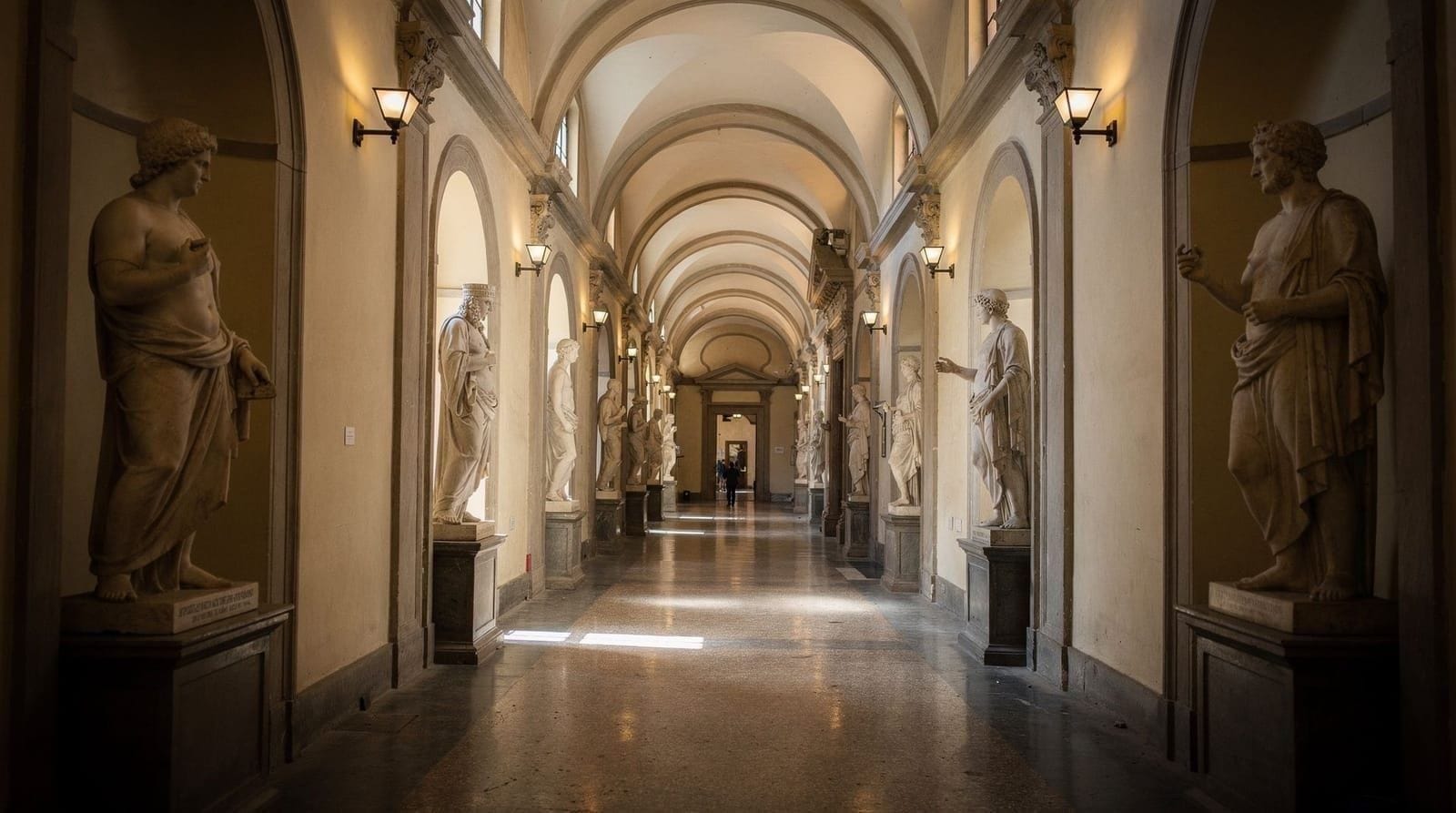
The Bargello opens at 8:15am and most tourists don’t arrive until 10 or later. This gives you the best part of two hours in one of Europe’s great sculpture museums in something approaching solitude.
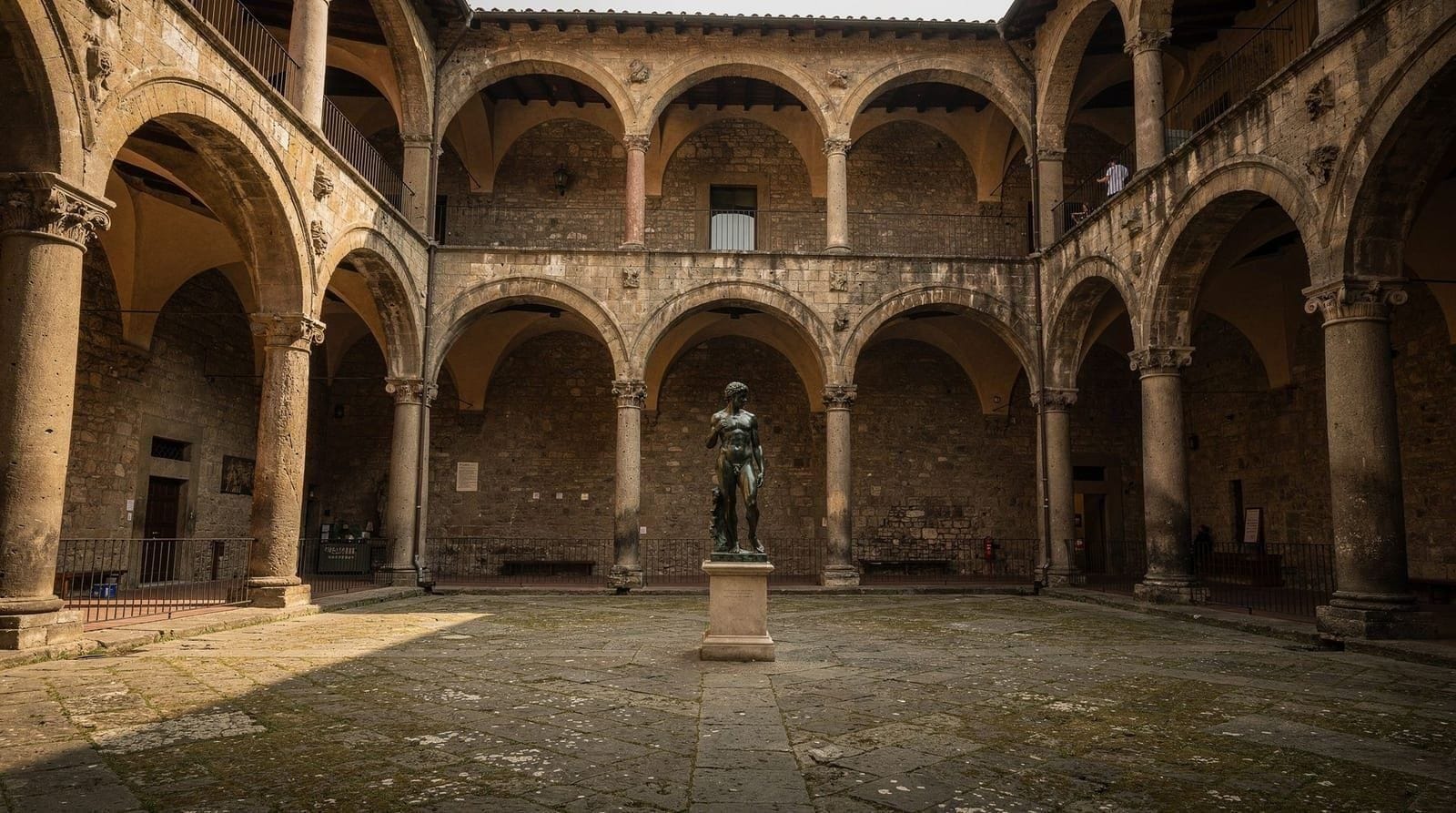
The building was Florence’s first seat of government, later a prison where executions were carried out in the courtyard. The rough stone walls and the hanging loggia give it a dramatic physicality that the Uffizi’s refined galleries don’t have.
What’s inside: Donatello’s bronze David (the first life-size freestanding nude of the Renaissance, completed around 1440), Donatello’s earlier marble David, Verrocchio’s David (the model that the young Leonardo almost certainly posed for — compare this face to the angel Verrocchio painted in the Baptism of Christ, which is now in the Uffizi), Michelangelo’s Drunken Bacchus and his unfinished Brutus, and the two bronze relief panels that Brunelleschi and Ghiberti submitted in competition for the Baptistery doors commission.
That competition — which Ghiberti won, launching a career that produced the Gates of Paradise — is one of the pivotal moments of Florentine art history. The Bargello has both panels in the same room. Stand between them. Look at how differently each artist handled the same subject (the Sacrifice of Isaac). This is the Renaissance argument in material form.
Entry: €10. No pre-booking required in most seasons. If you’d rather not plan this yourself, our Bargello museum guide has the full room-by-room layout.
10:30am — The Piazza della Signoria and Orsanmichele
Walk from the Bargello to the Piazza della Signoria, the political heart of Renaissance Florence. The open-air Loggia dei Lanzi on the piazza’s south side holds several major sculptures, including Cellini’s Perseus holding the head of Medusa (1554) and Giambologna’s Rape of the Sabine Women (1583). These are originals, in the open air, with no ticket required.
The Palazzo Vecchio on the piazza is worth the €12 entry for the Sala dei Cinquecento — a vast hall where Vasari’s ceiling paintings compete in scale with what Leonardo and Michelangelo were supposed to produce on the walls (neither of them completed their commissions; the story is complicated and fascinating). If you want the full context on the square itself before you arrive, the Piazza della Signoria guide covers what’s outdoors and free versus what needs a ticket.
Then walk one street north to Orsanmichele, the medieval grain market converted to a church. Its exterior niches hold bronze and marble sculptures by every major name of 15th-century Florentine art: Ghiberti, Donatello, Verrocchio, Nanni di Banco. The originals are mostly now replaced with copies, but the Museo di Orsanmichele upstairs (enter from Via Arte della Lana; limited hours, check in advance) holds most of the originals. Free entry to the church.
12:30pm — Lunch in the Oltrarno
Cross the Arno via the Ponte Vecchio and walk into the Oltrarno neighbourhood for lunch. The tourist density drops immediately once you’re south of the river.
Buca Mario (Florence’s oldest restaurant, Via delle Terme) is one reliable option for a proper Florentine lunch — bistecca Fiorentina if you’re committed, or the simpler pasta dishes. Alternatively, Trattoria Sostanza (Via del Porcellana), known locally as “Il Troia,” is a rough-edged institution where the butter pasta — tagliolini al burro — is one of the stranger and better Florentine experiences.
Allow an hour and a half. You have a long afternoon.
2:30pm — Timed entry at the Uffizi
Book your Uffizi timed entry for 2:30 or 3pm, after the midday wave has gone and before the late-afternoon crowds. In high season, book at least two weeks ahead; in shoulder season, a week is usually sufficient. Our step-by-step Uffizi ticket guide walks through the official booking site, which slot types exist, and the traps that catch first-time bookers — the same logic applies if you swap this slot for a morning one on a shorter itinerary.
Plan for three hours minimum. The standard tourist visit processes the Uffizi in 90 minutes, which is not enough. An art lover’s visit requires:
Room 10-14: The Botticelli rooms. The Primavera and Birth of Venus are here. The rooms are large but often crowded. The Birth of Venus is smaller than photographs suggest; you need to stand about two metres away to see the modelling of the figure’s face properly.
The Leonardo room: His Annunciation and the unfinished Adoration of the Magi are both here. The Annunciation, painted when he was probably 22-23, shows the angel’s wing with an entomologist’s anatomical accuracy that no other painter of the period attempted.
The Raphael room: La Bella Principessa portrait and the Madonna of the Goldfinch, one of the most beautiful small paintings in the world.
The Tribune: The octagonal room at the centre of the original Medici collection, built to display the most precious objects. The Medici Venus, the Wrestlers, and the small portable paintings that the family considered their private treasures.
The Caravaggios: Late in the gallery, easily missed by people who tire before they get there. The Medusa on a shield is one of Caravaggio’s most visceral works.
5:30pm — Medici Chapels (or the Accademia on a separate day)
A note of honesty: the Uffizi and Accademia in the same day is too much, particularly if you’re actually looking rather than ticking boxes. If you have a second day, give the Accademia its own morning — David requires attention.
If this is your only day, the Medici Chapels (Cappelle Medicee) near San Lorenzo close at 6:30pm and house Michelangelo’s late sculptures for the Medici tombs: the paired figures of Day and Night on the tomb of Giuliano de’ Medici, and Dawn and Dusk on the tomb of Lorenzo de’ Medici. These figures, particularly Night — a massive, torqued sleeping woman with an owl at her feet — are among the most psychologically charged works Michelangelo produced.
Entry €10. Usually short queues.
7pm — Aperitivo and the question of what to do with all of it
There is a phenomenon specific to heavy art days: aesthetic overload. By late afternoon, the capacity to actually see anything has diminished — you’re looking but not perceiving. This is normal and not a failure. It’s why the day is structured to build in breaks.
The aperitivo hour, at a small bar in the Oltrarno or near the Accademia, is where you let what you’ve seen begin to settle. Order a Negroni. Think about whatever image keeps surfacing — for me, it’s usually something unexpected. The face of Verrocchio’s David in the Bargello. The anatomically precise wing. The sleeping Night.
Art that has been properly looked at stays.
If you can’t get Uffizi tickets, or the queue looks brutal
Timed entry sells out in peak weeks, and walk-up lines for the Uffizi and Accademia can run past 90 minutes even with a ticket window that says otherwise. Our skip-the-line Florence guide covers the fallback options — combo passes, guided entry slots that bundle a reservation with a guide, and which secondary sights (Bargello, Orsanmichele, Palazzo Vecchio) are worth substituting in if the big two are genuinely unbookable on your dates. This is also the day to lean on it: losing the Uffizi slot doesn’t have to mean losing the day.
Why this itinerary skips the Duomo
Regular visitors ask why Brunelleschi’s dome and the Duomo complex don’t appear in an art-focused day. The honest answer: climbing the dome is a physical experience more than a looking one, and fitting it in properly (queue, climb, descent) eats ninety minutes to two hours that this itinerary spends instead inside the Bargello and Uffizi. If you have a third day, or want to swap it in, treat the Duomo complex as its own half-day rather than squeezing it between museum slots — the dome climb deserves its own unhurried morning, not a rushed detour.
Planning notes
Don’t underbook: Timed entry for the Uffizi and Accademia (and Medici Chapels in peak season) should be booked in advance. The Bargello and Orsanmichele rarely require advance booking but check current policy.
Wear comfortable shoes: The Uffizi alone requires 3-4 kilometres of walking across its galleries. A full art day in Florence is physically demanding.
Guided versus solo: Guided tours of the Uffizi and Accademia add interpretive depth that makes the experience richer, particularly for first-time visitors. The guides who specialise in Renaissance art (as opposed to general Florence guides) are typically excellent — look for ones with art history rather than tour-operator backgrounds.
Photography: Allowed in most Florence museums without flash. The Uffizi allows photography without tripods. Use it, but don’t let photographing the Primavera substitute for spending twenty minutes standing in front of it.
A second day: the Accademia and everything else
If you have a second day, the structure becomes:
Morning: The Accademia. David is the obvious focus, but spend time with the Prisoners — the four unfinished male figures in the hall leading to David, sculpted between 1519 and 1534, where Michelangelo left the figures apparently struggling to emerge from the marble. Whether he left them unfinished by design or circumstance is debated; what’s not debatable is the effect. These figures look more alive, more urgent, than many completed sculptures.
David himself, seen from below at the base of the plinth, in the round, changes with every position you move to. The slingshot over his left shoulder. The right hand disproportionately large — designed to be read from below in the piazza where he originally stood. The eyes, set at a slight upward angle so that from below they appear to look directly out, are a piece of optical engineering that Michelangelo calculated exactly.
Midday and afternoon: The Museo di Santa Maria del Fiore (Duomo Museum) for the depth of Florentine Renaissance understanding it provides. Then, if the legs hold up, the Museo dell’Opera di Santa Croce — in the cloister of the Santa Croce basilica, with Cimabue’s Crucifix (damaged in the 1966 flood and partially restored) and a Donatello St Louis of Toulouse in gilded bronze that is among his finest works.
What Florence’s art is actually about
The density of masterworks in Florence sometimes creates a problem: visitors see so much exceptional art that individual works start to blur together. The mechanism of looking becomes triage.
The alternative to this is to approach Florence’s art with a question rather than a checklist. The question that makes Florence most legible: what was the Renaissance actually solving?
The answer, in rough terms: how do you represent three-dimensional space on a two-dimensional surface, and how do you represent human figures with the psychological and physical specificity of real people rather than symbols?
Every significant work in the Uffizi, Bargello, and Accademia is either part of the effort to answer those questions or a demonstration of the solved answer. Brunelleschi solved perspective mathematically. Masaccio applied it in painting. Donatello applied it in sculpture. Ghiberti synthesised it into the language of relief. Leonardo extended it into the modeling of light on form.
When you look at the Bargello Donatello and the Uffizi Botticelli with this question in mind, the distance between them becomes legible as progress — not just stylistic difference but the development of a solution to a problem. That’s what makes Florence different from Rome or Venice or Paris: you can see the argument developing across 150 years and understand what was at stake.
Planning notes
Don’t underbook: Timed entry for the Uffizi and Accademia (and Medici Chapels in peak season) should be booked in advance. The Bargello and Orsanmichele rarely require advance booking but check current policy.
Wear comfortable shoes: The Uffizi alone requires 3-4 kilometres of walking across its galleries. A full art day in Florence is physically demanding.
Guided versus solo: Guided tours of the Uffizi and Accademia add interpretive depth that makes the experience richer, particularly for first-time visitors. The guides who specialise in Renaissance art (as opposed to general Florence guides) are typically excellent — look for ones with art history rather than tour-operator backgrounds.
Photography: Allowed in most Florence museums without flash. The Uffizi allows photography without tripods. Use it, but don’t let photographing the Primavera substitute for spending twenty minutes standing in front of it.
See the Uffizi gallery guide for full booking instructions, the Accademia and David guide for what to look for, and the Florence museums guide for a complete overview of what the city holds. For a structured multi-day version of this approach, see our Florence for art lovers itinerary.
Top experiences
Bookable activities with verified prices and instant confirmation on GetYourGuide.

Florence: Uffizi Gallery guided tour with skip-the-line ticket
- Skip the line
- Small group
Florence: Accademia Gallery and Michelangelo's David tour
- Skip the line
- Small group
Florence: Medici Chapels guided tour
- Skip the line
- Small group
Florence: Palazzo Vecchio and battlements guided tour
- Small group
- Free cancellation