The best rooftop aperitivo spots in Florence (honest ranking)
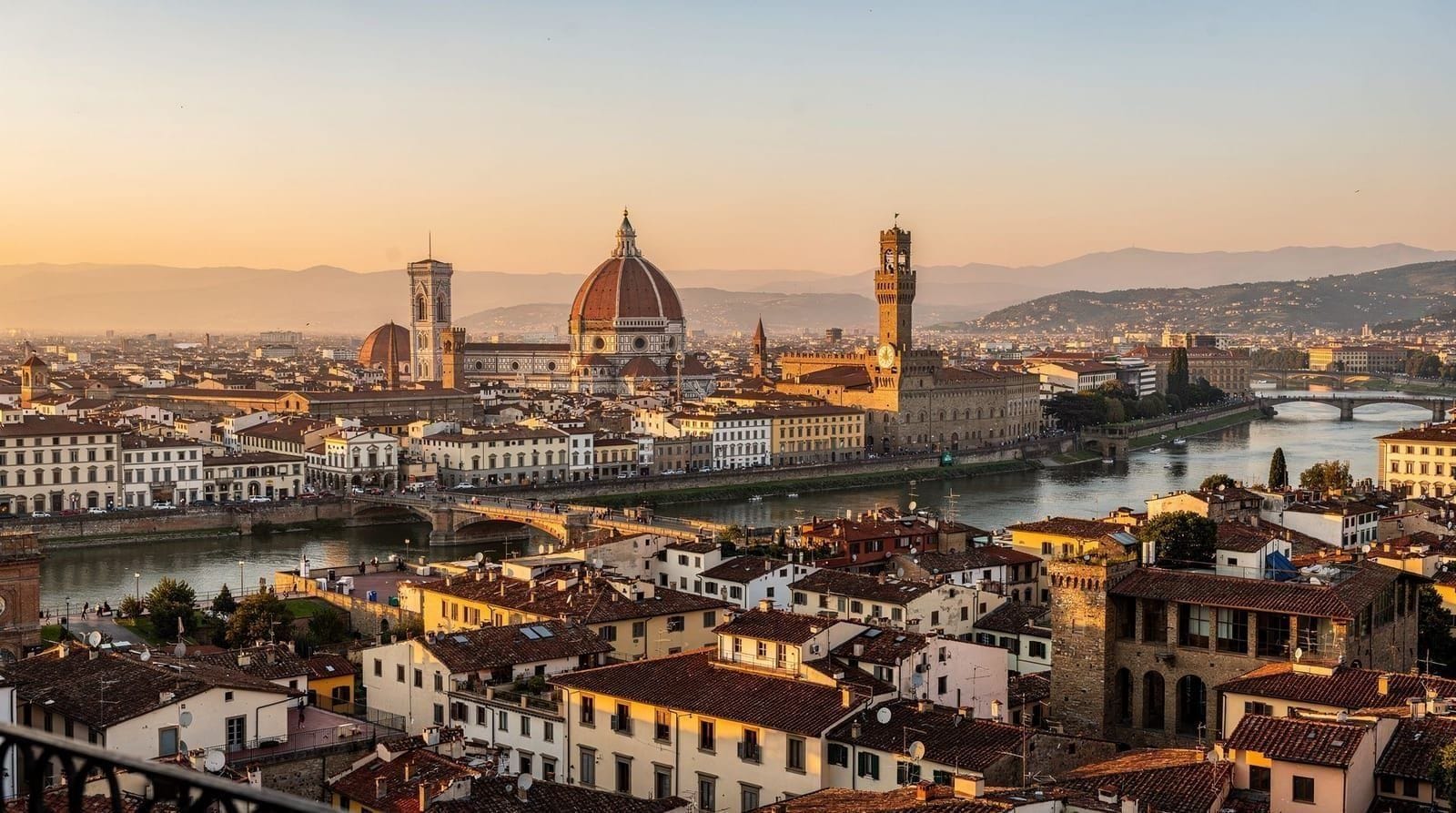
Florence is a rooftop city. The historic centre is mostly four to seven storeys of honey-coloured stone, and from any elevation above the third floor, the famous terracotta dome of the Duomo anchors the view while a sea of smaller cupolas and towers fills in around it. The city was designed to be looked at from above, and a handful of spots let you do exactly that with a Negroni in hand.
But not all of them are worth it. Some charge €18 for a Spritz and face a wall. Others are on the bucket-list because of a magazine article written before the management changed. Here is an honest account of what’s actually worth your evening.
| Where | Hotel rooftops (Lungarno, Oltrarno, Duomo area) or Fuori Porta + Piazzale Michelangelo |
| Cost | €8–24 per drink depending on venue |
| Time needed | 1–2 hours, ideally 6–8pm |
| Best time | May–June or September–October |
| Budget alternative | Piazzale Michelangelo (free) plus a neighbourhood bar |
The approach to aperitivo hour
First, the cultural context. Aperitivo in Italy, and particularly in Tuscany, is not a cocktail hour bolt-on. It’s a ritual: a drink (classically Campari Spritz, Negroni, or a glass of Chianti Classico), taken before dinner, often accompanied by snacks ranging from a bowl of crisps to a full spread of crostini and small plates. The right time is 6-8pm. Arriving at 8:30pm and asking for aperitivo puts you slightly outside the rhythm.
In Florence, most bars include a small spread of food with the drink purchase — this ranges from a single bowl of olives to an impressive buffet at certain spots. When a bar says “aperitivo included,” check what that means before assuming it’s dinner.
The honest rankings, compared
| Spot | View | Price | Best for |
|---|---|---|---|
| Lungarno terrace | Ponte Vecchio, close | €18–24 | A splurge occasion |
| SE·STO on Arno | Duomo, wide skyline | €18–22 | Generous buffet |
| Rasputin | Neighbourhood, Oltrarno | €8 | Real local aperitivo |
| Manifattura | Santa Croce, Fiesole hills | €12–15 | Value with real food |
| Terrazza Brunelleschi | Duomo, overhead | €20+ | Architecture and drama |
| Fuori Porta + Piazzale Michelangelo | Hills, then panoramic (free) | €6–9 | Best value overall |
Rocco Forte Hotel — Lungarno terrace
The terrace bar at the Lungarno Acciaiuoli, looking directly at the Ponte Vecchio from 15 metres up and 50 metres away, is one of the most purely beautiful places to drink in Italy. You are looking at the view every travel book uses on its cover.
The drinks are priced accordingly: a Negroni runs €22-24, a glass of Tuscan white around €18. The service is correct and unhurried. The snacks are elegant.
Is it worth it? For a special occasion, genuinely yes. For a backpacker on a budget, obviously not. But if you’re going to splurge once in Florence, this view at sunset — the Ponte Vecchio turning golden and its reflection on the Arno — is the one.
SE·STO on Arno — Westin Excelsior
On the sixth floor of the Westin Excelsior on Piazza Ognissanti, SE·STO has a wide terrace looking east toward the historic centre. The Duomo is visible. The Arno bends in the middle distance. It is a more expansive, less intimate view than the Lungarno terrace — you’re seeing more of the city, but from slightly further away.
Prices are similar to the Lungarno (€18-22 for cocktails). The buffet spread here is notably more generous — several hot dishes, crostini with different toppings, decent cheese. Come hungry and nurse your drink; the food alone makes the price reasonable.
Book a terrace table in advance for summer evenings. Walk-ins get pushed inside.
Rasputin — the honest local option
Not actually a rooftop (it’s a fourth-floor terrace), and not particularly well-known to tourists, Rasputin on Via dei Serragli in the Oltrarno is where Florentines actually drink aperitivo. The terrace is small, the views are neighborhood rather than panoramic, and the Spritz costs €8.
This is the aperitivo culture I’d recommend experiencing at least once, alongside the Instagram-optimised versions. The snacks are proper — bruschetta, small toasts with chicken liver pâté (crostini toscani), olives — and the local crowd is warm rather than performatively sophisticated.
Manifattura — Santa Croce neighborhood
A converted former manufacturing space near Piazza dei Ciompi, Manifattura has a rooftop deck that offers good views over the eastern historic centre. Less iconic than a Duomo shot, but genuinely lovely at dusk: orange rooftops, the tower of Santa Croce church, the hills of Fiesole on the horizon.
Drinks around €12-15. The kitchen serves actual small plates — not just bar snacks — and the overall price-to-experience ratio is the best of the “elevated but not absurd” category. Popular with both residents and tourists, which usually means the formula is right.
Terrazza Brunelleschi — Hotel Brunelleschi
Inside the hotel on Piazza Sant’Elisabetta (right behind the Duomo), the Terrazza Brunelleschi wraps around the ancient Byzantine tower that forms part of the hotel’s structure. The Duomo here isn’t in the distance — it fills the sky above you.
This is genuinely among the most dramatic architectural settings for a drink in Florence. Prices are high (€20+ for cocktails) but the spectacle is real. Note that it’s small and popular; reservations recommended.
La Terrazza Rooftop Bar — Hotel Continentale
Ponte Vecchio views again, from a different angle than the Lungarno — here you’re looking along the bridge from slightly upstream, seeing its full length with the river below. Equally beautiful, slightly more accessible, with a more varied menu.
The bridge illumination at night, particularly in winter when there are fewer people on the terrace, is something to see.
What to order
If you only order one drink in Florence, it should be a Negroni — gin, Campari, sweet vermouth, orange peel. This is Florence’s cocktail, invented here (allegedly by Count Negroni asking his bartender to strengthen his Americano with gin) and made well in almost every bar in the city.
Alternatively: Campari Spritz (Campari, prosecco, splash of water) for something lighter; or a glass of Chianti Classico, which at most bars is poured generously and pairs well with crostini toscani.
Avoid wine by the glass at the more tourist-oriented hotel bars, where the “house wine” can be indistinct. Ask specifically for something local and ask the price first.
Timing advice
May-June and September-October: ideal. Weather is warm, light lingers, the view after 7pm in June goes on beautifully as the sun drops northwest.
July-August: too hot to enjoy a rooftop at 6pm (35°C plus feels brutal with no shade). Wait until 7:30-8pm when the temperature begins to ease.
November-March: rooftop terraces close or partially close. Check before planning around one.
Sunday: many bars are busiest on Sunday afternoon. If you want a quiet terrace, Tuesday or Wednesday is more reliable.
The Negroni: what to know before you order it
If you’re going to order one drink at a Florentine rooftop bar, it should be a Negroni. The drink was allegedly invented in Florence in 1919, when Count Camillo Negroni asked his regular bartender at Caffè Casoni (on Via de’ Tornabuoni, still functioning under a different name) to strengthen his usual Americano by replacing the soda water with gin.
The correct proportions: 1:1:1 gin, Campari, sweet vermouth, stirred with ice and strained over a large ice cube, with an orange peel expressed over the top and dropped in. Simple, classic, unimprovable.
What differentiates a good Negroni from a mediocre one is almost entirely the quality of the gin and vermouth (Campari is Campari). A rooftop bar that uses a decent Italian gin (Gin del Professore, Etruscan Gin, or similar) and fresh Carpano Antica vermouth will make a better Negroni than one using a well-gin and supermarket vermouth.
The Negroni Sbagliato (the “wrong” Negroni, traditionally made with prosecco instead of gin) has been popularised recently and is lighter and lower-alcohol. It’s a legitimate variation — order it if you want something more summery.
Beyond the Negroni: local aperitivo options
For those who want to drink locally rather than by cocktail:
Chianti Classico by the glass: Any rooftop bar worth its view should pour a decent Chianti. The DOCG wines with the black rooster logo represent the quality benchmark; if a bar pours only generic “house Chianti,” the wine programme is not a priority.
Vermentino Toscano: The local white wine increasingly grown in southern Tuscany and on the Tuscan coast. Light, aromatic, slightly saline from the coastal influence. Better than most generic white wine options at bars.
Lampante: Not a drink but relevant — many rooftop bars serve a small plate of olives alongside drinks. Good Tuscan olives (Taggiasca or Frantoio variety) with good olive oil are worth requesting. The quality of the olives tells you something about the kitchen’s attention to detail.
The Oltrarno alternative
For the best non-hotel rooftop aperitivo experience in Florence, the answer is to skip the hotels entirely and go to a traditional Florentine enoteca. The Fuori Porta wine bar on Via Monte alle Croci in the Oltrarno has a terrace with a partial view toward the hills, an excellent wine list focused on small Tuscan producers, and prices around €6-9 per glass rather than €18-22.
The walk from Fuori Porta to Piazzale Michelangelo takes twelve minutes uphill. Go to Fuori Porta at 6:30pm for a glass of Brunello or Chianti Classico, then walk up to Piazzale Michelangelo at 7pm for the view without paying for it. Then come back down to the Oltrarno for dinner.
This is the Florentine approach to the rooftop question: good wine at honest prices, with the view accessed separately and for free. For the full context on the viewpoint itself, including how it compares to Fiesole and the other classic Florence panoramas, see the sunset at Piazzale Michelangelo guide.
Pairing aperitivo with dinner
Aperitivo is not dinner, however generous the spread looks. If you graze heavily on crostini and olives at 6:30pm, plan a lighter dinner later, or push dinner back to 9pm and treat aperitivo as a genuine pre-meal. Florentines rarely eat dinner before 8pm, so a 6–7:30pm aperitivo slot fits the local rhythm rather than fighting it. If you’re deciding where to eat afterwards, the best trattorias guide and the bistecca alla Fiorentina guide cover the classic follow-up meal, and the Oltrarno’s best restaurants are a short walk from both Rasputin and Fuori Porta.
A note on prices
Rooftop Florence can be expensive. Expect to pay €15-25 per drink at the premium hotel bars. If you want to experience the view on a budget, many of the hotel bars operate a terrace minimum consumption — one drink buys you the table. Nurse it wisely.
The free version of the rooftop experience is Piazzale Michelangelo — no drink required, panoramic views of the entire city, and busy but worth it at sunset. From there you can walk down to the Oltrarno for a reasonable aperitivo at a neighborhood bar before dinner. That combination — the view for free, the drink at scale — is how most Florentines actually do it.
See also: the Oltrarno neighborhood guide for the best local bar streets, Florence evening tours, and the Florence food and wine guide for what to eat after.
Top experiences
Bookable activities with verified prices and instant confirmation on GetYourGuide.