Montepulciano
Montepulciano: hilltop Renaissance town and home of Vino Nobile. Wine cellars under the town, Piazza Grande, and an honest guide from Florence by car.
Florence: private Montalcino and Montepulciano wine tour
- Free cancellation
Quick facts
- Distance from Florence
- 120 km / 1 hr 45 min by car
- Altitude
- 605 metres — bring comfortable shoes
- Best for
- Vino Nobile, Renaissance architecture, hill views
- Budget
- €40-80 including tasting and lunch
The hill town of Vino Nobile
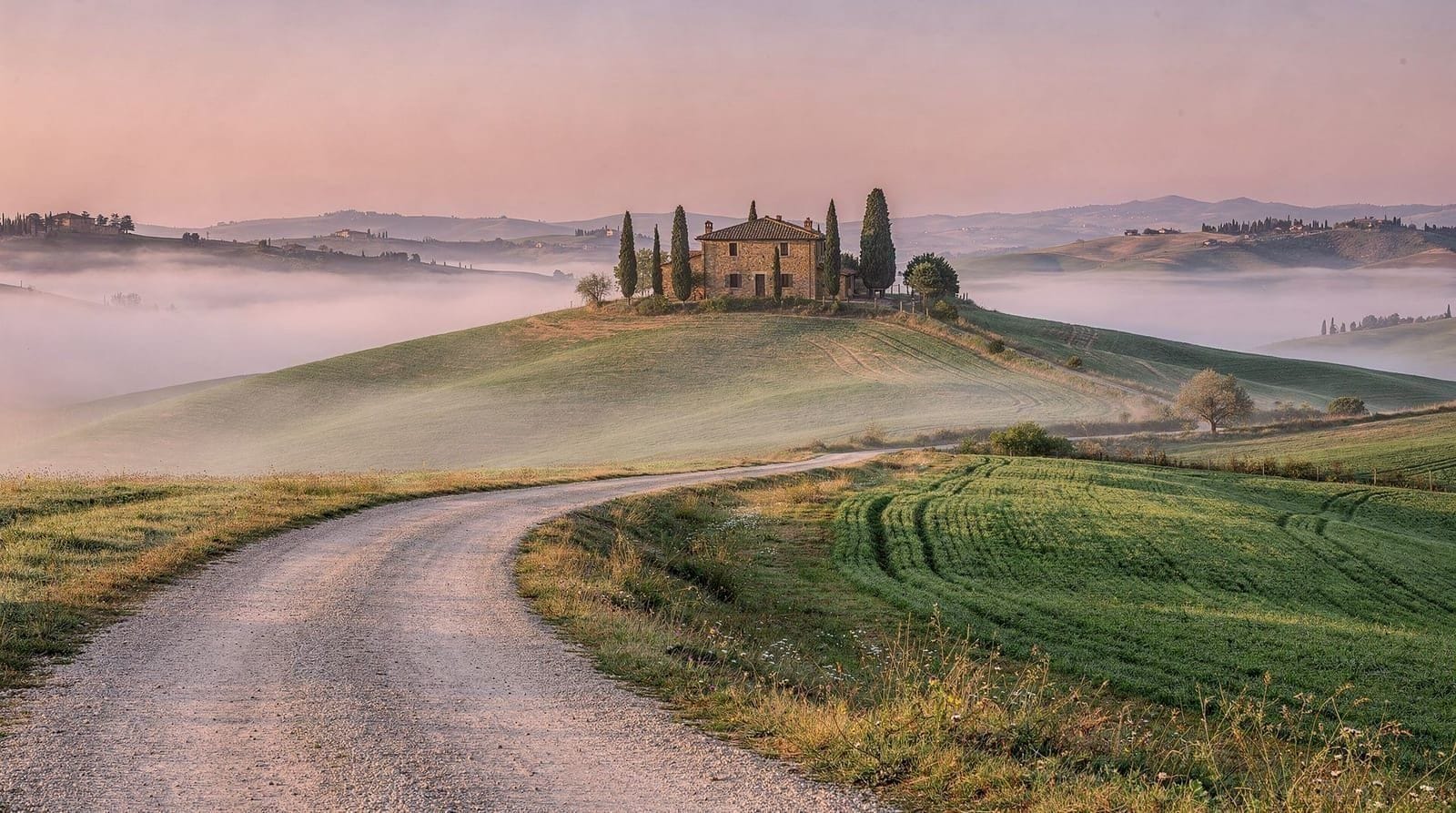
Montepulciano stands on a narrow ridge at 605 metres — high enough that the final drive up into the town, via a tight hairpin road between vineyards and olive terraces, announces clearly that this is somewhere requiring effort to reach and rewarding that effort substantially. The town has more architectural coherence than most of its Tuscan rivals: the Renaissance arrived here in force, and the nobility of Montepulciano employed Florentine and Sienese architects to remake their streets and palaces in the 15th and 16th centuries. The result is a small city with outsized architectural ambition.
Below all of this, quite literally, is Vino Nobile di Montepulciano — one of Italy’s great DOCG red wines, produced from Sangiovese (called Prugnolo Gentile here) grown in the surrounding territory. The major wine producers have their cellars carved into the tufa stone beneath the town’s foundations, and tasting in these underground spaces, vaulted and cool and smelling of centuries of wine, is one of the better experiences available in Tuscany.
| Where | 120 km southeast of Florence, Val d’Orcia |
| Time needed | Half day for the town; full day with a cantina visit and lunch |
| Cost | €40-80 including tasting and lunch |
| Getting there | Car recommended (1h45-2h); guided tour without a car |
| Best time | May-June, September-October |
Getting to Montepulciano from Florence
By car (recommended): Take the Superstrada Firenze-Siena south to Siena, then continue south on the SR2 (Via Cassia) through Torrenieri, then follow signs east on the SP146 to Montepulciano. Total: approximately 1 hour 45 minutes to 2 hours. Parking in the large free car parks at the base of the town (Parcheggio del Valle, Parcheggio Taborra) and walk up. The town’s ZTL is strictly enforced — do not drive into the historic centre.
By train: There is no train station in Montepulciano. The nearest stations are Chiusi-Chianciano Terme (15 km) and Montepulciano Stazione (9 km, served by limited LFI trains from the Chiusi line). A bus or taxi from either station is necessary. This route is possible but requires careful timetable coordination; check Trenitalia and LFI timetables before attempting it.
By bus from Florence: Tiemme buses operate to Montepulciano but with infrequent service and a journey time of approximately 2.5-3 hours including changes. Check current schedules at tiemmespa.it; this route is feasible with advance planning.
By guided tour: The most practical option without a car. Several Florence-based operators offer Val d’Orcia day tours combining Montepulciano, Pienza and Montalcino with transport included.
Walking up the Corso
Montepulciano’s main street is the Corso, which climbs from the Porta al Prato at the base of the town to the Piazza Grande at the summit — a difference in elevation of roughly 100 metres over 700 metres of street. Comfortable, non-slip shoes are essential. The walk is steep in places but entirely manageable; allow 20 minutes at a moderate pace.
Along the Corso you pass:
- Palazzo Avignonesi (Via Gracciano nel Corso 91): A handsome 16th-century palace now housing the Avignonesi winery’s shop and tasting room on street level.
- Palazzo Bucelli: Lower Corso façade embedded with Etruscan and Latin funerary inscriptions and reliefs — a peculiar decoration that reflects the 18th-century antiquarian collector who assembled them.
- Church of Sant’Agostino: Façade designed by Michelozzo (who also designed the Medici Bank in Florence), with a carved lunette above the portal.
- Colonna del Marzocco: A column topped by the Florentine lion (Marzocco), marking Montepulciano’s absorption into the Florentine state in 1511.
Piazza Grande and the summit
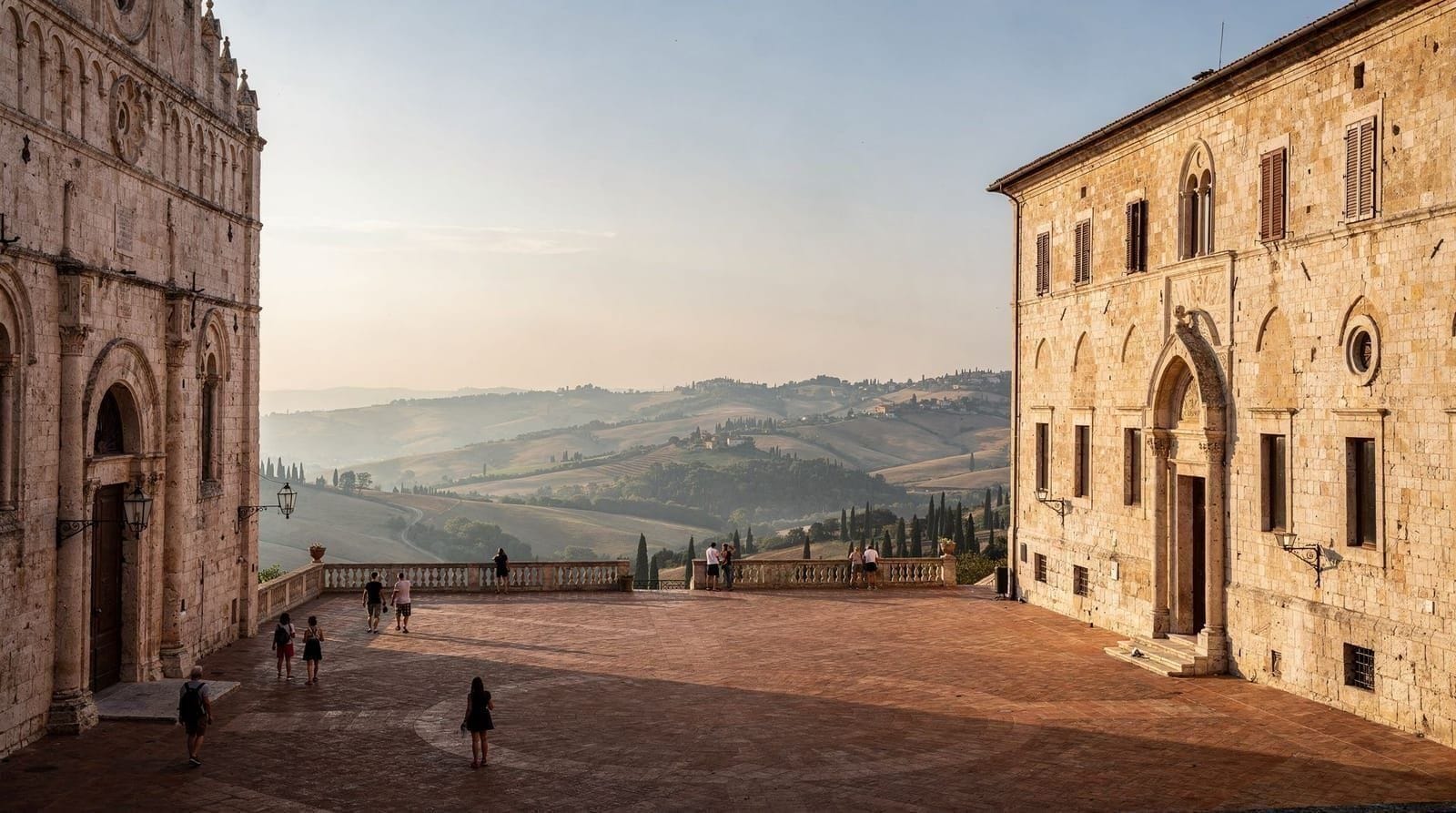
The top of the town opens into the Piazza Grande, one of the finest piazzas in Tuscany by virtue of its dramatic elevated position and the quality of its surroundings. Four major buildings define the square:
Cattedrale di Santa Maria Assunta: The unfinished brick façade (the cathedral was never given its intended marble cladding) is an aesthetic peculiarity but the interior is rewarding. The high altarpiece is the Triptych of the Assumption by Taddeo di Bartolo (1401), a masterpiece of Sienese Gothic painting with particular power in its gold ground and figure modelling. Michelozzo designed the baptismal font. Free entry.
Palazzo Comunale: Montepulciano’s civic hall, modelled on Florence’s Palazzo Vecchio. You can climb the tower for €5 — the 360-degree views across Val d’Orcia, Monte Amiata, and on clear days toward Monte Cetona and the Apennines, are exceptional and worth the stairs.
Palazzo Contucci: One of the major Vino Nobile producers with its cantina (cellar) directly beneath the piazza building. Free to visit the cellar; tastings available. A remarkable setting for wine tasting — the underground space beneath a Renaissance palace on the main piazza.
Palazzo Tarugi (Nobili-Tarugi): Attributed to Giacomo da Vignola or Antonio da Sangallo the Elder, this unfinished but striking palace has a loggia on the ground floor with lions holding the Montepulciano shield.
Wine cellars: tasting Vino Nobile
The major producers of Vino Nobile di Montepulciano maintain their cellars (cantine) in the historic fabric of the town. Several offer free entry to walk the cellars, with tastings available for a fee (typically €5-15 per person for 2-3 wines).
Cantina della Contucci (Piazza Grande): In the cellars of Palazzo Contucci, one of the oldest wine dynasties in Montepulciano. The family has been producing wine here since 1595. Cellar entry free; tastings from approximately €10. Open daily.
Cantina Errari (Piazza Grande, next to the Contucci): A rival historic producer with similarly impressive underground cellars. Direct comparison tasting between these two adjacent producers is an instructive experience.
Cantina Gattavecchi: Located near the church of Santa Maria dei Servi, this historic cantina occupies 13th-century cellars with ancient barrels. Tastings available; one of the most atmospheric settings in the town.
Avignonesi (Via Gracciano nel Corso): Shop and tasting room at street level. Avignonesi is one of the denomination’s most internationally recognised estates, also known for Occhio di Pernice Vin Santo (one of Italy’s great sweet wines). Tastings by appointment recommended.
For the full context of Vino Nobile and Tuscan wine, see our Vino Nobile di Montepulciano guide and our overview of Tuscan wine regions.
San Biagio: Sangallo’s masterpiece outside the walls
One kilometre downhill from the town walls (follow the signs from Porta al Prato), the Tempio di San Biagio is a High Renaissance pilgrimage church begun by Antonio da Sangallo the Elder in 1518 and completed after his death in 1545. The design — a Greek cross plan with a dome and detached campanile — is as close to architectural perfection as the period achieved in a minor building. The stone is travertine, honey-coloured, glowing in afternoon sun. The setting, on a terrace with views of the valley, is superb.
Few visitors who do not specifically know to look for San Biagio visit it. That is an error. It is among the finest Renaissance churches in Tuscany and is free. Allow 20-30 minutes.
Food in Montepulciano
Local specialities include pici pasta (thick, hand-rolled, served with a variety of sauces), wild boar, Cinta Senese pork products, Pecorino cheese (the Pienza variety from nearby), and naturally, everything paired with Vino Nobile.
Osteria Acquacheta (Via del Teatro 22): One of the most popular restaurants in town, known for enormous grilled bistecca and house-made pici pasta. Cash only; expect queues without a reservation, especially in summer. Booking strongly recommended.
La Grotta: Just outside the walls near San Biagio, this restaurant has a long reputation for classic Tuscan cooking in a pleasant garden setting. More formal than Acquacheta; expect €40-55 per person.
Enoteca La Dolce Vita: Simple enoteca on the Corso with good wine by the glass and light food. A good option for a quick lunch with a Vino Nobile tasting.
Practical notes for your visit
Parking: The two main car parks (Parcheggio del Valle below Porta al Prato, and Parcheggio Taborra on the east side) are free or cheap. A minibus (shuttle) runs from the car parks to the top of the town, though most visitors prefer to walk up the Corso.
ZTL: The historic centre is a ZTL (Limited Traffic Zone) for all but residents. Do not attempt to drive in; the cameras and fines are real. See our guide to ZTL zones in Tuscany.
Combination with Pienza and Montalcino: Montepulciano-Pienza-Montalcino is the standard Val d’Orcia circuit. Pienza is 13 kilometres west (15 minutes); Montalcino is 40 kilometres west (45 minutes). See our Val d’Orcia guide for planning a combined day or multi-day itinerary.
Opening hours: Most cantinas open 10:00-19:00 in summer; many close for lunch 13:00-15:00 in low season. The Cathedral opens daily 9:00-18:00. San Biagio daily 9:00-12:30 and 15:00-19:00.
Montepulciano vs Montalcino vs Pienza: which to prioritize
If you can’t do all three towns of the Val d’Orcia circuit in one day, this is how they compare:
| Montepulciano | Montalcino | Pienza | |
|---|---|---|---|
| Wine | Vino Nobile (Sangiovese/Prugnolo Gentile) | Brunello (Sangiovese Grosso) | Not a wine town; Orcia DOC nearby |
| Character | Renaissance architecture, underground cellars | Austere, wine-focused, Fortezza views | Renaissance “ideal city”, Pecorino cheese |
| Time needed | Half to full day | Half to full day | 2-3 hours |
| Best for | Architecture + wine combined | Serious wine collectors | Photography, cheese, quick stop |
| From Florence | 1h45-2h by car | 2h by car | 1h50-2h by car |
For a single day, Montepulciano gives the best balance of architecture and wine; add Pienza as an easy 15-minute detour on the way to or from Montalcino. See the full Val d’Orcia guide for combining all three.
The Bravio delle Botti and local festivals
Montepulciano’s calendar has more going on than the average Val d’Orcia hill town. The Bravio delle Botti (last Sunday of August) is the town’s signature event: teams from the eight historic neighbourhoods (contrade) race 80kg wine barrels uphill along the Corso by hand, a tradition dating to the 14th century. It draws large crowds and is worth timing a visit around if your dates allow, though accommodation books up months ahead.
Cantine Aperte (usually the last weekend of May) sees many of the wine cellars around Tuscany, including Montepulciano’s, open for informal tastings and cellar visits without the usual appointment requirement — a good weekend to visit if you want to sample widely without pre-booking every stop.
A realistic half-day plan
Morning — Arrive by 10:00, walk the Corso from Porta al Prato to Piazza Grande (20 minutes at a moderate pace, stopping at Palazzo Bucelli and Sant’Agostino en route). Midday — Piazza Grande: cathedral, Palazzo Comunale tower climb, and a cellar visit at Contucci or Gattavecchi. Early afternoon — Walk or drive down to San Biagio (20-30 minutes round trip), then lunch back in town or near the church. Late afternoon — Depart for Pienza (15 minutes) or return to Florence.
Frequently asked questions about Montepulciano
What is Vino Nobile di Montepulciano?
A DOCG red wine made from at least 70% Prugnolo Gentile (a local clone of Sangiovese) grown in the Montepulciano commune. Aged minimum 2 years (3 for Riserva), it is characterised by cherry and earthy notes with good tannic structure. It is generally more approachable younger than Brunello di Montalcino. Prices €15-60 for good quality examples.
Can I visit Montepulciano without a car?
With difficulty. The nearest accessible railway junction is Chiusi-Chianciano Terme with an LFI bus connection to Montepulciano Stazione, then a further bus into town. Bus connections from Florence require changes and take 2.5-3 hours. A guided tour from Florence with transport included is the practical alternative.
How long does Montepulciano take to visit?
A minimum of 3 hours to walk the Corso, visit Piazza Grande, one cantina and San Biagio. A comfortable half-day (4-5 hours) allows lunch, multiple cantina visits and a more leisurely pace. A full day is pleasant if you want to visit surrounding wineries in the countryside.
Is Montepulciano the same as Montepulciano d’Abruzzo wine?
No. Montepulciano d’Abruzzo is a different wine from a different region (Abruzzo in central-eastern Italy), made from the Montepulciano grape variety. Vino Nobile di Montepulciano is made from Sangiovese (here called Prugnolo Gentile) from this specific Tuscan town. The confusion is a longstanding one. When looking for the Tuscany wine, ask specifically for Vino Nobile di Montepulciano or Rosso di Montepulciano.
What is the best cantina to visit in Montepulciano?
For atmosphere: Contucci or Gattavecchi (historic underground cellars). For quality and international recognition: Avignonesi (book ahead). For a free-entry comparison: visit both Contucci and Errari on the main piazza on the same morning.
When is the best time to visit Montepulciano?
May-June and September-October for ideal weather, active cantinas and the best landscape views. The Bravio delle Botti festival (last Sunday of August) is Montepulciano’s famous barrel-rolling race between the town’s eight neighbourhoods — spectacular and worth planning around. Summer (July-August) is hot and crowded.
Top experiences
Bookable activities with verified prices and instant confirmation on GetYourGuide.

Florence: private Montalcino and Montepulciano wine tour
- Free cancellation
Florence: Montalcino, Montepulciano and Val d'Orcia with lunch
- Free cancellation
- Small group

Val d'Orcia: Montepulciano, Pienza and Montalcino with winery
- Free cancellation
- Small group

Montepulciano: wine tasting and cellar tour
- Free cancellation
- Small group
Montepulciano: Vino Nobile, architecture and the heart of Montepulciano
- Free cancellation
- Small group