Santo Spirito
Florence's most authentic piazza: Brunelleschi's church, neighbourhood bars, Saturday market and the artisan culture that makes Oltrarno worth visiting.
Florence: evening walking tour with all-you-can-eat aperitivo
- Free cancellation
- Small group
Quick facts
- Best for
- Local atmosphere, aperitivo, artisan streets
- Days needed
- 2-3 hours
- Getting there
- 10-15 min walk from Ponte Vecchio
- Key sights
- Basilica di Santo Spirito, Piazza Santo Spirito, local bars
| Where | Oltrarno, south bank of the Arno |
| Cost | Free piazza and church; €6-10 Brancacci Chapel |
| Time needed | 2-3 hours |
| Getting there | 10-15 min walk from Ponte Vecchio |
| Best time | Saturday morning (market) or evening (aperitivo) |
Florence’s neighbourhood piazza
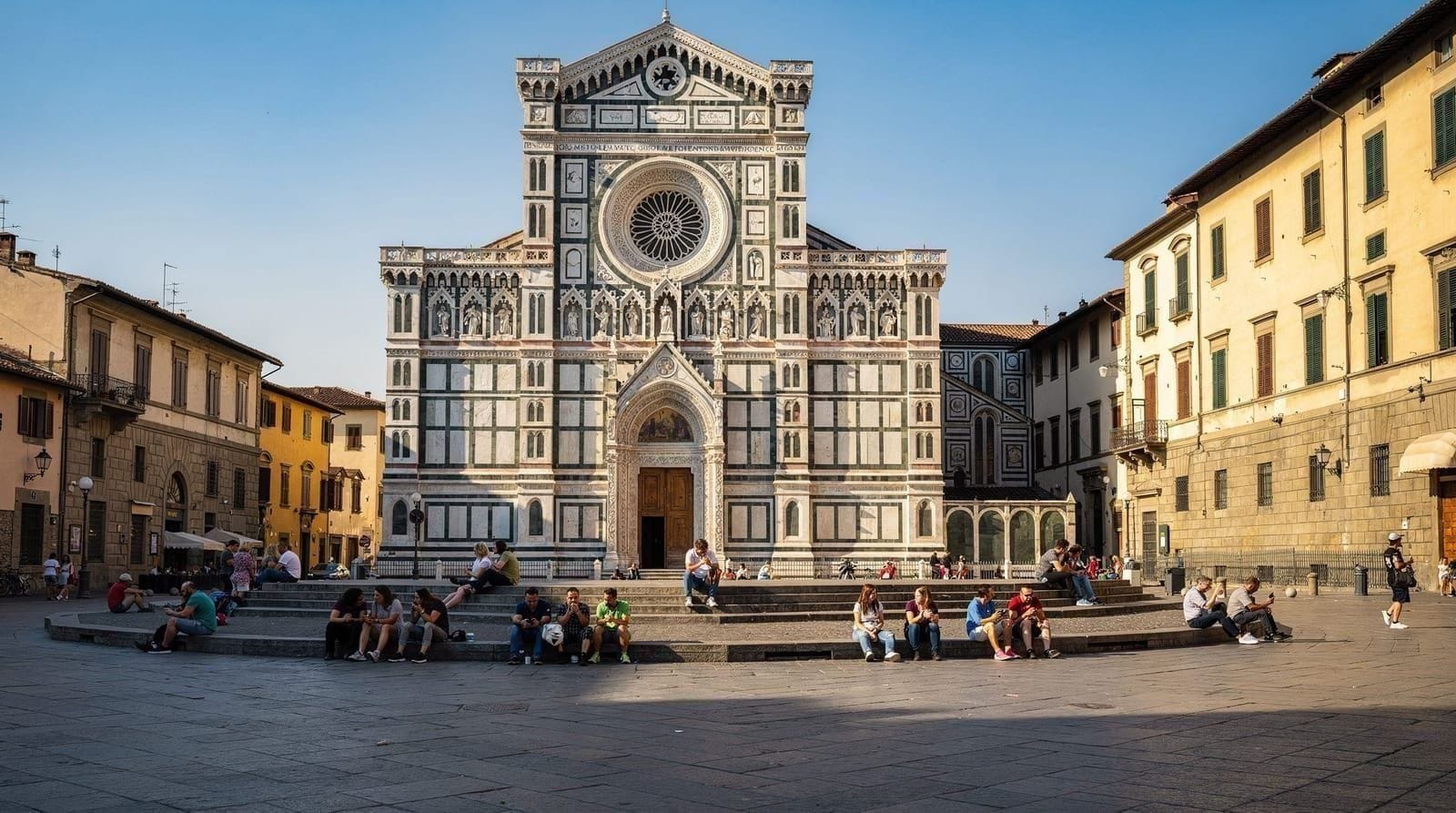
Piazza Santo Spirito is one of the few places in the centro storico where you can sit on a bench on a weekday afternoon and feel like you’re in an actual Florentine neighbourhood rather than a museum precinct. The piazza is surrounded by cafés and bars that serve residents rather than tour groups, occupied by locals of various ages from afternoon onwards, and anchored by the plain white facade of Brunelleschi’s last church.
It is, in short, exactly the kind of place that draws returning visitors to Florence while first-timers crowd the Uffizi queue.
Basilica di Santo Spirito
Brunelleschi designed Santo Spirito in 1428, the year before he died; the building was completed under different architects by 1487 and retains a few compromises from the post-Brunelleschi design (the vestibule arcade on the main facade, added in 1564, disrupts the purity of the original plan). The white lime facade is deliberately unfinished — the marble cladding planned in the original scheme was never funded.
Inside, the space is a masterpiece of early Renaissance geometry. Forty semicircular chapels ring the nave and transepts in a continuous colonnade; the grey pietra serena columns and arches against white plaster walls create the same proportional calm as Brunelleschi’s other major work, the Hospital of the Innocenti. Each chapel contains an altarpiece; collectively they trace Florentine painting from the 14th to the 16th century.
Notable works:
- A wooden crucifix attributed to Michelangelo (created when he was around 17 and living in the monastery), visible in the sacristy — though access is limited and not always available
- Filippino Lippi’s Madonna and Child with Saints (Nerli Chapel)
- Cosimo Rosselli’s Adoration of the Magi
Entry: free (a small donation is appreciated). Hours are limited; the church is typically open mornings and afternoons but closes during midday and Sunday mornings.
The piazza in practice
The piazza is a genuine community space. Key rhythms:
Saturday mornings: A small organic and artisan market fills the piazza — fresh vegetables, cheese, honey, bread, handmade objects. This is where Oltrarno residents shop for weekend food. The atmosphere is relaxed.
Late afternoon and evenings: The bars around the perimeter fill up from about 6pm onwards. Aperitivo (a cocktail plus free or discounted bar snacks) runs until 8 or 9pm. Volume (Piazza Santo Spirito 5r) is the most-cited option; Il Santino (nearby Via Santo Spirito) is the wine bar sibling of the excellent Enoteca del Santino.
Night: The piazza stays animated until late, particularly in summer. There are occasional noise complaints from residents about weekends; the energy is genuine but the neighbourhood is working hard to balance tourism and livability.
Streets worth exploring
Via di Santo Spirito: Running west from the piazza toward the Carmine, this street has several artisan workshops (frame-making, silversmithing) and mid-range wine bars and restaurants. Il Santino (Via di Santo Spirito 60r) and its parent restaurant Il Borro (same ownership as the Ferragamo estate winery) occupy the better end of the block.
Borgo San Frediano: Running northeast-southwest through the neighbourhood, this is the main commercial street of the western Oltrarno: alimentari, hardware shops, bookshops, a few bakeries, and the kind of shopfront mix that confirms the neighbourhood is still lived in. The Brancacci Chapel is at the western end.
Brancacci Chapel (Cappella Brancacci): In the church of Santa Maria del Carmine, a 10-minute walk west from Piazza Santo Spirito. The chapel contains Masaccio and Masolino’s fresco cycle of the Life of St Peter (1424-1427), one of the most important works in Renaissance painting — Masaccio’s panels were studied by every major artist of the subsequent century. Entry requires a timed ticket (€6-10), separate from the church. The number of visitors allowed simultaneously is limited.
Where to eat and drink
- Trattoria da Ruggero (Via Senese 89): Old-school trattoria, lunch and dinner, the ribollita is worth ordering specifically.
- Osteria del Cinghiale Bianco (Borgo San Jacopo 43r): Wild boar (cinghiale) pasta, Chianti wine list, unpretentious.
- Gelateria La Sorbettiera (Piazza Tasso 11r): One of Oltrarno’s preferred gelato spots; natural colours, seasonal flavours.
- Volume (Piazza Santo Spirito 5r): The reference aperitivo bar; books, vintage furniture, good cocktails.
Getting there
Santo Spirito is within the Oltrarno neighbourhood, accessed by crossing either the Ponte Vecchio or the Ponte alla Carraia from the north bank. From the Ponte alla Carraia, the piazza is about 8 minutes south on foot.
Santo Spirito versus San Niccolò: two sides of quiet Oltrarno
Santo Spirito and San Niccolò are both antidotes to the crowds of central Florence, but they offer different flavours of quiet. Santo Spirito is a genuine community piazza with a Saturday market and an active evening bar scene — livelier and younger, especially after dark. San Niccolò, further east along the river, is calmer still: a wine bar strip rather than a piazza, and the starting point for the walk up to San Miniato al Monte. If you want people-watching and aperitivo energy, choose Santo Spirito; if you want a quieter riverside wander toward a sunset viewpoint, choose San Niccolò. Both are easily combined in a single Oltrarno afternoon — see the Oltrarno neighbourhood guide for a fuller route linking the two.
A realistic evening plan
Arrive at Piazza Santo Spirito around 6pm as the aperitivo crowd gathers, and take a table at Volume or one of the piazza’s other bars. Visit the Brancacci Chapel late afternoon before it closes rather than after dark, and walk Borgo San Frediano to see the neighbourhood’s working shopfronts on the way. The Oltrarno artisan workshops guide and the where to eat in Oltrarno guide cover this district in more depth.
Top experiences
Bookable activities with verified prices and instant confirmation on GetYourGuide.