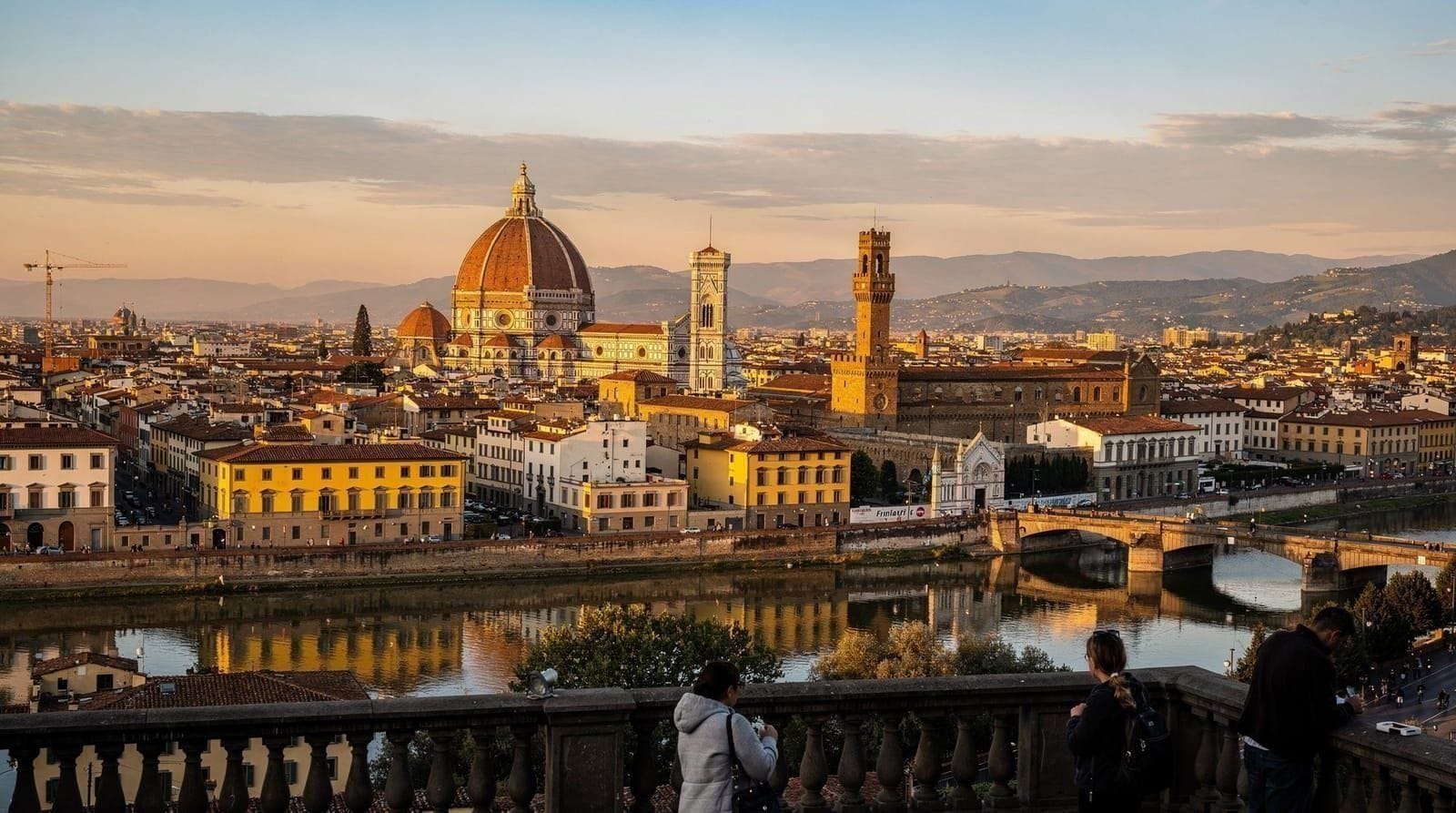
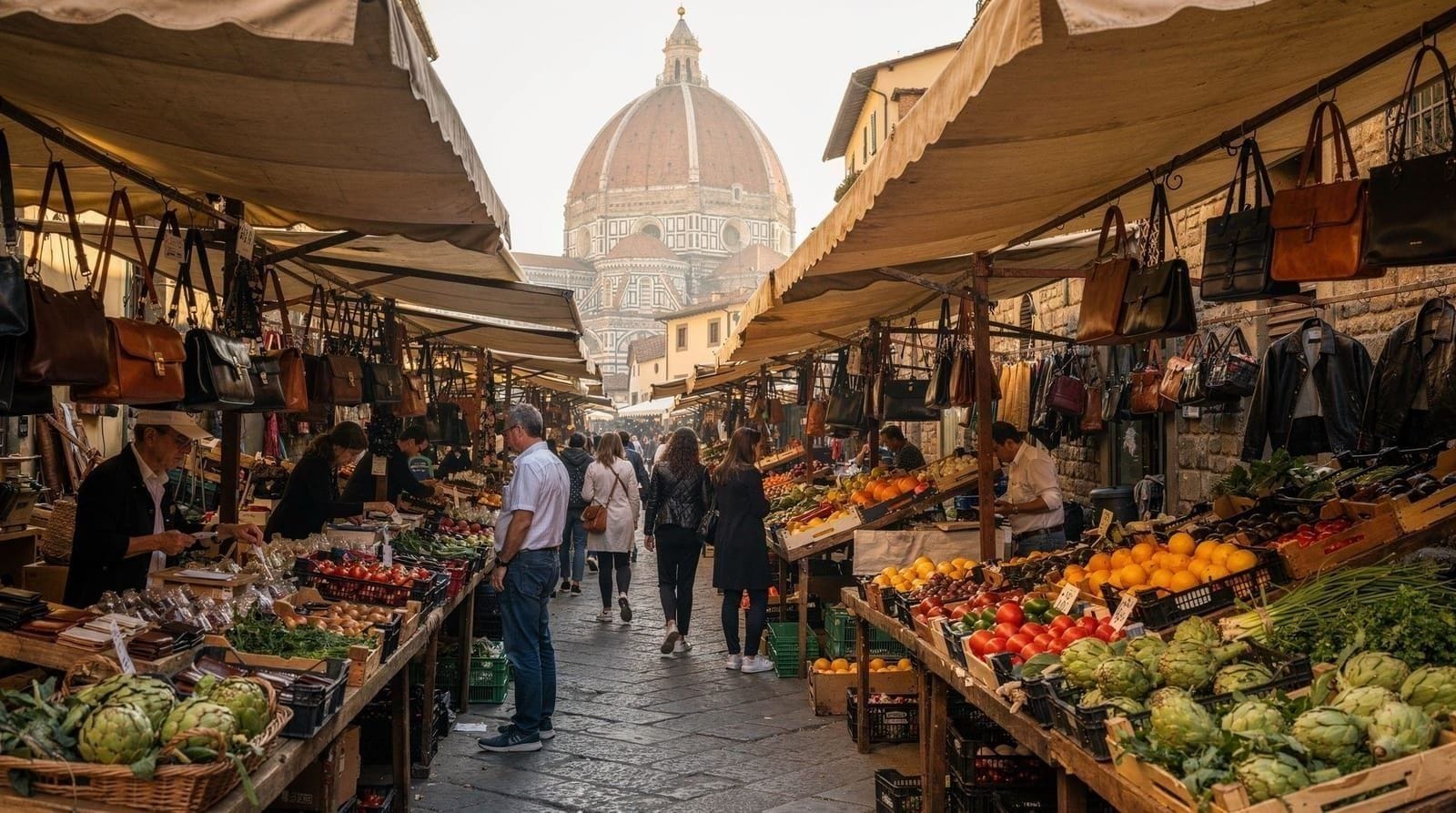
Santa Croce district
Florence's eastern artisan quarter: Santa Croce Basilica, Sant'Ambrogio market, the leather school and the best honest trattorias east of the Duomo.
Florence: entry ticket to the Santa Croce Basilica complex
- Instant confirmation
- Mobile ticket
Quick facts
- Best for
- Local food scene, the Basilica, artisan leather
- Days needed
- Half day to full day
- Key sights
- Basilica di Santa Croce, Sant'Ambrogio market, Piazza dei Ciompi
- Getting there
- 15-min walk from SMN station; 8-min walk from Duomo
| Where | East of the Duomo and Bargello, south to the Arno |
| Cost | Free market and streets; €8-9 basilica, €8-10 Bargello |
| Time needed | Half day to full day |
| Getting there | 15-min walk from SMN station; 8-min walk from the Duomo |
| Best time | Morning for the market, evening for aperitivo |
Florence’s eastern neighbourhood
Santa Croce sits east of the Bargello and south of the market district, bounded by the Arno to the south and a tangle of medieval streets to the north and east. It’s one of the oldest continuously inhabited parts of the city, historically the quarter of wool workers and leather tanners whose craft helped fund the Renaissance. Today it retains a genuine neighbourhood feel that the Duomo district has largely lost to souvenir shops.
The anchor is the Basilica di Santa Croce — a Franciscan church that doubles as Florence’s pantheon, containing the tombs of Michelangelo, Galileo, Machiavelli and Dante (a cenotaph; Dante died in Ravenna). But the neighbourhood rewards exploration beyond the basilica.
Basilica di Santa Croce
The church was begun in 1294, replacing an earlier Franciscan chapel on the same site. The green-and-white marble facade wasn’t added until the 19th century, funded by an English benefactor — which is why it looks slightly incongruous compared to the medieval interior.
Key works inside:
- Giotto’s frescoes in the Bardi and Peruzzi Chapels (right transept): among the earliest surviving narrative cycles in Italian painting, badly whitewashed in the 18th century and partially restored. The deterioration is part of the art’s history.
- Donatello’s gilded bronze Annunciation (right nave): a landmark of early Renaissance relief.
- Cimabue’s painted crucifix (now in the chapter house/museum): badly damaged in the 1966 flood and partly restored; the survival effort launched modern flood conservation techniques.
- Benedetto da Maiano’s marble pulpit.
- Michelangelo’s tomb (first on the right nave, designed by Vasari): the three allegorical figures represent Painting, Sculpture and Architecture. Michelangelo himself requested burial at Santa Croce, but died in Rome; his body was brought back covertly.
- Galileo’s tomb (on the left nave): buried here in 1737, after the Inquisition had prevented it for a century.
Entry to the church and museum costs €8-9. The museum includes the chapter house with Cimabue’s crucifix and a cloister by Brunelleschi — worth the combined ticket.
Opening hours: Generally 9am-5:30pm Monday to Saturday, 1pm-5:30pm Sunday. Hours vary; verify at the official website. The church is a working Franciscan community.
Sant’Ambrogio market
Three blocks northeast of Santa Croce, the Mercato di Sant’Ambrogio is the neighbourhood food market that Florentines actually use. It occupies an 1873 cast-iron hall plus an outdoor extension, and operates weekday mornings (typically 7am-2pm, Saturday 7am-5pm; closed Sunday).
Inside: vegetable vendors, cheese stalls, meat and offal butchers, dried pasta, olive oil and wine, fresh bread. Prices are substantially lower than any restaurant in the area. The lampredotto counter at the back serves one of the city’s most authentic versions of Florence’s iconic tripe sandwich (€4-5). Nerbone, the famous lunch counter inside the Mercato Centrale (San Lorenzo), draws more tourists; Sant’Ambrogio is where locals eat.
The outdoor stalls extend around the piazza and sell secondhand clothing and household goods — a less polished version of the Portobello Road aesthetic.
The leather school of Santa Croce
Behind the Basilica di Santa Croce, within the former friary complex, is the Scuola del Cuoio — the Florence leather school founded in 1950 by Franciscan monks working with Jewish survivors of WWII concentration camps. The school still operates as a workshop and training school for traditional leather craftsmanship, and the on-site shop sells handmade bags, wallets, belts and accessories at prices that reflect real skilled labour (€60-250 for a quality piece).
Visitors can watch craftspeople at work during opening hours. This is genuine handmade leather produced in Florence, which differentiates it from most of what’s sold at the San Lorenzo market (primarily imported and machine-made despite the “made in Italy” labels).
How to get there: Enter through the Santa Croce church cloister or via Via San Giuseppe 5R. Free entry to the workshop and shop.
Piazza dei Ciompi and surroundings
One piazza north of Sant’Ambrogio, Piazza dei Ciompi hosts a permanent antique and secondhand market (open Monday-Saturday, 9am-7pm). The Ciompi were the wool workers who led a brief workers’ revolt in 1378 — one of the earliest documented proletarian uprisings in European history. The piazza named for them is accordingly modest.
The surrounding streets — Via dei Macci, Via Ghibellina, Borgo La Croce — have excellent neighbourhood cafés and bars that serve Florentines rather than tourists. The aperitivo scene here, particularly on weekday evenings, is unpretentious and reasonably priced.
The Bargello
Technically at the border of Santa Croce and the Duomo districts, the Bargello (Via del Proconsolo 4) is Florence’s national sculpture museum and one of the most undervisited major art spaces in the city. The building is a 13th-century former prison and city hall; the collection includes:
- Donatello’s bronze David (1440s): the first freestanding bronze nude since antiquity, displayed in the inner courtyard
- Donatello’s marble Saint George: commissioned for a niche at Orsanmichele
- Two of Lorenzo Ghiberti’s original competition reliefs from the 1401 Baptistery doors competition (Ghiberti won; Brunelleschi’s losing entry is also here)
- Michelangelo’s Bacchus and Tondo Pitti
- Benvenuto Cellini’s original bronze bust of Cosimo I de’ Medici
Entry costs €8-10. The Bargello closes on Tuesdays and on certain bank holidays. It tends to be quieter than the Uffizi or Accademia; you can often have rooms nearly to yourself.
Where to eat in Santa Croce
The neighbourhood has some of Florence’s most honest trattoria eating:
- Trattoria Cibrèo (Via dei Macci 122r): The simpler offshoot of the famous Cibreo restaurant next door. No pasta (deliberately), but tomato aspic, braised tripe, roast offal. Lunch only, no reservations, arrive early.
- Il Latini (Via dei Palchetti 6, technically near Santa Maria Novella): Very popular communal table trattoria; long queue most nights but the atmosphere is part of the experience.
- Osteria dell’Enoteca al Paradiso (Piazza Ghiberti 17): Near Sant’Ambrogio, genuine neighbourhood pricing, strong wine list.
- All’Antico Vinaio (Via dei Neri 65r): The famous schiacciata sandwich shop — enormous queues at peak hours, but the sandwiches are genuinely good and substantial at €5-8. Multiple locations now exist across the city.
For the full food and restaurant picture, see the best restaurants in Florence guide.
Nightlife and bars
Santa Croce’s nightlife is student-oriented and concentrated around Piazza Santa Croce and the surrounding streets. This makes it genuinely lively and occasionally very crowded on weekend nights. The piazza itself hosts events including Calcio Storico Fiorentino — a medieval football game in period costume, played in June, which is exactly as violent as it sounds.
Notable bars:
- Rasputin (Via dei Benci): Craft beer, low-key.
- Mad Souls and Spirits (Borgo degli Albizi 4): Cocktail bar, strong on local amari.
- Volume (Piazza Santo Spirito): Technically Oltrarno but within walking distance; excellent aperitivo.
Getting around
From SMN station: 15 minutes on foot via Via dei Cerretani and Via dei Calzaiuoli, or slightly faster via Via dei Pecori.
From the Duomo: 8 minutes east via Via dell’Oriuolo or Via Ghibellina.
Bus C2 runs through the area. Bike parking is plentiful near Sant’Ambrogio.
Santa Croce compared to San Lorenzo for market and food
Santa Croce and San Lorenzo both have a working food market at their core, and travellers with limited time often ask which one to prioritise. Sant’Ambrogio is smaller, more local and less touristed than San Lorenzo’s Mercato Centrale — no upper-floor food hall, just vegetable and meat stalls serving neighbourhood households and restaurants. If you want a market experience closer to how Florentines actually shop, choose Sant’Ambrogio; if you want a wider range of food-hall dining options under one roof, San Lorenzo’s Mercato Centrale is the better bet. Both are walkable from the Duomo in under 15 minutes and can realistically be combined in a single morning if food is your focus.
A half-day route through Santa Croce
Start at the Basilica di Santa Croce around opening time to see Giotto’s frescoes before tour groups arrive, then walk the short distance to the Scuola del Cuoio to watch leather craftspeople at work. From there, head north to Sant’Ambrogio market for a mid-morning lampredotto sandwich or coffee, then browse Piazza dei Ciompi’s antique stalls if open. Finish at the Bargello in the early afternoon, when it’s typically quieter than the Uffizi or Accademia — its Donatello bronzes reward unhurried viewing. For dinner, book ahead at Trattoria Cibrèo or join the queue at All’Antico Vinaio for something faster. This sequence works well alongside the best walking tours of Florence guide and the Bargello Museum guide if you want more depth on the sculpture collection before you go.
Top experiences
Bookable activities with verified prices and instant confirmation on GetYourGuide.

Florence: entry ticket to the Santa Croce Basilica complex
- Instant confirmation
- Mobile ticket
Florence: Santa Croce Basilica exclusive tour
- Small group
- Free cancellation
Florence: Sant Ambrogio market food tour of 10 local dishes
- Free cancellation
- Small group
Florence: food and wine tour
- Free cancellation
- Small group