Brunelleschi's Dome: climb guide and engineering story
Florence: Dome 1-hour priority entrance tour
- Skip the line
- Small group
How do I book Brunelleschi's Dome climb tickets?
Book timed-entry tickets via the Opera del Duomo website or GetYourGuide at least 1–2 weeks ahead in peak season (April–October). The dome is part of the €30 Duomo Complex pass covering all six sites for 72 hours. No ticket is sold at the door — walk-up entry is not available.
Why the dome changed everything
When Filippo Brunelleschi completed the dome of Santa Maria del Fiore in 1436, he accomplished something no architect in Europe had managed for a thousand years: he covered a vast open space without collapsing it, without running out of timber, and without anyone being entirely sure how he would do it until he had.
The dome measures 44.9 metres in diameter at the base of the drum — slightly wider than the Pantheon in Rome. It rises 91 metres above the cathedral floor to the base of the lantern; add the lantern and the total height from ground level is approximately 114 metres. It remains the largest masonry dome ever built and, technically, one of the greatest structural achievements in the history of architecture.
For visitors, the 463-step climb between the double shells is an experience unlike any other in Florence: an encounter with both exceptional engineering and an exceptional view. If you’re mapping it into a wider visit, see the Florence Duomo guide for the whole complex and Duomo complex tickets explained for how the pass works.
| Where | Piazza del Duomo, entrance at Porta della Mandorla |
| Cost | Included in the €30 Duomo Complex pass (dome not sold alone) |
| Time needed | 45–60 min for the climb, longer with queues |
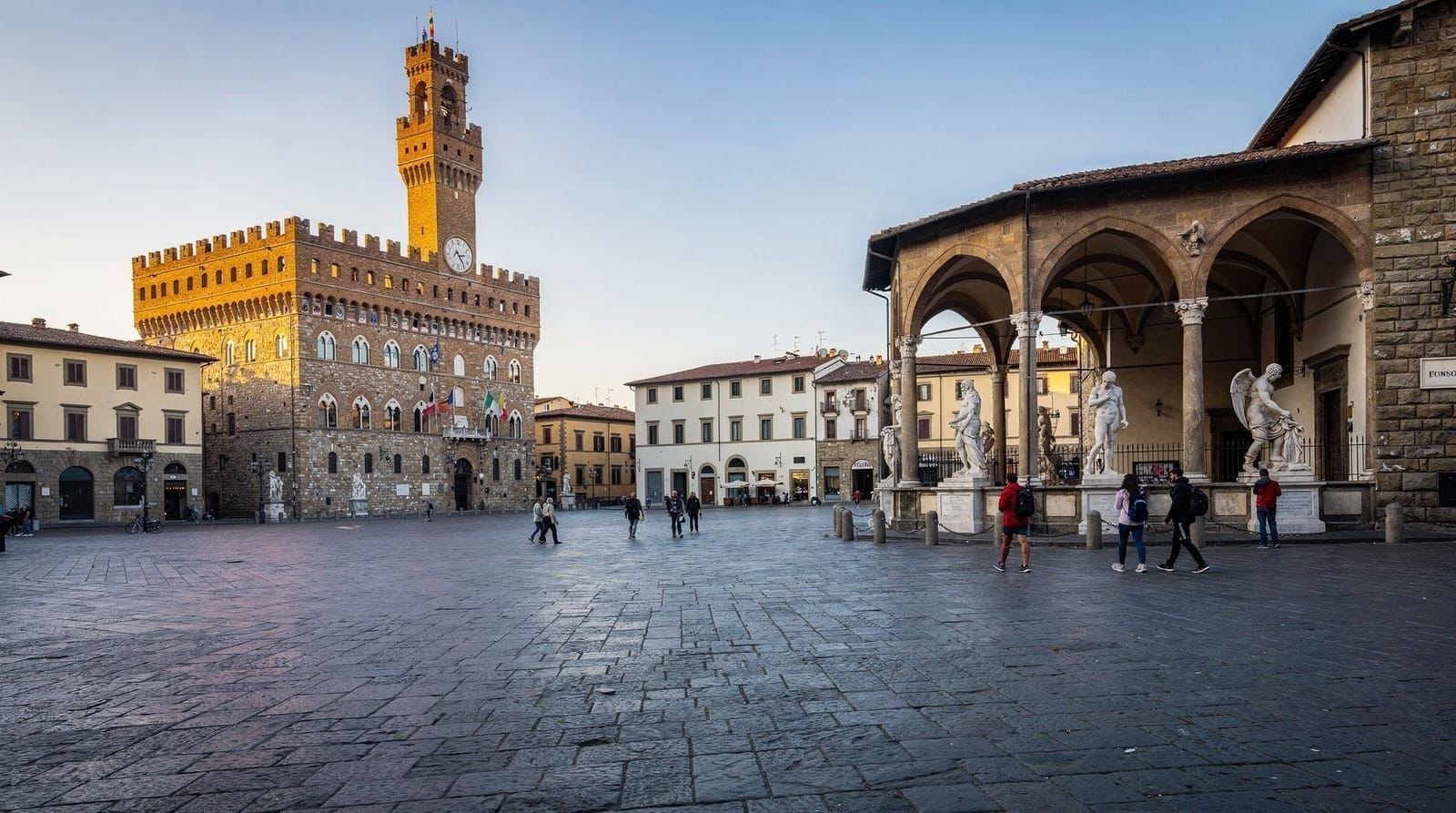
| Getting there | Central — 8 min walk from Piazza della Signoria |
| Best time | First slot (8:15am) for the quietest terrace |
The problem Brunelleschi solved
The cathedral had been under construction since 1296. The octagonal crossing — the space to be covered — was already 42 metres wide by the time the church was largely complete in the 14th century. No one had yet worked out how to span it.
The conventional method required centring: a massive temporary wooden framework filling the entire interior, from which the dome could be built. The problems were obvious. The timber required would be almost impossible to source. The weight of the centring on the existing walls risked destroying the building. The cost was prohibitive.
By 1418, the city held a competition. Brunelleschi won — though he refused to reveal his full method to the committee, which reportedly infuriated his rival Lorenzo Ghiberti. Construction began in 1420.
Brunelleschi’s three key innovations:
-
The double shell. Rather than one thick dome, he built two thinner shells separated by a gap. The outer shell is steeply pitched; the inner is shallower. The gap between them is the space you walk through during the climb. Structural ribs connect them at intervals.
-
Herringbone brickwork. At each horizontal course, Brunelleschi inserted a series of bricks laid vertically (on their heads, or “sapphire” course), which locked the rising courses together against outward thrust as the mortar cured. This made centring unnecessary — each successive ring was self-supporting as it went up.
-
Internal stone and timber chains. Concealed within the thickness of the dome, horizontal chains of sandstone blocks and iron clamps (and one wooden chain) act like hoops on a barrel, keeping the base of the dome from spreading outward.
He also designed custom machinery to lift building materials — including a multi-speed hoist powered by a single ox — that served as the precursor of modern construction cranes.
The climb step by step
Getting in
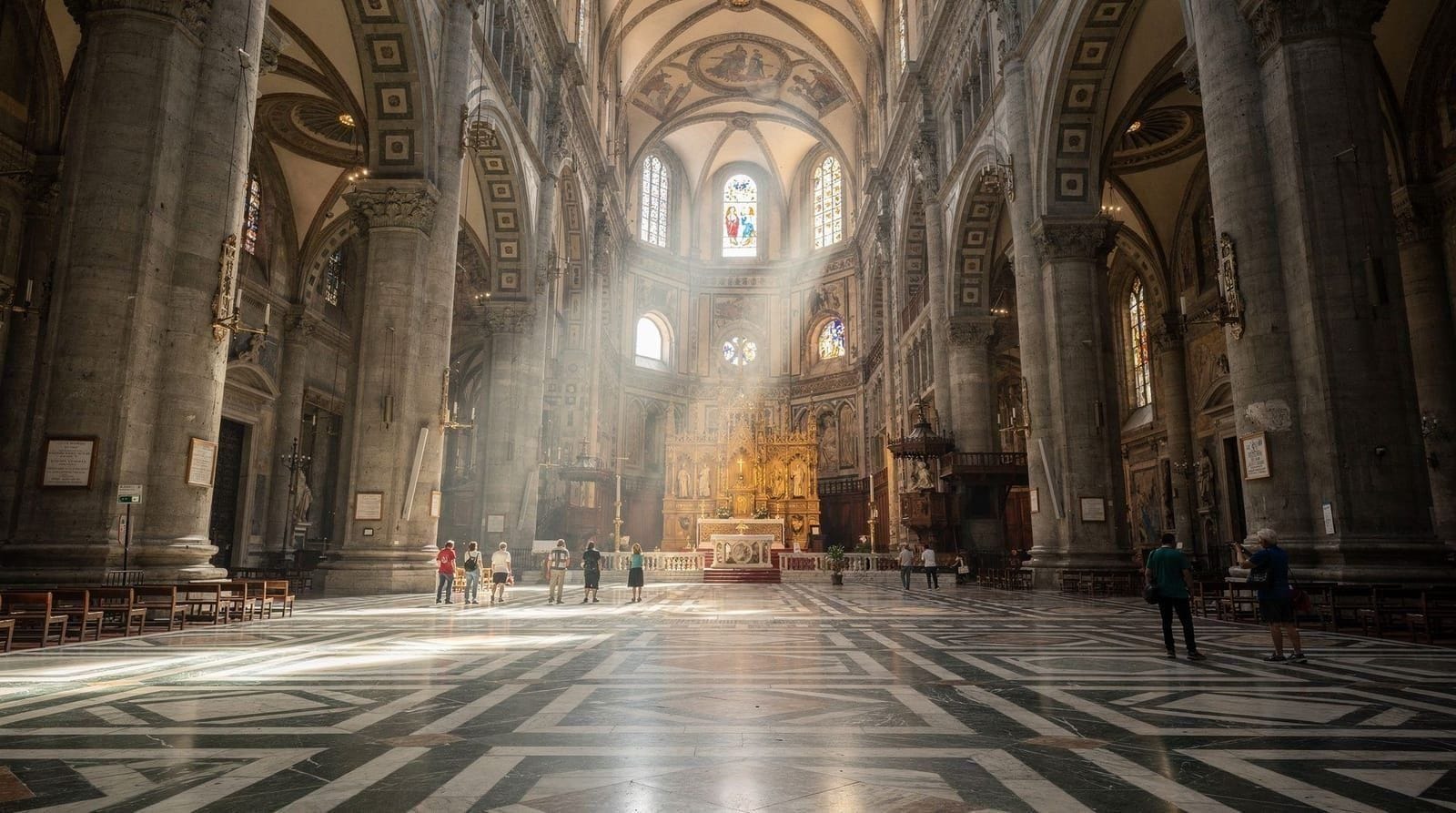
Entry to the dome is via the Porta della Mandorla on the north side of the cathedral. Your timed-entry ticket (booked in advance — see below) is scanned here. Do not enter through the main facade entrance; that leads to the free cathedral interior.
First section: the nave gallery
The first 150-odd steps take you up to the internal gallery at the base of the dome drum, approximately 50 metres above the cathedral floor. A low stone balustrade lets you look straight down into the nave — dizzying for some, fascinating for others. At this level you can also see the base of Vasari’s Last Judgement fresco at close range.
Second section: between the shells
From the gallery, the staircase enters the gap between the inner and outer shells. This is the most atmospheric part of the climb. The passage narrows to about 60 cm in places and tilts inward following the dome’s curve. Occasional openings allow glimpses of the city as you spiral upward.
The lantern terrace
The final steps emerge onto the circular terrace surrounding the lantern, approximately 91 metres above the cathedral floor and 114 metres above sea level. The panorama covers the entire city:
- North: the Apennine foothills, Fiesole on its hill
- East: Santa Croce’s facade, the curve of the Arno beyond
- South: Piazzale Michelangelo, the Boboli Gardens, the hills of Arcetri
- West: Santa Maria Novella’s bell tower, the Arno approaching the Cascine park
The terrace is narrow — a single person wide in most places. Crowds at the top can make it feel rushed. First-slot visitors (8:15) typically have 5–10 minutes with near-empty terrace; midday in August, waits for photos can be 15–20 minutes.
| Section | Approximate steps | Key feature |
|---|---|---|
| Ground to drum gallery | ~150 | Vertical view to nave floor |
| Gallery to shell corridor | ~200 | Between inner and outer dome |
| Shell corridor to terrace | ~113 | Final curve, then sky |
| Total | 463 | Lantern terrace panorama |
Tickets and booking
Combined Duomo Complex pass
The dome is only accessible as part of the €30 combined Duomo Complex pass, which includes:
- Santa Maria del Fiore cathedral
- Brunelleschi’s Dome
- Giotto’s Campanile
- Baptistery of San Giovanni
- Crypt of Santa Reparata
- Museo dell’Opera del Duomo
The pass is valid for 72 hours. You may visit each component only once.
How to book
| Option | Notes |
|---|---|
| Official Opera del Duomo website | Primary source; timed slots; direct booking |
| GetYourGuide | Authorised partner; timed-entry guaranteed |
| At the ticket office | Same-day availability only; sells out by 9:00 in peak season |
| Guided tours | Include skip-the-line dome access; groups of 10–15 |
Advance booking is essential from late March through October. The dome regularly sells out 1–2 weeks ahead on weekends. Midweek availability is somewhat better but not guaranteed. In November–February, 2–3 days’ notice is usually sufficient.
Do not book from third-party resellers not listed on the official Opera del Duomo site — several charge well above face value and cannot guarantee entry.
Guided tours vs. independent visit
Going independently gives you the freedom to linger at the gallery and terrace on your own schedule. A guided tour adds context: a good guide will explain the engineering of the double shell, point out Vasari’s iconographic programme, and answer questions the exhibit panels don’t address.
Guided dome tours (available through GetYourGuide and local operators) typically include:
- Priority timed-entry (no waiting in the general queue)
- A guide for the climb — groups of 10–15 maximum
- 1–2 hours total including the exterior complex
Small-group tours are particularly good for architectural interest; private tours allow you to pace the climb exactly as you wish.
Practical tips
What to wear: Covered shoulders and knees are required for the cathedral. For the dome, comfortable flat shoes with grip are essential — some steps are worn smooth. A light layer is useful at the top in all seasons.
What to bring: A small water bottle. In summer, the inside of the shell gets warm. Sunscreen for the terrace. A phone with a full battery for photos.
What not to bring: Large rucksacks are difficult in the narrow sections. Leave big bags at your accommodation or at the luggage deposit near the ticket office.
Vertigo and heights: The external terrace has a solid low wall, but the view is vertiginous. If heights are a concern, the internal gallery view (looking down to the nave) may be more challenging than the external terrace.
After the dome
The dome is one of six sites on the combined pass. After descending, the most natural sequence is:
- Museo dell’Opera del Duomo (10 minutes’ walk east) — see Brunelleschi’s death mask, his hoist model, and the tools used to build the dome
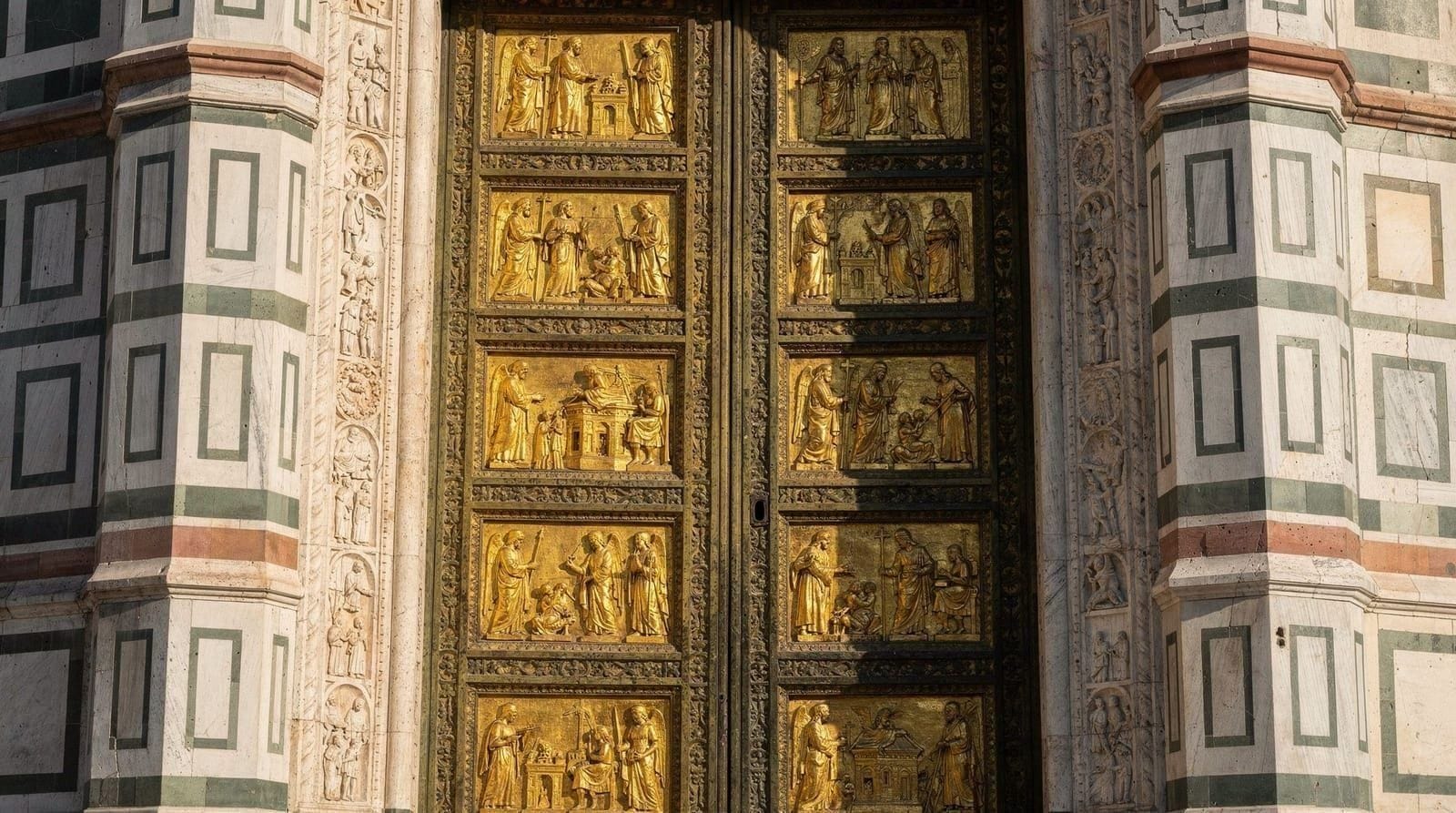
- Baptistery (directly opposite the cathedral) — Ghiberti’s Gates of Paradise, extraordinary mosaic ceiling
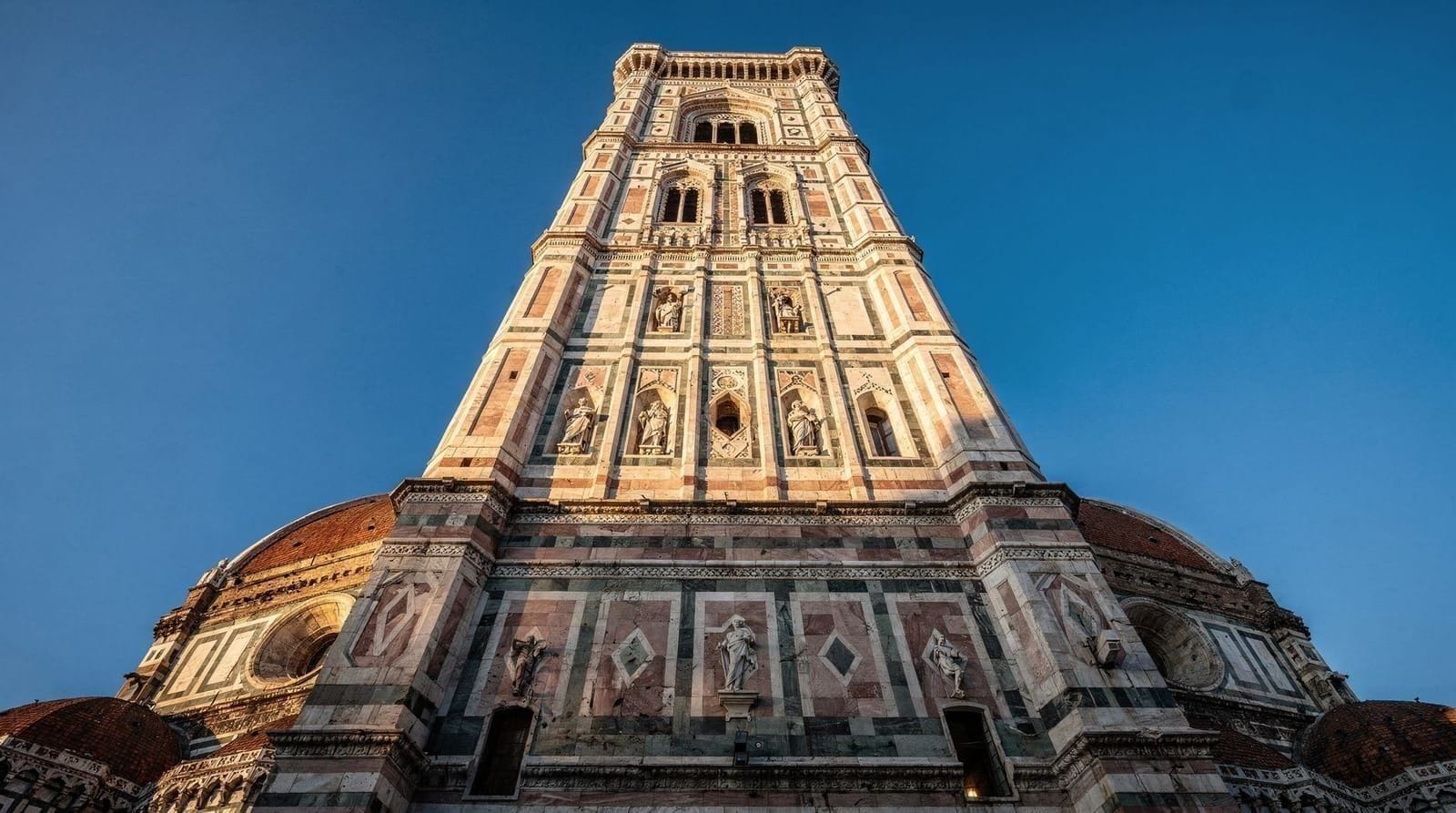
- Campanile (adjacent to the cathedral) — 414 steps, wider staircase, excellent view of the dome itself from outside
From the Piazza del Duomo, the Piazza della Signoria is 8 minutes on foot. The best walking tours of Florence nearly all pass through this square.
For the full planning context — transport, neighbourhood guide, and where to eat nearby — see the Florence destination guide.
The Vasari frescoes
Giorgio Vasari (author of the famous Lives of the Artists) and Federico Zuccari painted the interior surface of the dome between 1572 and 1579. The subject is the Last Judgement, covering approximately 3,600 square metres of surface area. Vasari’s art has been controversial: critics have complained that it obscures Brunelleschi’s architecture and that the painting itself is competent rather than great.
Whatever your view of the art, the scale is staggering when seen from the gallery at drum level — you are inside the painting, surrounded by its hierarchies of angels, the saved and the damned, in a way that no photograph conveys.
Frequently asked questions about the Brunelleschi Dome climb
Do I need to book the dome separately from the Duomo pass?
Yes. The dome requires a specific timed-entry slot, booked as part of the combined pass. You choose your dome entry time at the moment of booking. The other sites (Campanile, Baptistery, museum) operate on a walk-up basis with your pass.
Can children climb the dome?
There is no minimum age restriction, but the stairs are narrow, the climb is long, and some sections are steep. Children under around 8 years may find it difficult. The Campanile, with its intermediate terraces, is a better option for families with young children.
Is the dome ever closed?
Yes. The dome is closed on the first Tuesday of each month and on some religious holidays (Good Friday, Christmas Day, New Year’s Day). Hours are reduced on Sundays (opening at 12:45). Always check the official website before your visit date.
How different is the view from the dome vs. the Campanile?
The Campanile terrace sits at the same height as the drum of the dome — giving you a view that looks across to the dome itself, which is impossible from the dome’s own terrace. The dome’s lantern terrace is slightly higher and gives a wider panorama. Both are excellent; if you can do only one, the dome is the more dramatic architectural experience. Giotto’s Campanile has its own dedicated guide if you want the full comparison: see Giotto’s Campanile.
Does the dome climb work with the Firenzecard?
The Firenzecard covers entry to the Duomo Complex, but the dome climb still requires its own timed-entry reservation even with the card — you cannot simply turn up. Book the specific dome slot as soon as you activate the card, since the same sell-out patterns apply regardless of how you paid. The Firenzecard worth it guide covers whether the card makes sense for your itinerary overall.
Where the dome fits in a Florence day
Most visitors pair the dome with the rest of the Piazza del Duomo complex in the morning, then move on to a second major sight after lunch. A typical sequence: dome climb first thing (booked for 8:15–9:00am when the terrace is quietest), Baptistery and Museo dell’Opera del Duomo through mid-morning, then either the Uffizi Gallery or a walk through the Duomo district toward Piazza della Signoria for lunch. Trying to add the Accademia’s David on the same morning is possible but tight — the how many days in Florence guide has realistic pacing if you’re building a full itinerary around the major sights.
Travellers building a first Florence trip around one or two headline sights often default to “Uffizi and David,” which is reasonable, but the dome deserves equal billing. It’s the one major Florence experience that’s physical rather than purely visual — you feel the building rather than just look at it — and for many visitors it becomes the trip’s most memorable hour precisely because it’s active, not passive.
Top experiences
Bookable activities with verified prices and instant confirmation on GetYourGuide.

Florence: ticket to Brunelleschi's Dome with panoramic views
- Skip the line
- Free cancellation
Florence: cathedral terraces and dome skip-the-line tour
- Skip the line
- Small group
Florence: Duomo tour with Brunelleschi's Dome climb access
- Skip the line
- Free cancellation
Florence: Santa Maria del Fiore tickets with dome climb
- Skip the line
- Instant confirmation
Florence: skip-the-line Duomo, Baptistery and Giotto Bell Tower
- Skip the line
- Free cancellation