Giotto's Campanile Florence: complete climb guide
Florence: skip-the-line Duomo, Baptistery and Giotto Bell Tower
- Skip the line
- Free cancellation
How many steps are there in Giotto's Campanile?
414 steps to the top terrace. Unlike the dome climb, the Campanile has several intermediate terraces where you can rest. There is no lift. The Campanile is included in the €30 Duomo Complex combined pass.
Florence’s overlooked viewpoint
Most visitors to the Duomo complex focus entirely on Brunelleschi’s Dome. Giotto’s Campanile — the freestanding bell tower to the south of the cathedral — is overlooked in comparison, but it offers something the dome cannot: a clear view of the dome itself from outside, at close range, from a height that places you level with its drum.
The tower is 84.7 metres tall and clad in the same polychrome marble as the cathedral — white Carrara, green Prato serpentine, pink Maremma. From street level it reads as a single vertical statement; from the top it dissolves into a panorama of Florence that takes in everything from Santa Croce to San Miniato al Monte and, on clear days, the distant Apennines.
| Where | Piazza del Duomo, south side of the cathedral |
| Cost | Included in the €30 Duomo Complex pass — no separate ticket |
| Time needed | 25–40 minutes for the climb, longer with photo stops |
| Getting there | Central Florence — 8 minutes on foot from Piazza della Signoria |
| Best time | Early morning (before 9:30) or late afternoon (after 16:30) |
History: Giotto, Pisano, Talenti
The Campanile’s history is a story of three architects.
Giotto di Bondone received the commission in 1334, at the height of his fame as a painter. He designed a tower in the Gothic style with hexagonal and diamond-shaped relief panels at the base — allegorical representations of the arts, sciences, planets, and human endeavours. He completed the lower section to a height of perhaps 10 metres before his death in January 1337. The foundation and lowest registers of reliefs are Giotto’s direct legacy.
Andrea Pisano took over in 1337 and followed Giotto’s design broadly, completing the lower registers and adding the main panels above the base. His contribution includes some of the finest reliefs — scenes of the liberal arts, planets, and virtues — that are among the best Gothic sculpture in Tuscany.
Francesco Talenti completed the tower by 1359, adding the three upper levels with their Gothic biforate and triforate windows (two- and three-light windows divided by slender columns), and the open-air belfry at the summit. Talenti adjusted the proportions, making the tower slightly taller and more slender than Giotto’s original scheme.
The tower received its bells (still in regular use) in the 15th century. Eight bells remain active, tuned to the key of C.
The reliefs: what to look for on the lower panels
The hexagonal panels at the base of the tower form a programme of human knowledge and activity. The originals are in the Museo dell’Opera del Duomo — the reliefs you see on the tower itself are precise replicas. Still, spend a few minutes with them before climbing.
| Panel subject | Location |
|---|---|
| Agriculture, herding, weaving | West face, base row |
| Navigation, horsemanship, architecture | West and north base |
| Grammar, rhetoric, logic | North face |
| Arithmetic, geometry, astronomy, music | North and east base |
| The planets | Second register (diamond panels) |
| The virtues | Third register |
| The liberal arts | Upper registers |
The programme follows a medieval encyclopaedic tradition — a picture of the whole of human knowledge and society ordered from manual labour at the bottom to spiritual virtue at the top. It was radical for a church tower in 1334.
Climbing the Campanile
The staircase
The Campanile’s internal staircase differs significantly from the dome climb. The steps are wide enough for two people to pass, the walls are whitewashed rather than brick, and the intermediate terraces mean you are never more than 80–100 steps from a rest point.
| Floor | Height | Feature |
|---|---|---|
| Ground | 0 m | Entry, ticket scan |
| First terrace | ~18 m | Opening views over the Piazza del Duomo |
| Second terrace | ~36 m | Close view of the cathedral roof |
| Third terrace (belfry) | ~54 m | The eight bronze bells |
| Top terrace | ~84 m | Full panoramic view |
Steps per section: approximately 100 steps between each terrace. Total: 414.
At the belfry level, you pass close to the eight bells — when they ring (at noon and on the quarter-hours), the sound is extraordinary and overwhelming in the enclosed space. Check the time before climbing if you are sensitive to loud sounds.
What you see from the top
The top terrace is open on all four sides with solid stone balustrades. The key view is to the west and south-west: Brunelleschi’s Dome fills the mid-ground at eye level — you look across at the dome’s terracotta tiles, the lantern and its copper sphere and cross, and the ring of the external gallery. It is the closest most visitors will ever get to the dome’s exterior surface at height.
Beyond the dome: to the north-west, the white marble of Santa Maria Novella’s facade; to the east, the crenellated towers of Bargello and Badia Fiorentina; to the south, the Arno and Palazzo Vecchio’s tower; to the south-east, the hills rising to Piazzale Michelangelo and San Miniato al Monte.
On clear mornings in winter, the snowcapped Apennines are visible to the north. In summer, haze typically reduces the long-distance view.
Practical information
| Detail | Information |
|---|---|
| Height | 84.7 m |
| Steps | 414 |
| Lift | None |
| Intermediate terraces | Yes — 3 rest points |
| Suitable for wheelchairs | No |
| Dogs | Not permitted |
| Duration (up + top) | 25–40 minutes depending on pace |
Hours: The Campanile opens at 8:15 and closes at 19:15 (last admission 18:45). Hours are slightly reduced in winter. Check the Opera del Duomo website for current times.
Best time to climb: Early morning (before 9:30) or late afternoon (after 16:30) offers the best light and fewest people on the top terrace. Midday in summer can be hot on the exposed terrace.
Ticket: Included in the €30 Duomo Complex combined pass. The pass is purchased in advance online (Opera del Duomo website or authorised platforms including GetYourGuide). Walk-up tickets are sometimes available at the ticket office if the day’s allocation has not sold out. For a full breakdown of what each pass tier covers, see Duomo complex tickets explained.
Best months to climb
The Campanile has no lift and no shade on the upper terraces, so season affects comfort more than it affects the view itself.
| Month | Weather on the terrace | Crowds | Note |
|---|---|---|---|
| Dec–Feb | Cold, occasional wind at the top | Lightest | Clearest long-distance views of the Apennines |
| Mar–Apr | Mild, some rain | Moderate, rising | Good light, fewer crowds than May–Jun |
| May–Jun | Warm, comfortable mornings | Heavy | Book the earliest slot you can |
| Jul–Aug | Hot, exposed terrace by midday | Heaviest | Climb before 9:30 or after 17:00 to avoid the heat |
| Sep–Oct | Warm days, cooling evenings | Heavy, easing late Oct | Arguably the best trade-off of light, weather and crowds |
| Nov | Cool, occasional rain | Light | Good value season, pack a layer |
Booking the Duomo Complex pass without stress
Because the Campanile has no separate ticket, your access depends entirely on the Duomo Complex pass. Book it online in advance rather than turning up — the cathedral’s own ticket office sells a limited daily allocation and queues form early, especially May to September. The pass gives a specific entry window for the dome climb but the Campanile itself does not require a timed slot within the 72-hour validity, so you can climb it whenever you like once you’re inside the complex. For step-by-step guidance on the booking platforms and what to expect at pickup, see booking Florence attractions online.
If you’re combining the Campanile with other major sights on the same trip, our best Florence combo tickets guide compares which passes overlap and which are worth stacking.
Families, fitness and accessibility
The Campanile is the gentler of Florence’s two great climbs. The stairs are noticeably wider than the dome’s, the three intermediate terraces give genuine rest points with views (not just a landing to catch your breath), and there’s no need to squeeze past descending visitors in a one-way spiral, as happens inside the dome. That makes it a realistic choice for children who can manage 400+ steps at their own pace, and for travellers who want the view without the dome’s more claustrophobic middle section.
It is not, however, an option for anyone using a wheelchair or unable to manage stairs — there is no lift anywhere in the tower, and the terraces themselves have low openings rather than full glazing, so it isn’t suitable for visitors with limited balance either. For a fuller picture of what’s realistically accessible in the historic centre, see our accessible Florence guide. Travelling with young children more broadly? The Florence with kids itinerary plans a pace that mixes climbs like this with recovery time.
Campanile vs. dome: which to prioritise?
Both are worth climbing if time and fitness allow. If you must choose one:
| Choose Campanile if you… | Choose Dome if you… |
|---|---|
| Want the best view of the dome itself | Want the more dramatic architectural experience |
| Have children or less fit companions | Are physically fit and comfortable in confined spaces |
| Prefer wider, easier stairs with rest stops | Want to walk inside the building’s own structure |
| Have already booked the Duomo pass | Can book specific timed-entry for the dome |
The dome climb (463 steps) is the more memorable engineering experience; the Campanile (414 steps) is the better vantage point for photography of the dome.
The Museo dell’Opera del Duomo connection
The original hexagonal and diamond reliefs from the base of the Campanile are displayed in the Museo dell’Opera del Duomo, a 5-minute walk around the back of the cathedral. Seeing the originals alongside the Donatello and Luca della Robbia cantorias gives the programme of the tower a much clearer context than the exterior copies can provide.
The museum is included in the combined pass. If you are spending a full half-day on the Duomo complex, visit the museum after the Campanile to see the originals of what you have just studied on the tower’s facade.
Getting there and visiting in sequence
The Campanile stands adjacent to the south-west corner of the cathedral. The entry door is clearly signed from the Piazza del Duomo.
A logical sequence for the full complex:
- Museo dell’Opera del Duomo (Piazza del Duomo 9, east side) — less crowded in the morning; see the original reliefs before examining the copies on the tower
- Campanile — wide stairs, good warm-up for the dome climb
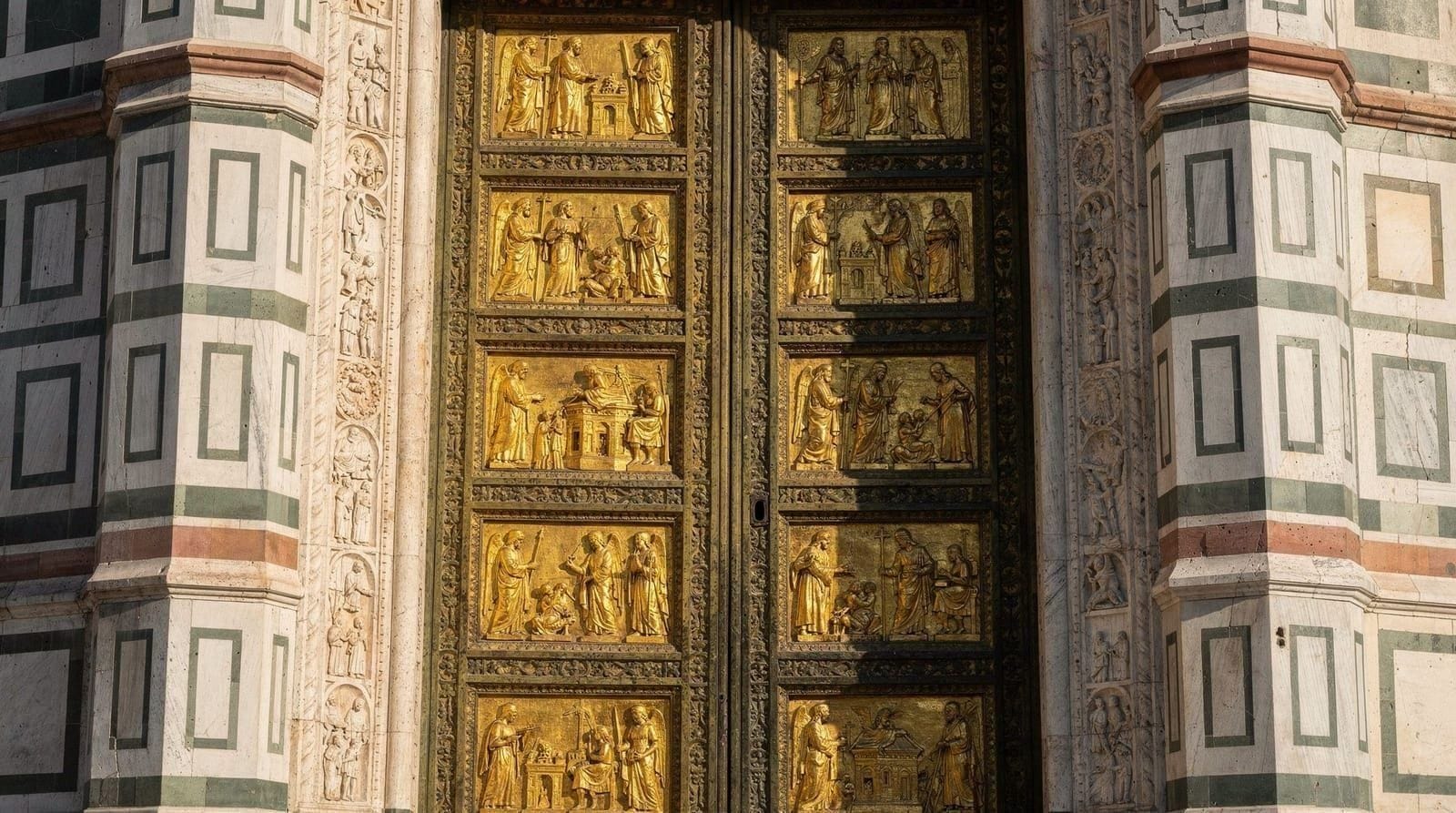
- Baptistery — 30 minutes; mosaic ceiling and portal bronzes
- Cathedral — free; Vasari fresco, Uccello clock, Ucello equestrian portraits
- Dome — the finale; timed-entry slot required
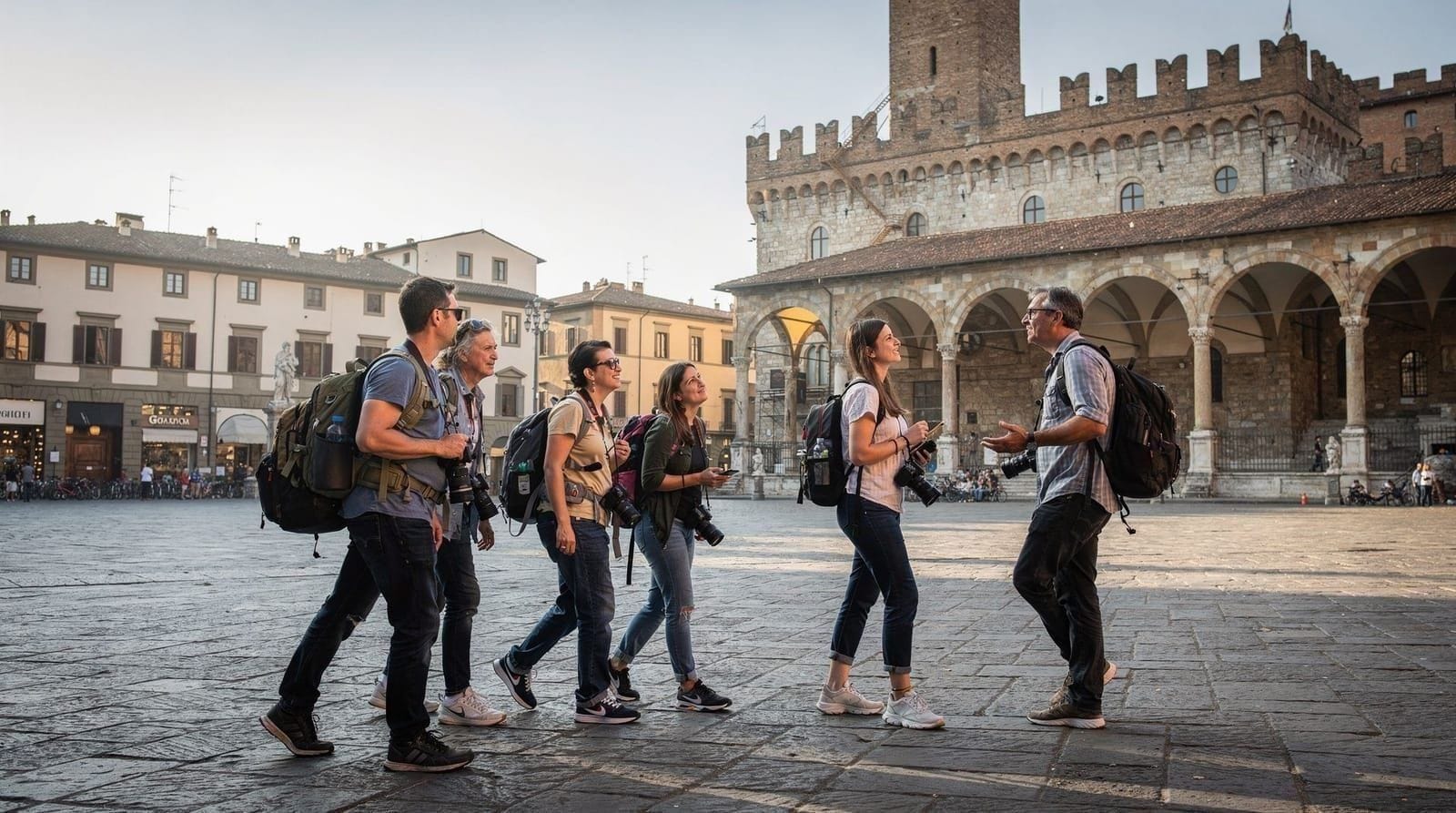
From the Piazza del Duomo, the Piazza della Signoria is 8 minutes on foot. For the best routes through the historic centre, see the best walking tours of Florence. The Florence destination guide covers transport, accommodation and full neighbourhood context. For the classic dome-and-tower photograph, see best photo spots in Florence.
Frequently asked questions about Giotto’s Campanile
Is the Campanile included in the Duomo pass?
Yes. The €30 Duomo Complex pass covers the Campanile, Brunelleschi’s Dome, the Baptistery, the Crypt of Santa Reparata, the cathedral, and the Museo dell’Opera. It is valid for 72 hours.
Can I hear the bells from the top?
Yes — and they are very loud at close range. The eight bells ring at noon and on the quarter-hours. If you are at belfry level (around the 54-metre terrace) when they ring, the sound is physically intense. Check your timing before the climb.
Is the Campanile accessible for visitors with reduced mobility?
No. The entire climb involves stairs with no lift alternative. The base of the tower and the Piazza del Duomo are wheelchair accessible.
Are there good photo spots near the Campanile?
The classic three-quarter view — dome, Campanile, and cathedral in one frame — is taken from the corner of Via dei Servi and Via del Castellaccio, about 100 metres north-east of the square. Early morning (before 8:30) or late afternoon (after 17:00) gives the best light; the marble glows in warm golden-hour tones.
Should I climb the Campanile or the dome if I only have time for one?
Climb the Campanile if you want the better photograph and an easier stair; climb the dome if the architectural experience itself — walking inside Brunelleschi’s double shell — matters more to you than the view. Many visitors regret skipping the Campanile more than skipping the dome, precisely because it’s the only place to see the dome from outside at close range.
Do I need to book a separate time slot for the Campanile?
No. Unlike the dome, which requires a specific timed-entry slot within your Duomo Complex pass, the Campanile can be climbed at any point during your 72-hour pass validity, subject to normal opening hours. That flexibility makes it easy to slot in whenever the queue looks short.
Top experiences
Bookable activities with verified prices and instant confirmation on GetYourGuide.