Florence leather markets guide
Florence: leather crafting experience — made in Florence
- Free cancellation
- Small group
Where can I buy genuine leather in Florence?
Genuine artisan leather is at the Scuola del Cuoio (inside Santa Croce church), Oltrarno workshops on Borgo San Jacopo and Via Maggio, and established shops near Santa Croce like Peruzzi and Il Bussetto. The San Lorenzo outdoor market sells a mix of genuine and counterfeit — price is a reliable indicator.
Florence’s leather tradition: the real story
Florence has been a centre of leather craftsmanship since the 13th century, when Florentine tanners and leather-workers were organised into powerful guilds and supplied goods to the Medici court. The Arte dei Cuoiai e Galigai (Guild of Tanners and Leather-workers) was one of the city’s wealthiest. Today, Tuscany remains Italy’s largest leather-producing region, supplying tanneries in the Santa Croce sull’Arno area (not Florence itself — an hour’s drive) and artisan workshops throughout the city.
This history is real. Florence genuinely has a leather tradition of global significance. It is also exactly why the tourist leather market has become so sophisticated at mimicking it.
| Where | San Lorenzo outdoor stalls; Santa Croce and Oltrarno workshops |
| Cost | Around €25 (souvenir) to €500 (artisan bag) |
| Time needed | 30–60 minutes to browse; longer for a workshop class |
| Genuine artisan source | Scuola del Cuoio, Il Bussetto, Madova, Peruzzi |
| Best time | Weekday mornings for calmer browsing |
The San Lorenzo market: what you are actually buying
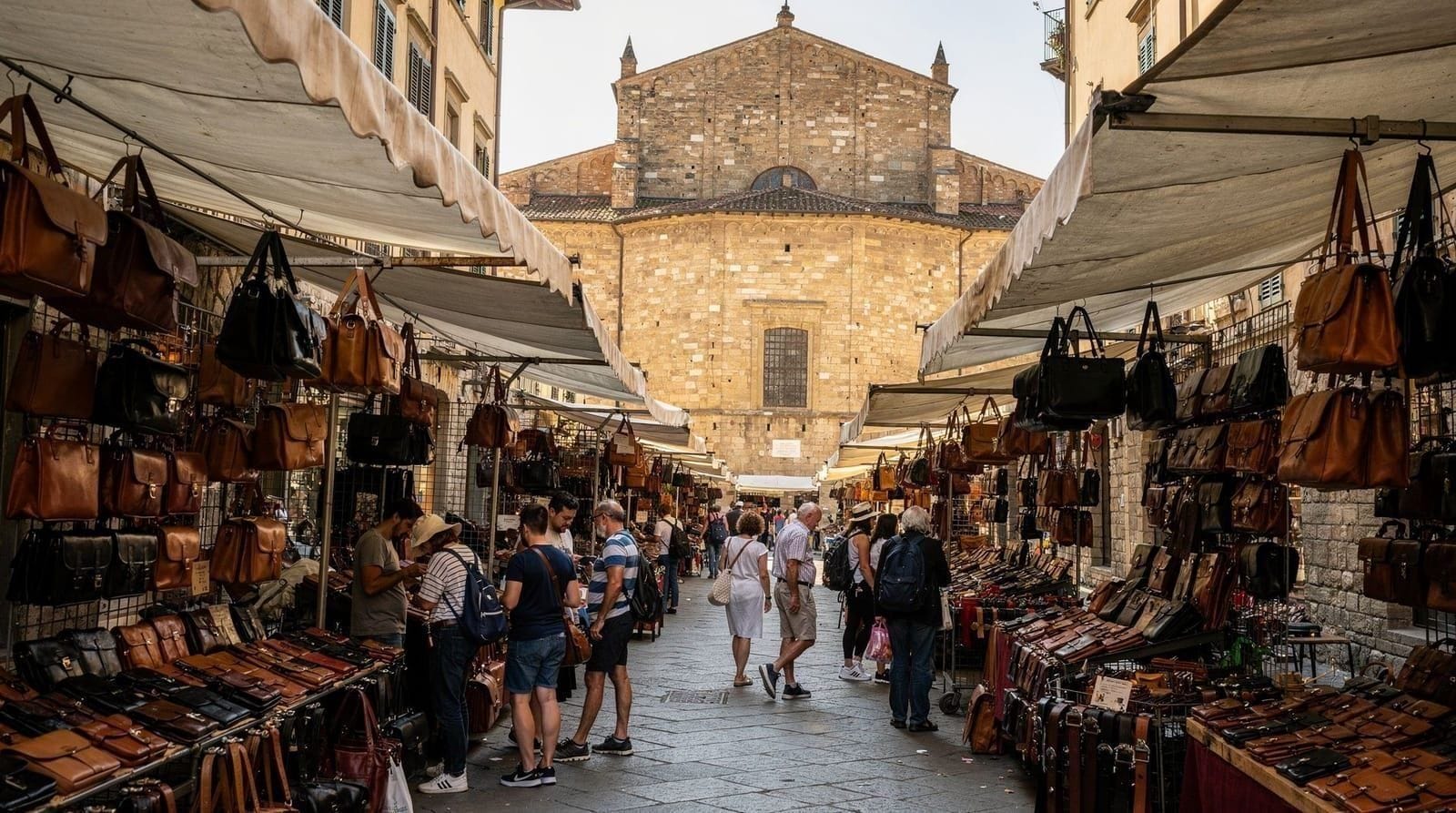
Mercato San Lorenzo’s outdoor stalls occupy the streets around the Basilica di San Lorenzo — Via dell’Ariento, Via Canto de’ Nelli, Piazza del Mercato Centrale and adjacent streets. Open daily except Sunday, from approximately 9 am to 7 pm.
The outdoor stalls sell approximately 200-300 different vendors’ goods across leather bags, belts, wallets, gloves, scarves, ceramic, and clothing. For a first-time visitor, it looks like Florence’s leather tradition made physical — stalls piled high with bags in every colour, vendors calling out prices, the smell of leather in the air.
The honest assessment
Some stalls sell genuine leather goods. Several vendors at San Lorenzo source their products from legitimate Italian manufacturers, including the Tuscan tannery district around Santa Croce sull’Arno. These products are real leather, Italian-made, and reasonably priced for their quality. A wallet at EUR 45-65 from one of these stalls might genuinely be worth EUR 45-65.
Many stalls sell Chinese-manufactured goods. Italy’s trade laws permit goods to be labelled “Made in Italy” if the final manufacturing step occurred in Italy. A bag cut, sewn and finished in China, with a clasp attached in a Tuscan warehouse, can legally carry this label. The difference in product longevity is significant: genuine Tuscan leather ages gracefully; Chinese imitations often delaminate, fade or crack within a year.
Some stalls sell bonded leather (not full-grain leather). Bonded leather is made from leather dust and offcuts compressed with polyurethane. It looks and smells approximately like leather but has a fraction of the durability. It is legal to sell and not technically counterfeit, but it is not what people mean when they imagine “Florentine leather.”
Price as a quality indicator
| Price range | What you are likely buying |
|---|---|
| EUR 10-25 (wallet/belt) | Almost certainly not genuine leather |
| EUR 25-50 (wallet) | Possibly genuine split leather; possibly bonded leather |
| EUR 50-80 (wallet) | Better chance of genuine leather; manufacturer unclear |
| EUR 80-150 (wallet) | Likely genuine full-grain leather if from established stall |
| EUR 30-80 (medium bag) | Treat as a souvenir; not artisan quality |
| EUR 100-200 (medium bag) | Possibly genuine; verify if you can |
The smell test: Do this before buying. Lift the bag or wallet and smell the interior. Real leather has a rich, slightly earthy or musky smell. Bonded leather or synthetic leather has a chemical or plastic edge to the smell. If a vendor will not let you smell the interior, consider why.
What to buy at San Lorenzo market
Our recommendation: treat the outdoor San Lorenzo stalls as a souvenir market, not an artisan leather source. This reframing makes the market enjoyable rather than frustrating:
- Scarves and silk goods (the leather question does not apply)
- Ceramics from producers with workshop marks
- Food products (olive oil, pasta, truffle goods) from stalls with provenance
- A EUR 25 wallet as a souvenir rather than as a “genuine Florentine leather” purchase
- Prints and decorative items
If you specifically want leather goods, the remaining sections of this guide direct you to better sources.
Genuine artisan leather: where to go
Scuola del Cuoio (Leather School of Florence)
Address: Piazza Santa Croce 16 (entrance through the Basilica di Santa Croce cloisters, or via Via San Giuseppe) Hours: Monday-Saturday 9:30 am-6 pm; closed Sundays and during Basilica events Website: scuoladelcuoio.com
The Leather School was founded in 1950 by the Franciscan friars of Santa Croce in collaboration with the Gori and Casini families, as a way to train young orphans in a skilled trade. It now operates as a working leather school and shop within the monastery of Santa Croce.
The goods are made on-site by students and master craftspeople. Visitors can watch the work in progress through the workshop windows. The range covers bags, wallets, belts, gloves, travel goods and accessories. Custom embossing (your initials, a design) is available for a small fee and takes about 20 minutes.
Prices: Wallets EUR 60-120, small bags EUR 180-400, belts EUR 80-150. Higher than the San Lorenzo market; significantly lower than boutique artisan pricing for comparable quality.
What to look for: Items made with vegetable-tanned leather (the traditional Tuscan method — slower, more expensive, more durable and more beautiful with age). The school uses this exclusively.
Il Bussetto (Oltrarno)
Address: Via del Parione 6 Hours: Monday-Saturday 9 am-7 pm
A small, quiet shop selling traditional small leather goods — wallets, coin purses, card holders, key fobs — made using the oldest Florentine techniques. Il Bussetto is not a workshop with visitors; it is a shop selling workshop-made goods. The stitching is hand-done, the leather is vegetable-tanned Tuscan hide.
No website needed. Walk in, browse, ask questions. The staff speak English and are knowledgeable. Wallets start around EUR 80; card holders around EUR 60.
Madova Gloves (Oltrarno)
Address: Via de’ Guicciardini 1r Hours: Monday-Saturday 9:30 am-7:30 pm
Florence has a tradition of leather glove-making that dates to the Renaissance (Cosimo I de’ Medici’s court required local suppliers). Madova has made gloves on premises since 1919. All gloves are cut and sewn in the workshop upstairs; the shop downstairs sells them.
Prices: EUR 35-120 depending on leather type and lining. Cashmere-lined gloves are the signature. Sizing is done in the shop — the staff can measure your hand and suggest the correct size.
Peruzzi (Santa Croce)
Address: Borgo dei Greci 8-20 Hours: Daily 9 am-7 pm
A large established leather shop occupying multiple shopfronts near Santa Croce. Not a workshop — Peruzzi buys from legitimate Italian manufacturers and sells at a margin. The advantage over workshop shopping is breadth: thousands of items in stock, clear pricing, English-speaking staff.
Quality is consistently genuine leather. For shoppers who want to browse a large range without committing to artisan prices, Peruzzi is the pragmatic choice. Bags EUR 100-400, wallets EUR 50-130.
Beltrame (Santa Croce area)
Address: Via della Vigna Nuova 70r
Mid-range to quality leather goods with a focus on classic Florentine styles — structured bags, leather-bound notebooks, travel accessories. The range skews toward traditional rather than contemporary design.
Leather workshops you can visit (and work in)
Several workshops offer visitor access and hands-on experiences:
Leather crafting experience — Made in Florence
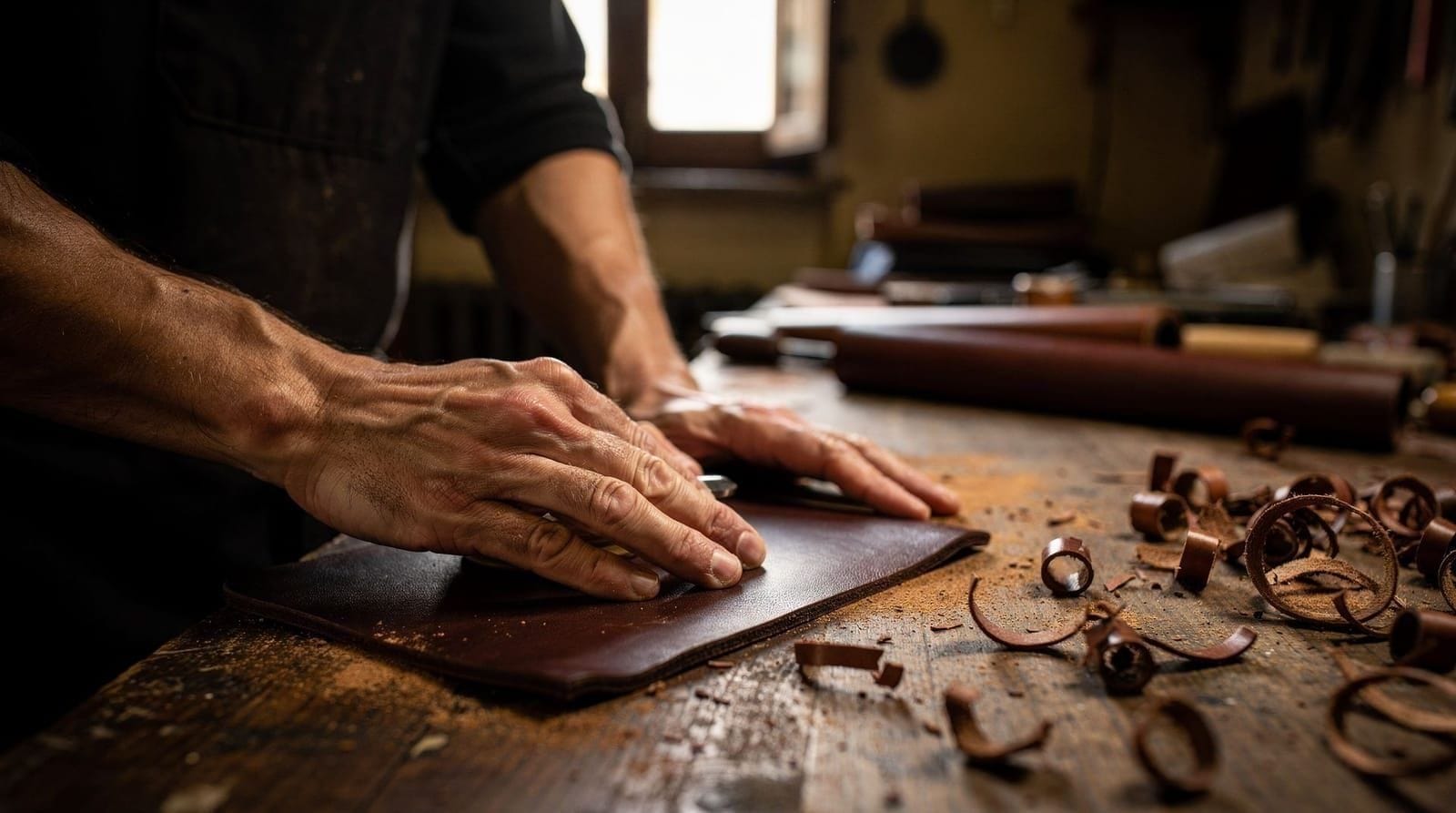
A 2-3 hour workshop where you make a small leather item (typically a wallet or card holder) under guidance from a Florentine craftsperson. You select your leather from a range of vegetable-tanned hides, learn hand-stitching technique, and leave with a completed item.
These workshops run in small groups (maximum 6-8 people) and book up 1-2 weeks ahead. Cost approximately EUR 70-110 per person including materials. Suitable for adults and children aged 10 and up.
Leather wallet making workshop
A shorter (approximately 90 minutes) session focused on making a specific item — typically a bifold wallet. Includes coffee and a visit to the workshop. Less exploratory than the full crafting experience but more accessible in terms of commitment time and cost (approximately EUR 50-70).
Leather and passion — Florentine craftsmanship tour
A guided tour of working leather workshops in Florence, visiting 2-3 artisan spaces to see different stages of the leather-working process — tanning, cutting, stitching, finishing. The guide explains the history and demonstrates techniques. Not a hands-on making class but valuable for understanding the craft. Cost approximately EUR 40-60 per person.
Understanding leather types sold in Florence
| Type | What it is | Durability | How to spot |
|---|---|---|---|
| Full-grain leather | The outermost layer of hide; least processed | Excellent; improves with age | Natural grain pattern; pores visible |
| Top-grain leather | Full-grain with surface sanded smooth; sometimes corrected | Good | Uniform surface; less character |
| Split leather | Lower layers of hide; thinner and weaker | Fair | Very uniform; often used for linings |
| Bonded leather | Leather dust + polyurethane adhesive | Poor; delaminates over time | Unnaturally smooth; no pores; chemical smell |
| Bicast/Patent | Split leather + polyurethane coating | Fair; coating cracks | Very shiny; uniform |
| PU / Faux leather | Entirely synthetic | Poor to fair | Plastic smell; no pores |
Vegetable tanning vs chrome tanning: Vegetable-tanned leather (the traditional Tuscan method) uses oak bark and other vegetable tannins. It takes months rather than days, costs more, but produces leather that develops a rich patina and becomes suppler over decades. Chrome tanning (industrial standard) is faster and cheaper. Most artisan Florentine leather is vegetable-tanned; most mass-market leather is chrome-tanned.
Buying leather as a gift
Leather goods travel well as gifts precisely because quality is visible and tactile even to someone unfamiliar with Florence’s market — a genuine vegetable-tanned wallet or belt communicates care in a way that’s hard to fake with cheaper alternatives. If buying for someone else, favour classic, unbranded pieces (a plain cardholder, a simple belt) over trend-driven styles, since vegetable-tanned leather is meant to be used and aged over years rather than replaced each season. Personalised initials from the Scuola del Cuoio add a specific, memorable touch that a mass-market gift cannot replicate.
Taking leather goods home
On aeroplanes: Leather goods are not restricted. Carry bags in your checked luggage if bulky; smaller items in hand luggage. Nothing to declare unless the total value of goods exceeds your country’s import allowance.
VAT refunds: Non-EU visitors can claim back Italian VAT (22%) on leather purchases above EUR 154.94 per receipt from participating shops. The Scuola del Cuoio, Peruzzi and most established shops participate. Ask at the point of purchase for a Tax Free form.
Customs: EU customs rules for returning residents are simpler — standard personal use allowances apply. US citizens: the duty-free threshold is USD 800 per person (USD 1600 for families travelling together).
Leather shopping as part of an Oltrarno visit
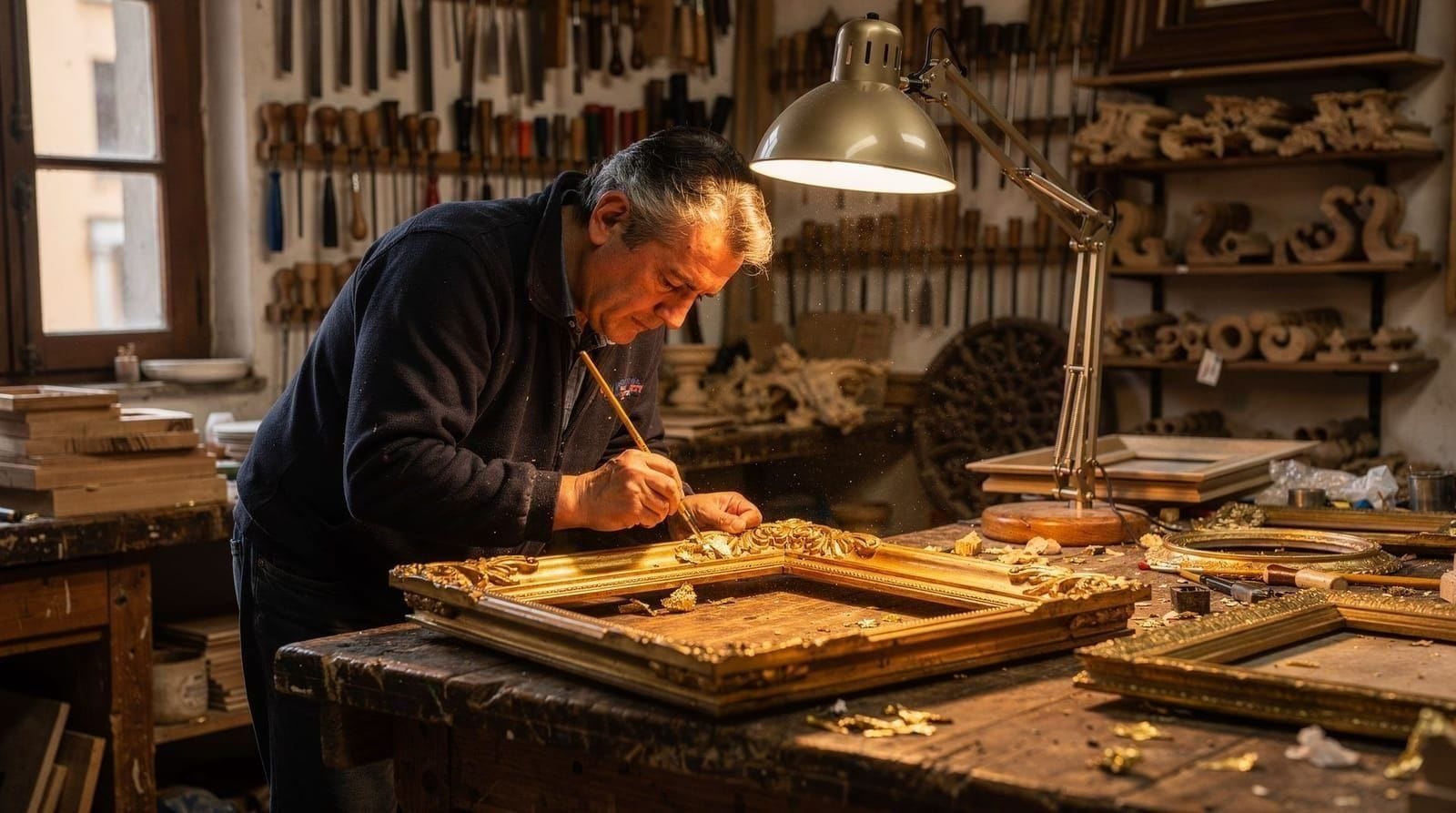
The Oltrarno’s leather workshops are best experienced as part of a broader afternoon in the neighbourhood rather than a standalone shopping trip. Combine a stop at Il Bussetto or Madova with the wider Oltrarno neighbourhood guide, which covers the area’s other artisan trades — frame-makers, bookbinders, and jewellers working in the same streets. If you want to see leatherworking as a craft rather than just buy the finished product, the artisan workshops in Oltrarno guide lists which studios welcome visitors to watch, beyond the hands-on classes covered above.
Negotiating at the outdoor stalls
Bargaining is expected at San Lorenzo’s outdoor market in a way it is not at the artisan shops covered above. Vendors typically build a margin into their opening price, and a polite counter-offer — often 10–20% below the asking price for a single item, more if buying multiple pieces — is a normal part of the transaction rather than an insult. That said, negotiation only affects price, not authenticity: haggling a bonded-leather wallet down from €30 to €22 does not make it genuine leather. Use negotiation for souvenir-tier purchases where you already know what you’re buying, not as a way to validate a vendor’s claims about quality.
Seasonal timing for leather shopping
The San Lorenzo market operates year-round, but the experience shifts with the season. Summer brings the heaviest tourist traffic and the most assertive sales pitches; winter mornings, especially January and February, are noticeably calmer, giving you more space to inspect goods without pressure and more attention from vendors willing to discuss materials honestly. If a slow, considered purchase matters more to you than convenience, a winter weekday morning is the better time to shop, whether at the outdoor stalls or the Oltrarno workshops.
How leather shopping fits the wider San Lorenzo area
The outdoor leather stalls sit within the San Lorenzo neighbourhood, a few minutes from the San Lorenzo food market and the Medici church of the same name. A practical approach for a single morning: browse the leather stalls first while energy is high and patience for haggling is intact, then move to the covered food market for lunch once the crowds and the sales pitches become tiring. This also means you’re comparing genuine artisan quality (seen in the surrounding shops) against the outdoor stalls’ offerings while it’s still fresh in mind.
Frequently asked questions about Florence leather markets
Is there a leather craft quarter in Florence?
The Oltrarno neighbourhood has the highest concentration of working leather artisans — Borgo San Jacopo, Via Maggio, Via dell’Orto and surrounding streets. It is not a designated quarter but the density of workshops there is unmatched in the city. Walking through the Oltrarno and watching workshop doors you will see leather being worked.
Can leather goods be personalised in Florence?
Yes, and this is one of the distinctive services of Florentine workshops. Hot-stamped initials or designs are available at the Scuola del Cuoio (EUR 10-25 depending on complexity, done in 20-30 minutes). Many workshops will personalise goods ordered in advance; if you have specific requirements, contact workshops before your visit.
Which is better — Oltrarno or Santa Croce for leather shopping?
Both are good. Oltrarno has more working workshops where you can see the craft in process; Santa Croce has the Scuola del Cuoio and established shops like Peruzzi with larger inventory. If you have time for both: visit the Scuola del Cuoio at Santa Croce (shop and watch), then spend an afternoon in the Oltrarno browsing workshops.
How do artisan leather goods compare in price to Italian luxury brands?
Artisan leather in Florence is typically 40-70% cheaper than comparable Italian luxury brands for similar quality. A Gucci wallet costs EUR 400+; a comparable artisan wallet from the Scuola del Cuoio costs EUR 90-140. Both use Italian leather and traditional techniques. The price difference reflects branding, marketing and distribution costs rather than craftsmanship quality.
Leather goods to buy in Florence: practical recommendations by type
Wallets
The single most practical leather purchase in Florence. Artisan workshops produce wallets in bifold, trifold, card-slim and zip-around formats using vegetable-tanned leather. Key considerations:
- Full-grain leather (preferable to top-grain or split): visible pores, slight natural variations
- Hand-stitched saddle stitching (two needles, one thread) outlasts machine stitching by decades
- Interior cotton lining rather than synthetic — breathes better
- Metal hardware (snaps, zips) should be solid brass rather than chrome-plated
Price to pay for a genuine artisan wallet: EUR 70-130. At this price from a reputable workshop, you are getting a wallet designed to last 10-20 years with care.
Bags
The most visible Florentine leather product and the most complicated to buy well. Key considerations:
- Gusset construction (the side panels) reveals quality: hand-sewn gussets hold their shape; glued gussets separate over time
- Inside finish: good bags have a finished, clean interior; cheap bags have unfinished edges with fraying visible
- Handle attachment: riveted handles are more durable than stitched-only attachment
- Weight: a very light bag using minimal leather is not a sign of quality — it may indicate thin leather or synthetic reinforcement
Price to pay for a genuine artisan medium bag: EUR 250-500. This is significantly more than San Lorenzo market prices; it is also a fundamentally different product.
Gloves
Florence’s glove-making tradition is one of the oldest and most specific of any Italian leather craft. Madova (Via de’ Guicciardini 1r) is the benchmark — all gloves made on premises since 1919. Gloves are fitted to your specific hand measurement in the shop.
Price: EUR 35-120 depending on leather type (lamb, deer, cashmere-lined). These are proper dress gloves for cold weather, not casual gloves.
Belts
An underrated Florentine purchase. A hand-made vegetable-tanned belt from a Florentine workshop typically outlasts a branded belt by 5-10 years because the leather thickens and burnishes with use rather than cracking.
Price: EUR 60-150 from a workshop; EUR 40-80 from an established shop like Peruzzi.
How to care for Florentine leather after purchase
Vegetable-tanned leather is alive in the sense that it responds to use, moisture and care. New vegetable-tanned leather is stiff; it softens and takes on the shape of its owner over months.
For bags and wallets:
- Condition with a quality leather conditioner (beeswax or neatsfoot oil based) every 6-12 months
- Dry immediately if wet — stuff with newspaper and dry away from direct heat
- Avoid prolonged contact with sharp objects or metal
- The patina that develops with age is a feature, not a flaw — darker patches where hands touch, lighter areas where light hits
For gloves:
- Store flat or on a glove form
- Do not wring or roll wet gloves — lay flat and air dry
- Condition annually with a glove conditioner
Several Florentine leather workshops will clean and recondition their own pieces — worth asking if you have an old Florentine leather item in need of restoration.
Top experiences
Bookable activities with verified prices and instant confirmation on GetYourGuide.

Florence: leather crafting experience — made in Florence
- Free cancellation
- Small group
Florence: leather wallet making workshop with coffee
- Free cancellation
- Small group
Florence: leather and passion — a tour of Florentine craftsmanship
- Free cancellation
- Small group
Florence: San Lorenzo food market and wine tasting tour
- Free cancellation
- Small group