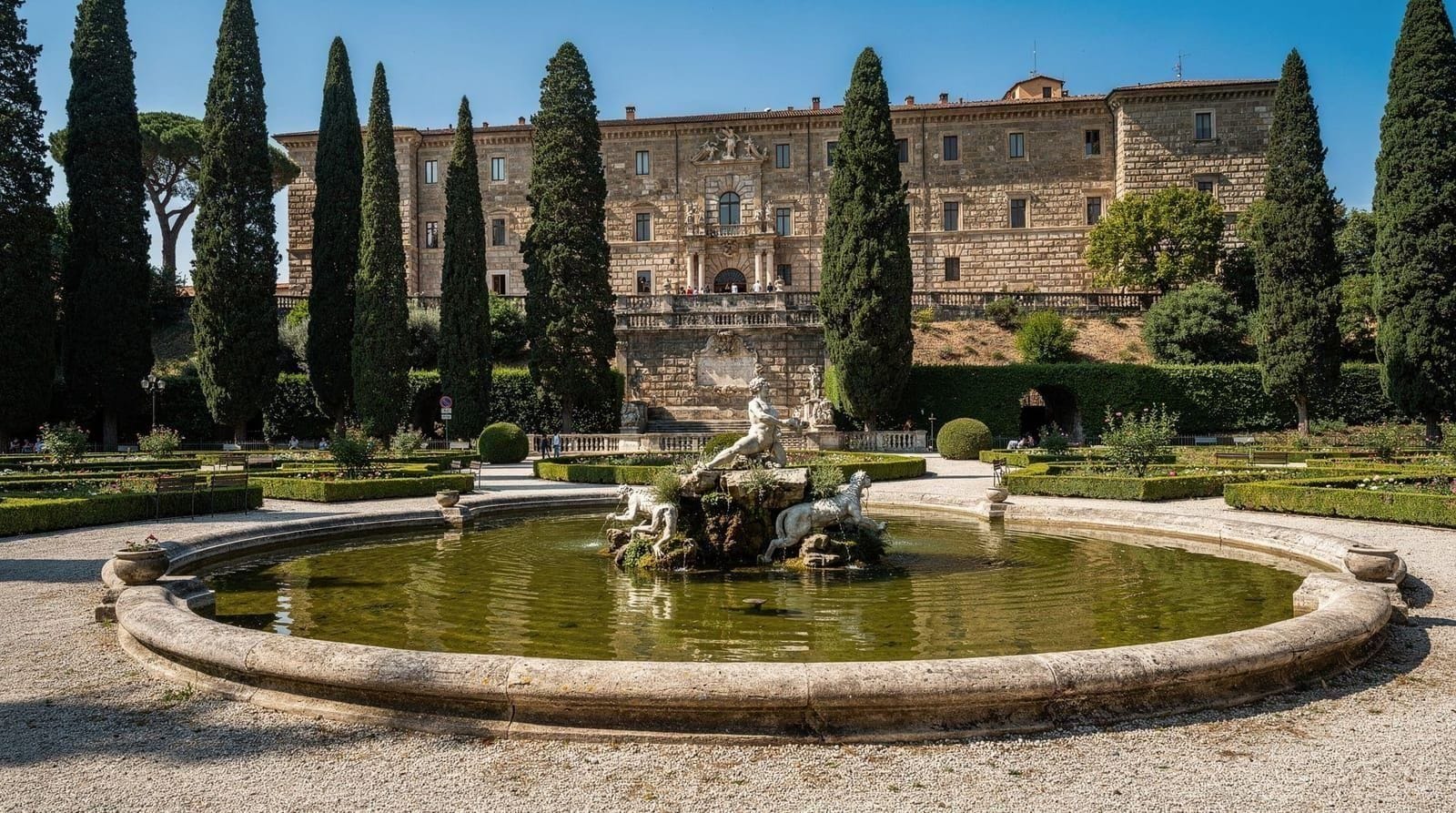
Oltrarno neighborhood guide: Florence's authentic left bank
Florence: Pitti Palace and Boboli Gardens walking tour
- Small group
- Free cancellation
What is the Oltrarno in Florence?
Oltrarno — literally 'beyond the Arno' — is the neighbourhood south of the Arno river. It contains Palazzo Pitti, the Boboli Gardens, the Brancacci Chapel (Masaccio's revolutionary frescoes), and the Bardini Gardens. More importantly, it retains a genuinely Florentine neighbourhood character that the tourist-saturated north bank has largely lost: artisan workshops, family-run trattorias, neighbourhood wine bars, and residents who have lived there for generations.
The Arno divides Florence not just geographically but culturally. North of the river: the Renaissance monuments, the tourist concentrations, the famous museums, the Duomo. South of the river: the Oltrarno, where Florence lives.
This is only slightly hyperbolic. The Oltrarno has been the working and artisan quarter of Florence for centuries — the tanners, the dyers, the woodworkers, the leather workers, the potters. The guilds that dominated the north bank’s economic life had their workshops on the south bank. The Medici moved their official residence from Palazzo Medici on the north bank to Palazzo Pitti on the south bank in 1549, and thereafter the Oltrarno had both royal patronage and artisan density.
Today the neighbourhood is changing — more boutique hotels, more tourist-oriented restaurants, higher property prices. But it retains more of its character than anywhere else in the historic centre. Come here for the Brancacci Chapel and Palazzo Pitti, and stay for an afternoon walk through the artisan streets.
| Where | south bank of the Arno, across Ponte Vecchio |
| Time needed | half a day for the highlights, a full day unhurried |
| Cost | Palazzo Pitti + Boboli combined around €22; Brancacci Chapel around €8 |
| Getting there | 5–10 minutes on foot from the Duomo or Uffizi |
| Best for | food, artisan shopping, a quieter pace than the north bank |
The key attractions
Palazzo Pitti and the Palatine Gallery
The largest palazzo in Florence — a hulking 200-metre Renaissance facade on Piazza dei Pitti — was built for the Pitti family in the 15th century, sold to the Medici in 1549, and remained the official Medici and later Lorraine grand-ducal residence until 1919. The building is enormous, and the collections inside are enormous too.
The Palatine Gallery occupies the first floor: painting of the Medici collection at its most densely hung, room after room of Raphael, Titian, Caravaggio, Rubens, and hundreds more, all hung from floor to ceiling in the manner of a 17th-century collector rather than a modern museum. There is more to see than any visitor can absorb in a single visit. The Raphael portraits alone — including the famous La Velata (Woman with a Veil) — would be the highlight of any other museum.
The Royal Apartments on the second floor show the succession of Medici, Lorraine, and Italian royal occupancies through their accumulated furniture, portraits, and decorative objects.
Separate museums in the building include the Museum of Fashions and Costumes, the Silver Museum (Museo degli Argenti — Medici silver, gem collections, and Grotesque ivory), and the Porcelain Museum in the Boboli Gardens.
Practical details: Tuesday–Sunday, 8:15 am–6:30 pm (last entry 5:30 pm). Closed Mondays. Tickets approximately €16; a combined ticket with Boboli Gardens is available and recommended. Book in advance for peak season.
Boboli Gardens
The 45,000 square metre gardens behind Palazzo Pitti rise steeply up the Oltrarno hillside in a series of terraced gardens, avenues, and hidden grottos. The gardens were designed for Eleanor of Toledo (wife of Cosimo I) beginning in the 1550s by the architect Niccolò Pericoli (known as il Tribolo) and were expanded by several successors including Buontalenti.
The main axis runs from the Palazzo Pitti directly uphill to the Kaffeehaus (a neoclassical structure at the garden’s highest point) and then to the Isolotto — an oval pool with a central island, fountains, and statuary. The route is about a 20-minute walk each way.
Features worth finding: the Buontalenti Grotto (near the entrance, containing casts of Michelangelo’s Prisoners in its outer room and extraordinary artificial stalactite formations), the Egyptian obelisk, and the Amphitheatre behind the palace where the first opera may have been performed.
Warning: The Boboli is hilly and exposed. In summer, the terraced sections above the palace can be very hot. Wear comfortable shoes and carry water. The gardens are most pleasant in spring (April–May) when the roses are out and in autumn (September–October) for the foliage.
Practical details: Hours vary by season (typically 8:15 am–5:30 pm winter, later in summer). Included in the Palazzo Pitti ticket or available separately. See Boboli Gardens guide for full details.
Bardini Gardens
A less-visited alternative (or addition) to Boboli, the Bardini Gardens (Villa Bardini, Costa San Giorgio 2) occupy the hillside east of the Boboli. They were created in the 17th century and restored in the early 2000s after decades of neglect.
The Bardini are more romantic and less formal than the Boboli — cascading wisteria in May, rose terraces in June, the smell of herbs in the heat of July. The villa at the top contains the collection of antique dealer Stefano Bardini and an excellent museum focused on decorative arts. The views from the upper terrace, looking over the Arno toward the Duomo, are outstanding.
Practical details: Daily except Tuesdays, approximately 8:15 am–6:30 pm (seasonally variable). Tickets approximately €10. Far less crowded than Boboli. Full guide: Bardini Gardens guide.
Brancacci Chapel
Inside the Church of Santa Maria del Carmine (Piazza del Carmine 14), the Brancacci Chapel contains what many art historians consider the most important frescoes of the early Renaissance — specifically Masaccio’s works painted between 1424 and 1427.
The Expulsion of Adam and Eve from the Garden, on the entrance arch, and the Tribute Money, the large scene on the left wall, are the key Masaccio works. The Expulsion shows two figures consumed by grief and shame, their bodies modelled with anatomical understanding and emotional directness unprecedented in religious art. Michelangelo studied these frescoes obsessively as a young man; Leonardo da Vinci studied them; every significant Florentine artist of the 15th and early 16th century used them as a school.
The chapel also contains work by Masaccio’s collaborator Masolino (his style immediately visible by contrast — flatter, more decorative, less anatomically engaged) and by Filippino Lippi, who completed the unfinished parts of the cycle 50 years later.
Practical details: Wednesday–Saturday and Monday, 10 am–5 pm; Sunday 1 pm–5 pm. Closed Tuesdays. Maximum 30 visitors at a time; timed entry required. Book in advance. Tickets approximately €8.
Basilica of Santo Spirito
Brunelleschi’s last major work, begun in 1434 and completed after his death in 1446, stands on the square of the same name. The exterior is plain grey stucco — Brunelleschi’s intended marble facade was never built. The interior is one of the purest expressions of Renaissance architectural geometry: a nave, transepts, and choir surrounded by semi-circular chapels, all in pietra serena stone against white walls, the proportions radiantly clear.
The chapel altarpieces were contributed by the major Florentine families who owned them: the result is a survey of 15th- and early 16th-century Florentine painting in the setting for which it was commissioned.
The sacristy contains Michelangelo’s early wooden crucifix (c. 1493), made in exchange for permission to study corpses from the adjacent hospital.
Practical details: Open Monday–Saturday (variable hours; typically 10 am–12:30 pm and 3–5:30 pm). Sunday closed to tourists during Mass. Free entry.
Eating and drinking in Oltrarno
Oltrarno has the best restaurant-to-tourist ratio in Florence’s historic centre. This means you can eat well without paying tourist-menu prices.
What to eat: The Florentine classics — ribollita (bread and vegetable soup), pappardelle with wild boar ragù, bistecca alla Fiorentina (the T-bone steak, sold by weight, always served rare) — are better represented in Oltrarno than anywhere in the tourist circuit. See best trattorias Florence for specific recommendations.
Wine windows: Several Oltrarno palaces have wine windows (buchette del vino) — small stone hatches in the facade through which wine was sold direct from the cellar in previous centuries. The custom was revived during the COVID pandemic and some windows operate today; look for the small round openings in palace facades on Via dei Bardi and nearby streets.
Where to drink: The area around Piazza Santo Spirito has Florence’s best concentration of aperitivo bars. Il Santino (Via di Santo Spirito 60r), the wine bar attached to the restaurant Il Santo Bevitore, is particularly good. The Rasputin wine bar (Via de’ Serragli 85r) is a neighbourhood staple. Bibo’s (Via San Miniato 2r) is the classic San Niccolo wine bar, a slightly warmer walk.
The artisan district
Via Maggio — the wide street running from Ponte Santa Trinita up toward Piazza Pitti — is lined with antique dealers, many operating from genuine 17th- and 18th-century palazzo spaces. The quality varies from museum-level to tourist-market, but the street is worth a slow walk regardless of whether you intend to buy.
The streets running south from Via Maggio toward Via dei Serragli contain the highest concentration of working craft studios: bookbinders, paper marblers, furniture restorers, gilders, picture framers, leather workers, jewellers. Several studios have window displays; some welcome visitors who ask politely to watch. The Florentine leather tradition guide covers what to look for and where to buy.
Walking the neighbourhood
The best Oltrarno walk takes about two hours at a comfortable pace:
Start at Ponte Santa Trinita — itself worth pausing on, with its three elliptical arches and sculptures of the Seasons. Walk up Via Maggio, browsing the antique shops. Turn left on Via dello Sprone to reach Piazza Santo Spirito; allow 20 minutes in the Basilica. Continue west on Via dei Serragli, then north on Via dei Cardatori to Piazza del Carmine and the Brancacci Chapel.
From the Carmine, go south on Borgo San Frediano to the Arno; turn east along Lungarno Soderini to Ponte Vecchio. Cross the bridge (you’re now on the north bank for a moment) and continue to Piazza Pitti, where the facade of the Medici palace fills the view. The Boboli Gardens entrance is to the right of the palace.
Return to the Arno via Via Guicciardini and cross at Ponte alle Grazie or walk back via Ponte Vecchio.
Getting around Oltrarno
The neighbourhood is entirely walkable. The main access points from the north bank are Ponte Vecchio, Ponte Santa Trinita, and Ponte alle Grazie (east). The buses that serve Oltrarno (lines 11, 36, 37) run along the main Lungarno streets.
There is a small ZTL zone within Oltrarno covering the historic streets closest to the Arno; vehicles need permits. Taxis can reach most hotels and the major attractions. The number 12 bus from the train station area crosses to Piazzale Michelangelo and continues to San Miniato, which is useful for sunset visits.
Where to stay in Oltrarno
Oltrarno accommodation splits roughly into two zones. Around Piazza Santo Spirito and Via Maggio, boutique hotels and design-conscious guesthouses have multiplied over the past decade, trading on the neighbourhood’s authenticity while pushing prices up; expect to pay a premium similar to, or slightly below, the north bank for a genuinely different atmosphere at your doorstep. Further south and east, toward San Niccolò and the base of the hill leading to Piazzale Michelangelo, apartments and smaller family-run hotels remain noticeably cheaper, at the cost of a longer walk to the Duomo and Uffizi.
Either choice trades a few minutes of walking distance for a neighbourhood that empties out in the evening rather than filling with day-trippers — worth it for most repeat visitors and increasingly popular with first-timers who’ve done their research. See the where to stay in Florence guide and best areas to stay guide for a fuller comparison against the north bank.
A one-day Oltrarno itinerary
For visitors with a single day to give the Oltrarno, a realistic sequence: start at Palazzo Pitti and Boboli Gardens in the morning (allow 2.5–3 hours for both, more if you love gardens), break for lunch around Piazza Santo Spirito or Piazza della Passera, spend the early afternoon in the artisan streets between Via Maggio and Via dei Serragli, and finish with the Brancacci Chapel (book your timed slot in advance) before an early aperitivo. Visitors who prioritise views over shopping can swap the artisan-street afternoon for the climb to San Miniato al Monte and Piazzale Michelangelo, timed for sunset.
The mistake most day-trippers make is trying to fit in both the hilltop viewpoints and the full artisan-district walk in a single day — the neighbourhood is larger and hillier than it looks on a map, and rushing defeats the point of visiting a slower-paced part of the city in the first place.
Frequently asked questions about Oltrarno
Is Oltrarno better than the Centro Storico?
For most visitors who have been to Florence before, yes. It offers a qualitatively different experience — more local, more atmospheric, better value for food and accommodation. For first-time visitors with limited time who want maximum proximity to the Uffizi and Accademia, the north bank is more convenient, though the walk from Oltrarno is not burdensome.
What is the best way to get to Piazzale Michelangelo from Oltrarno?
Walk — it’s the best part. From Piazza Santo Spirito or Via Maggio, follow Via dei Bardi southeast to the base of the hill, then climb the steps (well-marked) or follow the road to the piazza above. Allow 20 minutes from Santo Spirito. The bus (line 12 or 13) runs from the city centre to Piazzale Michelangelo if you prefer not to climb.
Where can I hear live music in Oltrarno?
The Oltrarno has several venues for live jazz and contemporary music, including Volume (Piazza Santo Spirito 5r) and the occasional concerts at the MAD (Murate Art District) in Piazza delle Murate. See also opera and music Florence for the Borgo San Frediano area venues.
Is parking possible near Oltrarno?
There is a pay car park on Lungarno della Zecca Vecchia and another at Piazzale Michelangelo (above the neighbourhood). Both charge approximately €1.50–2 per hour. Street parking with blue lines requires payment during business hours; look for the parking meters. The ZTL rules apply to the inner streets.
Top experiences
Bookable activities with verified prices and instant confirmation on GetYourGuide.