Galileo Galilei in Florence: his life, museum, and legacy
Florence: exclusive guided tour of Galileo's Museum
- Small group
- Free cancellation
What is the Galileo connection to Florence?
Galileo Galilei (1564–1642) studied in Florence, worked at the University of Pisa, and returned to Florence in 1610 as Court Mathematician to Grand Duke Cosimo II de' Medici — a position that gave him freedom to research without teaching duties. He lived in Florence for the rest of his working life. The Museo Galileo on the Arno holds the world's finest collection of Renaissance scientific instruments, including Galileo's original telescopes and the preserved middle finger of his right hand.
In the popular imagination, the story of Galileo Galilei is one of persecution: the Church versus science, dogma versus evidence, the old world refusing to yield to the new. This is not entirely wrong, but it flattens a more complicated reality. Galileo spent most of his working life in and around Florence, protected by Medici patronage, celebrated as one of the most brilliant minds in Europe, and for long stretches apparently on good terms with the Church hierarchy.
The conflict, when it came, was partly about theology, partly about personality — Galileo had a gift for making enemies — and partly about timing, arriving at a moment when the Counter-Reformation Church was particularly sensitive to challenges to its authority. The outcome was a house arrest that lasted nine years, but the discoveries had already been published and could not be undiscovered.
Florence has preserved Galileo’s legacy with exceptional care. The Museo Galileo is one of the great science museums in the world. Santa Croce holds his tomb. The villa at Arcetri where he spent his last years still exists, though it is privately owned and not generally open to visitors.
| Where | Museo Galileo, Piazza dei Giudici (near Uffizi/Ponte Vecchio) |
| Cost | Around €10 entry |
| Time needed | 90 minutes to 2 hours |
| Getting there | Walk from the Duomo or Uffizi, 5–10 minutes |
| Best time | Morning, combined with the Uffizi or Palazzo Vecchio |
Galileo sites in Florence at a glance
| Site | What it holds | Time needed | Cost |
|---|---|---|---|
| Museo Galileo | Telescopes, instruments, preserved finger | 90 min–2 hrs | Around €10 |
| Santa Croce tomb | Baroque monument, near Michelangelo and Dante | 15–20 min (part of visit) | Included in Santa Croce basilica entry |
| Villa Il Gioiello, Arcetri | House-arrest residence | Exterior only, not regularly open | Free (viewing from outside) |
| University of Pisa sites | Early education, pendulum legend | Half day (separate trip) | Varies |
Galileo’s early life and education
Galileo was born in Pisa on 15 February 1564 — the same year as Shakespeare, two months after Michelangelo’s death. His father, Vincenzo Galilei, was a lutenist and music theorist who conducted systematic experiments on the mathematics of musical tuning. The empirical approach to natural questions was in the family.
Galileo enrolled at the University of Pisa in 1581 to study medicine, at his father’s insistence. He found mathematics more interesting. According to a later story (probably exaggerated but containing some truth), he noticed a bronze lamp swinging in the cathedral of Pisa and timed its oscillations against his own pulse, discovering that pendulums of the same length have the same period regardless of amplitude — a property later called isochronism and applied to clockmaking.
He left university without completing his degree, returned to Florence, and supported himself by giving private mathematics lessons. He eventually secured an appointment at the University of Pisa (1589) and then, more lucratively, at the University of Padua (1592), where he would spend 18 years.
The telescope years and the Florentine appointment
In 1609, Galileo heard of a Dutch instrument maker’s invention — a tube with lenses that made distant objects appear closer. He rapidly improved the design and trained the result on the night sky. What he saw over the following months changed the world’s understanding of the universe.
The four large moons of Jupiter — now called Io, Europa, Ganymede, and Callisto — were his most significant early discovery. They were not orbiting the Earth; they were orbiting Jupiter. This was direct evidence that not all celestial bodies revolved around the Earth, undermining the Ptolemaic model at its foundation.
Galileo published his findings in the Sidereus Nuncius (Starry Messenger) in March 1610. In a brilliant political manoeuvre, he dedicated the book to Cosimo II de’ Medici and named Jupiter’s moons the “Medicean Stars.” The flattery worked. Within months, Cosimo had offered Galileo the position of Court Mathematician and Philosopher at the Florentine court, with a salary of 1,000 scudi per year and no teaching obligations.
Galileo accepted immediately. He moved to Florence in September 1610, to the Villa delle Selve in Sesto Fiorentino (north of the city), later moving to a house in Via Costa San Giorgio in the Oltrarno. The Florentine appointment gave him the time and freedom to conduct the investigations that would produce his major theoretical work.
The Museo Galileo: what to see
The Museo Galileo (formerly the Istituto e Museo di Storia della Scienza) occupies a medieval palazzo on the north bank of the Arno. It is one of the most undervisited major museums in Florence — consistently overlooked by visitors focused on painting and sculpture — and is genuinely extraordinary.
The collection is the finest in the world for Renaissance and early modern scientific instruments. For visitors who have spent several days in art museums, the Museo Galileo offers a completely different but equally rich experience.
Floor 1: Medici instruments
The first floor covers the Medici-era instrument collections: celestial and terrestrial globes, astrolabes, armillary spheres, sundials, mathematical instruments, and surveying devices from the 15th through 17th centuries.
The Florentine craftsmen who made these instruments were among the most skilled in Europe. The astrolabes and armillary spheres are not merely tools; they are objects of extraordinary beauty, engraved and gilded, made to be displayed as symbols of intellectual achievement as well as used for calculation.
Floor 2: Galileo’s instruments
The second floor contains the Galileo collection — the items that make the museum unique.
The telescopes: Two of Galileo’s original telescopes survive here. They are smaller than most visitors expect — simple tubes of wood covered in leather, with lenses at each end. One has been identified as the instrument Galileo used to observe Jupiter’s moons in 1610. Looking at these objects — so simple in construction, so enormous in consequence — is one of the more affecting museum experiences available in Florence.
The large lodestone: An impressive magnet from the Medici collections, mounted in a gilded armature. Lodestones (natural magnets) were objects of scientific fascination and philosophical dispute in Galileo’s time.
The preserved finger: Room 7 contains the most macabre object in any Florentine museum: the middle finger of Galileo’s right hand, removed during the translation of his remains in 1737 and preserved in a glass reliquary. The display is matter-of-fact by the museum’s standards, which adds to its strangeness. The finger is displayed pointing upward — a posture that has prompted considerable commentary over the years, though the orientation is probably coincidental.
Galileo’s compass: His geometric and military compass — a calculating instrument he designed and manufactured commercially — is in the collection. He sold these compasses as a commercial venture and wrote a manual for their use.
Booking
Entry is approximately €10; the Galileo Museum guided tour is the most efficient way to understand what you’re seeing. The museum has an English-language audio guide available at the entrance. Allow 90 minutes minimum for a serious visit.
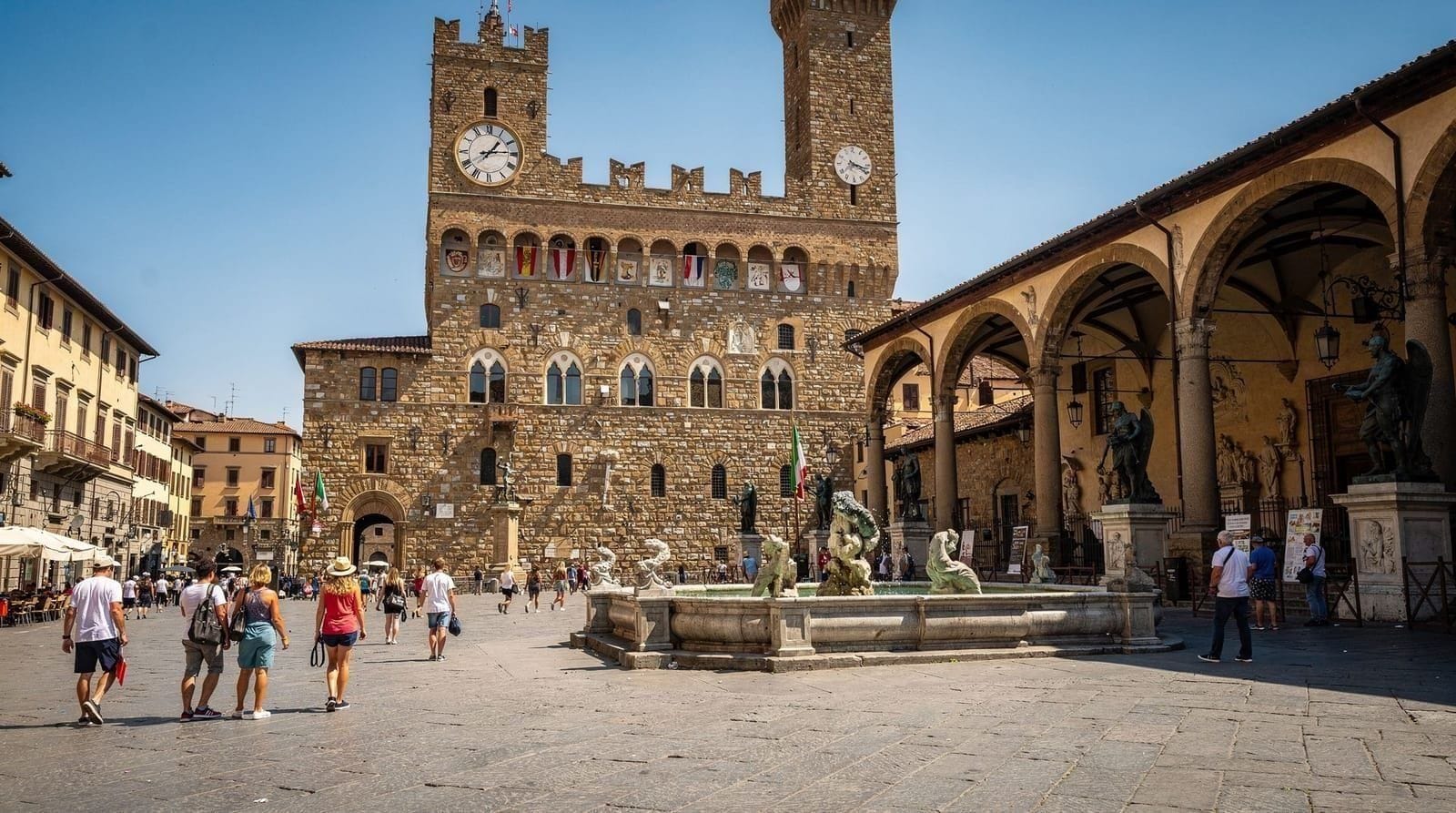
The museum is near the Uffizi and Palazzo Vecchio — easily combined with a morning in the Piazza della Signoria area. See best museums Florence and our dedicated Museo Galileo guide for the full room-by-room breakdown.
Galileo’s major scientific contributions
Mechanics: Before Galileo, the prevailing view (inherited from Aristotle) was that heavier objects fall faster than lighter ones. Galileo demonstrated experimentally that all objects fall at the same rate in the absence of air resistance — the foundational result of classical mechanics. The story of him dropping balls from the Leaning Tower of Pisa is almost certainly apocryphal, but he did conduct systematic experiments with inclined planes.
The telescope: While Galileo did not invent the telescope, he improved its magnification and was the first to turn it systematically on the night sky and to publish the results. His designs raised magnification from approximately 3x (the Dutch original) to around 30x.
Celestial mechanics: The moons of Jupiter, the phases of Venus, sunspots (which he observed and published, damaging his eyesight in the process) — these observations provided direct evidence that the Earth-centred model of the universe was wrong.
Pendulums: Galileo’s observations on pendulum isochronism led eventually (though not directly in his own work) to the development of the pendulum clock by Huygens in 1657 — one of the great precision timekeeping advances in history.
Methodology: Perhaps most significantly, Galileo systematically applied mathematics to physical phenomena and insisted on experimental testing of theoretical claims. This was not entirely new — medieval scholars had done some of it — but Galileo’s consistency and clarity in applying the approach made him the founding figure of the scientific method as it would be codified in the 17th and 18th centuries.
The trial: 1633
The Dialogue Concerning the Two Chief World Systems was published in 1632 with Church permission, obtained partly through misrepresentation. The book compared the Ptolemaic (geocentric) and Copernican (heliocentric) models of the universe in the form of a dialogue between three characters: Salviati (essentially Galileo), Sagredo (a sensible nobleman), and Simplicio (an Aristotelian who is outargued at every turn).
The problem was not only the book’s content but its apparent mockery of Pope Urban VIII, who had been a Galileo ally and whose arguments against Copernicanism were put in the mouth of the losing character Simplicio. Urban took this personally and ordered the Inquisition to summon Galileo to Rome.
Galileo was 68 years old and in poor health. He pleaded repeatedly to be tried in Florence but was overruled. In Rome, after a trial in which his physical condition meant he was housed comfortably rather than imprisoned, he recanted — formally abjuring the Copernican system. The legend that he muttered “and yet it moves” immediately after the recantation is almost certainly false, but psychologically plausible.
He was sentenced to house arrest for the remainder of his life, served first in Siena and then at his villa in Arcetri on the hills south of Florence. He spent the Arcetri years, blind by the late 1630s, dictating his final great work — the Discourses Concerning Two New Sciences (1638), on mechanics — to his disciples. He died at Arcetri in January 1642.
Santa Croce: Galileo’s tomb
The Basilica of Santa Croce is a five-minute walk from the Museo Galileo. Galileo’s tomb is in the left aisle near the entrance. He was initially buried without ceremony in 1642 (Church authorities had threatened to deny him Christian burial entirely, and the Grand Duke was careful not to give further offence). A proper monument was finally approved in 1737 — 95 years after his death — when the Church’s position had softened enough to allow public recognition.
The tomb is a baroque monument with an allegorical figure of Astronomy drooping in mourning at the side. Nearby are the tombs of Michelangelo, Machiavelli, and Dante’s empty cenotaph — the poet is actually buried in Ravenna, but Florence has long sought his symbolic return.
Santa Croce is open daily (small entry fee); see the Santa Croce basilica guide for opening hours and what else to see inside. The Santa Croce exclusive tour covers the major monuments in historical context. See also Florence history guide for how Galileo’s story fits the wider Medici-era picture, and our Medici family history guide for the patrons who made his Florentine career possible.
Building a Galileo-themed morning or day
A logical route: start at the Museo Galileo first thing, when it’s quietest, allowing 90 minutes to two hours. Walk the five minutes to Santa Croce for the tomb and the basilica’s other monuments (roughly an hour). If you have energy left, the Piazza della Signoria and the exterior of the Uffizi are a short walk from either stop and tie the visit into the wider Medici-era story that made Galileo’s Florentine career possible. This whole circuit fits comfortably into a morning, leaving the afternoon free for the Duomo complex or a different neighbourhood. For a broader sense of Renaissance science and art’s overlap, our renaissance art in Florence guide is a useful companion piece.
Frequently asked questions about Galileo in Florence
Can you visit Galileo’s villa in Arcetri?
The Villa Il Gioiello in Arcetri, where Galileo spent his final nine years under house arrest, is privately owned and not regularly open to the public. The surrounding Arcetri neighborhood is pleasant to walk through, on the hills south of the Arno accessible from Piazzale Michelangelo. An occasional open house is held; check with the local tourist board.
Is the Galileo Museum suitable for children?
Yes. The museum has genuinely spectacular objects — the telescopes, the globes, the mechanical calculators — that hold children’s attention. The finger is a conversation-starter. The museum also offers family programs and has interactive elements. It is considerably more engaging for younger visitors than a painting museum.
How long does the Galileo Museum take?
A thorough visit is 90 minutes to two hours. If combined with the Uffizi or Palazzo Vecchio on the same day, build in at least an hour and a half. The museum is not enormous but is dense with interesting things.
Is the Church’s condemnation of Galileo still in effect?
No. The Church’s position evolved gradually through the 18th and 19th centuries, and in 1992 Pope John Paul II officially acknowledged that the Inquisition’s condemnation of Galileo had been wrong. The Dialogue Concerning the Two Chief World Systems was removed from the Index of Forbidden Books in 1835.
How did Galileo’s work change astronomy?
Before Galileo, astronomy was primarily mathematical — calculating the positions of celestial bodies in order to create calendars and predict eclipses, without necessarily making physical claims about what those bodies actually were or how they moved. Galileo’s observations forced astronomy to become physically descriptive: Jupiter’s moons were real objects orbiting a real planet; the Moon’s mountains were real mountains. This shift set the stage for Newton’s mechanics a generation later.
Is the Museo Galileo worth it if I’m not particularly interested in science?
Yes, more than most visitors expect. The objects themselves are beautiful — gilded armillary spheres, hand-crafted instruments — and the human story (patronage, persecution, the preserved finger) is as engaging as anything in an art museum. It’s also one of the least crowded major museums in central Florence, which makes it a welcome change of pace after the Uffizi or Accademia queues.
Top experiences
Bookable activities with verified prices and instant confirmation on GetYourGuide.