Renaissance art in Florence: the complete guide
Florence: Uffizi Gallery guided tour with skip-the-line ticket
- Skip the line
- Small group
What Renaissance art should I see in Florence?
The absolute essentials are: Botticelli's Birth of Venus and Primavera at the Uffizi; Michelangelo's David at the Accademia; the Medici Chapels New Sacristy by Michelangelo; Donatello's bronze David and Judith at the Bargello; and the Brancacci Chapel frescoes by Masaccio in Oltrarno. Each requires advance booking from March through October.
Every painting in every museum in the Western world is, in some way, a response to what happened in Florence between roughly 1400 and 1550. The Florentine Renaissance did not just produce great art — it invented the categories through which all subsequent Western art would be judged: mathematical perspective, anatomical accuracy, the classical ideal, the concept of the artist as individual genius rather than anonymous craftsman.
| Where | Uffizi, Accademia, Bargello, Brancacci Chapel, Santa Maria Novella |
| Cost | €10–25 per venue; combo tickets and passes reduce the total |
| Time needed | 3–5 days for a focused, unhurried survey |
| Booking | Uffizi and Accademia essential to book ahead, March–October |
| Best time | Opening time (8:15 am) for the smallest crowds |
This guide covers what to actually see, where it is, and why it matters — with practical information on booking and realistic assessments of what each venue is like.
What “Renaissance” means, briefly
The word means rebirth — specifically, the rebirth of classical Greek and Roman knowledge and aesthetic values, which medieval Europe had largely set aside in favour of Byzantine religious formalism. Florentine artists in the 15th century studied Roman ruins, read Latin texts, and translated classical aesthetic principles into an entirely new visual language.
The three pillars of the Florentine Renaissance in visual art:
Perspective: The mathematical system for representing three-dimensional space on a flat surface, demonstrated by Brunelleschi around 1415 and theorised by Leon Battista Alberti in his treatise Della Pittura (1435). Before this, paintings existed in a flat, symbolic space. Masaccio’s Trinity fresco in Santa Maria Novella (1427) was the first painting to use correct linear perspective — and it still reads as uncannily modern.
Anatomy: Florentine artists, starting with Donatello, studied the human body with a scientific intensity unprecedented in medieval art. Michelangelo famously dissected corpses to understand musculature. The result was figures that moved and breathed in ways that medieval saints never did.
Humanism: The philosophical movement, centred on Lorenzo de’ Medici’s Platonic Academy, that placed human beings and human experience at the centre of art and thought. The classical gods and heroes who appear in Botticelli’s paintings are not simply decorative — they represent a serious attempt to synthesise Neoplatonic philosophy with classical mythology and Christian theology.
The Uffizi Gallery: the essential survey
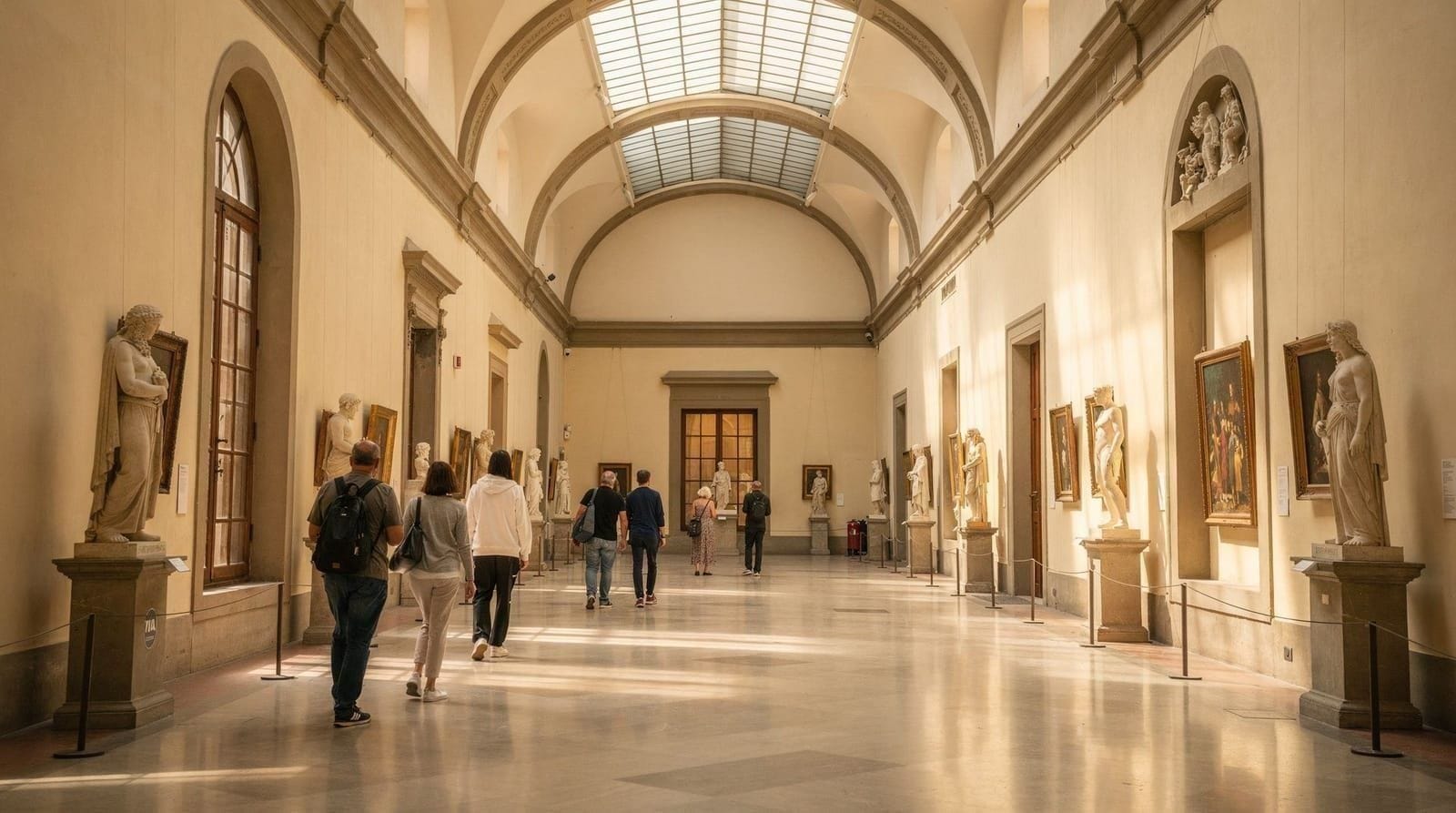
The Uffizi is the logical starting point. It traces the entire arc of Florentine and Italian painting from Cimabue (late 13th century) through Titian (16th century), with detours into Flemish and German painting that the Medici collected for comparative purposes.
The museum is large — 45 rooms on two floors — and most visitors significantly underestimate how much time they need. A serious visit takes four to five hours; two hours is enough for the essential rooms only. Do not attempt the entire museum on a first visit unless you have the stamina of a professional art historian.
What to prioritise at the Uffizi
Room 2: Cimabue and Giotto — the transition point before the Renaissance. Giotto’s Ognissanti Madonna (around 1310) and Cimabue’s and Duccio’s contemporary treatments of the same subject hang in the same room, making the contrast immediate and instructive. Giotto’s figures have weight and solidity that the others lack — it’s the beginning of the road to Masaccio.
Rooms 10–14 (Botticelli): This is what most visitors come for. Primavera (c. 1478) and The Birth of Venus (c. 1484–1486) hang here — enormous, startling paintings that look both older and stranger in person than in reproduction. The figures are elongated and slightly unreal; the scholarship suggests this was deliberate, representing Neoplatonic ideals rather than observed nature. The detail — the flowers in Primavera number over 190 identifiable species — is extraordinary. These rooms are usually crowded; come at opening time or in the final hour before closing.
Room 15 (Leonardo): Two early Leonardos: the Annunciation (c. 1472–1475) and the unfinished Adoration of the Magi (c. 1481–1482). The Annunciation shows a 19- or 20-year-old artist already painting light and shadow in a way no one had done before. The Adoration, which Leonardo abandoned when he moved to Milan, is technically unfinished but extraordinary as a record of his compositional process — dozens of figures sketched in underpaint, a horse rearing in the background, the psychological intensity fully present.
Room 35 (Michelangelo): The Doni Tondo (c. 1507) is Michelangelo’s only finished panel painting. The circular format and the muscular rendering of the figures — particularly the Virgin, who is shown in a pose more suited to a strong man than to the Mother of God — make it immediately identifiable. The figures in the background, which art historians have argued about for centuries, remain mysterious.
Room 83 (Caravaggio): Technically post-Renaissance, but the Medusa (c. 1597) is worth the detour.
Full Uffizi guide: Uffizi Gallery guide. Book Uffizi skip-the-line tickets well in advance for any visit between March and October.
The Accademia: Michelangelo’s David and the Prisoners
The Galleria dell’Accademia was built specifically to house the David after it was moved from its outdoor location in 1873. The museum also holds Michelangelo’s four unfinished Prisoners and the statue of Saint Matthew, making it the single best place in the world to study Michelangelo’s sculptural technique.
The David needs no elaborate justification: it is exactly as remarkable in person as the reputation suggests, and the physical reality — 5.17 metres of marble in a room built around it — is genuinely different from any photograph. The Prisoners, however, are equally compelling. The figures appear to be struggling to emerge from the raw stone; Michelangelo’s non-finito technique transforms what might have been abandoned sculptures into profound meditations on form and matter.
Full Accademia guide: Accademia Gallery guide.
The Bargello: Florence’s best sculpture museum
The Bargello, housed in what was originally Florence’s prison and police headquarters (the building dates to 1255), contains the best collection of Renaissance sculpture in the world. It is consistently undervisited because it lacks the star-power marketing of the Uffizi and the Accademia — a significant mistake.
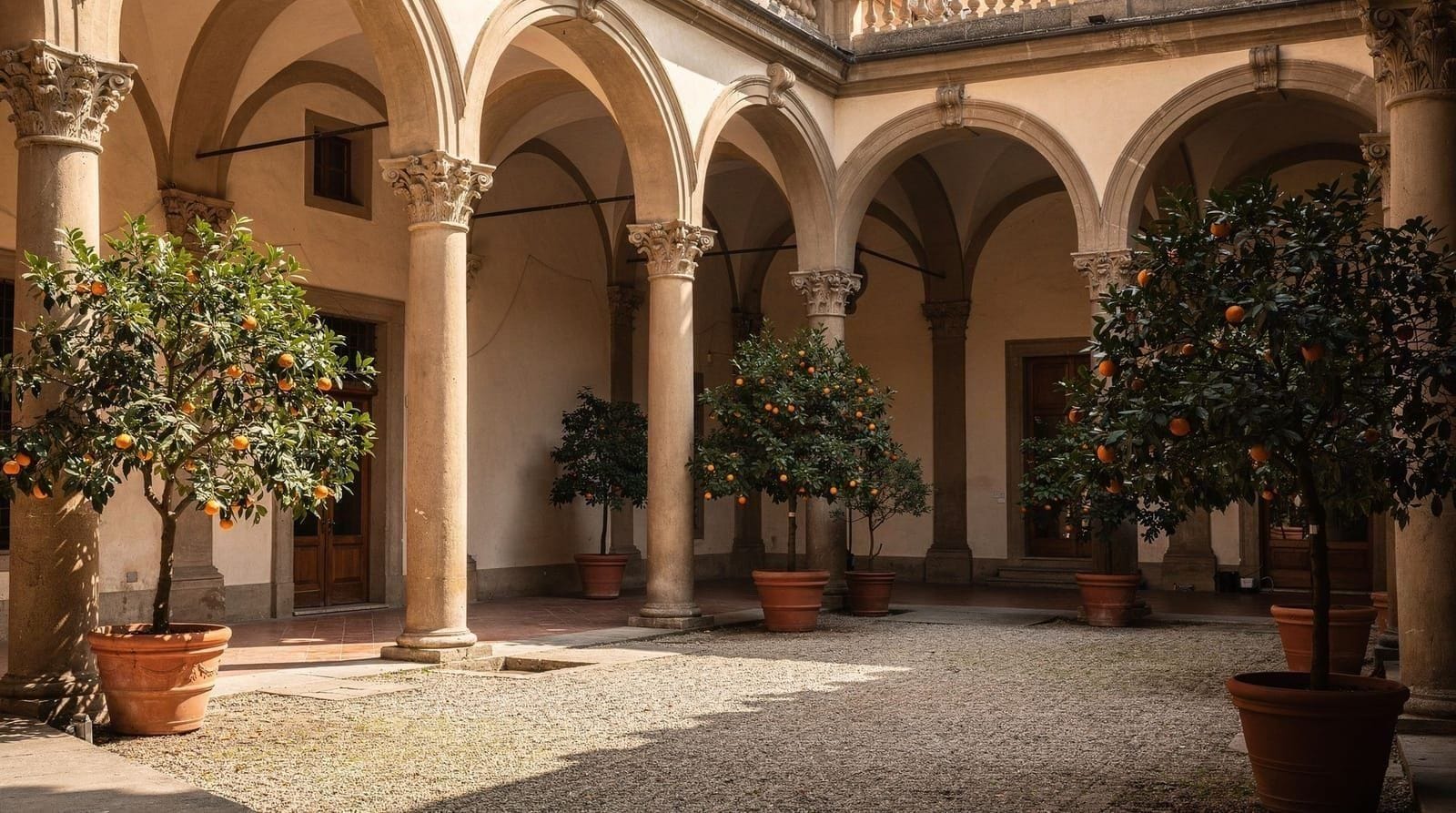
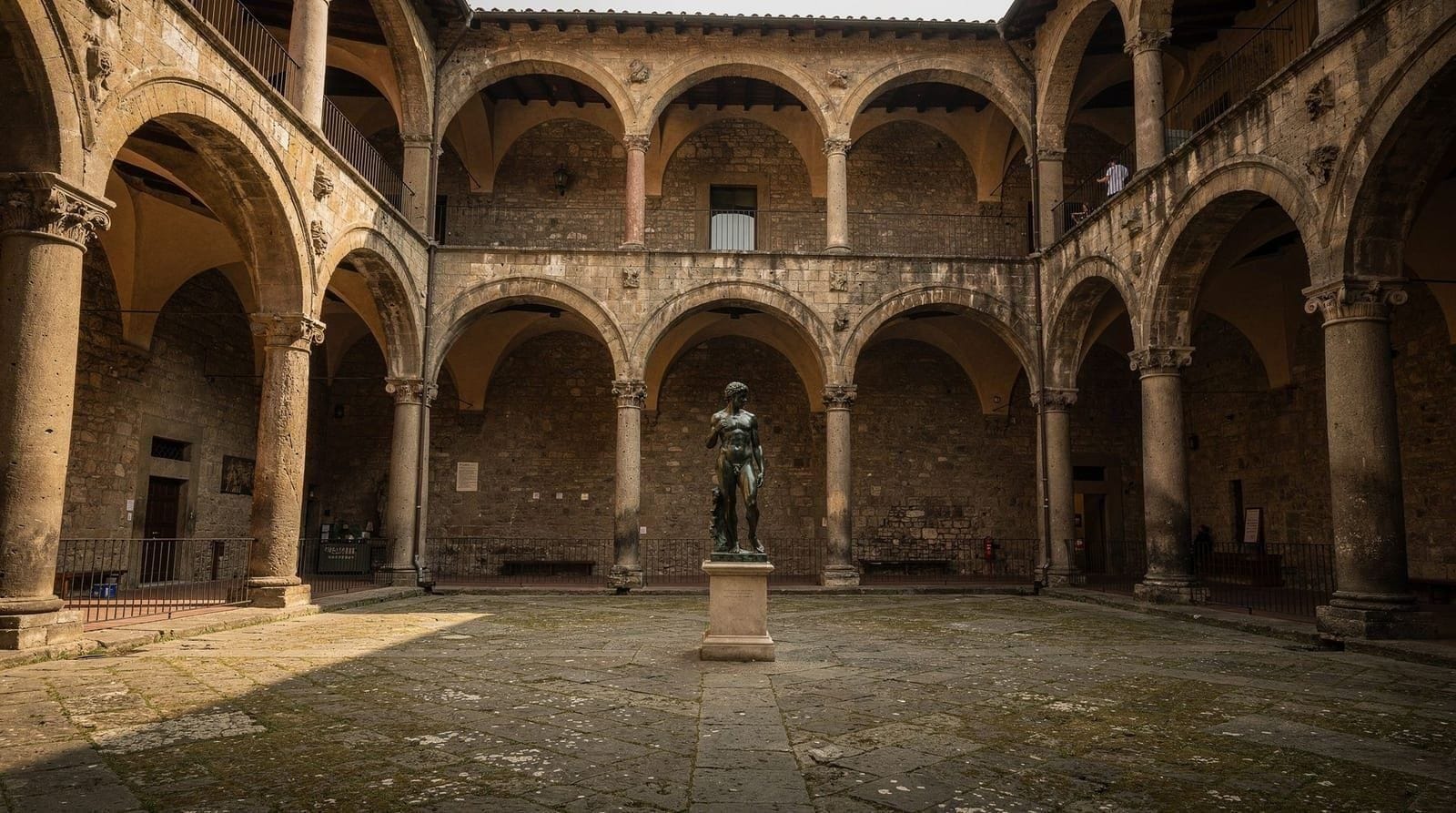
The ground floor courtyard is worth ten minutes of standing still just to absorb the architectural setting. The first-floor rooms contain what the Bargello calls its “greatest hits” — and they are extraordinary:
Donatello’s bronze David (c. 1440–1450): The first freestanding nude male sculpture since antiquity. Standing about 1.6 metres tall, Donatello’s David is the opposite of Michelangelo’s — youthful, almost androgynous, relaxed. He stands with his foot on Goliath’s severed head with an expression of such casual confidence that the work feels modern in a way that Michelangelo’s more formal heroism does not.
Donatello’s Judith: A companion piece in bronze showing Judith about to decapitate Holofernes. Originally placed in Palazzo Vecchio as a symbol of civic virtue, it’s now inside the Bargello.
The Ghiberti-Brunelleschi competition panels: The two test panels submitted for the 1401 Baptistery door competition — Ghiberti’s winning entry and Brunelleschi’s losing one — hang side by side. Comparing them is one of the great art-historical experiences available in Florence. Scholars still debate whether Ghiberti or Brunelleschi deserved to win.
The Bargello is open Tuesday–Sunday, 8:15 am to 5:00 pm. Tickets are €10; pre-booking is available but usually not strictly necessary outside peak season.
The Brancacci Chapel: where the Renaissance began
In the church of Santa Maria del Carmine in Oltrarno, the Brancacci Chapel contains frescoes that many art historians consider the true starting point of Renaissance painting. The central works are by Masaccio, painted in 1424–1427, and they represent a complete break with the Gothic tradition.
Masaccio’s Tribute Money — showing Christ directing Peter to find a coin in a fish’s mouth to pay taxes — uses a continuous narrative format (three moments in the same fresco), unified atmospheric lighting, and figures with genuine psychological weight. The Expulsion of Adam and Eve, painted on the entrance arch, shows two figures consumed by grief and shame, their bodies modelled with an anatomical understanding and emotional directness that had never appeared in religious painting before.
The chapel accommodates only a small number of visitors at a time; timed entry is required, and booking in advance is essential. The experience is quiet and concentrated — quite different from the crowds of the Uffizi.
Entry is through the church or via a small dedicated entrance. The combined ticket for the church and chapel is modest. See Oltrarno neighborhood guide for planning a visit to this area.
Palazzo Vecchio: power painted
The seat of Florentine government — Palazzo Vecchio on Piazza della Signoria — is also a museum of Renaissance power. The interior, completely redecorated for Cosimo I by Giorgio Vasari in the 1550s–1560s, is a sustained exercise in Medici propaganda and Renaissance illusionism.
The Salone dei Cinquecento (Hall of the Five Hundred) is the largest room, with walls intended to be decorated by both Michelangelo and Leonardo da Vinci — a commission that produced the famous “Battle of Anghiari” by Leonardo, lost in Vasari’s subsequent redecoration and probably hidden beneath the current frescoes. The apartments on the upper floors contain remarkable private rooms, each decorated with a complete iconographic program.
Full guide: see Florence history guide.
Santa Maria Novella: where perspective was born
The Dominican church near the train station is often dismissed as too convenient — tourists pass through it on the way between the station and the centre. This is a mistake. Santa Maria Novella contains:
Masaccio’s Trinity (c. 1427): The first painting in the Western tradition to demonstrate correct linear perspective. A painted barrel vault recedes with geometric accuracy into the wall above the altar; the figures below stand in identifiable social relationships. The illusion of space created by Masaccio’s system is still startling. The perspective was so convincing that 16th-century decorators painted over the lower section, not realising it was part of the original composition; the complete work was only rediscovered in the 19th century.
Ghirlandaio’s choir frescoes (1486–1490): Michelangelo apprenticed in Ghirlandaio’s workshop and reportedly helped with these frescoes as a 13-year-old. They are large, detailed, and populated with portraits of Florentine citizens dressed in contemporary 15th-century clothing amid biblical scenes — a charming period detail.
Brunelleschi’s crucifixion: The only surviving painted wooden crucifix by Brunelleschi, made in response to Donatello’s crucifix at Santa Croce. The two artists famously disagreed about how to represent the body of Christ — Brunelleschi found Donatello’s Christ too peasant-like, and made his own version of aristocratic dignity.
San Miniato al Monte: the Romanesque foundation
A visit to Florence focused entirely on the Renaissance risks missing the visual tradition against which Renaissance art was defining itself. San Miniato al Monte, perched on the hillside above Piazzale Michelangelo, is the clearest example of that tradition in Florence — a stunning Romanesque church built in the 11th century, with geometric marble inlay that directly influenced the Baptistery and, through the Baptistery, Florentine Renaissance architecture generally.
The church is also completely free to enter, usually uncrowded, and one of the quietest places in Florence. Combine it with the view from Piazzale Michelangelo on the same walk. See the Oltrarno neighborhood guide for the walking route.
Practical advice: how to visit Renaissance Florence
Book early: The Uffizi and Accademia require advance booking during peak season (March–October), sometimes months ahead. Walk-up entry is sometimes possible but the queues can exceed two hours. See booking Florence attractions online for a complete guide.
Start early: The Uffizi and Accademia open at 8:15 am. The first 90 minutes are significantly less crowded than the middle of the day.
Don’t try to do everything: A single day in the Uffizi is barely enough for a focused visit. Spreading Renaissance art across three or four days is more sustainable and more satisfying than a single exhausting marathon.
The Bargello and Brancacci are often overlooked: Both reward serious attention and are much less crowded than the major ticket venues.
Closed Mondays: Most Florentine museums are closed on Mondays. Plan accordingly and use Mondays for walking the city, visiting churches (most are free), or taking a day trip to Tuscany.
Prioritising when time is short: a comparison
| Venue | Crowds | Time needed | Skip if… |
|---|---|---|---|
| Uffizi | Very high, book weeks ahead | 2–5 hours | You’re only here 1 day and want breadth over depth — go anyway, just budget 2 focused hours |
| Accademia | Very high for David | 45–90 min | Never — the David alone justifies the short visit |
| Bargello | Low | 60–90 min | Only if you have under 2 days total; otherwise don’t skip it |
| Brancacci Chapel | Low, timed entry | 30–45 min | If you’re not visiting Oltrarno at all |
| Santa Maria Novella | Moderate | 45–60 min | If you’re arriving/departing from SMN station anyway, it’s on the way — don’t skip |
For visitors with only one or two days, the honest priority order is: Accademia first (short, unmissable, book the earliest slot), then a focused 2–3 hour Uffizi visit hitting Botticelli, Leonardo and Michelangelo rooms, then the Bargello if a half-day remains. The best museums in Florence guide and the Firenzecard worth it guide help decide whether a combined pass makes sense for your specific itinerary.
Renaissance art with limited time or mobility
Not every visitor wants or is able to do a multi-day museum marathon. If you have half a day and want the single most concentrated dose of Florentine Renaissance sculpture and painting, the Bargello and the Accademia together take under three hours and require far less standing and walking than the sprawling Uffizi. Both venues are step-accessible on their main routes, though check current provisions for any temporary exhibition spaces before visiting if mobility is a specific concern. The accessible Florence guide has museum-by-museum detail.
Frequently asked questions about Renaissance art in Florence
How much time do I need to see Renaissance Florence properly?
Three days minimum for the essential venues: one full day for the Uffizi, half a day for the Accademia, half a day for the Bargello, and at least half a day for Oltrarno including the Brancacci Chapel. Add a morning for Santa Maria Novella and the Baptistery, and an afternoon for the Medici Chapels and San Lorenzo. That’s four to five days of focused museum-going, which most visitors combine with walking, eating, and day trips.
Is the Uffizi worth the price?
Yes. The ticket price (€20–25 depending on booking method) is among the better value museum admissions in Europe given the quality and quantity of what’s inside. The Birth of Venus alone would justify it; the fact that you can also see Leonardo, Raphael, Titian, Caravaggio, and 40 other rooms of extraordinary art in the same visit makes it extraordinary value.
What is the best Renaissance art tour in Florence?
A private medieval and Renaissance walking tour covers the historical context and exterior sites well. For the galleries, the Uffizi and Accademia guided tour is efficient if you only have one day. The Renaissance and Medici walking tour is the best combination of historical narrative and art history.
Are there Renaissance artworks in Florence churches that are free?
Yes, many. Santa Maria Novella (Masaccio’s Trinity, Ghirlandaio choir frescoes) has a modest entry fee. The Orsanmichele church (free) has exterior niches with sculptures by Donatello, Ghiberti, and Verrocchio — it is an outdoor sculpture gallery without the queue. The Ospedale degli Innocenti, also free, has a Ghirlandaio altarpiece and the famous Brunelleschi loggia.
Should I hire a guide, or is Renaissance art in Florence manageable independently?
Both work, depending on how much context you want. A knowledgeable guide adds real value at the Uffizi and Palazzo Vecchio specifically, where the sheer density of works and political history rewards someone who can point you to what matters and explain the Medici context on the spot. Independent visits work fine at the Accademia (the David needs little introduction) and the Bargello, where a good audioguide or this guide’s room-by-room notes cover most of what a human guide would add. If budget is a factor, hire a guide for one venue — the Uffizi is the best use of that money — and go independently elsewhere.
What’s the single most underrated Renaissance sight in Florence?
The Bargello, without much competition. It holds Donatello’s bronze David — the first freestanding nude male sculpture since antiquity — and the original 1401 Baptistery door competition panels by Ghiberti and Brunelleschi side by side, yet it draws a fraction of the Uffizi’s crowds. Visitors who skip it because it lacks the marketing of the bigger museums are missing one of the clearest, quietest windows into how the Renaissance actually began.
Top experiences
Bookable activities with verified prices and instant confirmation on GetYourGuide.

Florence: Uffizi Gallery and Accademia Gallery guided tour
- Skip the line
- Free cancellation
Florence: Uffizi and Accademia Gallery skip-the-line tour
- Skip the line
- Small group
Florence: private medieval and Renaissance 3-hour walking tour
- Free cancellation
Florence: Renaissance and Medici walking tour
- Free cancellation
- Small group
Florence: Accademia Gallery and Michelangelo's David tour
- Skip the line
- Small group