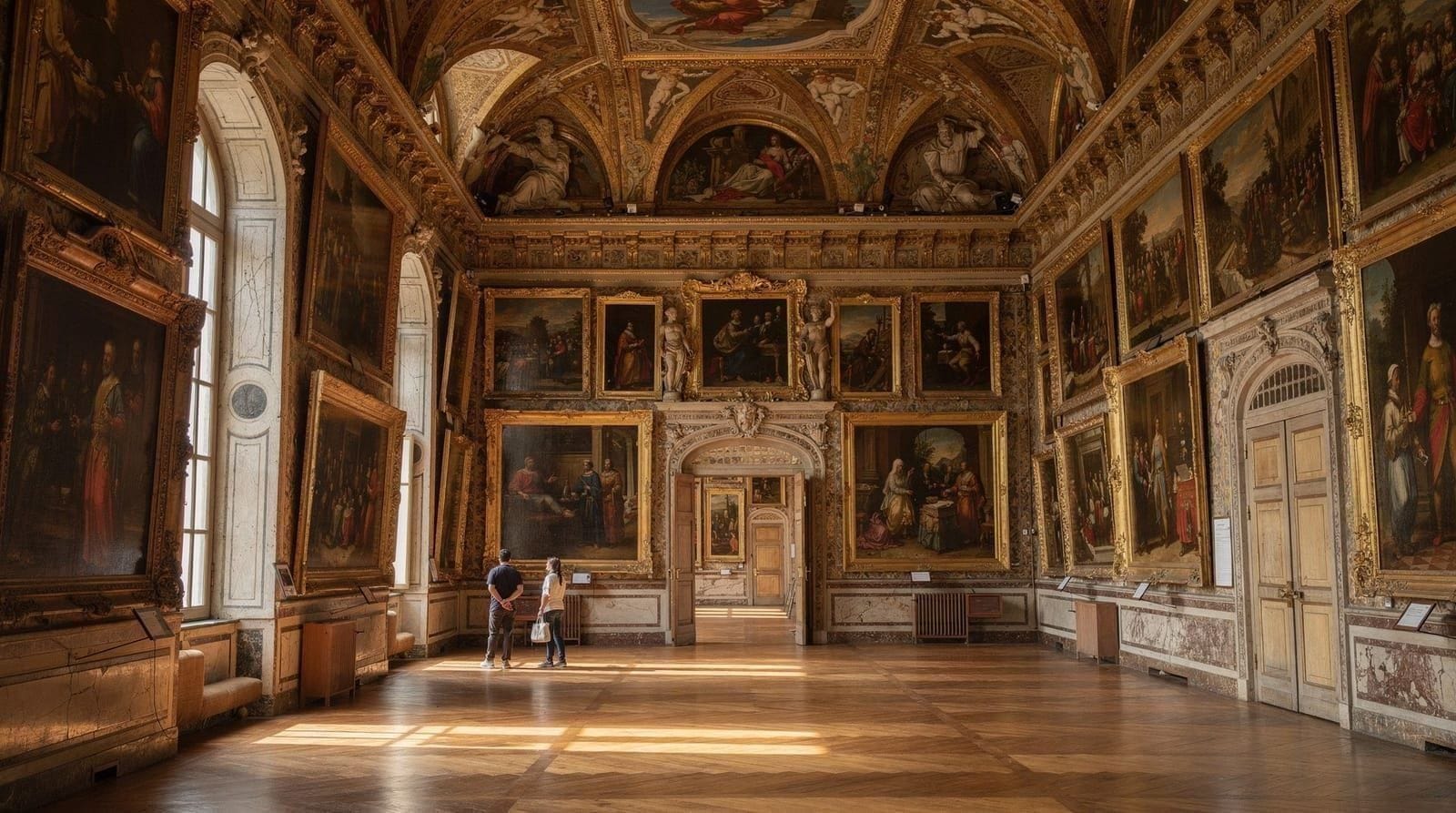
Museo Novecento: Florence's 20th-century art museum
Florence: walking tour
- Free cancellation
- Instant confirmation
What is the Museo Novecento in Florence?
The Museo Novecento is Florence's museum of 20th-century Italian art, housed in the Palazzo dello Strozzino near Piazza della Repubblica. It covers Italian artistic movements from Futurism through Arte Povera to contemporary installation, with particular strength in the Scuola Romana and the decades between the World Wars. Entry is €9.50.
Florence’s reputation rests so heavily on the Renaissance that the city’s significant engagement with modern art is almost entirely overlooked by visitors. The Museo Novecento corrects this — it presents Italian art from 1910 to 2000 in a beautifully converted medieval palazzo just off Piazza della Repubblica, one of Florence’s central squares.
This guide tells you what to expect, what not to miss, and how the museum fits into a realistic Florence itinerary.
| Where | Piazza Santa Maria Novella 10 |
| Cost | around €9.50; free with Firenzecard |
| Time needed | 60–90 minutes |
| Booking | not needed; walk-up entry |
| Best for | a break from Renaissance-heavy days, rainy afternoons |
Why this museum exists in Florence
Florence is defined globally by one period of its artistic history. The Uffizi, the Accademia, the Bargello, the Medici Chapels — all celebrate the explosion of Renaissance art that occurred in this city between roughly 1400 and 1600. Tourists come to Florence for Botticelli and Michelangelo. The Museo Novecento’s mandate is to correct the record.
Italian art did not stop at the Baroque period. Florence in the 20th century participated in the same upheavals that produced Cubism in Paris, Expressionism in Germany, and Constructivism in Russia — but with its own inflections, its own debates, and its own relationship to the overwhelming inherited tradition. Understanding Italian 20th-century art means understanding what it is to be a working artist in the shadow of the greatest art culture in Western history.
The Novecento opened in 2014 in a building that had previously served as the city’s former orphanage (the Spedale degli Innocenti administered it for centuries). The collection covers approximately 350 works, drawn from the city’s own civic art collection and supplemented by donations.
Essential visitor information
Address: Piazza Santa Maria Novella 10, Florence
Hours: Variable by season — generally Monday, Wednesday–Saturday 11:00 am – 8:00 pm; Tuesday 11:00 am – 5:00 pm; Sunday 11:00 am – 8:00 pm. Check musefirenze.it for current hours.
Tickets: €9.50; Firenzecard holders enter free
Time needed: 60–90 minutes for a thorough visit
Getting there: 3-minute walk from Santa Maria Novella station; 5 minutes from the Duomo; ZTL zone applies
The building: Palazzo dello Strozzino
The museum occupies the Palazzo dello Strozzino, a 15th-century palazzo that once belonged to a branch of the Strozzi family (rivals of the Medici). The interior retains much of its medieval and Renaissance fabric — stone staircases, vaulted ceilings, terracotta floors — while being adapted to display contemporary art. This collision of architectural periods is one of the museum’s defining characteristics.
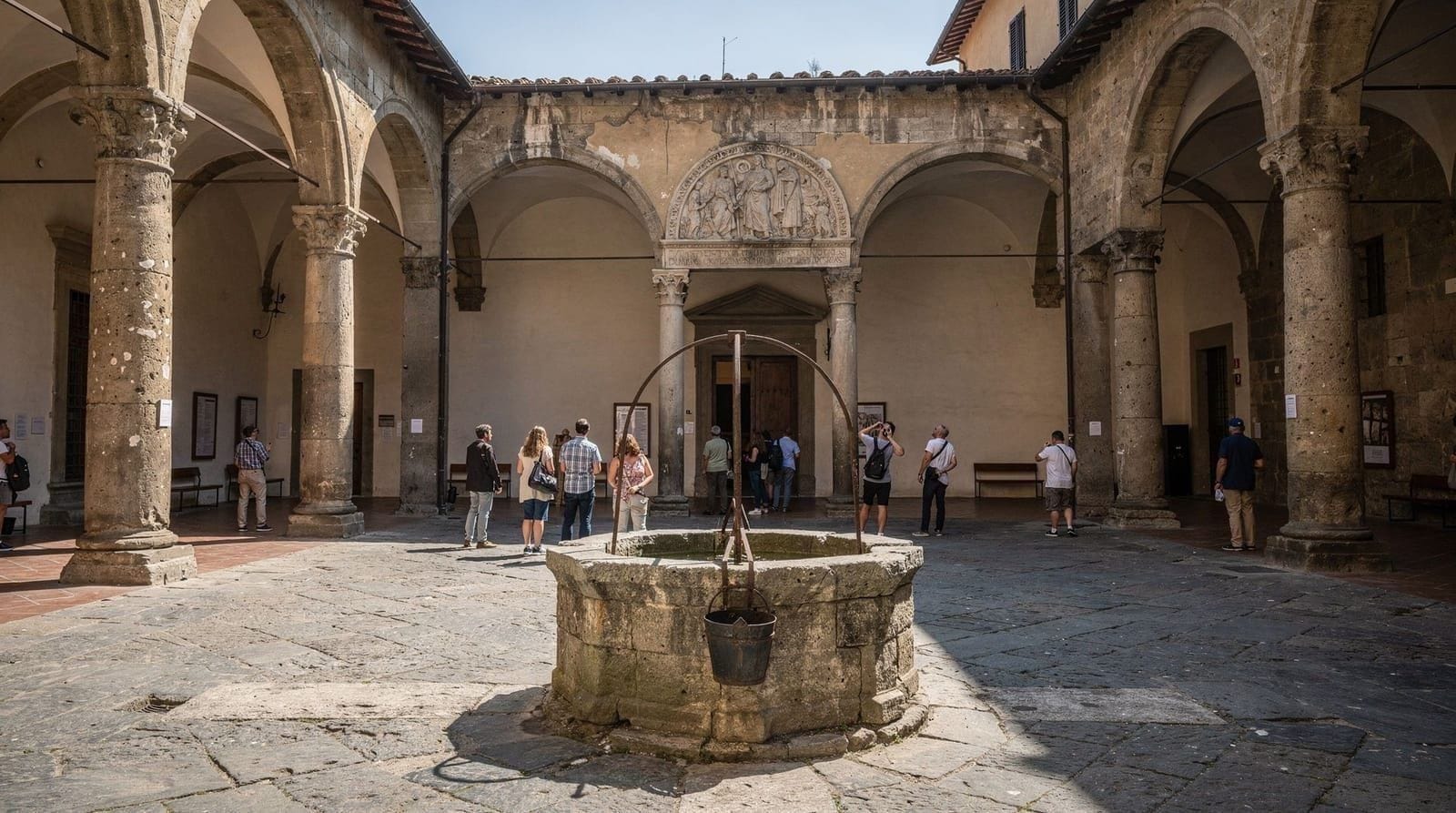
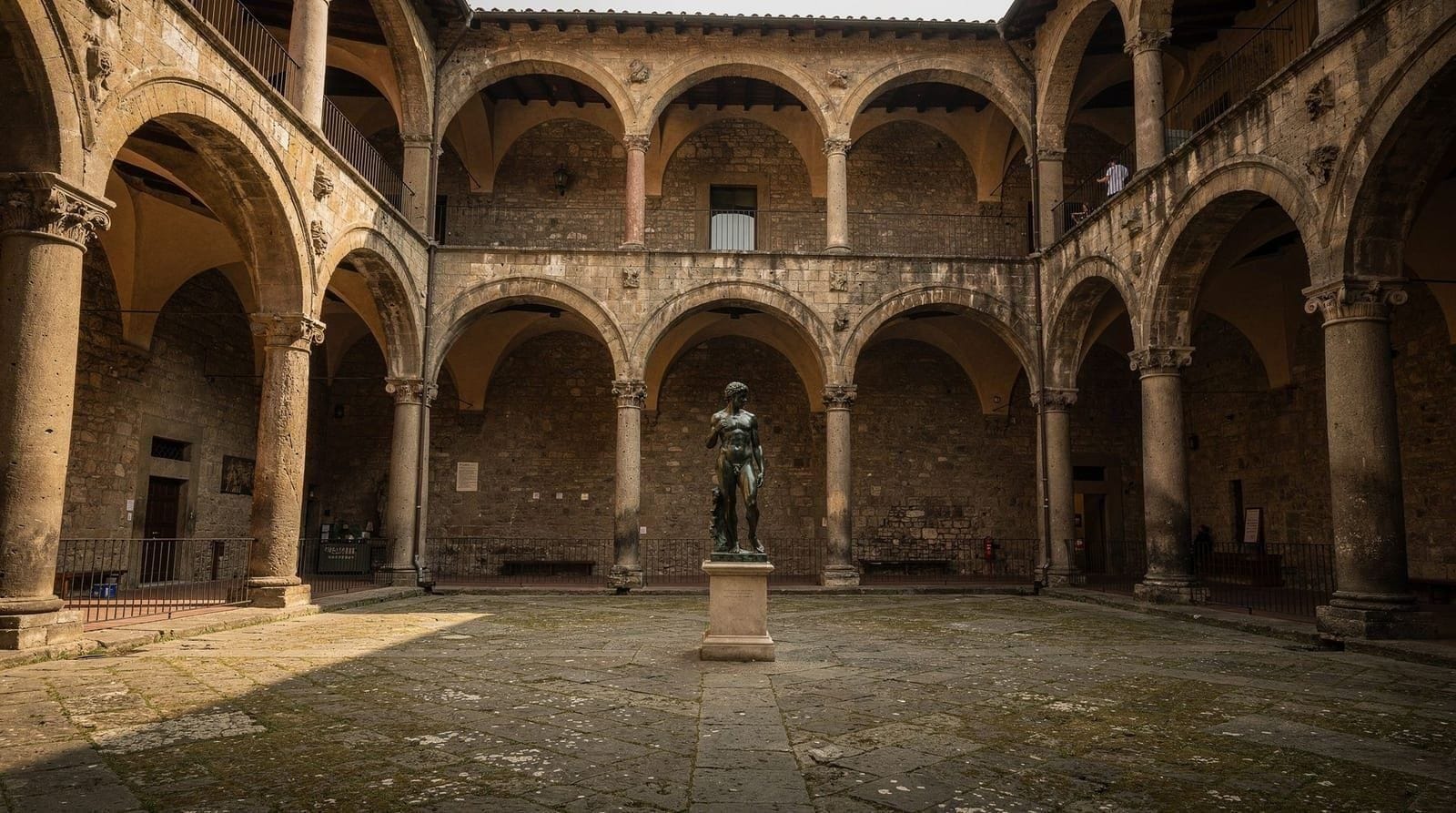
The courtyard is particularly good: a stone-paved space with a loggia that provides relief on warm days and serves as a venue for outdoor installations. The upper floors transition progressively through the 20th century’s artistic movements in roughly chronological order.
Room-by-room guide
Early 20th century: Futurism and reaction
The ground floor opens with the Italian artistic context of the early 1900s — the post-Divisionist moment when Italian painters were beginning to respond to international currents (Post-Impressionism, early Expressionism) while remaining entangled with academic tradition.
Futurism dominates the first major section. Launched in 1909 by the poet Filippo Tommaso Marinetti’s manifesto in Le Figaro, Futurism was Italy’s most original contribution to the early 20th-century avant-garde. The Futurists celebrated speed, technology, violence, and modernity — and despised museums, tradition, and anything that smelled of the past.
The irony: their paintings are now in museums. But their visual strategies remain thrilling — broken, dynamic forms suggesting motion, light fragmented into simultaneous views, the visual experience of velocity. Umberto Boccioni, Giacomo Balla, and Carlo Carrà are the central figures. The Novecento’s holdings include works that demonstrate the movement’s visual range, from the relatively gentle light studies of Balla to Carrà’s more agitated compositions.
The Futurists were also entangled with Italian nationalism and, later, Fascism — a relationship the museum contextualises honestly rather than eliding.
Arte Metafisica and the dream spaces of de Chirico
Giorgio de Chirico is the Italian artist most influential on 20th-century art internationally. His Pittura Metafisica (Metaphysical Painting), developed from around 1910, depicts uncanny Italian piazzas — deserted, bathed in sharp afternoon light, populated by mannequins, classical statues, and inexplicable shadows. The spaces are recognisably Italian (arcaded facades, long perspectives) but stripped of human warmth, transformed into dreamscapes of anxiety and longing.
André Breton and the Surrealists recognised in de Chirico a precursor and adopted his visual vocabulary; Dalí’s melting clocks are inconceivable without de Chirico’s empty arcades. The Novecento’s de Chirico holdings allow visitors to see the original context — these works produced in Italy, for Italian audiences, as philosophical and poetic objects rather than the strange dream-images they later became.
Carlo Carrà’s move from Futurism to Metafisica (they briefly corresponded and exchanged ideas in 1917) is also represented here.
The 1930s: Novecento Italiano and Fascist aesthetics
The official Novecento Italiano movement (distinct from the museum, confusingly) was a conservative turn in Italian art of the 1920s–1930s, promoted by Mussolini’s cultural apparatus and championed by the critic Margherita Sarfatti. It emphasised classical clarity, monumental forms, and a return to Italian tradition — aesthetically the opposite of Futurism, politically aligned with the regime.
The museum does not shy from this political context. Artists like Mario Sironi produced work of genuine quality while serving propaganda functions; the Novecento’s handling of this period is more nuanced than either simple condemnation or celebration.
Scuola Romana (Roman School): The alternative — a group of artists in Rome including Mario Mafai and his partner Antonietta Raphaël who maintained an expressionist, humanist mode during the Fascist period. Mafai’s paintings of flowers, ruins, and figures have a quality of melancholy persistence; Raphaël’s sculptural and painted work shows the influence of her Eastern European Jewish background (she was born in Lithuania and had been studying in Paris before moving to Rome). Their work represents a form of cultural resistance within the constraints of the period.
Post-war reconstruction: Arte Informale and abstraction
Italy’s post-war artistic scene underwent rapid transformation. The trauma of war, the collapse of Fascism, and the sudden opening to international currents (American Abstract Expressionism, Tachisme in France) produced an Italian Arte Informale (Informal Art) — gestural abstraction that prioritised material and process over representation.
Emilio Vedova: One of Italy’s most important post-war painters, associated with the partisan resistance and committed to an art of political urgency even in abstract form. His canvases are physically intense — paint applied with energy, the surface dense with marks.
Alberto Burri: Perhaps the most internationally significant Italian artist of the post-war period. Burri (1915–1995), a doctor who was held as a prisoner of war in Texas, began making art there and developed a practice using unconventional materials: burlap sacks stitched together, plastic burned and bubbled, rust, tar. His works are simultaneously abstract and viscerally physical — the surfaces suggest wounds, repairs, the aftermath of destruction. The Novecento holds examples that demonstrate the range of his material investigations.
Lucio Fontana: Fontana’s “Spatial Concepts” — canvases slashed with a knife, punctured with holes — were among the most radical gestures in 20th-century art. By cutting through the canvas, Fontana introduced actual space into a medium that had claimed space only illusionistically for 600 years. The act was simple; the implications for subsequent art were enormous.
Arte Povera and the 1960s–70s
Arte Povera (Poor Art) emerged in Italy in the late 1960s — a critical response to both the commercial art market and the established avant-garde. Artists used humble, non-traditional materials: twigs, earth, mirrors, animal skins, neon lights, stone, wire. The “poverty” was conceptual rather than economic — a refusal of the prestigious materials (oil, marble, bronze) associated with the Western art tradition.
Jannis Kounellis (Greek-born but closely associated with Rome and Italian Arte Povera) is represented here. His works often use live or dead animals, fire, and industrial materials to create installations that resist commodity status and assert their physical, temporal presence.
The movement’s other key figures — Mario Merz, Michelangelo Pistoletto, Giulio Paolini — are represented in the collection.
Contemporary and the permanent collection’s final sections
The upper floors move toward more recent Italian art — the 1980s return to figuration (Transavanguardia), the 1990s and 2000s engagement with installation and video. The collection thins somewhat in these final sections, reflecting both the recency of the work and the difficulty of acquiring significant contemporary work for a civic collection.
The rooftop installation
The museum’s roof terrace hosts rotating outdoor installations. These change seasonally — check the website for what’s currently installed. The terrace also provides views across the neighbourhood toward Santa Maria Novella and is one of the more pleasant outdoor spaces in central Florence. In summer, arriving at opening time (11:00 am) allows you to experience the rooftop before it becomes warm.
Temporary exhibitions
The Novecento runs 3–4 temporary exhibitions per year in dedicated ground-floor spaces. These have covered international modern art alongside Italian figures, and occasionally reach genuinely high-profile artists on European or Italian retrospective tours. A separate ticket is sometimes required; check the website before your visit.
The café and bookshop
The café opens onto the courtyard at street level with outdoor seating. The museum bookshop is one of the better small art bookshops in Florence, particularly for 20th-century Italian art publications that are difficult to find elsewhere. Worth a browse even if you’re arriving on a tight schedule.
Why the Museo Novecento belongs in your Florence itinerary
Three specific arguments:
Contrast as education: After spending a morning with Botticelli and Michelangelo, seeing Fontana’s slashed canvas or Burri’s burlap provides a genuine intellectual jolt. Italian artists in the 20th century were wrestling specifically with the inheritance of the Renaissance — their responses, whether violent rejection (Futurism), melancholy irony (de Chirico), or radical material experiment (Arte Povera), only make sense in this context. Florence is the best place in the world to understand both ends of the argument.
Practical relief: The Novecento is almost never crowded. On a July afternoon when the Uffizi is at capacity and the queue outside the Accademia stretches around the block, the Novecento’s courtyard is quiet. Museum fatigue is a real phenomenon; a less intense museum visit can renew energy for the major collections.
Genuine quality: The collection is not a consolation prize for people who couldn’t get into the Uffizi. De Chirico, Burri, Fontana, Vedova, and the Arte Povera figures are artists of international significance. Their work in this museum deserves engagement on its own terms.
Combining with nearby attractions
The museum’s Piazza Santa Maria Novella location makes it easy to combine:
- Basilica of Santa Maria Novella: Across the square — Masaccio’s Trinity fresco, Ghirlandaio’s Tornabuoni Chapel frescoes, one of Florence’s greatest church interiors
- Santa Maria Novella train station: 3 minutes — useful as a first or last stop
- Piazza della Repubblica: 5 minutes north — cafés, the historic Rinascente department store
- Museo Ferragamo: 10 minutes south, near Ponte Santa Trinita — a fashion museum with genuine collection depth
Related guides
- Best museums in Florence
- Is the Firenzecard worth it?
- Palazzo Vecchio visitor guide
- Palazzo Pitti galleries
- Bargello Museum guide
When to fit it into your trip
The Museo Novecento works best as a deliberate contrast, not a first stop. Visitors who go straight from breakfast to the Novecento, before seeing any Renaissance painting, often find the context-setting arguments in this guide land less well — the museum’s central case, that Italian 20th-century artists were wrestling with the weight of the Renaissance inheritance, only really resonates once you’ve felt that weight yourself in the Uffizi or the Accademia. The ideal slot is an afternoon after a morning of Renaissance art, or a rainy day when the Boboli Gardens and outdoor sights are off the table.
Because the museum rarely has queues, it also works well as a flexible filler — the kind of stop you can slot into a gap between a booked Uffizi slot and a dinner reservation without needing to plan around opening-hour crowds. The Tuesday early closing (5:00 pm rather than 8:00 pm) is the one schedule quirk to build around if you’re leaving it for later in the day.
Who gets the most out of this museum
The Museo Novecento rewards a specific kind of visitor more than others. Repeat visitors to Florence — people on their second or third trip who have already done the Uffizi, the Accademia, and the Duomo complex — tend to find it one of the most satisfying additions to a return itinerary, precisely because it offers something genuinely different from the standard Renaissance circuit. First-time visitors with only two or three days should generally prioritise the headline sights first, then add the Novecento only if a spare afternoon opens up.
Art-history enthusiasts specifically interested in Futurism, Metafisica, or Arte Povera will find the collection more focused than they might expect from a relatively small civic museum — the curatorial choices favour depth in a handful of movements over a scattered survey, which makes the visit feel coherent rather than encyclopaedic. Visitors expecting a comprehensive world-history-of-modern-art museum on the scale of Paris’s Pompidou Centre should recalibrate: this is a specifically Italian, specifically Florentine story, told through around 350 works.
Visitors with children have mixed but generally positive experiences here. Younger children respond well to the visually bold Futurist and Arte Povera rooms but tire quickly of the more academic Novecento Italiano and Scuola Romana sections; a targeted 30–40 minute visit focused on the ground floor and the rooftop terrace usually works better than an attempt at the full chronological survey.
Frequently asked questions about Museo Novecento
Is Museo Novecento included in the Firenzecard?
Yes. Museo Novecento is one of the civic museums covered by the Firenzecard. Cardholders enter free and use the priority entrance, which is the main entrance on Piazza Santa Maria Novella.
Is the Museo Novecento suitable for children?
The 20th-century collection may be more immediately accessible to younger visitors than Renaissance painting — the Futurist works have visual energy that appeals to children, Arte Povera’s use of everyday materials sparks genuine curiosity (“why is a piece of burlap hanging on the wall?”), and Fontana’s slashed canvases reliably produce strong reactions. Children aged 10 and up will engage more than younger ones. The museum is not specifically child-oriented but is not unwelcoming to families.
Does the Museo Novecento have temporary exhibitions?
Yes. In addition to the permanent collection, the museum runs temporary exhibitions covering Italian and international modern and contemporary art. These sometimes require additional admission on top of the standard ticket, sometimes are included. Check musefirenze.it for the current programme before your visit.
What is near the Museo Novecento?
The museum faces Piazza Santa Maria Novella, one of Florence’s major squares. The Basilica of Santa Maria Novella — with Masaccio’s Trinity fresco (c. 1427, one of the earliest uses of mathematical perspective in painting) and Ghirlandaio’s famous Tornabuoni Chapel frescoes — is directly across the square. Santa Maria Novella station is 3 minutes away. The neighbourhood around Via Tornabuoni (immediately east) has Florence’s most concentrated luxury shopping.
What is the difference between Novecento Italiano (the art movement) and the Museo Novecento?
The Novecento Italiano was an art movement of the 1920s–1930s, promoted during the Fascist period, advocating a conservative return to classical clarity in Italian art. The Museo Novecento is a 21st-century civic museum covering Italian art from 1910 to 2000 broadly. The museum covers the Novecento Italiano movement as one episode among many, not as a governing aesthetic.
Top experiences
Bookable activities with verified prices and instant confirmation on GetYourGuide.