Renaissance art in Florence for non-experts: what you need to know before you go
| Where | Uffizi, Accademia, Santa Maria Novella, Oltrarno |
| Time needed | 2 hours minimum for the Uffizi essentials; a full day to cover the major sites |
| Cost | Uffizi around €25, Accademia around €16 (booking fee extra) |
| Getting there | On foot within the historic centre |
| Best time | Early morning or last entry slot for smaller crowds |
You don’t need an art history degree to appreciate the Uffizi
Florence’s museums intimidate people. The Uffizi alone contains more than 3,000 works across 50-plus galleries, and before you’ve visited, the names — Giotto, Masaccio, Botticelli, Leonardo, Raphael, Michelangelo — can feel like an undifferentiated mass of Italian names attached to paintings you half-recognize from badly reproduced images.
This guide is not a summary of everything in the Uffizi. It’s a set of tools for approaching what you’ll see — some context, some vocabulary, some questions to ask yourself in front of specific works — that will make the experience more meaningful without requiring you to become an art historian.
What “Renaissance” actually means
The word means “rebirth,” and it refers to the rediscovery and re-evaluation of classical Greek and Roman culture that began in Italy — specifically in Florence — in the late 14th and early 15th centuries. This sounds like an academic description, but the practical effect was revolutionary: painters and sculptors stopped using the flat, symbolic conventions of medieval Christian art and started looking at the actual world — human bodies, natural light, perspectival space — with empirical attention.
The before-and-after contrast is dramatic. Medieval religious painting follows conventions: figures are frontal, gold background signals the sacred rather than real space, proportions are symbolic rather than observed (Christ is larger than the apostles because he’s more important, not because he’s taller). Byzantine painting, which dominated Italian visual culture through the 13th century, is magnificent in its way — extraordinarily refined and spiritually intense — but it is not trying to represent nature.
Then, between roughly 1400 and 1500, a series of artists in Florence changed the terms entirely. Brunelleschi invented the mathematical laws of one-point perspective. Masaccio used light and shadow (chiaroscuro) to model three-dimensional figures on a flat surface. Donatello made sculptures that look psychologically real rather than ritually correct. Botticelli painted mythological scenes with an emotional subtlety that secular painting had never attempted.
The Renaissance art Florence guide covers the historical arc in detail. What follows are the specific things to look for.
What to look for: the technical revolutions
Perspective: A painting from 1380 has no systematic way of creating the illusion of depth on a flat surface. A painting from 1435 does. Look at the floor tiles in Masaccio’s Trinity fresco in Santa Maria Novella — they recede according to a precise mathematical vanishing point, creating a barrel-vault space that the eye reads as real. This was the first time this had been done consistently in European painting. It was, at the time, astonishing.
In the Uffizi, watch for perspective in the architectural settings of Annunciation paintings — the colonnaded halls receding into space — and in the background landscapes of portraits.
Light and shadow (chiaroscuro): Medieval figures are outlined; the edge of the object tells you where it is. Renaissance figures are modelled: the light hitting a cheek, the shadow under a chin, the reflected light in an eye tell you the three-dimensional shape. Leonardo da Vinci perfected this into sfumato — a technique of blurring edges with very fine glazes to create the soft, smoky transitions visible in the faces of his Virgin and Child paintings.
Stand close to a Uffizi Botticelli and look at the hair, the hands, the drapery. Then move to a Leonardo and look at the transitions between light and dark on a face: the edges dissolve rather than remaining firm.
The human body: Medieval figures are draped to the point of architectural abstraction. Renaissance figures have bodies that move inside their clothes. Michelangelo’s sculptures — the David, the Prisoners in the Accademia — are studies in anatomical understanding developed from direct observation of the human form. When you see Michelangelo’s figures, the interest is in the specific way muscle and bone interact under tension or repose, not in generic “body.”
The key figures: who they are and what they changed
Giotto di Bondone (c.1267–1337): The first revolutionary. Working a century before the canonical Renaissance, Giotto introduced human emotion and spatial coherence to religious painting in a way that medieval painting didn’t attempt. His Ognissanti Madonna in the Uffizi shows this: Mary has weight, presence, psychological engagement with the viewer. Compare it to the Byzantine-style madonnas nearby — the difference is immediately legible.
Masaccio (1401–1428): Died at 27. Changed European painting in four years of mature work. His Trinity fresco in Santa Maria Novella (not in the Uffizi — in the church, free to see) is the first monumental painting with correctly calculated one-point perspective. His Brancacci Chapel frescoes in the Oltrarno gave Western painting its grammar of naturalistic figure painting. The Oltrarno walking tour covers a visit to the Brancacci Chapel.
Sandro Botticelli (1445–1510): The great mythological painter of the 15th-century Florentine court. His two most famous works — Primavera and Birth of Venus — are in the Uffizi, and they represent something unique: secular, mythological subject matter painted with a complexity of emotional and intellectual content that had never before appeared in Italian secular art. Look at the faces in Primavera — the variety of expression, the different psychological states of the different figures. This is not decoration; it’s narrative and philosophy.
Leonardo da Vinci (1452–1519): The paradigm case of Renaissance universalism — scientist, engineer, artist, anatomist, geographer, musician. The Uffizi contains his Annunciation (an early work from around 1472) and the unfinished Adoration of the Magi — an extraordinary compositional study, left incomplete when Leonardo departed Florence for Milan, but showing his ambition: not the standard Adoration scene but a swirling composition of emotional complexity.
Michelangelo Buonarroti (1475–1564): Sculptor, painter, architect, poet. In Florence: the David (Accademia), the Prisoners (Accademia), the Medici Chapels tombs, the Doni Tondo painting in the Uffizi (his only finished easel painting, characteristically ambitious and strange). Michelangelo’s particular contribution was to intensify the Renaissance’s interest in the human body into something transcendent — his figures seem under emotional and physical strain that goes beyond anatomical realism into something closer to existential drama.
The Michelangelo in Florence guide covers all the major works and their locations.
The Medici: why they matter for understanding the art
The art in Florence during the 15th century was largely produced under the patronage of the Medici family — the bankers who effectively controlled Florence from Cosimo de’ Medici’s rise to power in 1434 through the end of the 15th century (and again later, as Dukes, from the 1530s). Understanding the Medici helps explain why so much Renaissance art survives in Florence: it was commissioned, collected, and preserved by a family with extraordinary resources and sophisticated taste.
Cosimo de’ Medici patronized Donatello, Fra Angelico, and Brunelleschi. His grandson Lorenzo il Magnifico (1449–1492) ran a court that included Botticelli, Leonardo, and the young Michelangelo. This concentration of talent in a single city, supported by a single patron family, is historically anomalous and explains why Florence has the collection it has.
The Medici family history guide and the Medici Renaissance tour guide put this in context for a visitor who wants to follow the thread rather than see the art in isolation.
How to look at a painting without feeling lost
A method that works for most people who are not trained art historians:
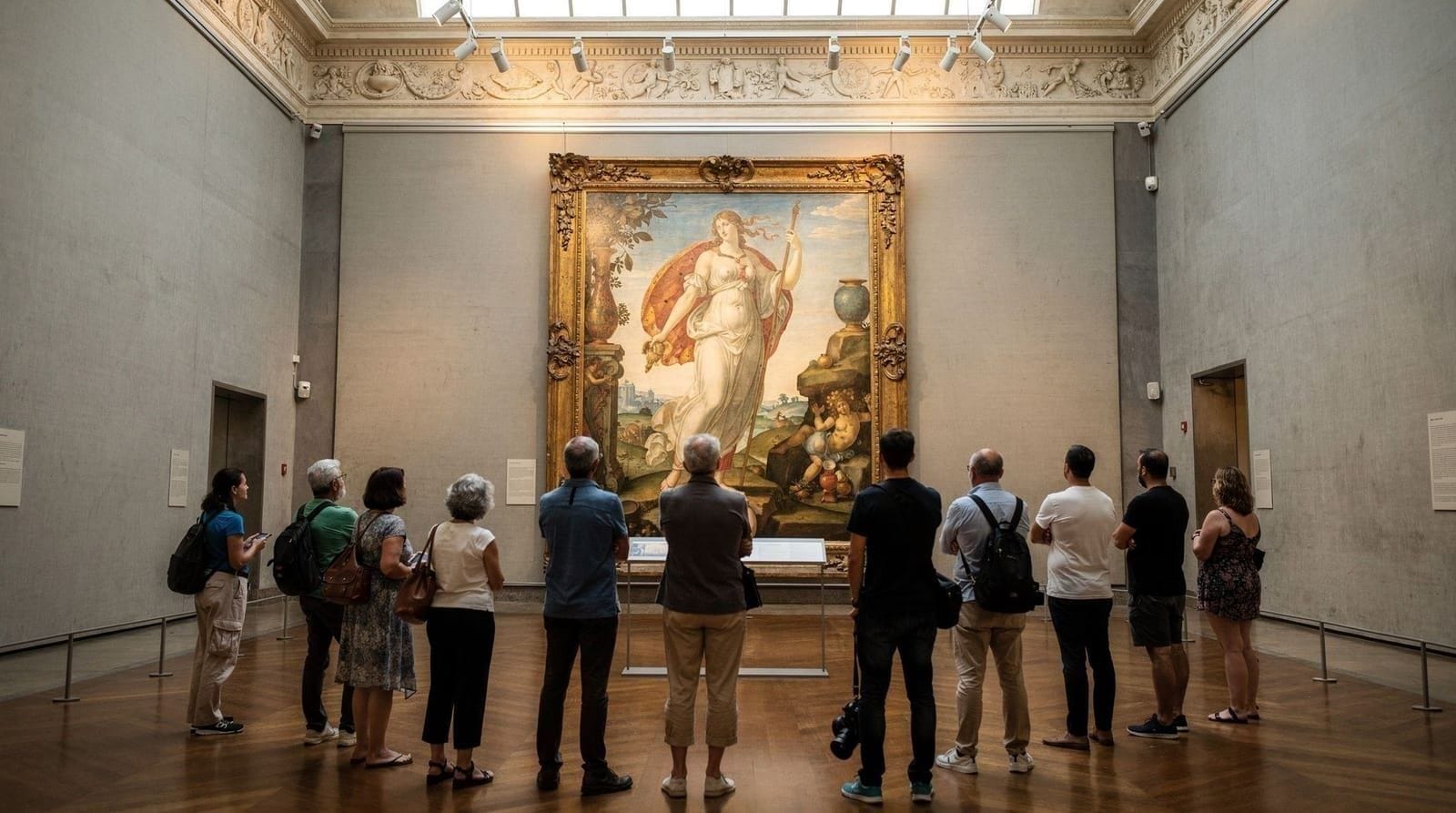
First, give it time. The initial impression of a painting changes significantly after 30–60 seconds of attention. Look at the overall composition before reading any label.
Then ask: What’s happening? (Subject: who are these people, what are they doing?) Where are they? (Setting: indoor, outdoor, architectural, landscape?) What is the light doing? (Where is it coming from, what is it illuminating, what does it avoid?) What are the faces expressing?
If you have a guide or an audio guide: use them. The Uffizi’s audio guide (available at the museum or via the app) provides the contextual information that converts a well-organized display of old paintings into something legible. A guided tour — particularly a small-group guided tour with an expert who can pause in front of specific works and respond to questions — converts it into a conversation.
The Uffizi Gallery guide covers the rooms and their contents in the sequence in which you’ll encounter them. Reading it before you visit is a significant advantage.
What to prioritize in the Uffizi
If you have two hours (a reasonable visit), the sequence: Rooms 2–4 for the Cimabue and Giotto Madonnas (the starting point of the Renaissance story), Room 8 for Fra Filippo Lippi, Rooms 10–14 for Botticelli (the Primavera and Birth of Venus are here — allow 20 minutes minimum), Room 15 for the Leonardo Annunciation and the Adoration, Rooms 22–23 for the northern European masters (Dürer, Cranach — a useful counterpoint), Room 35 for Michelangelo’s Doni Tondo. The first floor (Rooms 41–90) has Raphael, Titian, Caravaggio, and later works; if time allows, the Raphael rooms and the Caravaggios are the priority.
The museums on the Uffizi’s second floor — the Vasari Corridor works that are occasionally accessible — show Raphael’s and other artists’ self-portraits, which is a fascinating genre in itself but can be skipped without significant loss on a time-constrained first visit.
Frequently asked questions about Renaissance art in Florence
Do I need to know anything before visiting the Uffizi?
No knowledge is required, but having some orientation helps considerably. Even twenty minutes reading about Botticelli’s Primavera and Birth of Venus before standing in front of them will make the experience richer. A guided tour is the easiest way to acquire context without pre-reading.
Is the David really that impressive in person?
Yes. The photographs — and there are a lot of them — flatten the David into a familiar image. The reality of a five-metre marble figure that reads as psychologically present, in a room designed to frame it at the end of a long gallery, is different. Most visitors report that they underestimated the impact before seeing it.
How much time should I spend in the Uffizi?
Two hours is a minimum for a coherent visit to the essential rooms. Three to four hours allows you to move more slowly and see the wider collection. More than four hours in a single day leads to museum fatigue for most people; better to go twice (the Uffizi ticket is valid for one day but allows re-entry).
Which is more important: the Uffizi or the Accademia?
The Uffizi is a greater collection by volume and has more of the canonical Renaissance paintings. The Accademia has the David and the Prisoners. For most first-time visitors, both are worth visiting; the Uffizi should be prioritised if only one is possible.
Is it worth paying for a guided tour instead of visiting independently?
For most non-experts, yes, at least for the Uffizi. A guide converts a sequence of unfamiliar names into a narrative you can follow, and can pause in front of the works that matter most rather than treating every room equally. If budget is tight, a well-chosen audio guide plus 20 minutes of reading beforehand — on Botticelli’s Primavera and Birth of Venus especially — gets you most of the way there independently.
Do I need to visit the Uffizi and the Accademia on the same day?
No, and it’s often better not to. Both museums reward unhurried attention, and combining them in one day risks museum fatigue by the second stop. If your schedule allows, split them across two mornings, or pair one with a lighter afternoon like the Oltrarno rather than a second major museum.
Comparing the Uffizi and the Accademia
| Uffizi | Accademia | |
|---|---|---|
| Known for | Botticelli, Leonardo, Michelangelo’s Doni Tondo | Michelangelo’s David, the unfinished Prisoners |
| Typical visit length | 2–4 hours | 1–1.5 hours |
| Crowds | Consistently busy; book well ahead | Busy around the David; quieter elsewhere |
| Best for | Painting, breadth of the Renaissance story | Sculpture, a single overwhelming centrepiece |
If you can only choose one, the Uffizi covers more ground; the Accademia delivers one of the most direct emotional experiences in Florence in under two hours. Many visitors do both, on separate mornings, rather than choosing.
A short vocabulary for looking at Renaissance paintings
A handful of terms make gallery labels and audio guides far more useful. Sfumato (Leonardo’s smoky blending of edges) softens transitions between light and shadow so outlines dissolve rather than staying sharp. Chiaroscuro is the broader technique of using strong light-and-dark contrast to model three-dimensional form. Predella refers to the small narrative panels often found beneath a larger altarpiece, usually depicting scenes from the same saint’s life — worth crouching down for, since they’re easy to miss. Contrapposto describes a figure standing with weight shifted onto one leg, creating a natural S-curve through the body — visible clearly in Michelangelo’s David. Knowing these four terms alone will make most museum labels click into place.
Top experiences
Bookable activities with verified prices and instant confirmation on GetYourGuide.