A Vespa through the Chianti hills: the most fun I've had in Tuscany
The Vespa is the correct vehicle for Chianti. Not because it’s historically accurate — the hills south of Florence were farmed by oxcart well before the Piaggio factory started production in 1946 — but because the pace of a Vespa on a narrow winding road through vineyards is exactly the pace at which Chianti reveals itself.
In a car, you’re enclosed. You pass the smell of pine and wild herbs at 70 kilometres per hour, sealed off by glass. On a Vespa, you’re in it. The air has a quality down in the vine valleys on a September morning that I can only describe as saturated — warm sun, cooling air from the cypress shade, and the fermentation smell of crushed grapes starting from the vineyards along the road.
This is the case for doing a Vespa tour through Chianti at least once.
| Where | Via Chiantigiana (SR222), south of Florence |
| Duration | Half-day (4–5hrs) or full-day (7–8hrs) |
| Cost | Around €85–120 half-day, €130–180 full-day with lunch |
| Licence needed | Category B car licence (some accept AM/moped licence) |
| Best months | May–June, September–October |
What the tour actually involves
Most Chianti Vespa tours from Florence fall into roughly the same template: meet at a point near the city, receive a safety briefing and practice circuit in a car park, head south on the Via Chiantigiana (the famous wine road, the SR222), stop at a vineyard or agriturismo for lunch and wine tasting, ride back by late afternoon.
The variations between tours are in route length (half-day versus full-day), group size, lunch quality, and whether you’re on a classic Vespa GTS 125/150, a Vespa Primavera (smaller), or an electric Vespa.
Classic Vespa: the real thing, the experience of gripping handlebars that vibrate slightly and leaning into switchbacks on a machine that sounds exactly right. You need a valid driving licence.
Electric Vespa: quieter, smoother, easier to manage, slightly less romantically authentic. Some operators now offer these as the primary option; others still run the classic GTS for riders with licences.
Fiat Topolino: some tours offer a 1950s-style electric Fiat Topolino two-seater as an alternative for passengers or non-drivers. Fun, slightly novelty-ish, good for couples where only one person has a licence.
The Chianti road: what you’re riding through
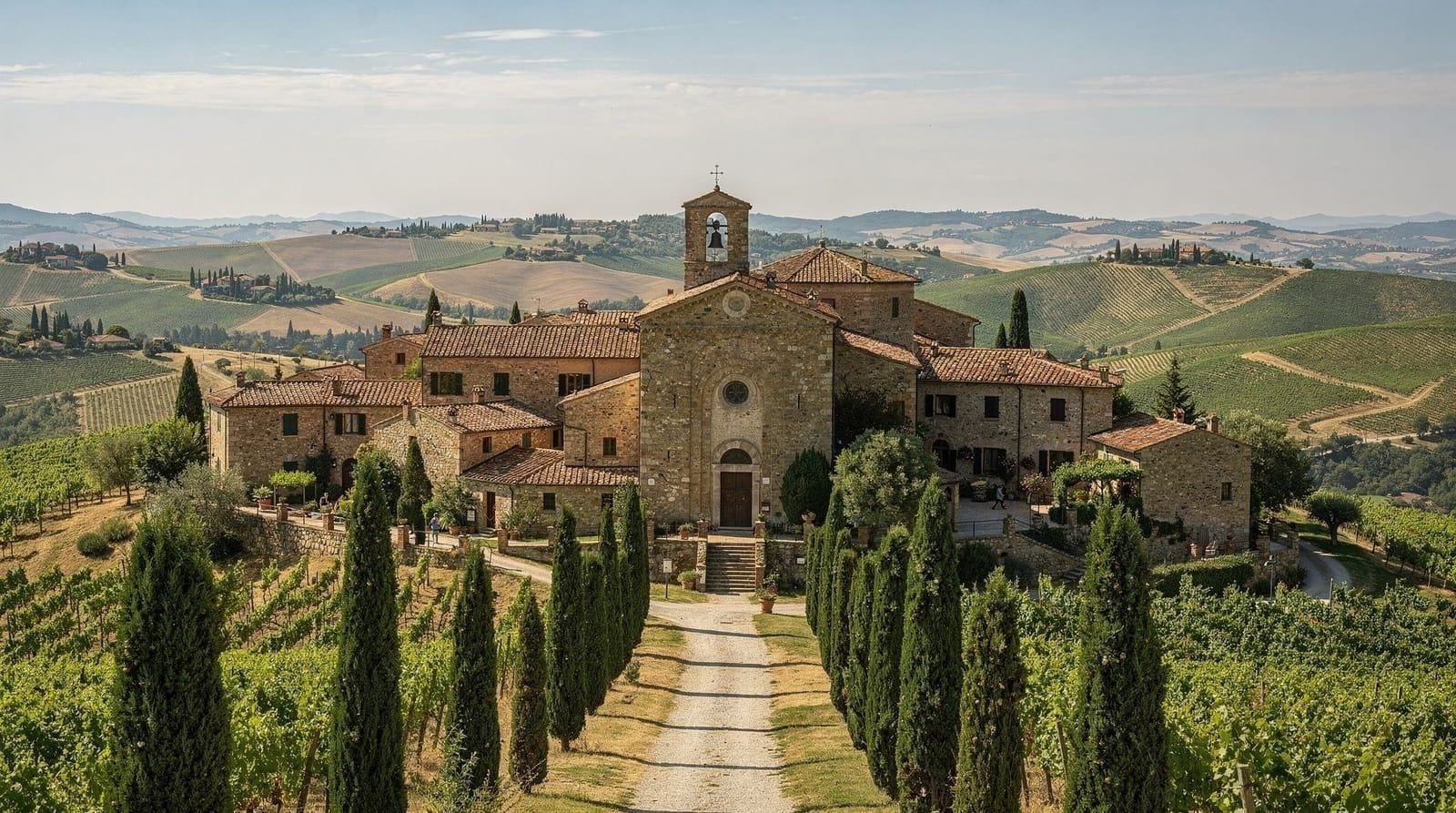
The Via Chiantigiana (SR222) runs from Florence south through Greve in Chianti, Panzano in Chianti, Radda in Chianti, and eventually reaches Siena. It’s the main artery of the Chianti Classico wine zone — the territory that produces the DOCG wine with the black rooster logo.
The road is beautiful and also narrow and winding in places, with steep drops off the side in sections. This is relevant: if you’ve never ridden a scooter, start honest with yourself about your comfort level before committing to a full-day route in the hills. Most operators have a practice session, and most will tell you honestly whether you seem ready. Listen to them.
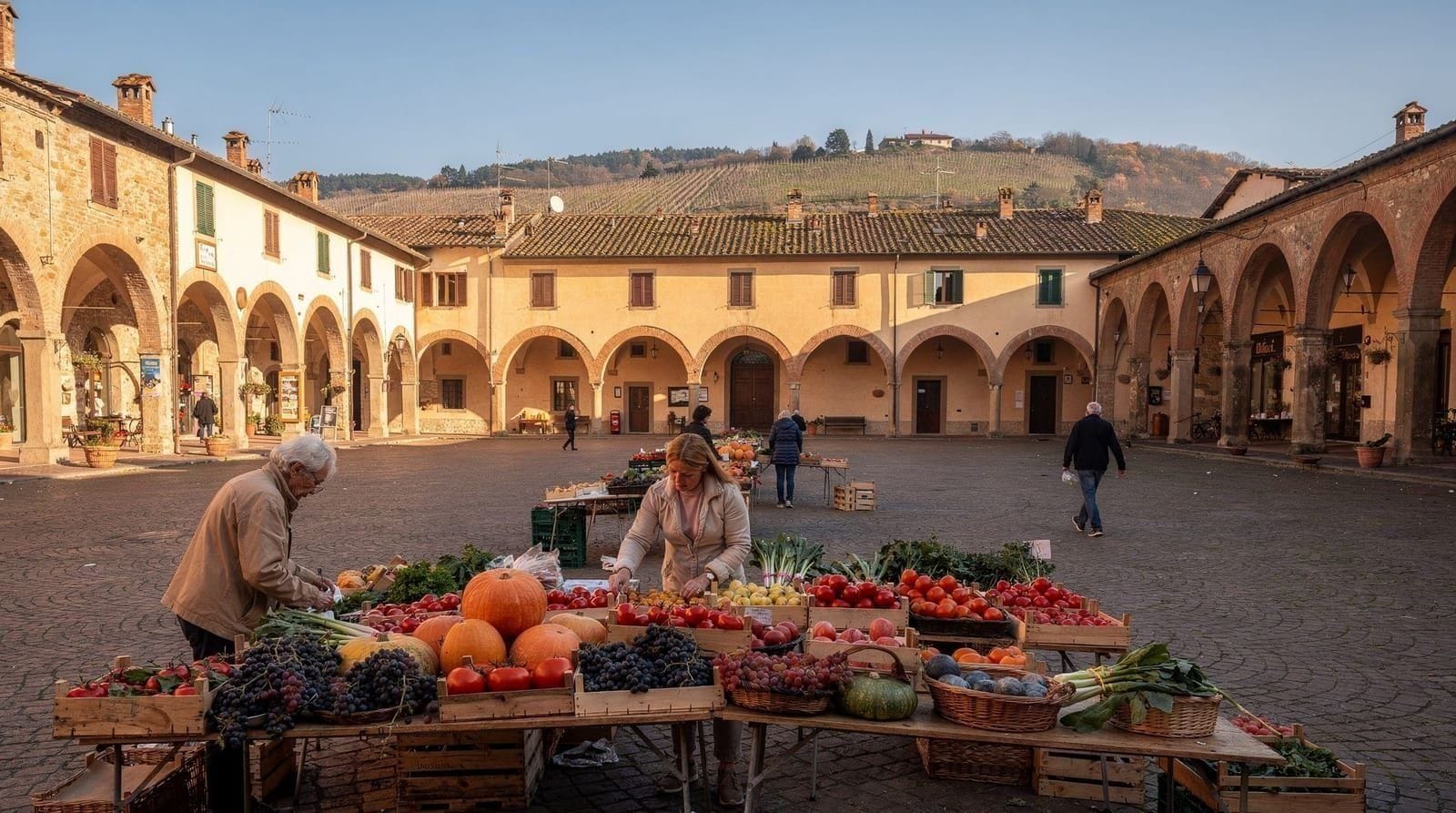
The Greve in Chianti village — the main town of the northern Chianti — is about 27 kilometres south of Florence, roughly 45 minutes on the Vespa at comfortable pace. It has a triangular main piazza lined with arcades, a butcher selling Chianina beef and wild boar salami, and a wine shop (the Enoteca del Chianti Classico) where you can taste before you buy.
The vineyard stop
Most tours include a stop at an agriturismo or small winery in the hills between Greve and Panzano. The quality of this stop varies considerably between operators.
The minimum acceptable version: a table under a pergola, a plate of local antipasti (crostini, salumi, pecorino), two glasses of the estate Chianti Classico. This is good, and honest, and sufficient.
Better tours include lunch — a full Tuscan meal of pasta and grilled meat — in addition to the wine, at a farmhouse property where the olive oil on the table comes from the trees visible out the window.
Ask specifically when booking: does the vineyard stop include lunch or just wine tasting? Is it a working winery or a farm that also sells wine? How long is the stop?
The morning of the tour
Most Florence departures leave at 9 or 9:30am to take advantage of the cooler morning temperatures and to arrive in Chianti before the worst of the midday heat. In September and October, this timing means you’re riding through vines at the beginning of the harvest season, when the grapes are fat on the vine and the farmhouses along the road have harvesting equipment parked in the yard.
The briefing is more thorough than you might expect — route instructions, hand signals for the guide to communicate with the group, what to do if you have mechanical trouble. Take it seriously. The guide sets the pace and you follow; don’t ride around them.
Practical advice
Driving licence: Required for most Vespa tours in Italy — at minimum a category B car licence. Some operators accept an AM licence (moped licence) but confirm in advance.
What to wear: Closed shoes (not flip-flops — this is a safety requirement, not a suggestion). Sunglasses. Light jacket or layers, because temperatures in the Chianti hills are cooler than Florence, especially in spring and autumn mornings.
Helmet: Provided. Check that the one you’re given fits properly — a loose helmet is useless. Ask for a replacement if it doesn’t fit.
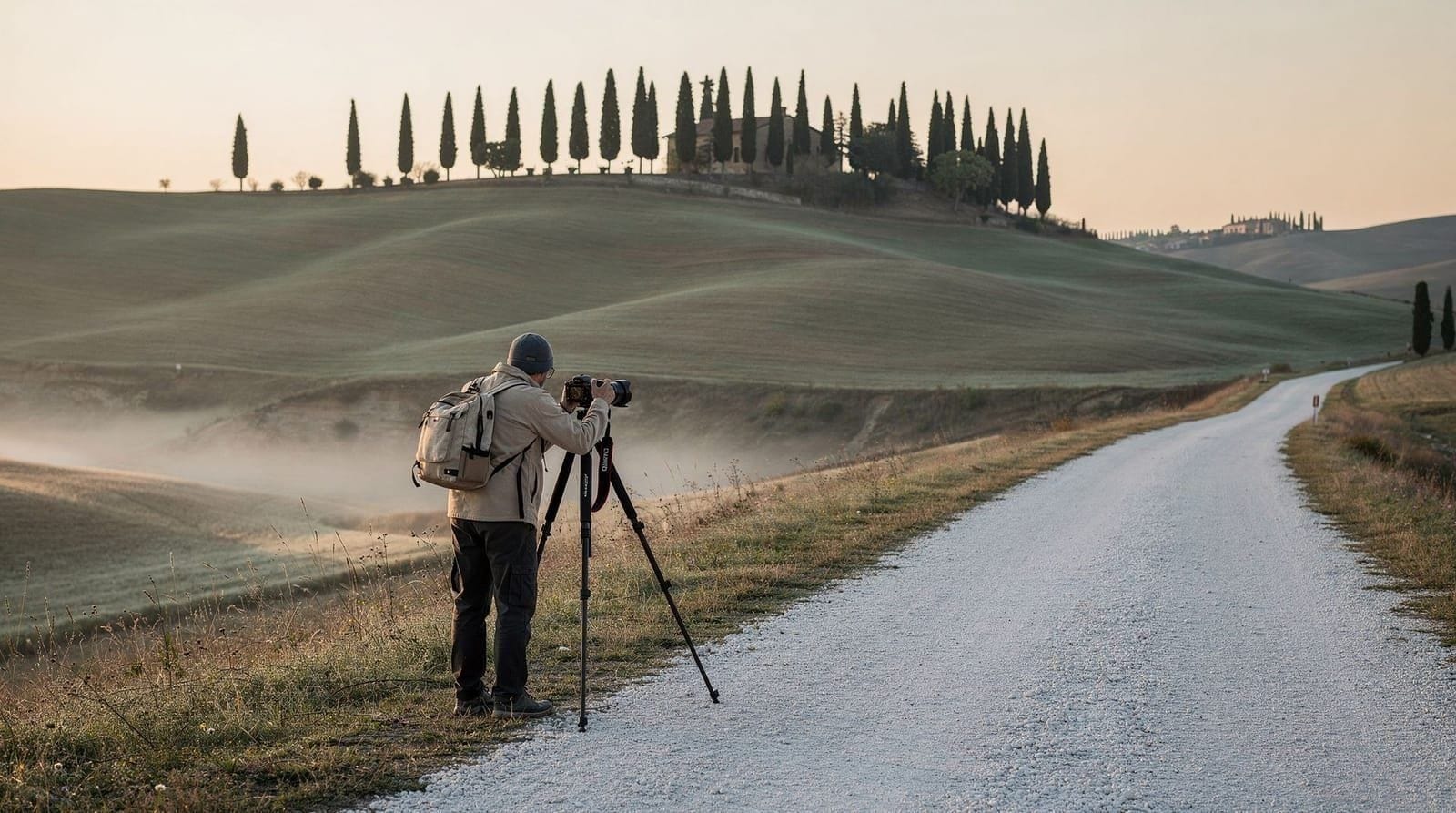
Photography: You cannot photograph while riding. Plan stops at specific viewpoints where the group pulls over. Tell your guide at the briefing if photography is a priority; most good guides know the best pull-over spots with views.
Booking: At least a week ahead in high season (May-June, September-October). Tours fill up. Cancellation policies vary — check before paying, as weather cancellations do happen.
Half-day versus full-day
A half-day tour (4-5 hours including the winery stop) covers roughly 50-60 kilometres and gives a genuine taste of the Chianti landscape without exhausting anyone. Recommended for first-timers on a scooter or those with a tight itinerary.
A full-day tour (7-8 hours, 80-100 kilometres) goes further south into the deeper Chianti — toward Radda or even Castellina in Chianti — and typically includes a proper lunch rather than just a tasting. This is the option for people who want the full experience and are comfortable on a bike.
Prices run €85-120 per person for a half-day, €130-180 for a full-day with lunch. Private tours cost more but allow you to set your own route.
| Half-day | Full-day | |
|---|---|---|
| Distance | 50–60 km | 80–100 km |
| Includes | Wine tasting, light snack | Wine tasting plus full lunch |
| Reaches | Greve, Panzano area | Deeper into Chianti toward Radda/Castellina |
| Price | €85–120 | €130–180 |
| Best for | First-timers, tight itineraries | Confident riders, full-day free |
Choosing between an operator and going deeper into Chianti
Most Florence-based operators run a similar route, so the differences that matter are group size, the quality of the vineyard stop, and how far south you actually go. If your main interest is the wine rather than the ride, a full-day tour that pushes toward Castellina in Chianti or Radda covers more serious wine country than the shorter loop around Greve and Panzano. The Chianti Classico route guide maps the zone in more detail if you want to understand what you’re riding through before you book, and the Chianti day trip guide is useful for comparing the Vespa option against a car-based day trip covering similar ground.
What if it rains?
Chianti weather in spring and autumn is unpredictable, and riding a scooter in the rain is both unpleasant and genuinely more dangerous on the region’s winding roads. Reputable operators reschedule or refund for weather cancellations rather than running the tour regardless — confirm this policy before paying. If the forecast looks marginal on the morning of your tour, call the operator rather than assuming it’s cancelled or that it’s running; decisions are often made a few hours ahead based on the actual conditions rather than the forecast alone.
The honest moment I keep thinking about
About an hour into the ride, somewhere between Greve and a winery whose name I’ve forgotten, our guide pulled over on a ridge above a valley full of vines. It was September. The harvest was a week away, the vine leaves just beginning to turn red at the edges. We could see three different medieval hilltop farms across the valley. There was no sound except wind in the cypress trees.
I had a €1.20 piece of machinery under me, a borrowed helmet on my head, and a glass of wine at the next stop. It cost €140 for the day and I’ve thought about it more than most things I’ve paid considerably more for.
The Chianti wine zone: what you’re riding through
The Chianti Classico DOCG — the wine with the black rooster label — is produced in a specific zone between Florence and Siena, roughly the area between Greve in Chianti to the north and Castelnuovo Berardenga to the south. The grape is Sangiovese (minimum 80%), typically blended with small amounts of other varieties.
As you ride south from Florence on the Via Chiantigiana, you’re passing through vineyards producing some of the most significant wine in Italy. The names on the road signs — Antinori, Ricasoli, Frescobaldi — are Florentine families who have been making wine in these hills for centuries. Barone Ricasoli’s estate at Brolio, a castle visible from the road south of Gaiole, has been continuously producing wine since the 13th century.
The wine you’ll taste at the vineyard stop on your tour is typically Chianti Classico Annata (the standard release) or Chianti Classico Riserva (aged longer, more structured). If the operator sources from a serious estate, the quality is excellent at the price point. Don’t skip the wine because you’re riding a motorised vehicle — the quantities served at a tasting are measured and won’t impair anyone.
What else to look for along the route
The Chianti landscape rewards attention to detail:
Galestro soil: The schistous, rocky soil that characterises much of the Chianti — poor, fast-draining, and the reason the wines are structured rather than heavy. The roads cut through it and you can see the pale, crumbly stone in the road cuts.
Fattorie (farms): The large consolidated farming estates that emerged in the 19th and 20th centuries, many converted to agriturismo operations. The long cypress-lined driveways leading off the main road to hilltop farmhouses are often available to visit for wine tasting with advance notice.
Medieval towers: Several Chianti villages retain their medieval defensive towers — Montefioralle (near Greve), Gaiole, and various isolated hilltop positions. Montefioralle, a tiny fortified village above Greve, is perfectly preserved and has one of the best views in the northern Chianti.
Wildlife: Wild boar (cinghiale) are common in the Chianti hills, emerging particularly at dawn and dusk. The small memorial shrines on road bends are sometimes there for less poetic reasons than they appear.
Safety and traffic
The Via Chiantigiana is a public road shared with local traffic. In summer weekends, other cyclists, cars visiting wineries, and tour buses all use it simultaneously. Your guide will set the riding pace and spacing to manage this, but be attentive — particularly on downhill stretches where speed builds quickly on a scooter.
The gravel road sections (strade bianche) between some vineyards require particularly careful riding — loose gravel under a scooter wheel behaves differently from tarmac. Reduce speed before turning on gravel, and don’t brake sharply mid-corner.
Most riders arrive in Florence with their confidence significantly higher than when they started, which is the right direction of travel. The Chianti is excellent training ground — the roads are challenging but not dangerous if ridden with appropriate care.
See the Chianti wine region guide for more about the landscape and wineries you’ll pass through, and Val d’Orcia road trip for a comparable drive-through-beautiful-Tuscany experience if you’re renting a car. For self-drive tasting options once you’re back on four wheels, the best wineries near Florence guide rounds up estates worth a return visit.
Frequently asked questions about Chianti Vespa tours
Do I need experience riding a scooter?
No, most operators run a practice circuit in a car park before the road portion and will honestly tell you if you’re not ready for the hills. That said, some baseline comfort with balance and gears helps, and this isn’t the activity to attempt for the very first time on narrow, winding roads with drop-offs. If you’re nervous, ask about the electric Vespa or Fiat Topolino options, which are gentler to handle.
Is it safe after wine tasting?
The quantities served at a tasting stop are measured and typically light enough not to impair riding, and most operators schedule the tasting toward the end of the loop rather than the middle. That said, if you’re at all concerned, ask your guide about swapping to the Fiat Topolino for the return leg, or choose a tour where the wine stop is the final stop before returning by van.
What’s the closest Chianti village to visit without a full tour?
Greve in Chianti, about 27 kilometres south of Florence, is the most accessible base — reachable by car or bus in under an hour, with its own piazza, wine shop, and butcher worth the trip even without a Vespa involved.
Top experiences
Bookable activities with verified prices and instant confirmation on GetYourGuide.

Florence: Chianti wine region Vespa or Fiat Topolino tour
- Free cancellation
- Small group

Florence: vintage Vespa tour of Florence and surrounding countryside
- Free cancellation
- Small group

Florence: Tuscany half-day Vespa tour with traditional lunch
- Free cancellation
- Small group
Florence: 4-hour electric Vespa tour exploring Fiesole
- Free cancellation
- Small group