Free walking tours Florence 2026: complete guide
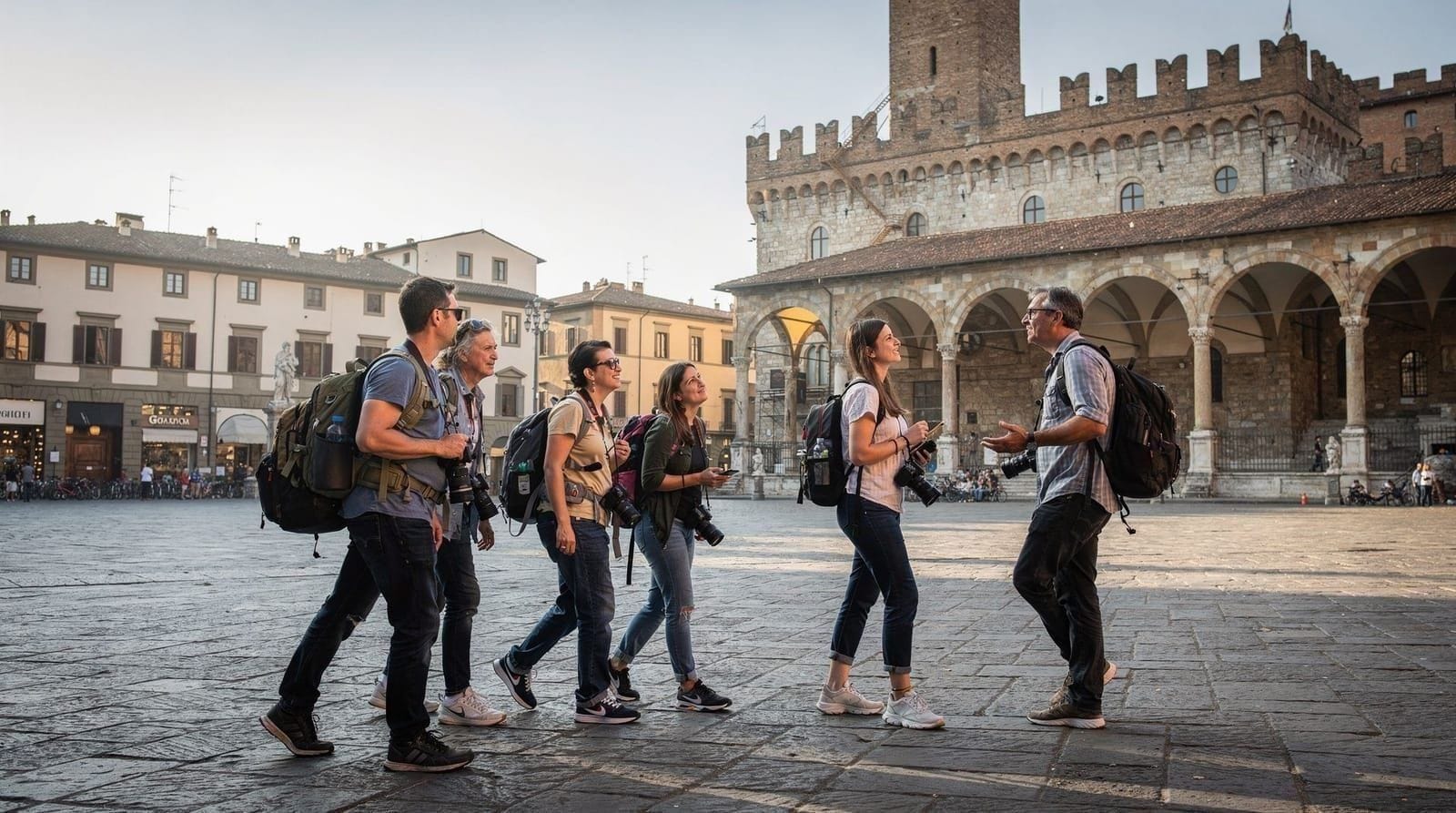
Florence: free guided walking tour with a local guide
- Free cancellation
- Instant confirmation
Are there free walking tours in Florence?
Yes. Florence has several free-entry walking tours that operate on a tip model — you pay nothing upfront and tip the guide at the end based on what you felt the tour was worth (€10–20 per person is standard practice). They typically run 2–2.5 hours and cover the main sights: Duomo, Piazza della Signoria, and Ponte Vecchio.
What “free” actually means
The phrase “free walking tour” requires some clarification before you book one. These tours charge no upfront fee — the booking process typically requires only a name and email address, not a credit card. At the end of the tour, you tip the guide what you feel the experience was worth.
This is a real business model that has been operating successfully in European cities for 20+ years. The guides are typically self-employed, knowledgeable about the city, and financially dependent on tips. For a 2-hour tour with a group of 25 people, a guide who earns €10 per person brings home €250 — a decent hourly rate, but only if the tips materialise.
The practical implication: if you take a free tour and enjoy it, tip generously. €10 per person is baseline; €15–20 is appropriate for an excellent guide. If you book and then cannot attend, message the operator in advance — large groups showing up with no-shows affect logistics.
| Where | Meets at Piazza della Repubblica, Piazza del Duomo, or Santa Maria Novella station |
| Cost | Free upfront; tip €10–20 per person at the end |
| Time needed | 2–2.5 hours, about 4 km on foot |
| Getting there | All meeting points are in the walkable historic centre |
| Best time | Book the day before or morning-of; morning tours are less crowded |
What free tours cover
Most free Florence tours cover the same core circuit:
Piazza del Duomo (20–30 minutes): Exterior context for the Duomo, dome, Baptistery, and Campanile. No entry included. The guide explains the commission history, Brunelleschi’s engineering challenge, and the civic significance of the Baptistery.
Orsanmichele (10–15 minutes): The grain market-turned-church on Via dei Calzaiuoli, with exterior niches containing copies (and sometimes originals) of bronze statues commissioned from Donatello, Ghiberti, and Verrocchio by the major trade guilds. This building is consistently under-explained by guidebooks and consistently illuminating when a guide explains the guild competition context.
Piazza della Repubblica (5–10 minutes): The large central piazza built on the site of the Roman forum and the medieval ghetto, demolished in the 19th century urban renewal. The triumphal arch inscription records the “squalid confusion” removed to make way for the piazza — one of the more honest civic inscriptions in Italy.
Via dei Calzaiuoli and the medieval street pattern (10 minutes walking): The guide typically explains how the street plan preserves the Roman grid with medieval adaptations, and points out towers, palaces, and logge along the route.
Piazza della Signoria (20–30 minutes): Palazzo Vecchio exterior, Loggia dei Lanzi sculptures, Neptune fountain, the Savonarola disk, copies of the David and Marzocco. This section covers the shift from republic to Medici rule and the civic ideology embedded in the public sculpture programme.
Uffizi exterior (5–10 minutes): Context for the collection and the Vasari Corridor above.
Ponte Vecchio (10–15 minutes): Bridge history, the jewellers’ guild, WWII survival, Vasari Corridor connection.
Total: 2–2.5 hours, approximately 4 km on foot.
The honest limitations
Group size: Free tours attract large groups. In peak season, 30–50 people is common. Hearing the guide in Piazza della Signoria, with traffic, other tour groups, and general noise, requires either very good amplification equipment (some guides carry it) or proximity to the guide that 40 people cannot all have simultaneously. In smaller groups (10–20, which is more typical on quieter weekdays or in low season), the experience is significantly better.
Depth: 2 hours covers 12 major stops at an average of 10 minutes each. This is orientation, not deep study. The guide cannot spend 25 minutes on the Loggia dei Lanzi sculptures or follow one thread of Renaissance art history through multiple locations. If depth is what you want, a specialist small-group tour (see the best walking tours Florence guide) is a better investment.
Variability: Guide quality varies considerably. Some free tour guides are extraordinary — recent art history graduates with genuine passion and knowledge. Others are memorising a script. The reviews on GetYourGuide and TripAdvisor give the most reliable picture of current guide quality; filter for reviews from the last 3 months.
No museum access: Free tours do not include Duomo complex tickets, Palazzo Vecchio entry, or any museum entry. These cost extra and must be booked separately.
Free vs. paid: when to choose each
| Free walking tour | Paid walking tour |
|---|---|
| First-ever visit to Florence | Return visit wanting depth |
| Budget is tight | Specialist topic (Medici, Renaissance art) |
| Just arrived, want orientation | Small group important for experience |
| Fine with a large group | Museum entries included |
| Good guides reviewed recently | Private tour for family/special interest |
| 1–2 day trip | Longer stay with time to plan |
The two categories are not mutually exclusive. Many visitors take a free tour on day one for orientation and a specialist paid tour on day two for depth. This is an excellent strategy if your budget allows.
Meeting points and logistics
Most Florence free tour operators meet in one of three locations:
Piazza della Repubblica: The central piazza with the large triumphal arch. Look for guides in the east section of the piazza, near the arch. Multiple operators use this location; arrive slightly early to find the right group.
Piazza del Duomo: The steps to the north side of the cathedral. More crowded and harder to identify your group — look for the coloured umbrella or sign.
Santa Maria Novella train station: The steps or immediate piazza in front of the station. Convenient if you are arriving by train on day one and want to start immediately.
What to look for: Guides typically carry a visible marker — coloured umbrella, company flag, or branded sign. Confirm the company name and tour time when you book; the confirmation email will specify exact meeting instructions.
Arrival time: Arrive 5–10 minutes early. Most operators have multiple tours running simultaneously; if you miss your group, finding the right one in a crowded piazza can be difficult.
Tips on tipping
Tipping is genuinely important for free tour guides — it is their primary income. Some guidelines:
| Experience | Suggested tip |
|---|---|
| Disappointing or basic | €5–8 |
| Good, informative, enjoyable | €10–15 |
| Excellent — in-depth, engaging, well-paced | €15–25 |
| Outstanding private-level quality | €25+ |
Tipping in cash (EUR) is preferred. Have small denominations ready at the end of the tour — hunting for change in your wallet while the guide waits is awkward for everyone.
If you booked but cannot attend: cancel in advance if the operator allows it, or simply message them. Free tour groups are measured by the operator; no-shows affect their planning.
Finding and booking free tours
Several GetYourGuide-listed tours offer excellent value and are verified by the platform, including guaranteed meeting-point logistics and customer support if something goes wrong. The main advantage of booking via a platform rather than a street-level sign-up is the review transparency and the operator accountability.
Book the day before or even the morning of the tour — unlike dome-climb tickets, free tours rarely sell out, though some operators limit group sizes and close early on popular dates.
Combining with other Florence activities
A free walking tour on the first morning is a logical foundation for:
- Florence Duomo guide: Understand the context before you book the dome climb
- Piazza della Signoria: Return later to go inside Palazzo Vecchio
- Ponte Vecchio: The tour passes it; come back at sunset or sunrise
- Best walking tours Florence: Book a specialist follow-up for depth
- Oltrarno walking tour: Cross the bridge for a different perspective on the city
For full trip planning, see the Florence destination guide and our Florence in one day itinerary or Florence in two days itinerary, both of which slot a free tour naturally into the first morning.
Where to go afterward for lunch or coffee
Free tours usually finish near Ponte Vecchio or Piazza della Signoria in the late morning, which is good timing for lunch before the early-afternoon crowds build. Avoid the restaurants with photo menus immediately beside the tour’s final stops — walk a few streets into Santa Croce district or across into the Oltrarno instead, where prices drop and quality tends to improve. If you’d rather keep the momentum going with another activity, our best restaurants in Florence guide and best gelato in Florence guide both work well as a follow-on to a morning tour.
First-time visitor logistics beyond the tour
If this free tour is your very first orientation to the city, it’s worth pairing it with a few practical basics before you set off further on your own: our first time in Florence guide covers the essentials the tour itself won’t (transport passes, tipping norms generally, and typical scam patterns to watch for), and booking Florence attractions online guide explains which of the sights the tour walks past — the Duomo dome, Palazzo Vecchio, the Uffizi — need advance booking versus walk-up entry.
Frequently asked questions about free walking tours in Florence
Are free walking tours actually good?
Quality varies. The best free tour guides in Florence are genuinely excellent — knowledgeable, engaging, and adept at managing large groups in noisy squares. The worst are scripted and distracted. Reviews are the best guide: look for recent (last 3 months) feedback about specific guides by name, which the best operators list.
What languages are free tours available in?
English is dominant. Spanish, French, Italian, and German free tours are available through specific operators, but the selection is narrower and the schedule less frequent.
Do free tours run every day?
Most operators run daily tours, sometimes multiple per day (morning and afternoon). Some reduce frequency in November–February. Check specific tour pages for the current schedule.
Can I join a free tour with children?
Yes. Free tours are typically unticketed and flexible about age. A 2-hour tour is manageable for children over 8; younger children may struggle with the pace and duration. Several operators offer shorter family-specific tours — check the listing descriptions. See our Florence with kids guide for more on pacing museum and walking time with children generally.
Do I need to book a free walking tour in advance, or can I just show up?
Booking ahead (even the night before) is strongly recommended, even though it’s free — it guarantees your spot in a specific group and gives you the exact meeting point details by email. Popular time slots, especially the mid-morning departure in high season, can fill up, and turning up unbooked risks being turned away if the group is already full.
Top experiences
Bookable activities with verified prices and instant confirmation on GetYourGuide.