Gelato and pizza classes in Florence: formats, prices, what to expect
Florence: pizza and gelato cooking class
- Free cancellation
- Small group
How long does a gelato or pizza class take in Florence and what does it cost?
Gelato-only classes last about 2 hours (€45–65 per person). Pizza classes are similar. Combined pizza and gelato classes run 2.5–3 hours (€55–80 per person). Most include eating what you make, and all are suitable for beginners with no cooking experience required.
Why pizza and gelato classes are Florence’s most accessible cooking experiences
Not every cooking class visitor wants to spend three hours learning to shape tortellini. Some want a lighter, more fun, more immediately gratifying experience — one that works for mixed groups, families, and people with limited time. For these visitors, the pizza and gelato class is the answer.
The combination class has several advantages: it’s faster (2–3 hours), covers two of Italy’s most iconic foods, requires no cooking experience, works for ages 6 to 86, and ends with eating substantial amounts of what you’ve made. There’s no equivalent food experience in Florence that delivers this much return on a half-afternoon investment.
This guide covers both gelato-only classes and pizza-only classes, then the combined format in detail.
| Where | City-centre kitchens, or a farm with a wood-fired oven outside town |
| Cost | Around €45–80 per person; €30–45 for children |
| Time needed | 2 hours (single class) to 3 hours (combined) |
| Getting there | Most kitchens are walkable from the historic centre |
| Best time | Morning slots end with lunch; late afternoon ends near dinner |
Gelato-making classes: what you actually learn
The theory
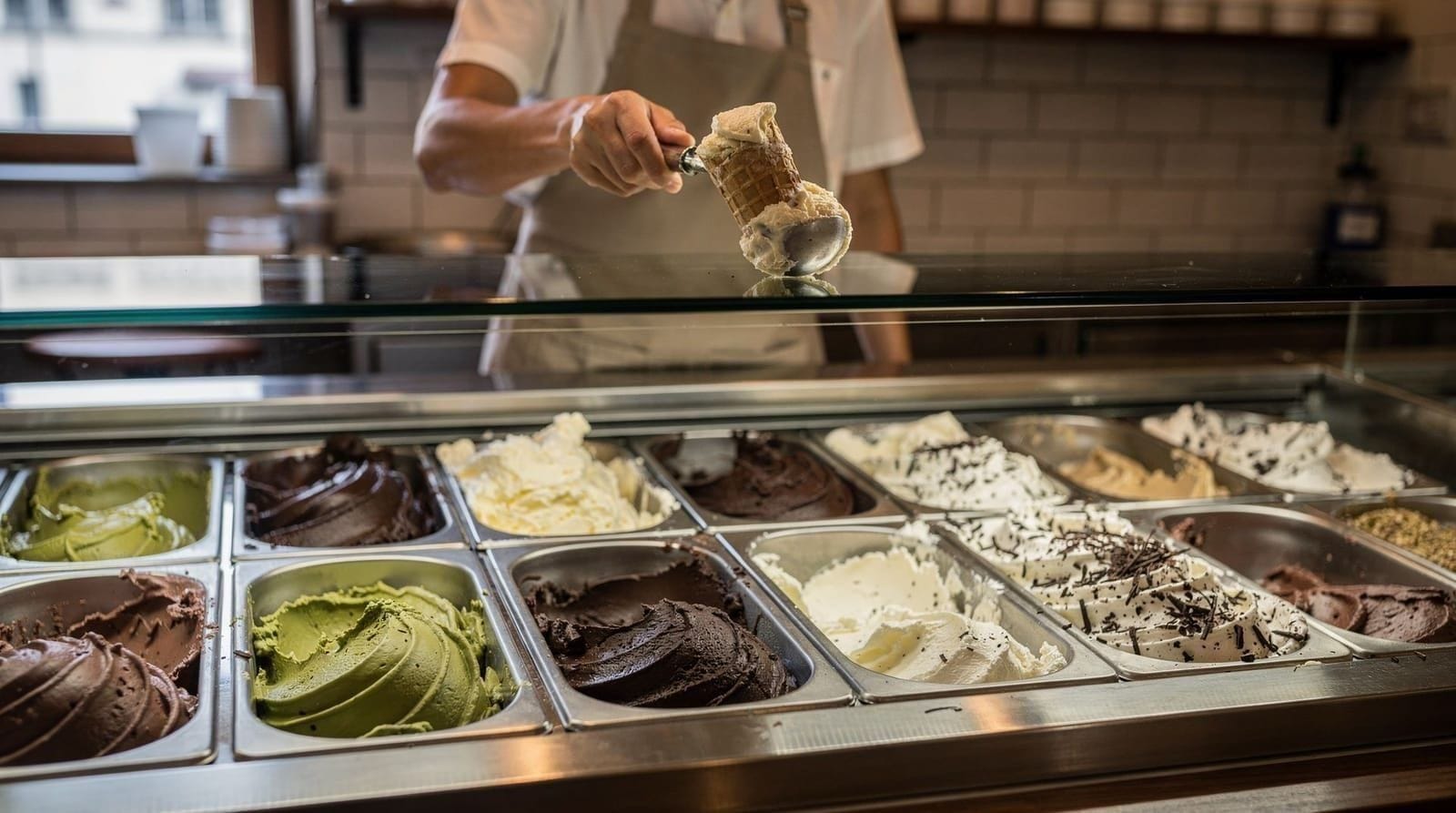
The class begins with an explanation of what separates artisan gelato from industrial product. This is more useful than it sounds — after a Florence trip full of questionable gelato piled high in uncovered cases, understanding what real gelato is (stored in pozzetti, made fresh daily, with natural colours and no artificial stabilisers) provides context for why the artisan gelaterie are worth finding.
Key concepts:
- Air incorporation: industrial gelato churns in large amounts of air (overrun 80–100%), making it light and voluminous but less flavourful. Artisan gelato incorporates much less air (overrun 20–30%), making it denser and more intensely flavoured
- Temperature: gelato is stored at -11°C to -13°C, warmer than ice cream (-18°C). This makes it softer and more immediately creamy at serving temperature
- Fat content: gelato uses more milk and less cream than ice cream, resulting in a lower fat content but more intense flavour from the base
The practice
Cream-based gelato (fiordilatte, crema, cioccolato):
- Make the custard base: heat milk, add sugar, egg yolks (for crema/vanilla) or melted chocolate, stir until thickened
- Cool the base rapidly (ice bath)
- Add flavouring (vanilla, chocolate, coffee, pistachio paste)
- Churn in the gelato machine until thickened and aerated to the correct consistency
- Taste, adjust, portion into containers
Fruit-based gelato (fragola, limone, pesca): Simpler — fresh or puréed fruit, sugar, a small amount of water. Churn directly without a custard base. The sugar content needs adjustment based on the fruit’s natural sweetness (a brix test or simple taste assessment).
Duration: The hands-on component is about 75–90 minutes; the remaining 30–45 minutes is eating the gelato you’ve made, often with coffee or a glass of prosecco.
What you take home: Recipe cards, the knowledge of the technique, and occasionally a small container of your gelato.
Can you make gelato at home without a gelato machine?
Technically yes (freeze the base, stir every 30 minutes for 3 hours) but the result is significantly inferior to machine-churned gelato. For a serious gelato production at home, a domestic gelato machine (€150–400) is the realistic requirement. The class is valuable even without home equipment because it builds appreciation for what artisan gelaterie do.
Pizza classes: what you learn
Types of pizza class in Florence
Thin-crust Florentine style: A local variation using less water and a faster fermentation, producing a crispier base suited to a conventional oven. More practical for home replication.
Neapolitan style: Wet, extensible dough (70%+ hydration) fermented 24–48 hours, cooked in 90 seconds in a 450°C wood-fired oven. Theatrically impressive, harder to replicate at home without the right oven.
Pizza al taglio (Roman-style, thick crust): Less common in Florence classes but occasionally offered. Thick, airy dough cooked in a rectangular pan.
Most Florence pizza classes teach the Neapolitan or thin-crust style with a conventional oven component.
What you make
- The dough: Mix flour, water, yeast, salt. For a class, the dough has often been pre-prepared for 24–48 hours; you learn the stretching and shaping technique with pre-fermented dough.
- The sauce: Simple tomato sauce — good quality San Marzano or local Tuscan tomatoes, olive oil, salt, basil added after cooking. No cooking, no herbs in the sauce (contrary to what many home cooks do).
- Toppings: Fior di latte mozzarella (standard Margherita), prosciutto and rocket, seasonal vegetables. Each participant typically makes one pizza and customises their toppings.
- The bake: In a very hot oven (conventional ovens at max, wood-fired ovens at some farm classes). 8–12 minutes depending on oven temperature.
- Eat: The classic ending. Your pizza, divided with whoever is next to you.
What makes a good pizza class
- Pre-fermented dough (24–48 hour cold fermentation) produces a more flavourful result than same-day dough
- Genuine Fior di latte (fresh mozzarella made daily, different from the vacuum-packed version) makes a visible quality difference
- San Marzano DOP tomatoes for the sauce — the acidity and sweetness balance is different from generic canned tomatoes
- A teacher who explains why the dough is hydrated to a specific percentage, not just what to do
The combined pizza and gelato class: the most popular format
The combined class covers both pizza and gelato in a single 2.5–3 hour session. The typical structure:
Session 1 (45–60 min): Pizza — shaping and topping with pre-made dough, explanation of sauce and toppings, baking.
Break: While the pizza bakes, the class moves to gelato.
Session 2 (45–60 min): Gelato — making a cream base and a fruit base, churning, tasting.
Eating (30–45 min): Pizza first (just out of the oven), then gelato as dessert. With wine or a soft drink.
This structure works well for groups with varying interests and attention spans. The pace is fast enough to feel productive; the variety keeps engagement high throughout.
Price range: €55–80 per person for a combined class. The lower end tends to be group classes of 12–20; the higher end is smaller groups (6–10) with more hands-on time.
Family-friendly classes: specific options
Several Florence cooking schools have specifically designed family classes for parents with children. Key features:
- Shorter duration (1.5–2 hours rather than 3+)
- Child-friendly toppings and flavour options
- Aprons in small sizes
- Adjusted pacing with more time for hands-on activity per station
- Lower pricing for children (typically €30–45 for under-12s)
For families visiting Florence with children, a pizza and gelato class is one of the most effective non-museum activities — engaging, practical, produces something to eat, and provides a memorable shared experience. See our Florence with kids guide for how it fits into a broader family day, and family gelato treats for other kid-friendly gelato ideas beyond the class itself.
Pizza + walking tour combination
Some schools offer a hybrid format: a guided city walking tour that covers food history and neighbourhood highlights, followed by 1.5–2 hours of pizza or gelato making. This covers more of Florence in a single booking. The trade-off is less cooking time and a busier schedule. For visitors with one day in Florence who want both sightseeing and a food experience, this format is worth considering.
What to look for when booking
Group size: For pizza and gelato classes, larger groups (up to 20) work reasonably well because the tasks are simple enough to run in parallel. If the listing says “max 6 people” for a gelato class, expect significantly more personal attention.
Setting: City kitchen (convenient) vs. farm with pizza oven (more dramatic, slightly more expensive). A wood-fired oven produces a better pizza but most participants won’t return home with a wood-fired oven.
Language: Classes are almost universally in English for the Florence tourism market. Italian is used for names of ingredients and techniques.
Location convenience: Check exactly how far the kitchen is from your accommodation before booking — some highly rated classes are a 20–25 minute walk or a short taxi ride from the historic centre, which matters more with tired children or in August heat than the class listing photos suggest.
What’s included: Apron, ingredients, the food you make, typically wine or prosecco for adults, soft drinks for children.
After the class: where to compare your results
After a gelato class, visit one of the artisan gelaterie covered in the best gelato in Florence guide — Gelateria dei Neri, Gelateria dei Medici, Vivoli — and compare your class product to what trained professionals produce. The gap will be instructive; so will the things you recognise in the professional version from your own class experience.
After a pizza class, the equivalent comparison would be a sit-down Neapolitan pizzeria. Florence is not Naples — the best pizza in the city is not as good as the best pizza in Naples — but there are several competent pizzerias in the Oltrarno and Santa Croce areas. Our Florence street food guide covers quick eats between class and dinner, and if you want to build a whole day of hands-on food experiences, the best cooking classes in Florence guide rounds up pasta, market-to-table and other formats alongside this one.
How this compares to other cooking class formats
Gelato and pizza classes are the lightest, fastest, and most family-friendly of Florence’s cooking experiences. If you want a deeper, more technique-focused session, our pasta making class guide covers a format that runs closer to 3–4 hours with more individual instruction, and market-to-table cooking adds a Mercato Centrale shopping component before you cook. Choosing between them mostly comes down to time and appetite for structure: pizza and gelato suits a fun, low-commitment afternoon; pasta and market-to-table suit visitors who want a genuinely immersive culinary session.
Frequently asked questions about gelato and pizza classes
What do I wear to a pizza class?
Comfortable clothes you don’t mind getting floury. Aprons are provided but flour still gets everywhere. Avoid open sandals — wear closed shoes.
Is there a minimum age for gelato and pizza classes?
Most schools set no minimum age but recommend 6+ for practical participation. Younger children can attend but should be accompanied by an adult who participates on their behalf. For specifically family-designed classes, check the school’s age recommendation when booking.
Can I make authentic Neapolitan pizza at home?
Partially. The dough and technique are entirely replicable at home. The main limitation is oven temperature — a domestic oven maxes at 250–280°C; Neapolitan pizza needs 450°C. A pizza stone or steel improves home results significantly. For the full effect, an outdoor wood-fired pizza oven (available from €400) is necessary.
What is the best time of day for a pizza and gelato class?
Morning classes (10:00–13:00) end with lunch (pizza) and a dessert (gelato). Late afternoon classes (15:30–18:30 or 16:00–19:00) end around dinner time. Both work; it depends on how you want to structure your day.
What happens if I have dietary restrictions?
Pizza classes can accommodate most dietary restrictions with advance notice — gluten-free dough alternatives, dairy-free toppings, vegan cheese. Gelato classes can make dairy-free sorbetto. Always notify the school when booking.
Should I book a pizza and gelato class or a full pasta-making class?
If your priority is a fun, fast, low-pressure experience that works for the whole family, choose pizza and gelato. If you want a deeper, slower, more technique-heavy session — and don’t mind a longer time commitment — the pasta making class delivers more individual instruction and a more restaurant-quality result to take home as a skill.
Top experiences
Bookable activities with verified prices and instant confirmation on GetYourGuide.

Florence: pizza and gelato cooking class
- Free cancellation
- Small group
Florence: gelato making class
- Free cancellation
- Small group
Florence: first pizza and gelato preparation class
- Free cancellation
- Small group
Florence: walking tour with pizza and gelato making class
- Free cancellation
- Small group
Florence: pizza making and gelato experience
- Free cancellation
- Small group
Florence: pizza cooking class with cathedral views
- Free cancellation
- Small group