Best gelato in Florence: where to find the real thing
Florence: gelato tour and culinary walk in city center
- Free cancellation
- Small group
Where is the best gelato in Florence?
Gelateria dei Neri (Santa Croce), Gelateria dei Medici (San Lorenzo), and Vivoli (Santa Croce) are consistently the best. Real artisan gelato has muted natural colours and is stored in covered metal containers (pozzetti), not piled in towering display mountains.
The gelato trap: why Florence has a problem
Florence has a legitimate claim to being one of the best gelato cities in the world. It also has a serious gelato-trap problem. The two coexist a short walk apart, and distinguishing between them is one of the most useful skills a visitor can acquire.
The trap version: bright colours, towering mounds, €5 per scoop, located within sight of the Duomo or Ponte Vecchio. Often the same industrial base mix with different food colourings. Technically edible. Frequently photographable. Never worth it.
The real version: muted natural colours, flat covered metal containers (called pozzetti), made fresh in the shop daily, €2.50–3.50 per serving. Located in neighbourhood streets, not tourist thoroughfares. The difference in flavour is not subtle.
| Where | Santa Croce, San Lorenzo and Oltrarno beat the Duomo/Ponte Vecchio area |
| Cost | Around €2.50–4 per cup at genuine artisan gelaterie |
| Best flavour test | Muted pistachio (greenish-grey), not neon green |
| Storage tell | Covered metal pozzetti, never mounded open display |
| When | Year-round, but fresh fruit flavours peak April–October |
How to identify artisan gelato: the checklist
Storage method
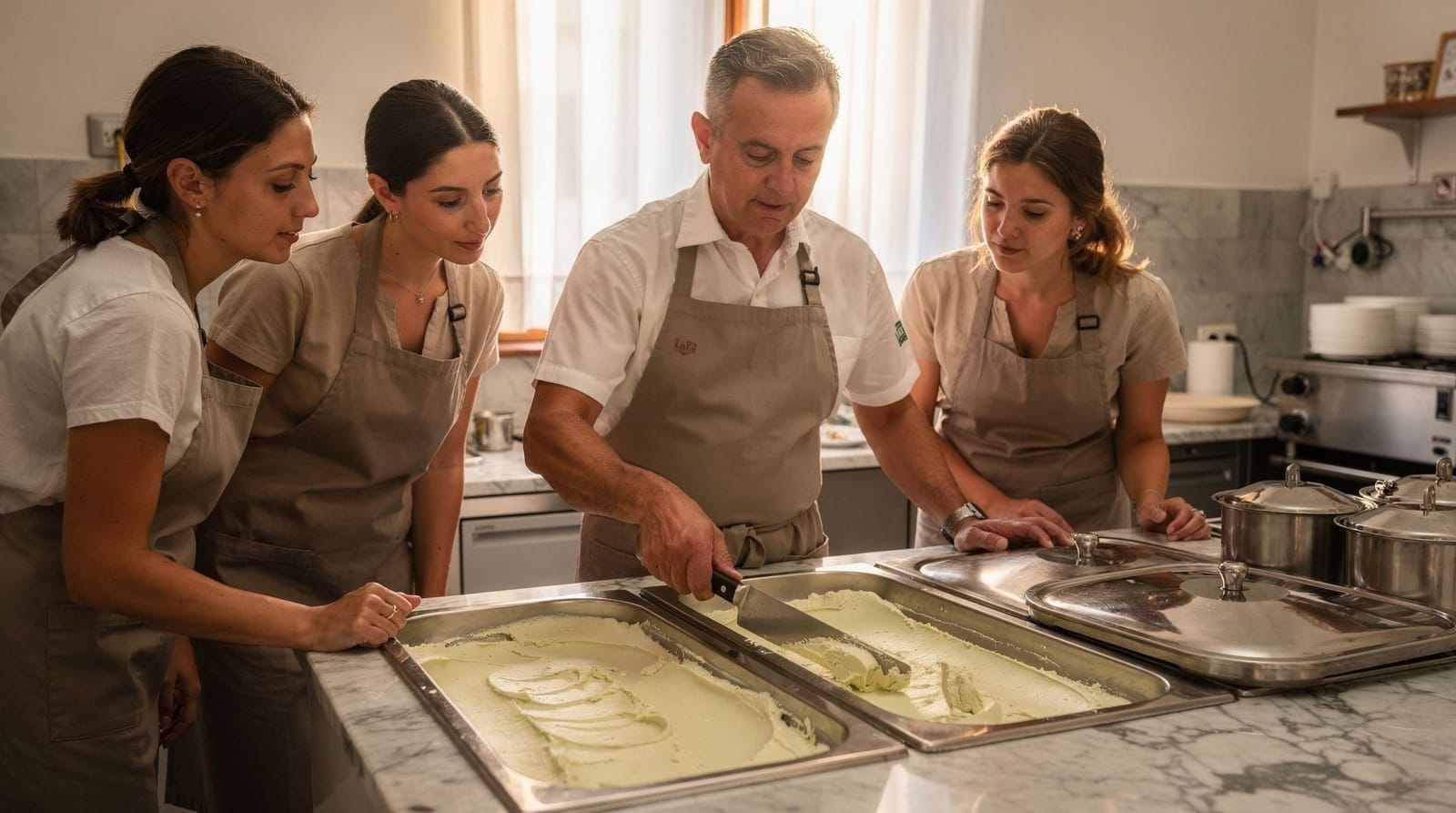
The single most reliable indicator. Artisan gelato is stored in covered metal pozzetti — horizontal containers with lids that protect the gelato from air and light. The lids are removed briefly when serving. You cannot see the gelato colours from outside the counter.
Fake gelato is stored in open, uncovered display cases with the gelato piled high above the rim. This “mountain” style is a visual display technique with no flavour benefit — it actually degrades quality through temperature fluctuation and air exposure.
Colours
Pistachio: Should be greenish-grey, the actual colour of ground Sicilian pistachios. Bright green pistachio gelato is made with pistachio paste containing chlorophyll colouring.
Strawberry: Pale pink to medium pink. Electric pink or red strawberry uses colouring.
Lemon: Pale yellow, almost white. Bright sunshine yellow suggests artificial colour or flavouring.
Chocolate: Rich brown to dark brown. Very dark, almost black chocolate is made with high-quality cocoa.
Hazelnut: Warm medium brown. If it looks identical to milk chocolate gelato, it may be the same base with different labelling.
Freshness
Good gelaterie produce in small batches and rotate flavours daily. Ask what was made that morning — cosa avete fatto stamattina? A gelateria that makes everything fresh will tell you which flavours are newest. One that uses industrial pre-mix won’t know.
Ingredients list
Most good gelaterie post their ingredient lists or are happy to explain their sourcing. Look for mentions of Bronte pistachios (from Sicily, the best in Italy), Perugian hazelnuts, Valrhona or Domori chocolate, local milk.
The best artisan gelaterie in Florence
Gelateria dei Neri (Santa Croce)
The most consistent recommendation from Florentine residents. Located on Via dei Neri — a street that also has All’Antico Vinaio, creating one of the city’s best food corners — dei Neri operates with pozzetti storage, natural colours, and seasonal flavours that change throughout the year.
Don’t miss: the crema (vanilla custard), pistachio, and the dark chocolate with sea salt. In autumn, the fig and ricotta combination is exceptional.
Price: €2.50 (small), €3.50 (medium), €4 (large). No tourist markup, no mounding.
Address: Via dei Neri 9–11, Santa Croce quarter. Open daily 10:00–24:00 (22:00 in winter).
Gelateria dei Medici (San Lorenzo)
A short walk from the Mercato Centrale, dei Medici focuses on traditional Florentine flavours and is particularly strong on cream-based gelato (fior di latte, crema, zabaione). The seasonal fresh fruit flavours use produce from the San Lorenzo market.
Don’t miss: fior di latte (plain cream, the benchmark for gelato quality), the pistachio, and in summer the fragola (strawberry) when local berries are available.
Price: €2.50–4 per serving.
Address: Via del Corso 44 (also at Via Sant’Antonino), San Lorenzo. Closed Tuesdays.
Vivoli (Santa Croce)
Florence’s oldest gelateria, operating since 1929. A tourist destination in its own right, but the quality has remained genuine. Vivoli is notable for serving gelato only in cups, never cones — a practical position as cones would dilute the gelato experience. The crema is their signature, served in a deep metal cup.
Don’t miss: Vivoli’s chocolate (three variations: milk, dark, and bitter), the zabaione (egg yolk and Marsala wine), and the seasonal coppa di fragole (strawberry cup with cream) in spring.
Price: €3–5 per cup. Slightly more expensive than neighbourhood gelaterie but quality-justified.
Address: Via dell’Isola delle Stiche 7, Santa Croce. Closed Mondays.
Gelateria Il Procopio (Oltrarno)
In the Oltrarno neighbourhood, Il Procopio makes small daily batches using Sicilian pistachios and local milk. The range is shorter than the big-name gelaterie — around 15 flavours — but everything is made in-house and the quality is consistently high. It fits neatly into a broader Oltrarno neighbourhood walking tour, alongside the artisan workshops the district is known for.
Don’t miss: the ricotta e fico (ricotta and fig) in season, and the nocciola (hazelnut).
Address: Piazza Santo Spirito area. Check current hours.
Edoardo (Duomo area — a rare exception near the tourist centre)
One of the few gelaterie near the Duomo worth visiting. Edoardo uses organic ingredients and certified natural flavourings. The flavours rotate seasonally and the storage is traditional pozzetti. More expensive than neighbourhood spots (€4–5.50 per serving) but genuinely made.
Address: Piazza del Duomo 45. Open daily.
Gelaterie to approach with caution
Gelaterie with bright colours, mounded display, and prices above €5 near the Piazza della Repubblica, Ponte Vecchio, Piazzale Michelangelo, and along Via dei Calzaiuoli are almost universally industrial quality. The mounding effect is a visual-marketing technique with no culinary justification.
A useful test: look at the pistachio. If it’s the colour of a cartoon frog, walk past.
Pairing gelato with the rest of Florence’s food scene
Gelato rarely stands alone on a Florence food day. Via dei Neri, where Gelateria dei Neri sits, is also home to some of the city’s best casual eating — see the Florence street food guide for the panino and lampredotto stalls nearby. San Lorenzo’s Gelateria dei Medici pairs naturally with a browse through the Mercato Centrale food hall upstairs. If you’d rather sit down properly first, check the best restaurants in Florence for options near each gelateria, and finish the day with an espresso from the Florence coffee culture guide — Florentines rarely order gelato and coffee at the same stop, but doing both across an afternoon is a very Florentine way to eat.
How to order gelato in Florence
Cup or cone? Coppetta (cup) or cono (cone)? A cup is generally a better choice — you get more gelato per euro, avoid the mess of a melting cone, and the shop doesn’t need to charge extra for cone materials. Many locals order cups.
Sizes: Typically small (€2.50–3), medium (€3–4), large (€4–5). In a cup you can usually fit 2–3 flavours at the medium size. Ask for due gusti (two flavours) or tre gusti (three flavours).
Panna (whipped cream): Often offered on top, usually free. Not essential on good gelato but it’s a Florentine tradition.
Eating standing at the counter: Completely normal and slightly cheaper at some old-school gelaterie that still maintain a banco (counter) price versus a tavolo (table) price — though this is less common now.
Gelato beyond Florence: a seasonal note
The best gelato is seasonal. Pistachio, hazelnut, and chocolate are year-round staples. Fresh fruit flavours are best in season: strawberry in April–June, peach and cherry in July, fig in September–October, persimmon in November. In winter, cream-based flavours (crema, zabaione, fior di latte) take centre stage.
Visiting in January? Don’t expect a June strawberry experience. Do expect excellent chocolate, hazelnut, and crema flavours, plus some gelaterie’s winter specialties: panforte-flavoured gelato (spiced Sienese fruitcake), chestnut, and orange with dark chocolate.
Making gelato yourself
Several Florence cooking schools offer gelato-making classes — typically 2–3 hours, covering technique, ingredient selection, and flavour combinations. See the gelato and pizza classes guide for vetted options, including combined classes that cover both pizza dough and gelato in a single session.
Frequently asked questions about gelato in Florence
Can I visit a gelato-making class in Florence?
Yes — several schools offer excellent classes. The gelato and pizza classes guide has details. Most classes last 2.5–3 hours and include eating what you make; prices run €55–85 per person.
Is there dairy-free or vegan gelato in Florence?
Yes, increasingly. Most artisan gelaterie now offer sorbetto (fruit-based, no dairy) and some offer almond or soy milk bases for cream flavours. Ask for senza latte (without milk) and most gelaterie can direct you to suitable options.
How much should I tip at a gelateria?
Tipping is not expected at gelaterie. The price you see is the price you pay; the coperto (cover charge) that applies at restaurants does not apply at gelato counters.
Why is Florentine gelato considered special?
Florence was where the modern gelato tradition developed — food historians link early gelato recipes to Bernardo Buontalenti, a Medici court architect and confectioner in the 16th century. Whether or not the historical claim is entirely accurate, Florence’s artisan gelato tradition is genuinely strong, and the concentration of good gelaterie per square kilometre is exceptional.
What is a “granita” and is it different from gelato?
Granita is a Sicilian ice dessert made from water, sugar, and flavourings — rougher-textured than gelato, closer to a flavoured crushed ice. It’s less common in Florence than in Sicily, where coffee granita with a brioche is a standard breakfast. You’ll find it at some Florentine bars and gelaterie in summer.
Which is better: dei Neri or Vivoli?
Both are genuinely good, but they suit different priorities. Vivoli has more history (open since 1929) and a slightly more formal cup-only tradition, while dei Neri is more consistently rated by residents and sits on a livelier street for combining with other Florence street food. If you can only visit one, dei Neri edges it for value; visit Vivoli if the history and the zabaione flavour appeal specifically.
Do gelaterie near the Duomo ever deserve a visit?
Occasionally — Edoardo is the clearest exception, using organic ingredients and traditional pozzetti storage despite its central location. As a rule of thumb, though, walking two or three streets away from the Duomo or Piazza della Repubblica towards Santa Croce or San Lorenzo delivers noticeably better gelato for the same money.
Top experiences
Bookable activities with verified prices and instant confirmation on GetYourGuide.

Florence: gelato tour and culinary walk in city center
- Free cancellation
- Small group
Florence: old city street food tour and guided sightseeing
- Free cancellation
- Small group
Florence: gelato making class
- Free cancellation
- Small group
Florence: walking tour with pizza and gelato making class
- Free cancellation
- Small group