Tuscan wine regions guide
Florence: Tuscany full day small group wine and food tour
- Free cancellation
- Small group
Which Tuscan wine region should I visit from Florence?
Chianti Classico is the most accessible (30 minutes by car, excellent winery infrastructure). Montalcino and Montepulciano require 1h45 by car and are best combined as a full-day Val d'Orcia loop. Bolgheri is 80 km west on the coast — also a full day. Day trips from Florence work well for all of them.
| Closest region | Chianti Classico, 30–45 min from Florence |
| Furthest day trip | Bolgheri coast, 1h30, or Montalcino/Montepulciano, 1h45 |
| Cost of tastings | €10–30 per person at most cantinas |
| Car needed | Yes for most regions; Chianti Rufina reachable by train |
| Best single first visit | Chianti Classico half-day tour |
Tuscany’s wine map: the big picture
Tuscany is Italy’s most diverse wine region, producing everything from light, crisp whites to some of the world’s most powerful and age-worthy reds. The common thread is Sangiovese — a grape so adaptable and site-sensitive that it produces completely different wines depending on whether it’s grown in the cool hills of Chianti, the high-altitude slopes of Montalcino, or the warm coastal plains of Maremma.
Understanding the major wine regions will help you make better choices about where to visit and what to drink. This overview covers each region, its flagship wines, and how to access it from Florence.
The red wine regions
Chianti Classico DOCG
Location: The hills between Florence and Siena Flagship wine: Chianti Classico (minimum 80% Sangiovese) Distance from Florence: 30–45 minutes by car
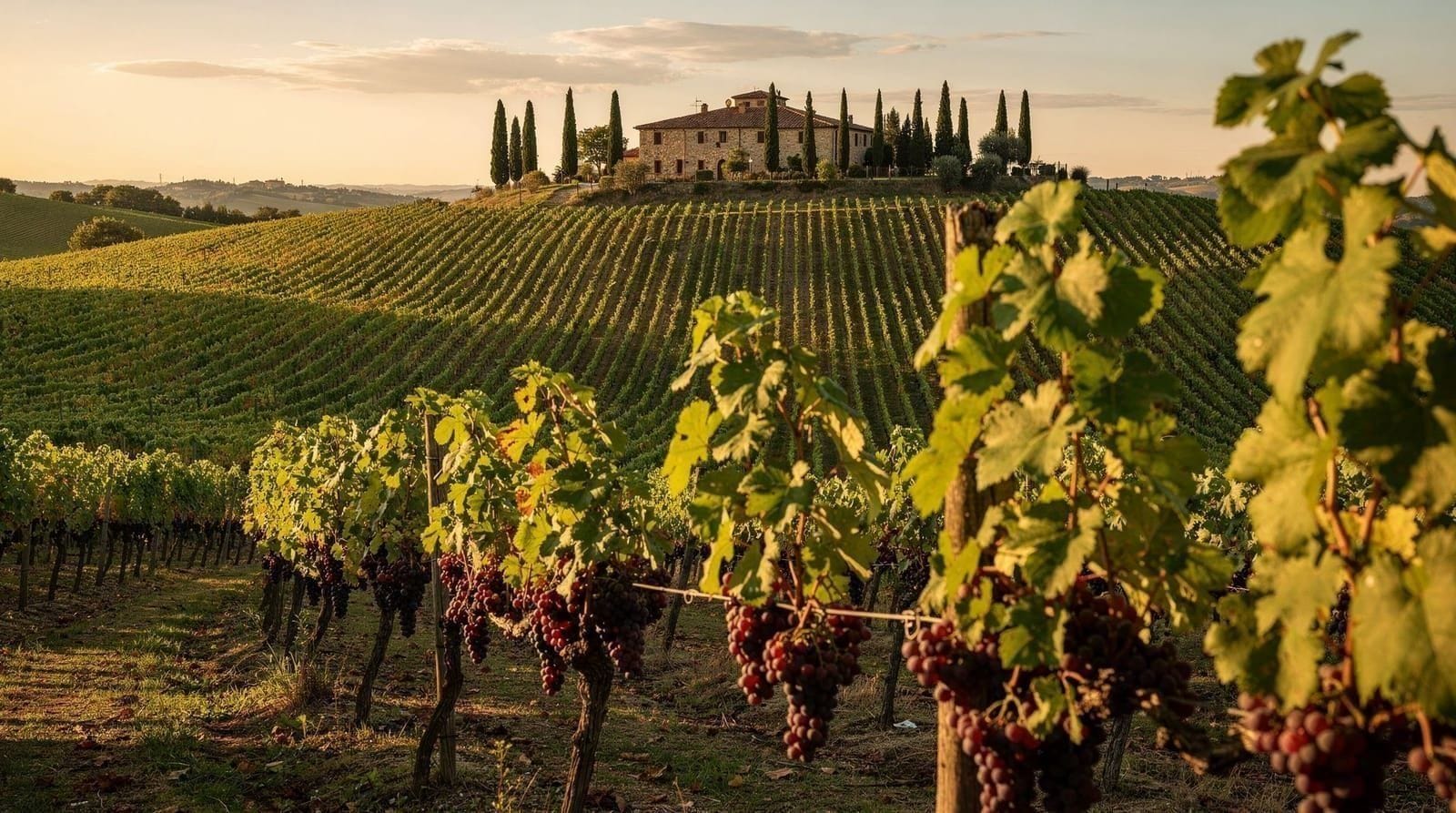
The anchor of Tuscan wine, and the region closest to Florence. The Chianti Classico DOCG covers approximately 72,000 hectares between Florence and Siena, with the towns of Greve, Panzano, Radda, Gaiole, and Castelnuovo Berardenga as its main centres.
Chianti Classico ranges from fresh, everyday drinking wines (Annata, €12–22) to complex Gran Selezione that rival Brunello (€40–90). The black rooster (Gallo Nero) on the neck label is the official quality mark.
This is the most visitor-friendly wine region in Tuscany: dozens of estates welcome visitors, infrastructure is well developed, and there are good restaurants throughout. See the complete Chianti wine guide and the Chianti Classico route for full detail.
Brunello di Montalcino DOCG
Location: The commune of Montalcino, south of Siena Flagship wine: Brunello di Montalcino (100% Sangiovese Grosso, 5 years aging) Distance from Florence: 1h45 by car
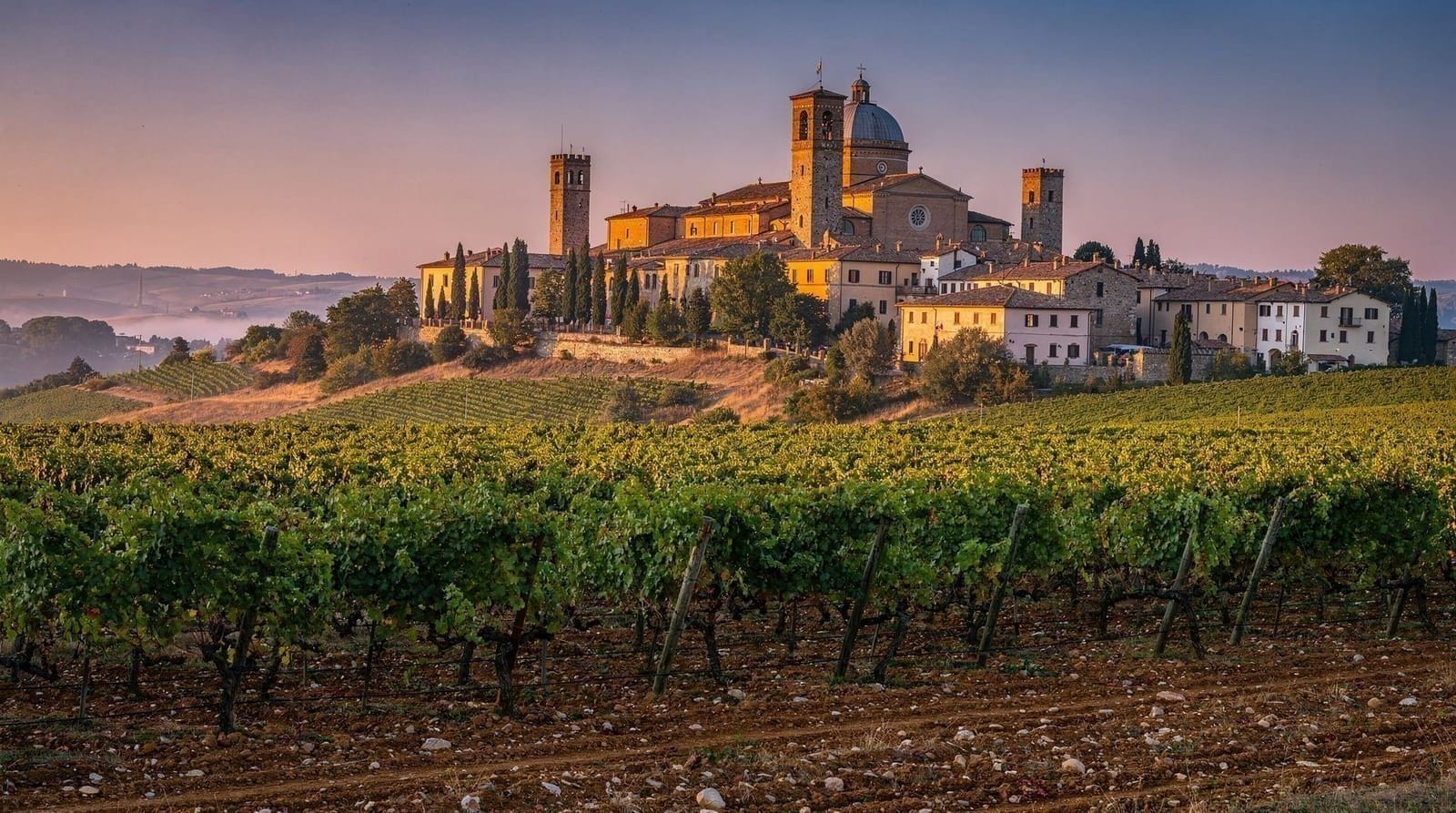
Italy’s most prestigious red wine appellation. Strict rules (100% Sangiovese, mandatory 5-year aging) produce wines of extraordinary complexity and longevity. The hilltop town of Montalcino has a medieval fortress with an excellent enoteca; the surrounding countryside is part of the Val d’Orcia UNESCO landscape.
Top producers include Biondi-Santi (the originator), Castello Banfi (large, visitor-friendly), Il Poggione, Casanova di Neri, and Poggio di Sotto. Prices start around €40 for standard Brunello and reach €250+ for Riserva from top estates. The Brunello di Montalcino guide covers all the detail.
Vino Nobile di Montepulciano DOCG
Location: Around the hilltop town of Montepulciano, Val d’Orcia Flagship wine: Vino Nobile di Montepulciano (minimum 70% Prugnolo Gentile/Sangiovese) Distance from Florence: 1h45 by car
Tuscany’s second DOCG (tied with Brunello, both received designation in 1980). Vino Nobile occupies the middle ground between Chianti’s accessibility and Brunello’s power. The underground cantinas in Montepulciano are among the most atmospheric wine venues in the region. Prices are generally lower than Brunello (€18–40), making this excellent value. See the Vino Nobile guide.
Morellino di Scansano DOCG
Location: Maremma, southern Tuscany (near Grosseto) Flagship wine: Morellino di Scansano (minimum 85% Sangiovese, called Morellino locally) Distance from Florence: 2 hours by car
One of Tuscany’s most underrated wines. Morellino grows in a warmer, more Mediterranean climate than Chianti, producing rounder, more immediately approachable Sangiovese with more purple fruit and less tannin. The wines are excellent value (€12–25 for good bottles) and drink well young. Producers to seek out: Moris Farms, Fattoria Le Pupille, and Erik Banti.
Not typically visited as a day trip from Florence — the area is better suited to those spending time in the Maremma or on the Tuscan coast.
Carmignano DOCG
Location: West of Florence, near Prato Flagship wine: Carmignano (minimum 50% Sangiovese, 10–20% Cabernet Sauvignon permitted) Distance from Florence: 30–40 minutes by car
One of Italy’s oldest appellations — Cosimo de’ Medici issued a protective decree for the wines of Carmignano in 1716. The DOCG was one of the first in Italy. Carmignano is notable for having included Cabernet Sauvignon in its blend since before the modern wine law debates — making it, in a sense, the original Super Tuscan. Producers: Capezzana (the dominant estate, also excellent Vin Santo), Artimino, and Piaggia.
Easily combined with a visit to the nearby Medici villas (Villa di Artimino, Villa di Poggio a Caiano). Good for a half-day from Florence.
Chianti DOCG sub-zones
Beyond Chianti Classico, the broader Chianti DOCG includes several named sub-zones worth knowing:
Chianti Rufina: Northeast of Florence in the Sieve valley. Often called the “Burgundy of Tuscany” — cooler, more elegant, higher acid. Selvapiana and Frescobaldi’s Nipozzano estate are the key producers. Outstanding value (€18–25 for Riserva). Accessible as a half-day from Florence.
Chianti Colli Fiorentini: The hills immediately around Florence. Often decent table wines; occasionally very good from serious small producers.
Chianti Colli Senesi: The hills around Siena, a large and varied zone encompassing much of the territory outside the Classico designation. Very variable quality.
The white wine regions
Vernaccia di San Gimignano DOCG
Location: Around San Gimignano, 50 km southwest of Florence Flagship wine: Vernaccia di San Gimignano (100% Vernaccia grape) Distance from Florence: 1–1h30 by car or bus
Italy’s first DOCG white wine (designated 1966). Vernaccia is a distinctive grape — not aromatic like Riesling or Sauvignon Blanc, but mineral, dry, and slightly bitter on the finish. At its best from estates like Montenidoli and Panizzi, it has real complexity and ages beautifully for 5+ years.
San Gimignano is one of the most visited towns in Tuscany, famous for its medieval towers. It’s easily combined with a Chianti wine visit — the town has several good enotecas and restaurants. Consider San Gimignano wine tours that include the white wine alongside a Chianti tasting.
Vermentino di Toscana IGT
Location: Maremma and Tuscan coast Not a DOCG but increasingly significant. The Vermentino grape produces fresh, aromatic whites that are a natural pairing for seafood and lighter dishes. Found throughout the coastal zone from Livorno south to Orbetello.
The sweet wines
Vin Santo del Chianti Classico DOC
Location: Chianti Classico zone Style: Sweet, oxidative, amber-coloured Made from: Dried Trebbiano and Malvasia grapes, aged minimum 3 years in small wooden barrels
Vin Santo is the traditional dessert wine of Tuscany, found on virtually every restaurant menu. It ranges from thin, alcoholic, and cloyingly sweet (cheap commercial versions) to extraordinary complexity and depth (from producers like Isole e Olena, Avignonesi Occhio di Pernice, Capezzana).
The Occhio di Pernice (“partridge eye”) style from Avignonesi is made from Sangiovese rather than white grapes, producing a deeper amber colour — and is considered one of Italy’s finest dessert wines. Production is tiny; bottles cost €80–150 for a half-bottle.
The coastal zone: Bolgheri and the Super Tuscans
Bolgheri DOC and Sassicaia DOC
Location: Near the town of Castagneto Carducci, Maremma coast Flagship wines: Sassicaia, Ornellaia, Masseto Distance from Florence: 80 km, 1h30 by car
The birthplace of the Super Tuscan revolution. Bolgheri is Mediterranean in character — warmer and more maritime than the inland hills — producing Cabernet Sauvignon-based blends with power and fruit that have no equivalent elsewhere in Italy. Sassicaia has its own exclusive DOC (the only single-estate DOC in Italy). Ornellaia, Guado al Tasso, and Grattamacco are nearby.
The village of Bolgheri is tiny and charming, famous for the Viale dei Cipressi (cypress avenue) described by poet Giosuè Carducci (who lived nearby) and for being connected by a 5 km-long dead-straight cypress road. Visits to the major estates (Sassicaia, Ornellaia) require advance booking and often have limited availability.
Maremma Toscana DOC
Location: Grosseto province, southern Tuscany A broad DOC covering both reds and whites from Maremma. The red wines (often Sangiovese-based or blends with Syrah and Cabernet) offer excellent value. The area has seen significant investment from producers like Antinori (Guado al Tasso), Frescobaldi, and smaller artisan producers. Still evolving as a wine destination.
Comparing the regions: a quick guide
| Region | Main grape | Style | Price range | Best for |
|---|---|---|---|---|
| Chianti Classico DOCG | Sangiovese | Medium-full, food-friendly | €12–90 | Everyday to special occasion |
| Brunello di Montalcino DOCG | Sangiovese Grosso | Full, powerful, age-worthy | €40–250+ | Collectors, celebrations |
| Vino Nobile di Montepulciano DOCG | Prugnolo Gentile | Medium-full, traditional | €18–80 | Good value alternative to Brunello |
| Carmignano DOCG | Sangiovese + Cabernet | Elegant, food-friendly | €20–60 | History lovers |
| Bolgheri DOC | Cabernet Sauvignon, Merlot | Full, rich, modern | €30–500+ | Power and prestige |
| Morellino di Scansano DOCG | Sangiovese (Morellino) | Approachable, fruit-forward | €12–30 | Value seekers |
| Vernaccia di San Gimignano DOCG | Vernaccia | Crisp, mineral, slightly bitter | €12–25 | White wine lovers |
| Chianti Rufina DOCG | Sangiovese | Elegant, high acid, long-lived | €18–40 | Terroir enthusiasts |
Understanding Sangiovese: the thread connecting all Tuscany
One grape dominates Tuscan wine to an extent unusual among the world’s great wine regions. Sangiovese — in its various biotypes — is the primary variety in Chianti Classico, Brunello di Montalcino, Vino Nobile di Montepulciano, Morellino di Scansano, Carmignano, and most other significant Tuscan reds. Understanding Sangiovese helps you understand all of them simultaneously.
Key characteristics of Sangiovese across all Tuscan appellations:
High natural acidity: Sangiovese ferments with significantly more natural tartaric and malic acid than, say, Cabernet Sauvignon. This acidity makes Sangiovese wines extraordinary food companions — the acid cuts through fat and revives the palate. It also contributes to aging potential.
Firm, drying tannins: In youth, Sangiovese wines often feel astringent — the tannins grip the gums and dry the palate. With 5–10 years of bottle age, these tannins soften and integrate into the wine’s structure.
Bright red fruit: Sangiovese’s primary aromas are cherry (often dried cherry rather than fresh), plum, and dried herbs. Secondary aromas from aging include tobacco, leather, earth, and mineral.
Site sensitivity: No grape changes more dramatically with terroir. Sangiovese in the cool, mineral galestro soils of Chianti Rufina produces an entirely different wine from the warm clay-limestone slopes of Montalcino, which in turn is different from the coastal influence at Morellino. This sensitivity makes Tuscany one of the world’s most interesting wine regions for terroir exploration.
The biotypes matter too: Brunello (Sangiovese Grosso at Montalcino), Prugnolo Gentile (at Montepulciano), Morellino (at Scansano), and the various clones used in Chianti Classico are not the same plant even though they share the Sangiovese name. Local adaptation over centuries has created distinct sub-varieties.
The rise of natural and organic winemaking
Tuscany has become a significant centre for natural, organic, and biodynamic winemaking in Italy. The Chianti Classico zone has a notably high proportion of certified organic producers — partly because the traditional Chianti terroir is less susceptible to the fungal diseases that make organic viticulture difficult in wetter regions.
Key organic and biodynamic producers worth noting:
- Fontodi (Panzano): Biodynamic since 2010; one of the most respected Chianti Classico producers
- Fèlsina (Castelnuovo Berardenga): Transitioning to organic, excellent Riserva
- Avignonesi (Montepulciano): Certified biodynamic since 2009; the largest biodynamic wine estate in Italy at the time of certification
- Podere Le Boncie (Chianti Classico): Small-scale, natural approach, cult following
The distinction between “organic” (certified: no synthetic pesticides, herbicides, or fertilisers) and “natural” (organic + minimal intervention in the cellar: no added sulfites, spontaneous fermentation, no fining or filtration) matters for consumer choice. Both approaches are increasingly common across all Tuscan appellations.
How Italian wine classifications work in practice
The DOCG/DOC/IGT hierarchy confuses visitors and even experienced wine drinkers. A quick clarification:
DOCG (Denominazione di Origine Controllata e Garantita): The top tier. The appellation rules specify grape varieties, yields, aging requirements, and a mandatory government tasting panel. Every bottle is approved by an official tasting committee. Examples: Chianti Classico, Brunello di Montalcino, Vino Nobile di Montepulciano.
DOC (Denominazione di Origine Controllata): One tier below. Geographic origin and grape variety rules apply, but requirements are generally less strict than DOCG. Examples: Bolgheri DOC, Morellino di Scansano (now DOCG), Rosso di Montalcino.
IGT (Indicazione Geografica Tipica): Geographic indication only. No requirements on grape varieties or winemaking. Used for wines that don’t conform to a DOCG/DOC appellation. Most Super Tuscans are IGT Toscana. The IGT classification carries no implication of lower quality — some of Italy’s most expensive wines are IGT.
Vino d’Italia/Vino da Tavola: No geographic indication at all. A declining category.
The key insight: classification level and quality are not directly correlated in Tuscany. A €120 IGT Tignanello is a fundamentally different wine from a €6 IGT Toscana supermarket red that also carries the “IGT Toscana” designation. The hierarchy tells you what the regulations are, not what the wine tastes like.
Planning your Tuscany wine itinerary
If you’re spending 5–7 days based in Florence and want a structured approach to the wine regions:
Day 1: Chianti Classico — the SR222 route from Florence to Greve, Panzano, Radda, return via motorway
Day 2: Florence city — wine tasting session in the city, exploring the enotecas and wine bars. Visit Cantinetta Antinori for Super Tuscans by the glass
Day 3: Val d’Orcia loop — Montalcino (Brunello visit at Castello Banfi or Ciacci Piccolomini), Pienza (lunch, Pecorino shopping), Montepulciano (Vino Nobile cantina in the afternoon)
Day 4: San Gimignano — Vernaccia di San Gimignano tasting, the medieval towers, optional Siena in the afternoon
Day 5: The coast — drive to Bolgheri for the cypress avenue and Sassicaia/Ornellaia visits (reservations essential), return via the Via Aurelia
This programme is ambitious but achievable with a car. Two of the five days involve significant driving; the others are more contained. Alternatively, guided tours cover each area without the logistics.
Frequently asked questions about Tuscan wine regions
Which wine region is closest to Florence?
Chianti Classico — the hills literally begin at the city’s southern edge, and excellent estates sit within 30 km. Carmignano is only 30–40 minutes to the west. Both are realistic for a half-day excursion.
Are there wine regions north of Florence?
Carmignano is northwest. Chianti Rufina is northeast, in the Sieve valley. Neither is as famous as Chianti Classico or Brunello, but both are worth exploring and less crowded. Rufina in particular is underrated and under-visited.
What is the single best wine experience in Tuscany for a first-time visitor?
A structured Chianti Classico half-day tour from Florence — it covers the most accessible region, produces the most visitor-friendly estate experiences, and gives you the best understanding of what makes Tuscan wine distinctive. From there, the deep dives into Brunello and Bolgheri make more sense.
Top experiences
Bookable activities with verified prices and instant confirmation on GetYourGuide.

Florence: Tuscany full day small group wine and food tour
- Free cancellation
- Small group
Florence: small group wine tasting experience in Tuscany
- Free cancellation
- Small group

Florence: Chianti wineries tour with wine tasting
- Free cancellation
- Small group

Florence: Val d'Orcia cheese and wine tasting tour
- Free cancellation
- Small group