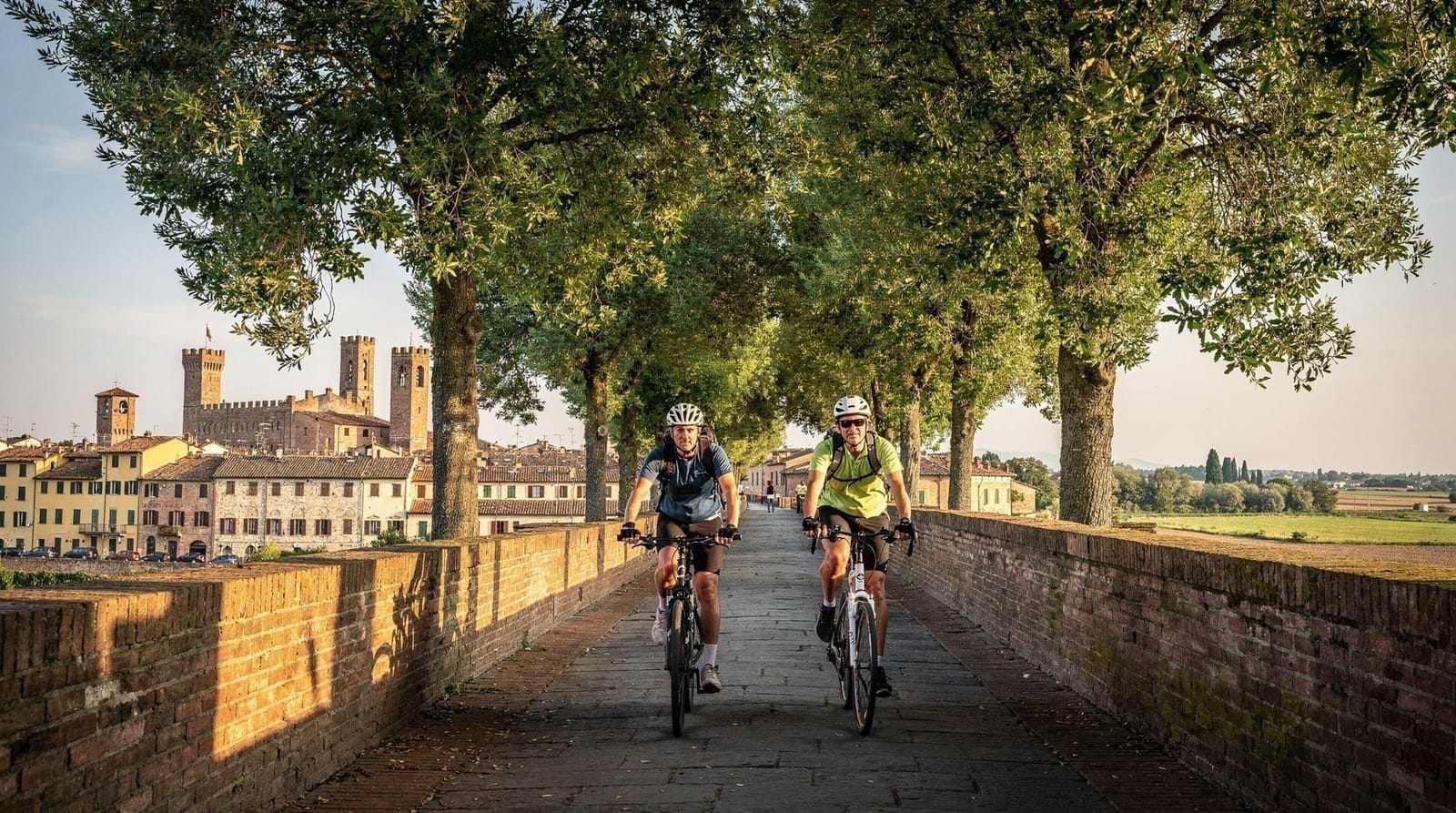
Cycling the walls of Lucca: a day trip worth every pedal
There is one thing about Lucca that no other city in Italy can offer: a complete circuit of Renaissance defensive walls, four kilometres of promenade, wide enough at the top to ride a bicycle and planted with trees that turn gold in October. You can cycle around the entire perimeter in thirty minutes. Most people do it three times.
I went to Lucca on a train from Florence, spent six hours there, and cycled those walls until I knew every tree.
| Getting there | Train from Florence SMN, about 1h20 |
| Cost | €9–15 train + €12–18 half-day bike rental |
| Time needed | 5–6 hours for a proper day trip |
| Getting around | Walk or cycle; no cars inside the walls |
| Best time | Spring or autumn, especially October for the trees |
Getting there: the easy part
The train from Florence Santa Maria Novella to Lucca takes about 1 hour 20 minutes, usually with one change at Pisa Centrale. There are direct trains, but they’re less frequent — check Trenitalia on your specific dates. Return fares run €9-15 each way in second class, and you should book in advance in high season to guarantee a seat.
The Lucca train station sits just outside the walls on the north side of the city. From the platform to the nearest city gate, Porta San Pietro, is a three-minute walk. From there, the historic centre is entirely on foot or by bicycle — no cars inside the walls, making Lucca one of the most pleasant cities in Italy to actually move around.
The walls: what they actually are
Lucca’s walls were built between 1513 and 1645, during the period when the city was an independent republic trying to defend itself from the various Tuscan powers around it. They’re a classic Renaissance ravelino design — not vertical castle walls but thick earthworks, angled to deflect cannon fire, wide enough at the top for artillery movement.
They also never had to be used in battle. Lucca negotiated its way through every conflict, and eventually Napoleon simply handed the city to his sister Elisa Bonaparte. The walls, perfectly preserved, became a civic promenade in the 19th century and were planted with the double row of trees — mostly linden and plane trees — that give the top its green, shaded character.
The circuit is 4.2 kilometres. At a leisurely cycling pace it takes about 25 minutes. Walking the whole circuit takes around 75 minutes. Most people combine: cycle twice, then walk a section slowly, looking out over the city on one side and the Apuan Alps on the other.
Renting a bike
There are half a dozen bike rental shops clustered near the train station and the main city gates. Prices range from €3.50-5 per hour for a basic city bike to €8-10 per hour for an e-bike. A half-day rental (3-4 hours) typically runs €12-18 for a standard bike. Most rental places provide a lock as standard.
The bikes are single-speed uprights — sensible for the walls, which are flat, but slightly impractical if you want to explore the countryside around the city. For that, an e-bike makes more sense.
I rented from Cicli Bizzarri on Piazza Santa Maria, just inside the walls (about €4 per hour, good-condition bikes, friendly staff). There are several comparable options nearby.
The city below the walls
Lucca’s historic centre is magnificent and genuinely undervisited compared to Florence or Siena. The oval Piazza dell’Anfiteatro — built on the footprint of a Roman amphitheatre, its buildings following the curve of the original arena — is one of the most architecturally interesting public spaces in Tuscany. The towers that once defined the skyline, built by rival Lucchese families as status symbols, still stand in several places.
The Duomo di San Martino holds the Volto Santo, a carved wooden crucifix that was one of the great pilgrimage objects of medieval Europe. The church of San Michele in Foro has a facade that’s almost aggressively ornate by Tuscan standards, every column different, saints and angels climbing the upper tier.
But you don’t come to Lucca to tick museums. You come for the atmosphere — a prosperous, lived-in city that has managed not to be entirely colonised by tourism, where residents still cycle to the market in the morning and the restaurants on the side streets serve people who actually live there.
What to eat
Lucca has its own culinary identity, distinct from Florence. The local pasta is tordelli lucchesi — a stuffed pasta somewhere between ravioli and tortellini, filled with a mixture of meat, herbs, and ricotta, and served with a rich meat ragù. Order it at any trattoria with handwritten menus.
For lunch, try Trattoria da Leo on Via Tegrimi — a proper local institution where three courses costs €20-25 and the menu changes with what’s in season. Tables fill up by 12:30pm, so arrive early or you’ll queue.
The local sweet is buccellato, a ring-shaped bread flavoured with anise and studded with raisins, sold by the wheel at Pasticceria Taddeucci on Piazza San Michele. Buy a chunk and eat it on the walls.
Lucca also produces its own olive oil — the hills around the city are thick with olive groves — and you can buy excellent cold-pressed bottles at shops inside the city gates for €10-15.
A day’s schedule
9:30am: Arrive by train from Florence (departing around 8:10am) 9:45am: Rent a bike, cycle the walls twice (1 hour) 11am: Walk Piazza dell’Anfiteatro, San Michele in Foro 12:15pm: Lunch at Da Leo or similar 2pm: Duomo di San Martino and the Volto Santo 3:30pm: Gelato and second wall circuit (or third) 5pm: Train back to Florence, arriving by 6:30pm
This gives you about six hours in Lucca, which is the right amount for a day trip. If you add Pisa (30 minutes by train from Lucca), you get roughly three hours per city, which is enough to see the Tower and Cathedral but leaves Lucca feeling rushed.
Guided tours from Florence
Several operators run half-day and full-day tours to Lucca from Florence, typically in small groups of 8-12. These include return transport (usually minibus), a local guide for the city walk, and the bike rental on the walls. The advantage is that you don’t have to navigate the train connections; the disadvantage is that you’re on a group schedule rather than your own.
A guided half-day to Lucca from Florence typically costs €45-65 per person. Full-day tours that add wine tasting in the surrounding hills run €80-110.
If you combine Pisa and Lucca, the private day-trip option — your own driver/guide in a minivan — allows you to prioritise Lucca properly without feeling like you’re on a race through both cities.
Beyond the walls: the countryside around Lucca
If you have more time or your own transport, the hills surrounding Lucca — the Lucchesia — offer some of the best cycling in Tuscany on relatively quiet roads with significant elevation change.
The Villa Reale di Marlia and the Villa Mansi, both 7-10 kilometres north of Lucca in the hills, are Baroque garden estates from the 17th and 18th centuries. The Villa Reale’s garden (open Tuesday-Sunday) was once owned by Napoleon’s sister Elisa Bonaparte and features water features, lemon groves, and a theatre topiary. Neither is heavily visited.
For wine, the Colline Lucchesi DOC zone produces a Sangiovese-based red that is less well-known than Chianti but good. The local white, based on Vermentino, is fresh and mineral and sold for €8-12 at farm stands along the country roads.
E-bikes from Lucca open up the hills properly — the road climbs to Moriano and then north toward the garfagnana valley are serious ascents on a standard bike but manageable on an e-bike, with views over the valley and Lucca’s distant walls appearing through gaps in the olive groves.
The Puccini connection
Giacomo Puccini was born in Lucca in 1858. His birthplace on Corte San Lorenzo (adjacent to the main shopping street) is now a small museum with his original piano, personal effects, and costumes from productions of La Bohème and Tosca. Entry is €7; the museum is small but charming and almost always uncrowded.
Lucca’s Teatro del Giglio, one of the historic opera houses of Tuscany, continues to stage opera including Puccini works. If you’re there in the evening and the programme aligns, attending a performance in the jewel-box interior is one of those cultural accidents that can become the highlight of a trip.
The Puccini Festival at Torre del Lago (the lakeside village where Puccini lived and composed for most of his adult life, 30 minutes west of Lucca toward the coast) runs July-August each year at an outdoor theatre on the lake. Performances are Puccini operas in situ — the lake, the summer night, the composer’s house visible in the background. Tickets from €30; book well in advance.
Why Lucca is better than people expect
Most visitors to Tuscany put Lucca third or fourth on their list, if they include it at all. This is a mistake. Siena has more drama, San Gimignano has the towers, Florence is Florence — but Lucca has the walls, the Piazza dell’Anfiteatro, and something none of the others have: the feeling of a city that hasn’t completely surrendered itself to tourism.
You can cycle around a 500-year-old fortification and pass Lucchese grandmothers walking small dogs. You can eat lunch at a place that has been serving the same menu since 1945 without a single tourist-menu laminated card in sight. You can buy olive oil from the hills you can actually see from the walls.
This is the Tuscany that can be hard to find.
Combining Lucca with other Tuscan day trips
Lucca works well as a standalone day, but it also slots into a longer Tuscany itinerary. The Lucca destination guide has the broader overview if you’re considering an overnight rather than a day trip. Pisa is 30 minutes away by train, making a combined Pisa day trip genuinely feasible if you’re comfortable with a faster pace. If cycling flat city walls has whetted your appetite for something more demanding, the cycling in Tuscany guide covers the hillier routes around Chianti and the Lucchesia hills for a return visit with proper road or e-bikes.
See also: Florence day trips guide for more options, getting to Lucca from Florence, and the Pisa and Lucca combined day trip if you want to combine both cities.
Top experiences
Bookable activities with verified prices and instant confirmation on GetYourGuide.