How to spend a rainy day in Florence (and why you should stop complaining about the weather)
| Where | City centre — museums, covered markets, churches |
| Time needed | A half-day to a full day |
| Cost | Free entries at several churches; museum tickets around €6–12 |
| Getting there | On foot — most options below are within the historic centre |
| Best time | November through February brings the most persistent rain |
It rains in Florence. Not dramatically, not constantly, but November through February brings overcast skies and persistent drizzle that can last three or four days at a stretch, and even in spring and autumn a rain day appears without much warning. Most visitors, confronted with a grey morning and wet cobblestones, feel that their plans have collapsed.
They haven’t. A rainy day in Florence is actually, in some respects, a better day — the Uffizi is less crowded, the narrow streets that can feel suffocating in August have a moody beauty, and the small indoor experiences the city quietly offers are the kind that never make the ten-minute travel video but stay with you for years.
The case for rain
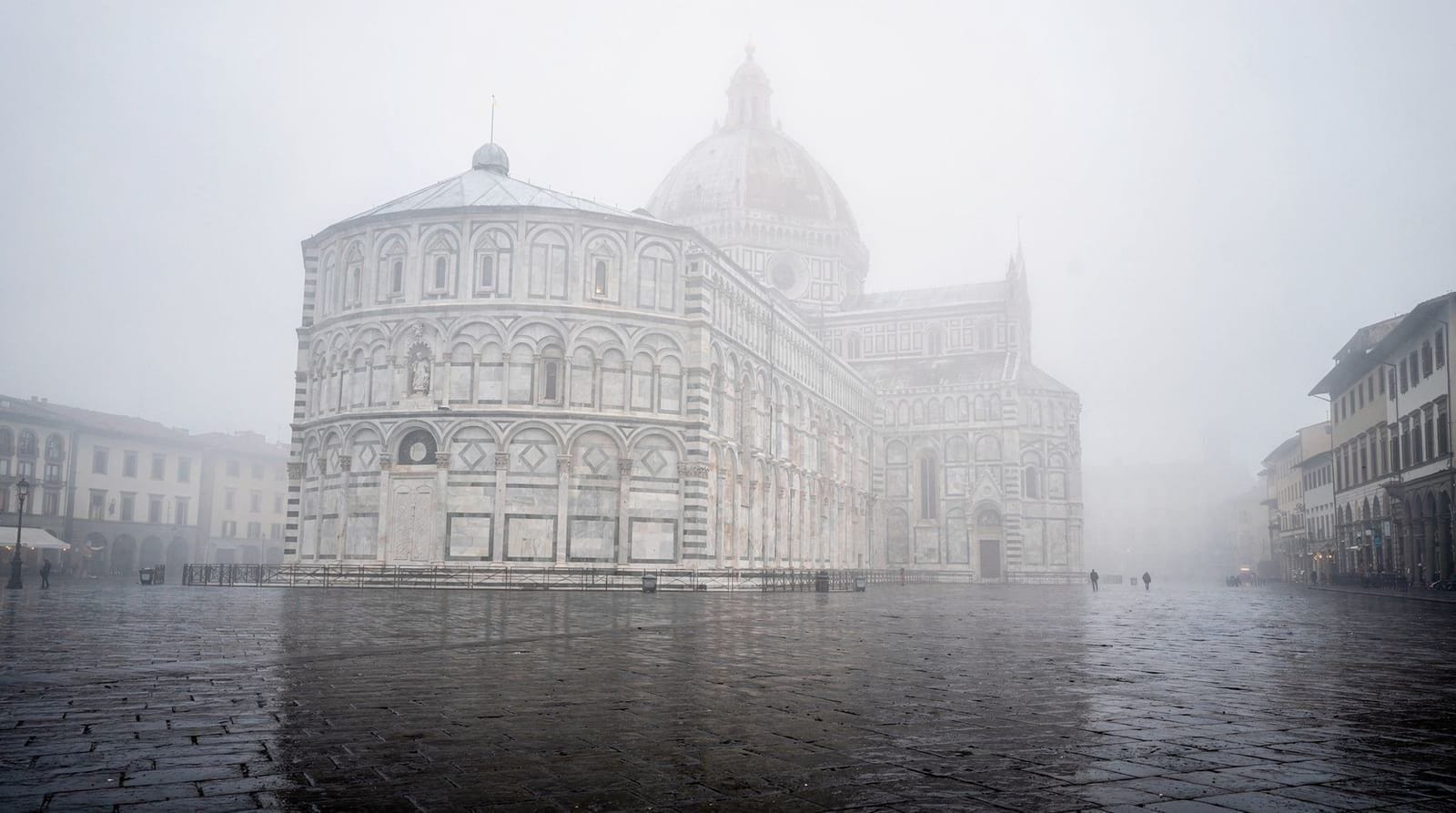
The practical advantage first: rainy days suppress tourist numbers at outdoor attractions and popular walking routes. The queue at the Uffizi without rain is still a queue; the queue at the Uffizi in November rain is shorter. The Piazza del Duomo — normally a wall-to-wall photo scrum — has a particular melancholy beauty when the stone is dark and the Baptistery’s golden mosaics glow through the doors.
The Florentines navigate rain with efficient dignity. Every resident appears to own a large black umbrella purchased locally (if you didn’t bring one, the shops around Santa Maria Novella sell decent ones for €8-12). The covered arcades of Via de’ Tornabuoni and the loggia of the Palazzo degli Uffizi provide good shelter for walking. The Vasari Corridor — if you’ve booked a tour — is entirely covered.
The museums you should have gone to anyway
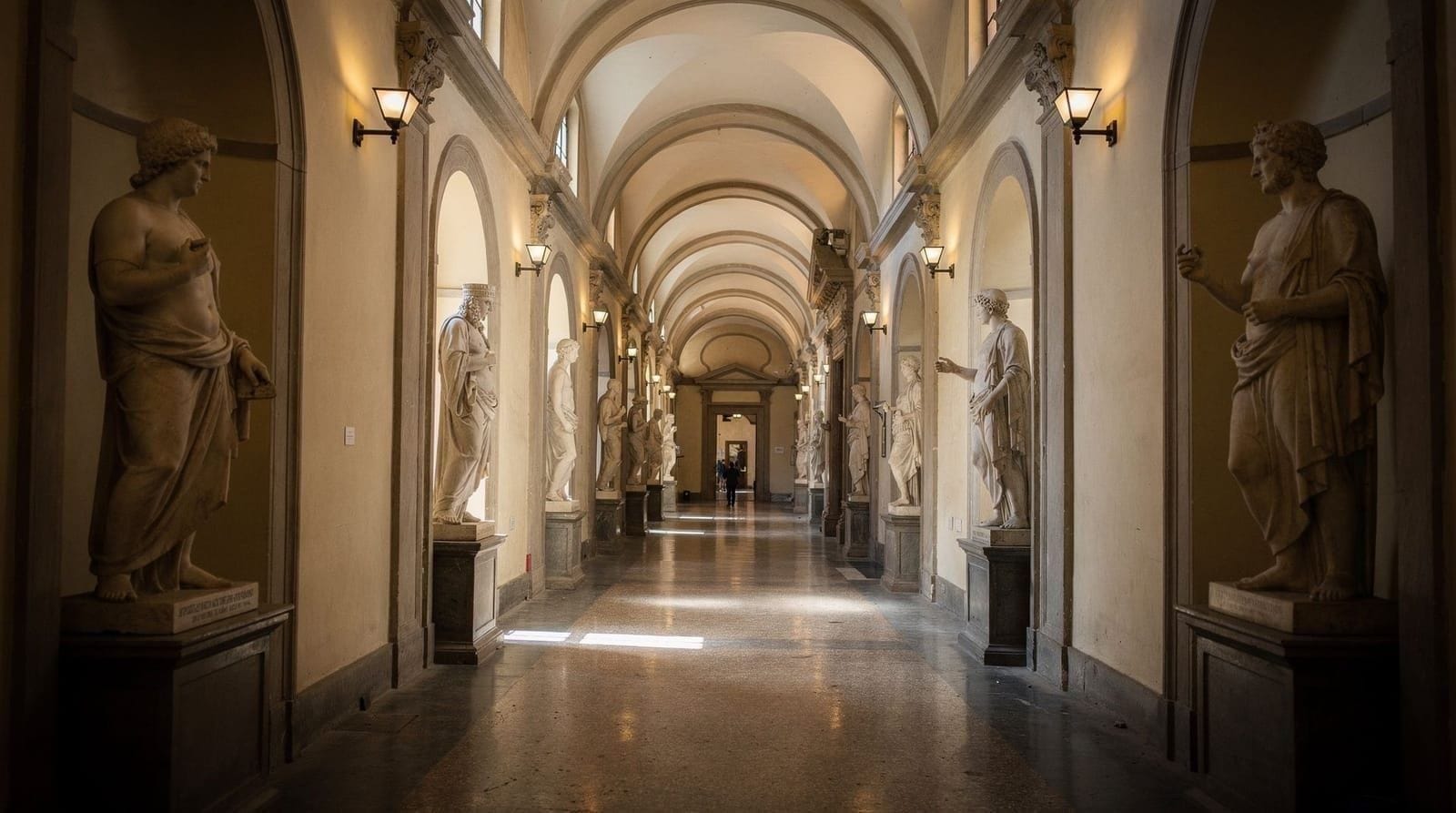
Florence has more museum-quality art per square kilometre than almost anywhere on Earth, and rain gives you the excuse to see the ones you might have skipped on a sunny day in favour of the Piazzale Michelangelo.
The Bargello: This is, genuinely, one of the most underrated museums in Europe. In a medieval fortified palace that served as Florence’s first seat of government and later as a prison, you’ll find Donatello’s David (the bronze one, the first life-size freestanding nude since antiquity — arguably the work that inaugurated the Renaissance), along with Verrocchio’s David (which served as the model for the young Leonardo da Vinci) and room after room of medieval armour, majolica, and decorative arts. Entry costs €10. On a busy day in May, you might share the first floor with thirty people.
The Museo di Santa Maria del Fiore (Duomo Museum): The exhibits extracted from the Cathedral complex — Ghiberti’s original Gates of Paradise panels, Michelangelo’s Bandini Pietà, the Florentine silver altar — are world-class and often overlooked in favour of queuing for the dome. The dome exhibition, explaining Brunelleschi’s engineering in detail with models, is excellent. Allow two hours.
The Galileo Museum: Galileo Galilei spent most of his productive career in Florence under Medici patronage. The Museo Galileo on the Lungarno, overlooking the Arno, holds his original instruments — the telescopes he used to observe Jupiter’s moons, the compass he invented, and preserved pieces of his actual finger (two fingers and a thumb are housed in elaborate reliquaries — strange, fascinating, very Italian). Entry around €12. Almost never crowded.
The Museo Nazionale del Bargello: See above — the best-kept secret in the city.
Palazzo Davanzati: A 14th-century Florentine merchant’s house preserved almost intact, furnished with period items, showing how a wealthy urban family actually lived during the Renaissance. Three floors of medieval domestic life, including kitchen, loggia, and the bedroom where frescoed bird cages decorate the walls. Often empty of other visitors entirely.
Covered markets in the rain
The Mercato Centrale on Via dell’Ariento is a two-floor covered market where the ground floor remains a working food market (produce, meat, cheese, wine) and the upper floor houses food stalls with seating. On a rainy day, the upper floor of Mercato Centrale is not quiet — it’s one of the more reliable options for lunch, with everything from lampredotto sandwiches to proper pasta. Arrive before 12:30pm for a seat.
The Mercato di Sant’Ambrogio (Via Pietrapiana) is smaller, more genuinely local, less touristically developed. A bowl of ribollita — the dense Florentine bread and vegetable soup — at the simple trattoria inside the market on a November afternoon is one of the better €12 meals in Florence.
The covered experience: a leather workshop tour
Rain makes outdoor activities impractical and artisan workshop visits suddenly very appealing. Several of the Oltrarno craft workshops — including proper bookbinderies, paper-marbling studios, and the leather school inside Santa Croce convent — operate regardless of weather and become slightly more atmospheric with rain drumming on the stone courtyard outside.
The Scuola del Cuoio (Leather School) operates inside the former convent of Santa Croce and is both a school and a shop. You can walk through the working area watching craftspeople produce bags, belts, and wallets; the adjacent shop sells the finished pieces. No booking required for the visit.
Coffee culture on a rainy day
The Italian bar — caffè, not the drinking kind — becomes essential infrastructure in wet weather. The Florentine approach to rain is not to shelter in your hotel room but to shelter in a bar, drink a macchiato standing at the counter, and wait for a gap in the clouds.
The bar counter is where Florentine social life happens at 10am on a Tuesday. The ritual: order at the counter, pay when you order (not at the end), drink standing (sitting at a table attracts a surcharge at most places). The macchiato — espresso with a dash of hot milk — costs €1.10-1.30 at the counter; the same drink at a table is €3-4.
Caffe Rivoire on Piazza della Signoria is expensive but the square view through the rain is extraordinary. Bar San Biagio at Piazza Frescobaldi in the Oltrarno is where the locals go. Seabolic in Piazza Santa Felicita is excellent and gives you a view of the 13th-century church.
What to skip in the rain
Piazzale Michelangelo: The view is obscured. The platform is exposed. Skip it and add it to the following morning if the weather clears.
Fiesole: An outdoor hill-town visit. Save it for sunshine.
The Boboli Gardens: Possible in light rain with good shoes, but the sloped paths become treacherous in heavy rain and sections may be closed.
Open-top bus tours: Self-explanatory.
What rain makes better
The Ponte Vecchio and the Arno in rain, with fewer people and the grey light on the water, is genuinely more beautiful than the same scene in peak summer. The medieval courtyard of the Bargello, which you can see from the first-floor gallery, is extraordinary with rain falling on the worn stone.
The dark streets of the historic centre — Via dei Tornabuoni, Via della Vigna Nuova, the lanes around Orsanmichele — have a quality in November rain that no Instagram filter approximates. The 14th-century grain market of Orsanmichele, its exterior niches housing masterworks by Donatello, Ghiberti, and Verrocchio while the interior serves as a church, is free to enter and almost always quiet.
A rainy afternoon is also the right moment to spend three hours in a bookshop. The Libreria Brac on Via dei Vagellai has a good selection in multiple languages and an attached vegetarian cafe. Babbo Books on Via del Leone in the Oltrarno is tiny and excellent.
The indoor experience money can’t buy: Gregorian chant
San Miniato al Monte, the Romanesque basilica above Piazzale Michelangelo, holds vespers sung in Gregorian chant at 5:30pm on most days by the Olivetan monks who have been based here since the 13th century. The service lasts 20-30 minutes.
In the candlelit marble interior — striped green and white, the columns ancient Roman granite reused in the 11th-century construction — the chant echoes in a way that reminds you this building was designed around sound as much as sight. Entry is free. Visitors are welcome but expected to observe in silence.
This is one of the experiences in Florence that no amount of planning or budgeting prepares you for. It’s simply what happens when a medieval acoustic space and a medieval musical tradition come together in a room on a dark afternoon.
Florentine church architecture on a rainy day
Rain gives you a reason to slow down inside the great churches of Florence, most of which are free to enter (Santa Croce charges €8; Orsanmichele has limited free hours; most others are open without charge).
Santa Trinita (Piazza Santa Trinita): Quiet, often almost empty, with a cycle of frescoes by Domenico Ghirlandaio in the Sassetti Chapel that includes portraits of Lorenzo de’ Medici and his circle — real Florentine faces, carefully observed, dressed as characters in a biblical story. Remarkable and rarely visited.
Ognissanti (Borgo Ognissanti): Holds the church where Amerigo Vespucci’s family worshipped. Botticelli’s St Augustine and Ghirlandaio’s St Jerome flank the nave across from each other, painted in the same year (1480) for the same patron. Comparing them directly — one artist precise and scholarly, the other luminous and lyrical — is a miniature lesson in what Florence was doing in the late 15th century.
San Marco (Piazza San Marco): The Dominican convent where Fra Angelico painted his cell frescoes — a different fresco for each monk’s cell, painted to aid contemplation — is now a museum (€6 entry) and one of the most beautiful spaces in Florence. Fra Angelico’s Annunciation at the top of the staircase is perhaps the most perfectly calibrated image of its subject ever painted.
The artisan market for rainy afternoons
Piazza Santo Spirito in the Oltrarno holds a small artisan market on weekdays, and a larger one on the second Sunday of each month. On rainy days, the stalls are few but the surrounding bars and the church interior (simple, Brunelleschi’s last work, unfinished facade of rough stone that has remained so for 500 years) make the area worth a visit regardless.
The Oltrarno is the right neighborhood for a rainy afternoon more broadly — the streets are narrow enough that the buildings provide some shelter, the bars and small galleries are spaced closely enough that you can move between them without getting comprehensively wet, and the neighborhood’s working-craft character means there are authentic things to look at beyond the tourist circuit.
Carry an umbrella. See the Bargello. Drink macchiato at the counter. It’s a good day.
See also: Florence museums guide, Uffizi booking guide, and visiting Florence in November for full seasonal planning advice.
A ready-made rainy morning
If you’d rather follow a plan than assemble one from the sections above: start at the Bargello when it opens, walk the covered streets toward Piazza San Marco and spend an hour at San Marco with Fra Angelico’s frescoes, then head to the Mercato Centrale for lunch on the upper floor. Finish the afternoon in a bookshop or, if it’s a Wednesday or Friday, time your walk past San Miniato al Monte for the 5:30pm vespers. None of this requires advance booking except, potentially, a table at a popular lunch spot inside the market.
Rainy day versus sunny day: what actually changes
| Factor | Sunny day | Rainy day |
|---|---|---|
| Uffizi/Accademia queues | Long, even with booking | Shorter, but pre-booking still matters |
| Piazzale Michelangelo | Best version of the view | Skip — obscured and exposed |
| Bargello, Museo Galileo, San Marco | Good but often overlooked | Genuinely excellent, usually quiet |
| Boboli Gardens | Ideal | Possible in light rain only; paths can flood |
| Church interiors | Pleasant | More atmospheric — candlelight and quiet reads differently |
The pattern is consistent: outdoor viewpoints lose, indoor culture wins. Plan around that rather than fighting it.
Frequently asked questions about rainy days in Florence
How many rainy days should I expect on a week-long trip? It depends heavily on season. In November through February, several consecutive grey or wet days are common. In late spring and early autumn, a single rain day appearing without much warning is more typical, with the rest of the week clear. Summer (July–August) is Florence’s driest stretch.
Are the Uffizi and Accademia worth visiting specifically because it’s raining? Rain thins the walk-up crowds somewhat, but it doesn’t remove the need for a pre-booked, timed-entry ticket — those two museums are busy in almost any weather. The bigger rainy-day wins are the Bargello and the Galileo Museum, which are genuinely much quieter and rarely require advance booking.
Top experiences
Bookable activities with verified prices and instant confirmation on GetYourGuide.

Florence: Uffizi Gallery guided tour with skip-the-line ticket
- Skip the line
- Small group
Florence: Accademia Gallery and Michelangelo's David tour
- Skip the line
- Small group
Florence: exclusive guided tour of Galileo's Museum
- Small group
- Free cancellation
Florence: free guided walking tour with a local guide
- Free cancellation
- Instant confirmation