Kid-friendly museums in Florence
Florence: Accademia Gallery and Michelangelo's David tour
- Skip the line
- Small group
Which Florence museum is best for kids?
Museo Galileo for children aged 5-10 (hands-on science, short visit, no queues), Accademia for ages 8 and up (David is genuinely awe-inspiring), and Bargello for teenagers interested in sculpture. The full Uffizi is too overwhelming for most children under 12.
How to choose a museum when you are travelling with children
The single most useful decision you can make before entering a Florentine museum is agreeing on an exit time before you enter. Children do not fail at museums — poorly planned museum visits fail children. Ninety minutes is the realistic ceiling for ages 6-10; up to two hours for ages 10-14; longer only for teenagers with genuine interest in art or history.
With that in mind, here is an honest ranking of Florence’s main museums by how well they work with children at different ages.
| Best starting point | Museo Galileo (ages 5–10) or Accademia (ages 8+) |
| Cost | Free for EU under-18 at most museums; €6–16 elsewhere |
| Time needed | 60–90 minutes per museum, one per morning |
| Getting there | All within walking distance in Centro Storico |
| Best time | First slot of the day (8–9am), avoid free Sundays |
Museo Galileo: the underrated family museum
Best for: ages 5-10. Visit time: 60-75 minutes. Queues: usually none.
Museo Galileo (Piazza dei Giudici 1, open daily 09:00-18:00, closed Tuesdays in winter) is the city’s best-kept family secret. The collection centres on the Medici’s extraordinary scientific instruments: original telescopes used by Galileo himself, mechanical globes that show the movement of the planets, astronomical clocks, mathematical instruments, and two preserved fingers from Galileo’s right hand (a macabre highlight children consistently mention when they get home).
What makes it work for children:
- Scale: Two floors, manageable in 60 minutes
- Interactive elements: A reconstruction room with replica instruments children can handle
- Narrative: Galileo’s trial by the Inquisition is a story children immediately understand — a scientist being punished for being right
- No queues: Unlike the Uffizi or Accademia, you can usually walk straight in
Entry: EUR 10 adults, EUR 6 children aged 6-18, under 6 free. No booking fee required; you can book online but walk-in is usually fine.
What children remember: The telescopes (“Galileo could see the moons of Jupiter with that”), the enormous mechanical celestial globes, and the fingers.
Accademia: David changes children
Best for: ages 8 and up. Visit time: 75-90 minutes. Queues: long without booking.
Michelangelo’s David is 5.17 metres tall and stands on a 1.8-metre plinth, putting the base of the statue above most children’s eye line. Looking up at it changes your relationship to the sculpture completely. Adults have described the experience; children tend to go quiet.
The Accademia is a genuinely focused museum: the main attraction (David) is in a purpose-built rotunda at the end of a corridor showing Michelangelo’s Prisoners — rough-hewn figures that look like they are trying to emerge from the marble. These unfinished sculptures are, in our experience, more affecting for children than the David itself, because they show the sculpture in process.
Booking is non-negotiable in season. In summer without a pre-booked ticket, you will queue for 90-120 minutes. Timed entry slots cost EUR 12-16 for adults (EUR 4 booking fee on top). EU children under 18 enter free; non-EU children under 18 pay EUR 4-8 reduced rate.
Practical tip: book the 9 am or 9:15 am slot. The museum is quieter in the first hour. By 11 am the rotunda holding David is genuinely crowded and the experience suffers.
What children remember: The scale of David, the Prisoners (“they look like they are stuck”), and the feeling of being smaller than a statue.
Bargello: the castle museum
Best for: ages 8-13. Visit time: 60-90 minutes. Queues: minimal.
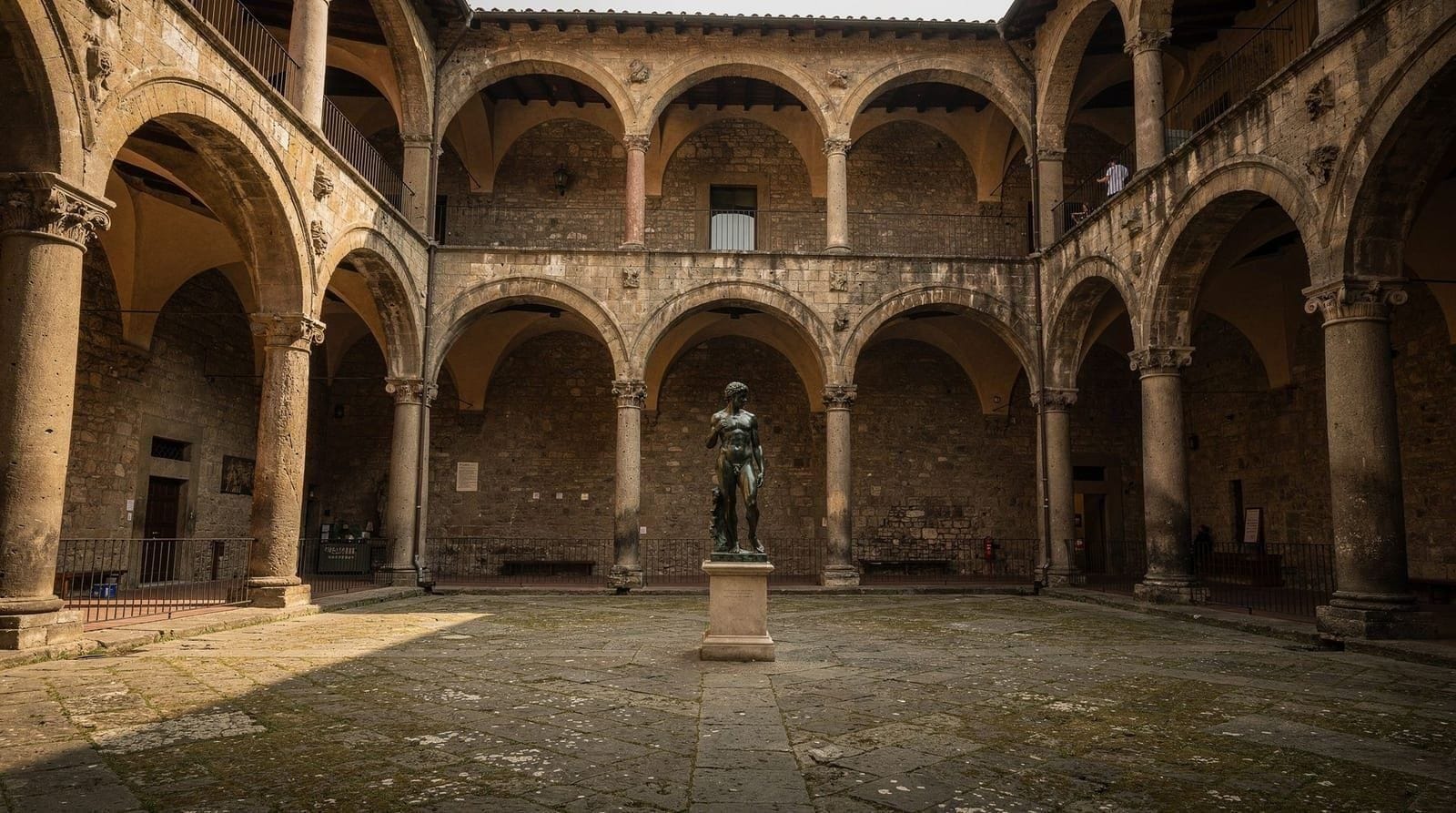
The Bargello (Via del Proconsolo 4, open daily 08:15-17:00, closed Tuesdays and some Mondays) was Florence’s first civic building and served at different points as a prison, courthouse and barracks. The courtyard has the authentic feel of a medieval fortress: stone walls, external staircases, coats of arms carved into stone.
The collection is primarily Renaissance sculpture, which sounds dry but is not. Key works:
- Donatello’s bronze David — the first free-standing nude male sculpture since antiquity, and notably smaller and more relaxed than Michelangelo’s. Good for comparison.
- Donatello’s Mary Magdalene — carved in wood, raw and affecting
- Verrocchio’s bronze David — the one that was modelled on a real young man (possibly Leonardo da Vinci, his apprentice)
- Michelangelo’s early Bacchus — an intentionally tipsy young man, which children find funny
Entry: EUR 8-10 adults (varies by exhibition period), free for EU under-18. No booking fee required; walk-in almost always possible.
What children remember: The courtyard (it really feels like a castle), the three different Davids, and the fact that Leonardo may have posed for one of them.
Palazzo Vecchio: secret rooms and a tower
Best for: ages 9-14. Visit time: 90-120 minutes. Queues: moderate.
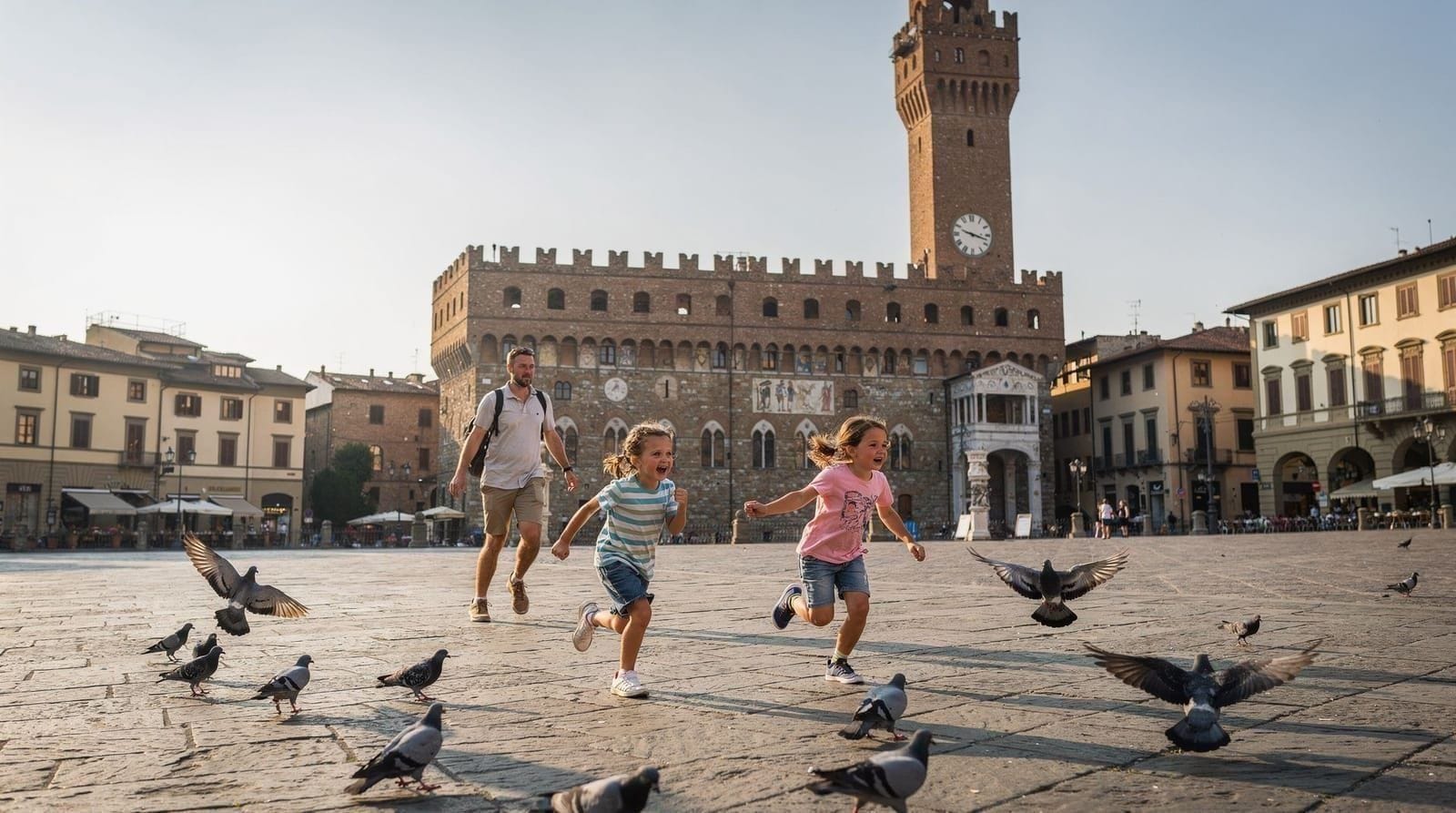
Palazzo Vecchio (Piazza della Signoria, open daily except Thursday, 09:00-19:00) is Florence’s town hall and has been in continuous use since 1299. It is also one of the few museums in Florence that has specifically designed activities for children.
The “Museopé” family trail (available at the ticket desk, free) gives children a themed route through the palace with activities and questions. The studiolo — a tiny room hidden behind a painting — is the highlight: Cosimo I de’ Medici’s private cabinet, with every inch of wall covered in paintings hiding the real storage behind.
The Torre d’Arnolfo (tower climb, EUR 6 extra, children must be old enough to manage the exposed wooden walkway at the top) gives the best views in Florence if you cannot or do not want to climb the Dome.
Entry: EUR 14 adults (museum only), reduced rates for children. The tower is EUR 6 extra. Combined museum+tower tickets available.
What children remember: The hidden room behind the painting, the massive Hall of the Five Hundred (Salone dei Cinquecento), and the tower view.
The Uffizi: honest assessment for families
Best for: ages 12 and up with focused plan. Ages under 12: skip or do briefly. Visit time: 90 minutes minimum. Queues: long without booking.
The Uffizi Gallery contains approximately 50 rooms across two main corridors and is one of the greatest art collections in the world. For adults and art-literate teenagers, it is unmissable. For children under 10, it is typically too long, too dense and too abstract.
If you do bring younger children:
- Book the first slot of the day (8 am; the museum opens 8:15 am on weekdays)
- Set a 90-minute limit before you enter
- Go directly to room 10-14 (Botticelli: Birth of Venus, Primavera), room 35 (Michelangelo’s Tondo Doni), and the Leonardo rooms
- Skip the Dutch and Flemish sections entirely
Timed entry tickets: EUR 20-25 adults (more with booking fee). EU under-18 free. Advance booking via uffizi.it or GetYourGuide — essential in peak season.
What children remember: Birth of Venus (“she’s standing on a shell”), the enormous size of the building, and whether they lasted as long as they thought they would.
Medici Chapels: short and specific
Best for: ages 10 and up with Medici context. Visit time: 45-60 minutes. Queues: short.
The Medici Chapels (Piazza Madonna degli Aldobrandini, open daily except Mondays and some Tuesdays, 08:15-13:50) consist of the New Sacristy designed by Michelangelo and the grandiose Chapel of Princes. The New Sacristy, containing Michelangelo’s sculptures of Dawn, Dusk, Night and Day, is genuinely powerful and relatively quick to see.
This works best as a supplement to a morning that has already included the Accademia, giving children a chance to see more Michelangelo work in context. On its own, it may be too brief to justify the time investment for families with limited days.
Entry: EUR 9 adults (sometimes higher during special exhibitions), free for EU under-18.
Museo Nazionale Alinari della Fotografia: for teenagers
Best for: teenagers. Visit time: 45-60 minutes. Queues: rare.
The Alinari Photography Museum (Piazza Santa Maria Novella 14) holds one of the world’s most important historical photography collections. For teenagers who are interested in visual arts, the rotating exhibitions and the permanent collection of 19th-century Italian photography provide a very different window into Florence’s history than the Renaissance museums.
Entry: EUR 9 adults, EUR 6 for under-18. Worth 45 minutes for the right teenager.
Practical museum planning for families
Getting into museums without queuing
The most reliable booking platforms are the official museum websites (uffizi.it for the Uffizi and Accademia) and GetYourGuide for guided tours with skip-the-line access. Our booking guide covers the full process.
Avoid resellers offering “skip-the-line” tickets at dramatically higher prices near museum entrances — these are legal but overpriced. The official booking fee (EUR 4) is all you need to pay on top of admission.
The Firenzecard: is it worth it for families?
The Firenzecard covers 60+ museums for EUR 85 (adults only; children still get free/reduced entry separately). For a family of two adults and two children spending 3-4 days with 2-3 major museums per day, it can represent good value — but only if you actually use it intensively. Our Firenzecard guide has the full calculation.
Free entry days
The first Sunday of each month offers free entry to all Italian state museums. This sounds like a gift but comes with a significant crowd penalty — the Uffizi on a free Sunday is extremely busy. Our recommendation: pay for entry mid-week and save queuing energy for the museums themselves.
Audio guides and family apps
The Uffizi and Accademia both have official audio guide apps (downloadable before your visit). Several private companies offer family-specific audio guides designed for children, with shorter explanations and story-based commentary. These are worth the EUR 5-8 investment.
Museum logistics by age
| Age | Best museum | Duration | Pre-booking needed? | Free entry (EU)? |
|---|---|---|---|---|
| 4-7 | Museo Galileo | 60 min | No | No |
| 6-9 | Bargello | 75 min | No | Yes |
| 8-12 | Accademia | 90 min | Yes | Yes |
| 9-14 | Palazzo Vecchio | 90-120 min | Recommended | Partial |
| 12+ | Uffizi (focused) | 90 min | Yes | Yes |
| 10+ | Medici Chapels | 60 min | No | Yes |
| Teen | Alinari Photography | 45 min | No | Reduced |
Frequently asked questions about kid-friendly museums in Florence
Can I bring a stroller into Florentine museums?
Most major museums accept strollers/prams but require them to be checked at the cloakroom in some buildings. The Uffizi and Accademia have ramps and lifts but the approach roads are cobblestoned. Folding strollers are much more practical. Baby carriers are unproblematic in all museums.
Are there any hands-on museums for children in Florence?
Museo Galileo has the best hands-on content. Palazzo Vecchio runs occasional family workshops (check their website). The Oltrarno artisan workshops offer hands-on leather and bookbinding experiences for children aged 8 and up, though these are not traditional museums.
How do we make museum visits more engaging for children?
Three techniques work well: (1) tell the story before entering, not during — read the David story the night before, not in the rotunda; (2) give children a scavenger hunt card (many museums provide these, or make your own); (3) set a clear end time before you enter so children know the exit is coming.
Is there a children’s museum in Florence?
Florence does not have a dedicated children’s science or discovery museum in the style of northern European cities. The closest equivalent is Museo Galileo for science content and the Palazzo Vecchio for interactive historical content. The Boboli Gardens and Cascine Park serve the outdoor play role.
What’s the best single museum if we only have time for one with kids?
Museo Galileo for children under 10 — it’s short, hands-on, has no queue, and the story of Galileo’s trial is genuinely gripping for that age. For children 8 and up, the Accademia edges it out, since seeing the David in person is the kind of thing children remember years later, but it requires booking ahead to avoid the queue.
Do teenagers actually enjoy Florence’s museums, or is it mainly younger children who benefit?
Teenagers with any interest in art or history often get more out of Florence than younger children, since they can engage with the full Uffizi, the Bargello’s sculpture comparisons, and the Alinari photography collection without needing the pacing adjustments smaller children require. The main risk with teenagers is boredom from over-scheduling, not attention span — build in free time and let them choose one thing to focus on rather than marching through every room.
Combining museums with food: the practical pacing strategy
The most consistent mistake families make in Florence is trying to do too much in a single museum day. The better approach structures each day around one museum in the morning, a food break that is an experience in itself, and an outdoor activity in the afternoon.
The sequence that works:
Morning (9-11 am): Museum visit (Accademia for David, or Bargello, or Galileo). Keep to 90 minutes maximum. Exit before 11:30 am.
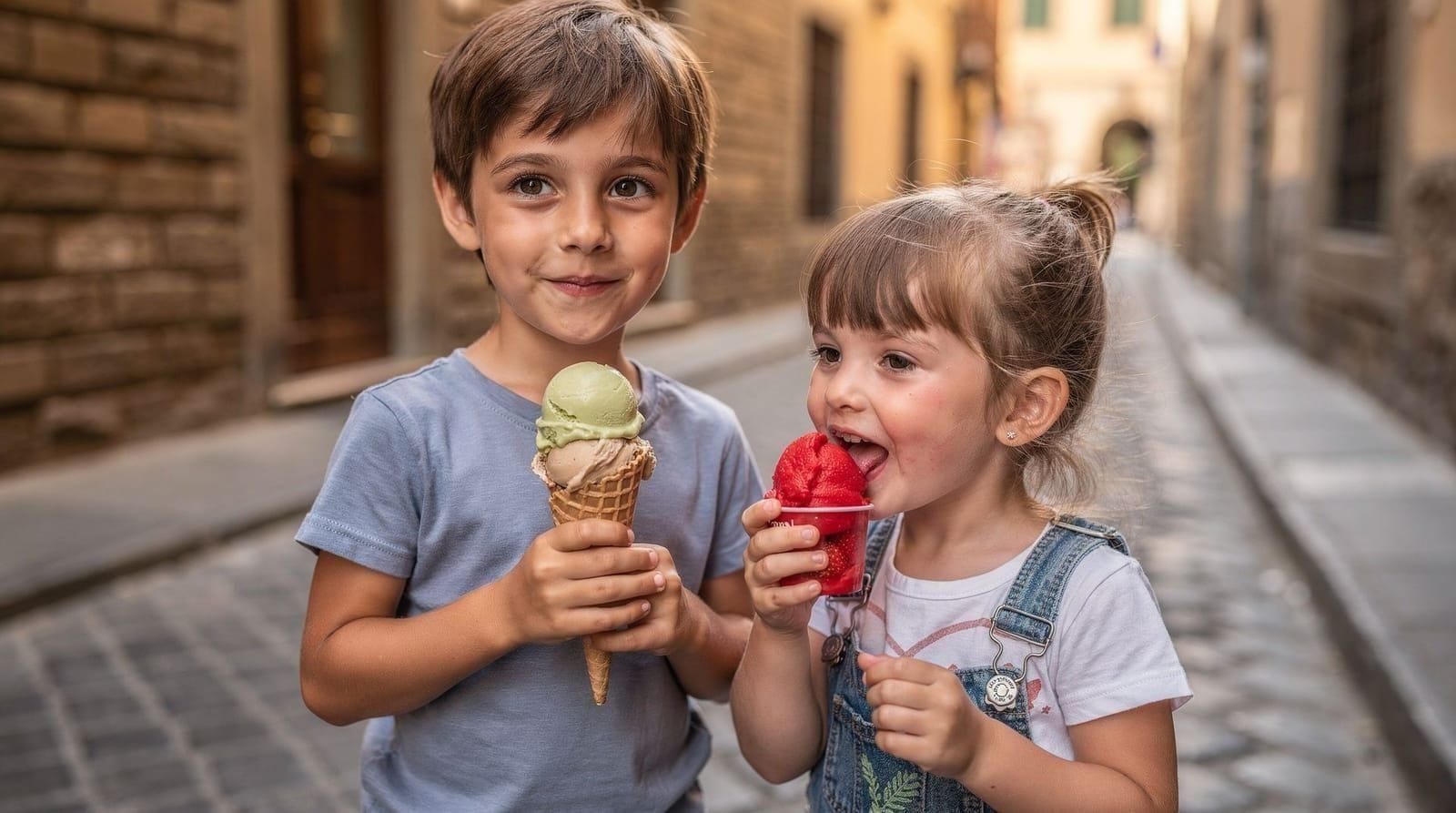
Mid-morning break (11:30 am-12 pm): Gelato or schiacciata (flat olive-oil bread) from a bakery — not a sit-down meal but fuel. Children who have been walking marble corridors since 9 am are usually hungry and slightly overstimulated by noon.
Lunch (12-1:30 pm): A neighbourhood trattoria. Avoid places immediately near museums (prices inflate near tourist destinations). Walk 3-4 minutes from the museum entrance and the options improve immediately.
Afternoon (2-5 pm): Boboli Gardens, Piazzale Michelangelo, or Cascine Park. Physical outdoor time after indoor morning.
This pacing is more sustainable than attempting two museums in a day with young children — and you will see the museum content better without the children’s attention already exhausted.
Museum shop strategy
Florence’s museum shops are among the best in Europe for quality reproductions, art books and educational materials for children. Key recommendations:
Uffizi museum shop: Excellent art books at all levels — picture books explaining the Botticelli paintings for ages 5-8, proper art history texts for teenagers. Reproductions of Botticelli details work as room decoration and conversation starters.
Accademia museum shop: Postcards and small reproductions of Michelangelo works. The boxed set of postcards showing the Prisoners and David in sequence is educational and very portable.
Bargello shop: Less commercial than the larger museums — good quality and less touristy. Look for reproductions of the Donatello bronzes.
The museum shops are inside the museum — you access them on your way out without re-entering. For children who want something to take home from the museum day, budget EUR 5-15 for a small reproduction or book.
What to skip if you have limited days
With only 2-3 days and children in tow, resist the urge to fit in every museum on this list. The Medici Chapels and the Alinari Photography Museum, while worthwhile, are the easiest to cut if time is short — both work better as additions on a longer trip than as priorities on a short one. Palazzo Vecchio’s tower climb is also skippable if you’ve already done Giotto’s Campanile or the Duomo dome, since children rarely need two tower climbs on the same trip. Prioritise Museo Galileo and the Accademia first; add Bargello if the children are engaged and still have energy; treat everything else as bonus content for a return visit.
Pre-trip preparation: making the most of museum visits
Children who arrive in Florence with some knowledge of what they are about to see have significantly richer experiences. Three preparation approaches that work:
Books for children aged 6-10: Illustrated guides to Renaissance art aimed at children are available in English. The “Florence for Kids” format is sold at major bookshops (Feltrinelli in Piazza della Repubblica has English titles). Reading about the David story or Botticelli’s paintings the evening before the museum visit primes children’s attention.
Audio guides and apps: Several museum apps (the Uffizi has an official app available free) allow children to explore content before arrival. The Accademia app includes a children’s mode with shorter explanations.
The “one thing” rule: Ask each child to find one thing in the museum that they want to tell someone about when they get back. This gives children an active role rather than passive observation. The stories children choose are often surprising — not the most famous works but the most personally resonant ones.
Connecting to school curriculum: Children who have studied the Renaissance in school (common in the UK, US, and many European systems) benefit from seeing the physical reality behind what they have learned abstractly. Knowing that Michelangelo was 26 when he started the David and that the marble block had been rejected by two previous sculptors makes the statue meaningful rather than merely impressive.
Building a full family day around one museum
A single well-chosen museum, paired with outdoor time and food, makes a more satisfying family day than trying to cover two museums. If you’re planning several days with children in Florence, our Florence with kids itinerary sequences museum mornings against park and gelato afternoons across a full multi-day stay, so you’re not reinventing the pacing each morning. For rainy days when the outdoor half of the plan falls through, the rainy day Florence guide has indoor alternatives that still respect the same 90-minute attention ceiling.
Top experiences
Bookable activities with verified prices and instant confirmation on GetYourGuide.