A day trip to San Gimignano: medieval towers, Vernaccia wine, and the best saffron gelato in Italy
| Where | 56km south-west of Florence, Siena province |
| Cost | Around €8–12 train + €2.50 bus, or €40–60 on a tour |
| Time needed | Half a day minimum, full day better |
| Getting there | Train to Poggibonsi + bus, or car (1h15) |
| Best time to arrive | Before 9am or after 4pm |
The tower town that earned its nickname
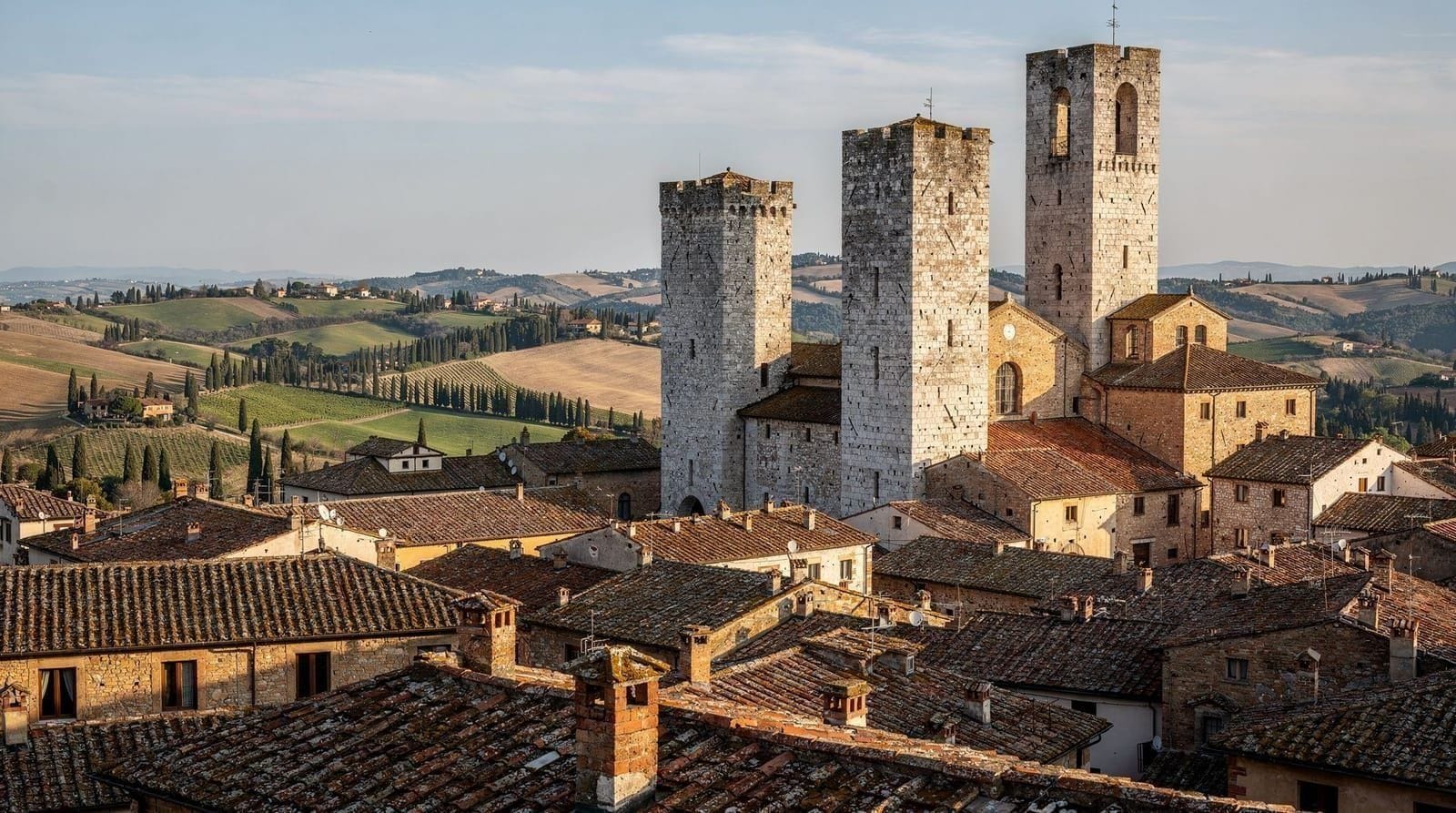
San Gimignano sits on a ridge in the Siena province, 56 kilometres south-west of Florence, and from a distance it looks like a children’s drawing of a medieval city: too many towers, too concentrated, too perfectly silhouetted against the sky to be entirely real. There are fourteen towers still standing of the original 72 built by competing noble families in the 12th and 13th centuries. In the Middle Ages, height meant power; the higher your tower, the greater your family’s prestige and, in case of civil conflict, the stronger your defensive position.
The result — a cluster of medieval towers rising above the Tuscan plain — is the most visually striking skyline in Tuscany and the reason San Gimignano was declared a UNESCO World Heritage Site in 1990. It is also, on certain August afternoons, one of the more overcrowded places in Italy.
This guide covers how to see it without being part of the problem.
Getting there from Florence
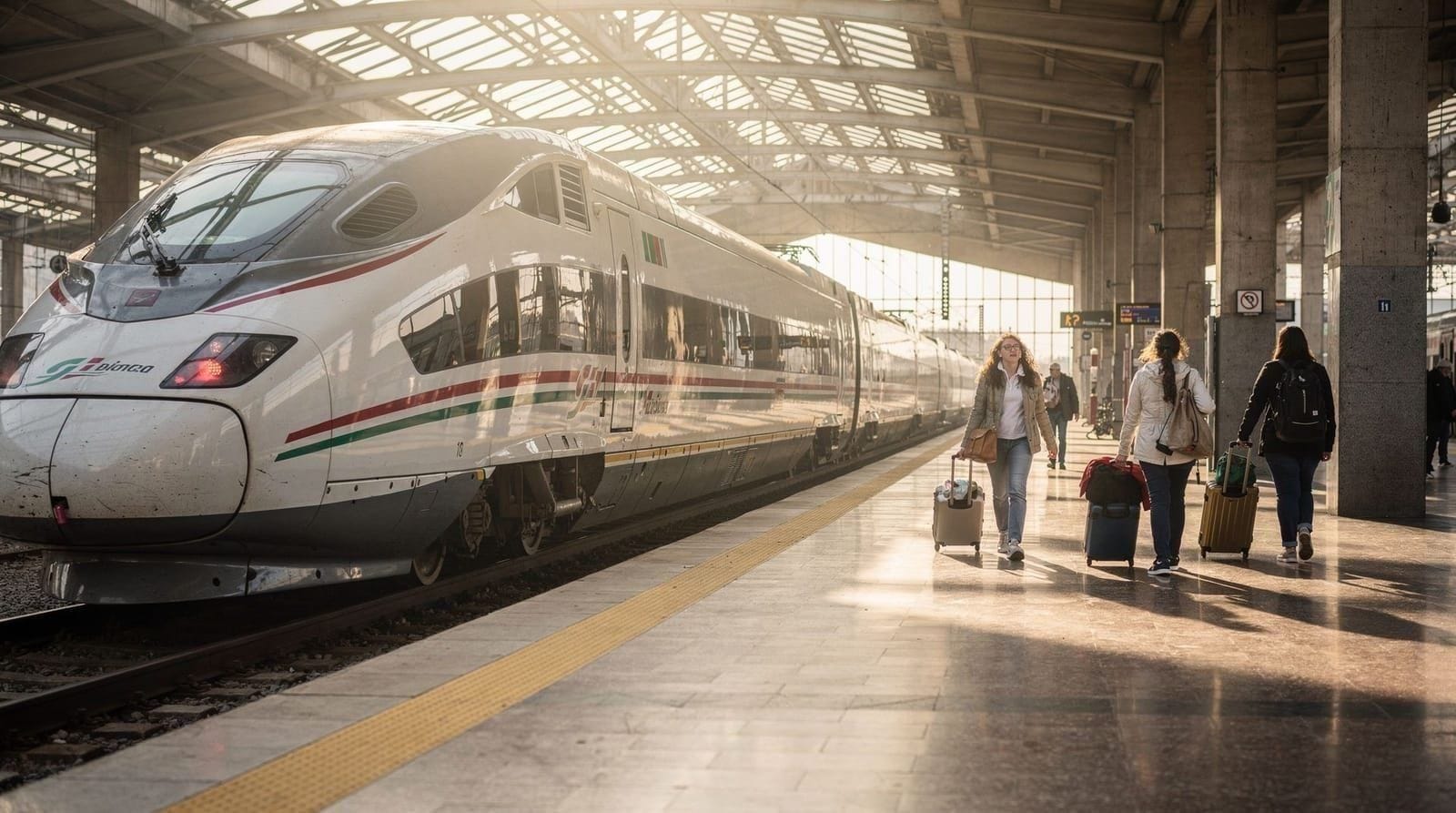
San Gimignano has no train station. The closest rail connection is Poggibonsi-San Gimignano, served by trains from Florence Santa Maria Novella (about 1 hour, €8–12), with a connecting bus from the station up to the town (20 minutes, approximately €2.50). The total journey is about 90 minutes from Florence centre.
Alternatively: most day tours from Florence include San Gimignano as part of a combined Siena and Chianti itinerary. These typically depart around 8:30–9 a.m. and return by 7–8 p.m., with transport included. The best day trips from Florence guide covers the comparison between going independently and joining a tour.
By car: 1 hour 15 minutes via the superstrada (toll-free) through Poggibonsi. Parking is outside the walls (the historic centre is limited traffic zone); the car parks at Porta San Giovanni and Porta San Matteo have spaces and are a short walk from the main gate.
When to arrive and when to leave
San Gimignano’s tourist pressure is extreme and disproportionate for a town of 8,000 residents. The tour coaches start arriving around 10:30 a.m. and the main street — Via San Giovanni running north from Porta San Giovanni to the piazzas — becomes almost impassably crowded by midday in summer.
The optimal schedule: arrive by 9 a.m. before the coaches, spend the mid-morning doing the towers and main sights, have lunch in the town, and leave by 2 p.m. as the afternoon crowd peaks. Alternatively, arrive mid-afternoon (4 p.m.) and stay into the evening — day visitors largely clear out by 5–6 p.m., and the town at 7 p.m. on a summer evening, nearly empty, with the towers lit, is the version worth staying for.
This means either booking the first bus/train from Florence or booking accommodation in San Gimignano itself (see below for why that’s a good idea anyway).
The towers: which ones to climb
Of the fourteen surviving towers, one is publicly accessible for climbing: the Torre Grossa (“Big Tower”), which is part of the Palazzo Comunale complex in Piazza del Duomo. The climb involves 218 steps and takes about 20 minutes up and down. The view from the top — over the town’s own towers, the surrounding vineyards and olive groves, the ridge of hills toward Siena — is among the finest in Tuscany.
Entry to the tower is included in the Palazzo Comunale and Museum ticket (approximately €9), which also covers the civic museum with its Sienese Gothic paintings and the Sala di Dante (where Dante delivered an address on behalf of Florence in 1300, when he was a city official).
Don’t rush the climb. The view from the top is significantly better than the view from halfway, and the tower at its summit provides a perspective on the other towers — seeing them from above rather than from their bases — that is the visual argument for why they were worth building.
What to see beyond the towers
Collegiata di Santa Maria Assunta: The main church of San Gimignano contains a remarkable cycle of frescoes — Old Testament scenes on the north wall, New Testament scenes on the south wall, and a Last Judgment fresco of considerable scale and ambition on the west wall. These were painted in the 14th century and are in better condition than most medieval church frescoes because San Gimignano’s relative obscurity after the plague of 1348 meant the church wasn’t continuously renovated. Admission €4.
Sant’Agostino church: At the northern end of town, quieter and less visited than the Collegiata, with a beautiful cycle of frescoes in the choir depicting the life of St Augustine painted by Benozzo Gozzoli in 1465.
The two piazzas: Piazza della Cisterna (named for its 13th-century well) and Piazza del Duomo connect in the centre of town. The Cisterna piazza is the more atmospheric — brick-paved, with the well at its centre and the towers rising on three sides. This is where the afternoon aperitivo life happens when the day visitors have left.
Vernaccia di San Gimignano: the wine
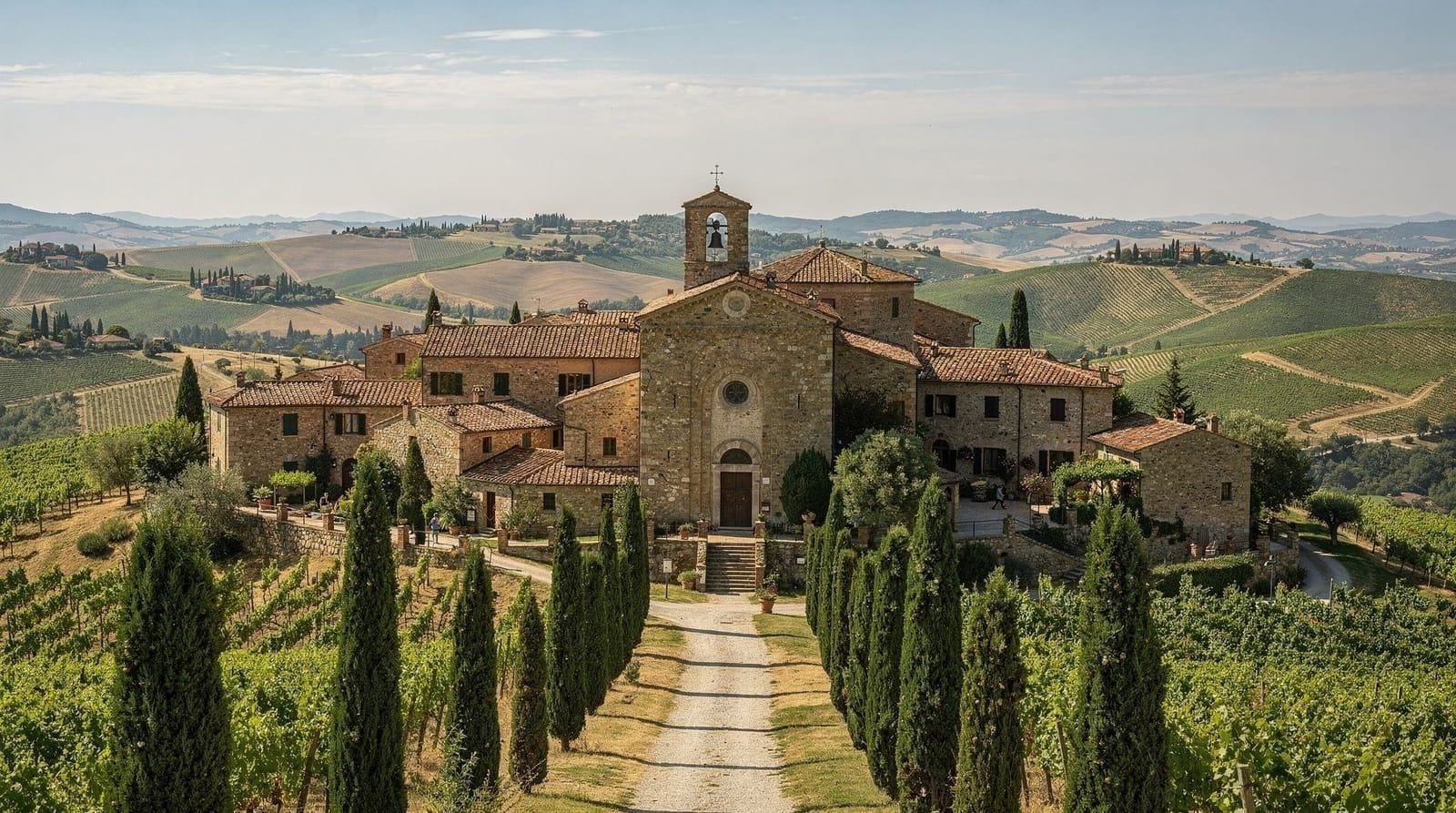
San Gimignano produces Italy’s first DOCG white wine: Vernaccia di San Gimignano, a dry, aromatic white made from the Vernaccia grape variety that has been grown here since at least the 13th century. The wine is produced within a specific zone around the town, with approximately 70 producers ranging from large co-operatives to single-estate producers with a few hectares.
The flavour profile varies considerably by producer and vintage: at its best, Vernaccia is dry, golden, with a slightly bitter almond finish and good minerality from the galestro soil. At its worst, from producers who overcrop or pick early for volume, it’s thin and acidic. The Chianti wine guide covers the Vernaccia alongside the other Tuscan white wine traditions.
For tasting: the enoteca run by the Consorzio del Vino Vernaccia di San Gimignano in the rocca (the old fortress, a 10-minute walk from the town centre) offers structured tastings of local wines in a setting with excellent views. Several producers have tasting rooms in the town; look for the “Vino Vernaccia” signs.
The gelato you should not miss
The Gelateria Dondoli in Piazza della Cisterna — run by Sergio Dondoli, who has won the World Gelato Championship twice — is genuinely world-class and worth the queue. The saffron-and-pine-nut gelato is the signature flavour and was invented here; it should be tried once on principle.
The flavours change seasonally. In addition to the saffron, the Champelmo (grapefruit sorbet with Rosé Champagne and grappa) and the Crema di Santa Fina (cream with saffron, named after the town’s patron saint) are both outstanding. Prices are €3–4.50. The queue in summer can be 20–30 minutes; arrive before 10 a.m. or after 4 p.m. for a shorter wait.
There are several other gelaterias in San Gimignano positioning themselves as rivals to Dondoli. One or two are good. Most are trading on the town’s gelato reputation without competing with the original. The Dondoli queue is worth it.
Where to eat lunch (and when)
The restaurants on Via San Giovanni, the main tourist street, mostly serve the undiscriminating tourist lunch: pasta with mushroom sauce, bistecca, tiramisu. These are not necessarily bad — the ingredients in Tuscany are good even when the cooking is mediocre — but they’re not the reason to travel 56 kilometres from Florence.
Walk instead to Piazza Sant’Agostino at the north end of town, which has a couple of restaurants serving a more local clientele. Ristorante La Mangiatoia, a few streets from the main piazza, has good ribollita and roast pork. The enoteca options near the rocca tend to have better wine lists.
Lunch should be before the noon rush or after 2 p.m. The tables at the better restaurants fill by 1 p.m. and empty by 3.
Is it worth staying overnight?
Yes, if you have time. San Gimignano at 7 a.m. — after the overnight visitors have gone, before the day-trippers arrive — is a different town. The towers in the early light, with no crowds, the fog sometimes sitting in the valleys below the ridge, is one of the better arguments for building extra time into a Tuscany itinerary.
Several agriturismo options in the surrounding hills offer the combination of countryside accommodation and easy access to the town. The staying in Tuscany vs day trips guide covers the comparison.
San Gimignano combined with Siena and Chianti
Most guided day tours from Florence combine San Gimignano with at least one other stop — usually Siena and/or a Chianti winery. The combined format (San Gimignano towers in the morning, Siena Cathedral in the afternoon, Chianti wine tasting at a winery, return to Florence by evening) covers a significant part of southern Tuscany’s highlights in one long day.
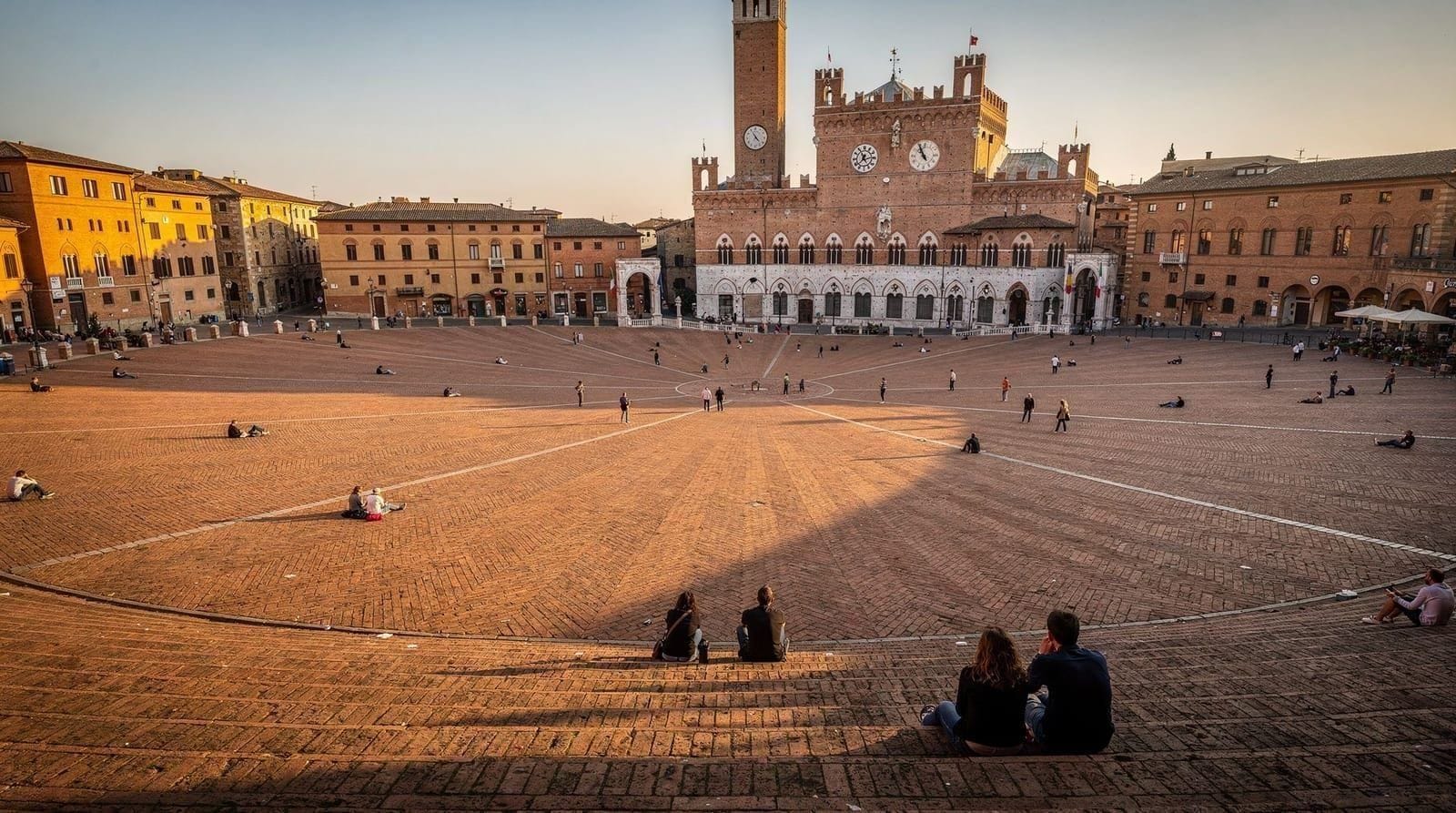
This is compressed — you’re getting a tasting rather than a deep experience of any single place — but it’s legitimate for first-time visitors who want an overview. The Siena day trip guide covers the case for spending more time in Siena specifically. If Chianti is the priority rather than a quick add-on, the Chianti day trip guide makes the case for dedicating a whole day to the wine region instead of splitting it three ways.
How San Gimignano compares to other Tuscan hill towns
If you’re deciding between San Gimignano and other hill towns rather than trying to see all of them, the honest distinction is this: San Gimignano wins decisively on skyline and is the most photogenic from a distance, but it’s also the most crowded and the most tourist-priced of the group. Volterra, 30 minutes further south-west, has a similar medieval density with a fraction of the crowds and a genuinely different atmosphere — more working town, less stage set. Montepulciano and Pienza, further south in the Val d’Orcia, trade the towers for Renaissance architecture and a slower pace. If your time is limited to one hill town, San Gimignano earns the reputation; if you have two days, pairing it with Volterra shows you the range.
Frequently asked questions about the San Gimignano day trip
How far is San Gimignano from Florence?
56 kilometres by road, roughly 1 hour 15 minutes by car or 90 minutes by public transport (train plus bus).
Can you combine San Gimignano with Siena in one day?
Yes — it’s a common combination and the two towns are about 40 kilometres apart. San Gimignano in the morning (arrive 9 a.m., leave 1 p.m.) and Siena in the afternoon (arrive 2 p.m., leave 6 p.m.) is manageable but creates a rushed feeling in both places. Better to pick one for a longer visit unless you’re joining an organised tour that handles the transitions.
Is San Gimignano expensive?
More expensive than comparable Tuscan hill towns because of the tourist traffic. Lunch at a restaurant runs €20–40 per person. The tower climb/museum entry is €9. Gelato at Dondoli is €3–4.50. A night in a local hotel or B&B runs €80–150 for a double.
When should I avoid San Gimignano?
July and August weekends and any Italian public holiday. The town is genuinely overwhelmed on these dates. The shoulder months — April, May, September, October — are significantly better, and November has the specific advantage of very few visitors and the olive harvest beginning in the surrounding groves.
Is the tower climb suitable for kids or people with limited mobility?
The Torre Grossa climb is 218 narrow stone steps with no lift, so it’s not accessible for wheelchairs or significant mobility limitations. Children old enough to manage stairs steadily usually enjoy it, but keep a close hold on younger ones — the steps are uneven and the final stretch is a narrow spiral. The town itself, outside the tower, is manageable on foot though the streets are cobbled and slope steeply in places.
Top experiences
Bookable activities with verified prices and instant confirmation on GetYourGuide.