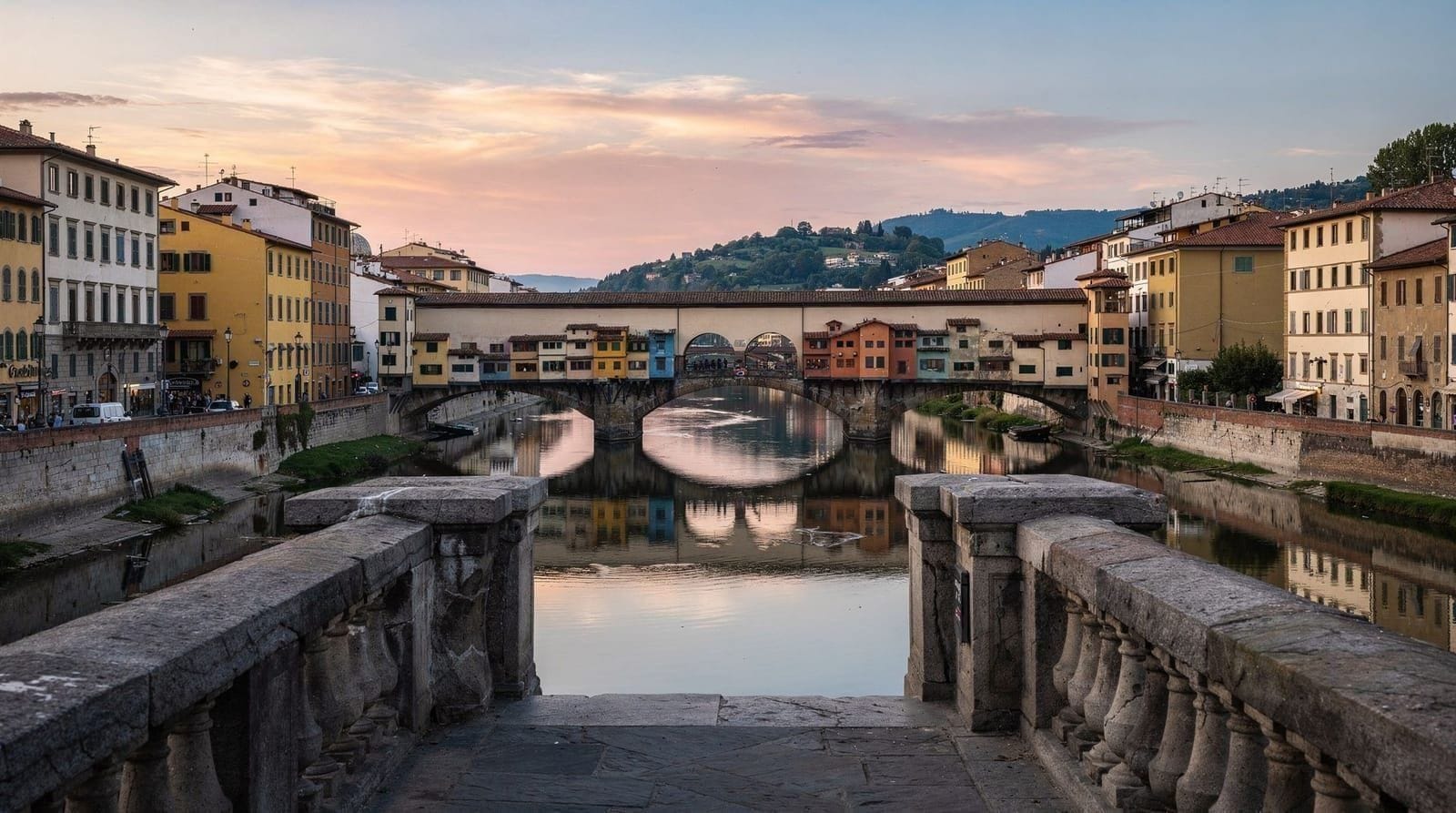
Sunset at Piazzale Michelangelo: the honest guide to Florence's best viewpoint
| Where | Oltrarno hillside, above Florence’s south bank |
| Time needed | 30–45 minutes at the terrace, plus the climb |
| Cost | Free; only the terrace bar/restaurant charges |
| Getting there | 20–25 minute walk from the Ponte Vecchio, or bus 13 |
| Best time | Early morning for solitude, 30–45 min before sunset for the classic view |
The view is real, the crowds are real, and you should go anyway
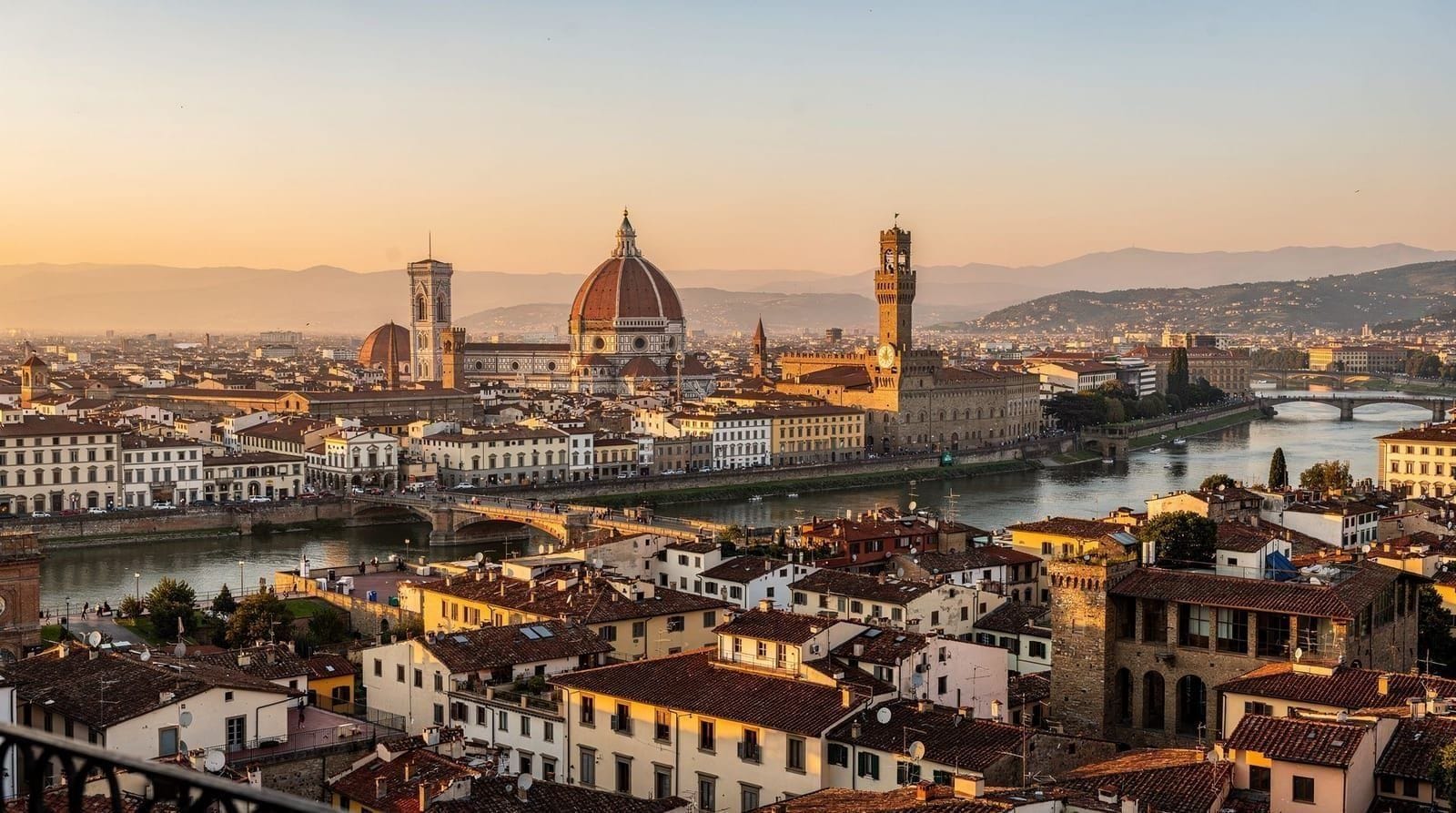
Piazzale Michelangelo is the terrace cut into the Oltrarno hillside above Florence, accessible by a long zigzagging staircase or a winding road, and it offers what is probably the most photographed view in Tuscany: the city’s terracotta roofline dominated by the Duomo’s dome, the Arno snaking through the centre, the hills of Fiesole and Mugello rising beyond the northern suburbs.
The view is genuinely extraordinary. It is also, between approximately 6 p.m. and 8:30 p.m. in summer, shared with several hundred other people who have had the same idea. This is a fact about Piazzale Michelangelo: it is popular, and its popularity is a structural feature rather than a temporary problem.
Here is the honest guide to making the most of it.
How to get there
The most satisfying route is on foot from the south bank of the Arno. From the Ponte Vecchio, cross to the Oltrarno and walk south-east along the river. After about five minutes, turn uphill on the Viale Poggi and follow the road as it curves, or take the stepped path (Scalinata del Poggi) that zigzags more directly up the hill. The climb takes about fifteen minutes at a moderate pace.
This approach is better than arriving by bus (line 13 from the station runs to the piazzale) or by taxi — not because it’s more virtuous, but because you arrive having passed through the Oltrarno and having earned the view gradually rather than stepping out of a vehicle directly into it.
An e-bike or a segway tour from the city centre is also a legitimate option, particularly for those who don’t want to climb in the heat. Several operators run sunset-specific tours that combine a guided walk or ride through the Oltrarno with arrival at Piazzale Michelangelo at the right moment. The best photo spots in Florence guide covers the photography angle.
When to go for the best experience
Worst time: A weekend evening in July or August, arriving between 6:30 and 7:30 p.m. This is peak-of-peak. The bus from the city centre stops here, the tour coaches stop here, and every visitor to Florence who has read the same travel blog you read will be there simultaneously. The view is still beautiful. The experience is not.
Better time: A weekday evening, or September/October when the summer crowds thin significantly. The September light is particularly good — longer days than winter but with the warm angle of late season, casting the city’s terracotta in tones that the flat summer overhead light doesn’t produce.
Best time overall: Early morning. The piazzale at 7 a.m. is almost empty, the light comes from the east and illuminates the Duomo frontally, and the city is just beginning its day below you. The view at this hour is the one the photographs aspire to. Bring coffee in a thermos.
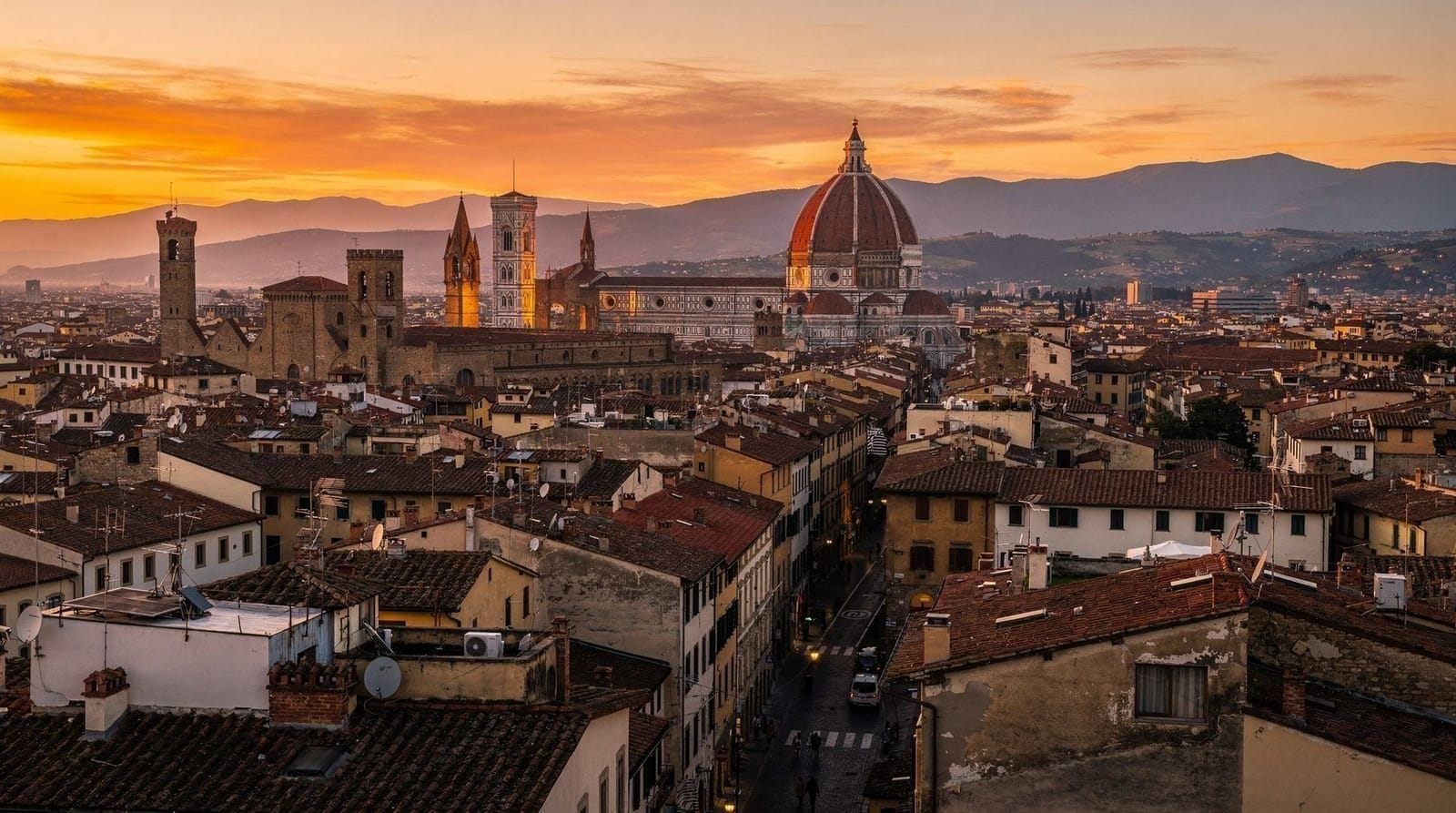
For photography specifically: The golden hour before sunset gives the dome and campanile a warm-toned illumination that photographers chase. The hour after sunset, in the blue hour, the city lights begin and the sky goes a deep cobalt that is genuinely beautiful if you stay for it.
What the piazzale actually is
Piazzale Michelangelo was designed by the architect Giuseppe Poggi in 1869, as part of a comprehensive restructuring of Florence’s southern hillside when the city briefly served as Italy’s capital (1865–1871). The bronze replica of Michelangelo’s David in the centre of the square is often missed in the rush for the view — it’s a later addition and significantly less interesting than the real thing, but it’s there, along with four smaller bronze figures based on the Medici tomb figures.
The terraced gardens below the piazzale — part of Poggi’s original design — are largely overlooked and often almost empty even when the main terrace is crowded. Descending into the gardens and finding a bench with a partial view of the city below is a more peaceful alternative to the main terrace.
The secret upgrade: San Miniato al Monte
A hundred metres above Piazzale Michelangelo, up another flight of steps and through a small park, is San Miniato al Monte — a Romanesque church begun in 1018 and one of the oldest and finest examples of Romanesque architecture in Tuscany. The church sits on a hilltop with a view that is marginally better than the piazzale’s (you’re slightly higher, the angle slightly different) and almost always significantly less crowded.
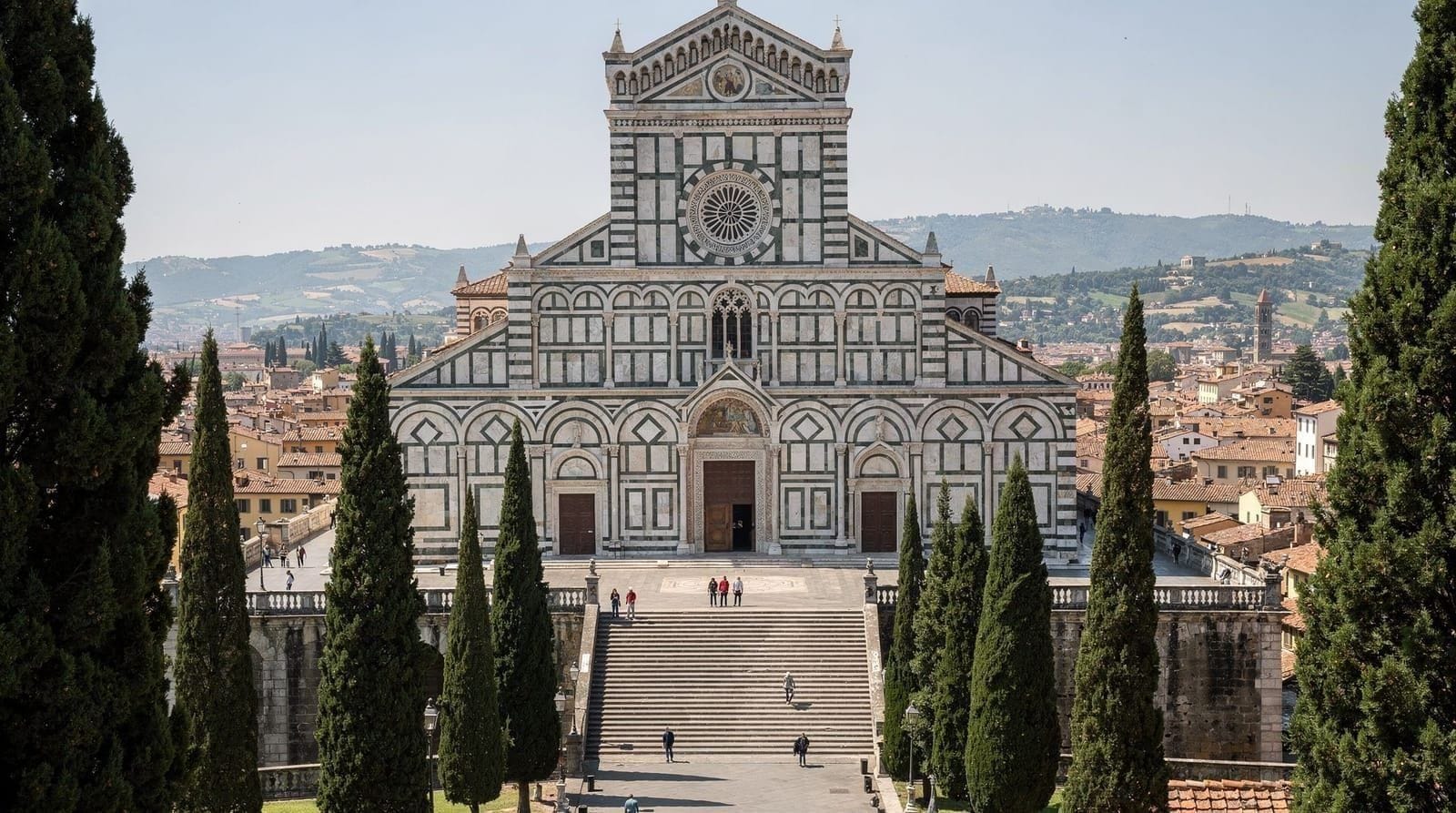
The church itself is extraordinary: a green-and-white marble facade, a 13th-century mosaic in the apse, a raised choir accessed by marble stairs, a crypt with columns taken from ancient Roman buildings. The monks who maintain it sing Vespers at 5:30 p.m. on weekdays — Gregorian chant echoing through a thousand-year-old stone church, with the city visible through the west door if you’re standing in the right place.
This is not a secret widely kept — the sunset spots Florence guide covers San Miniato prominently — but it is consistently less crowded than the piazzale because it requires the additional climb and because many visitors don’t know it exists.
The combination — Piazzale Michelangelo first, then climb to San Miniato for Vespers and the view from a slightly higher angle — is the classic Oltrarno sunset programme and can be done in two hours from the Ponte Vecchio.
Other viewpoints that don’t get enough attention
The view from the Duomo dome (accessible with the Duomo complex ticket, €20) is different from the piazzale in that you’re looking out from the centre of the city rather than down at it from outside. The city radiates outward from where you’re standing, and you can see the Oltrarno hill and the piazzale itself in the distance. The dome climb is popular but manageable with advance booking — do the Duomo complex ticket process before you go.
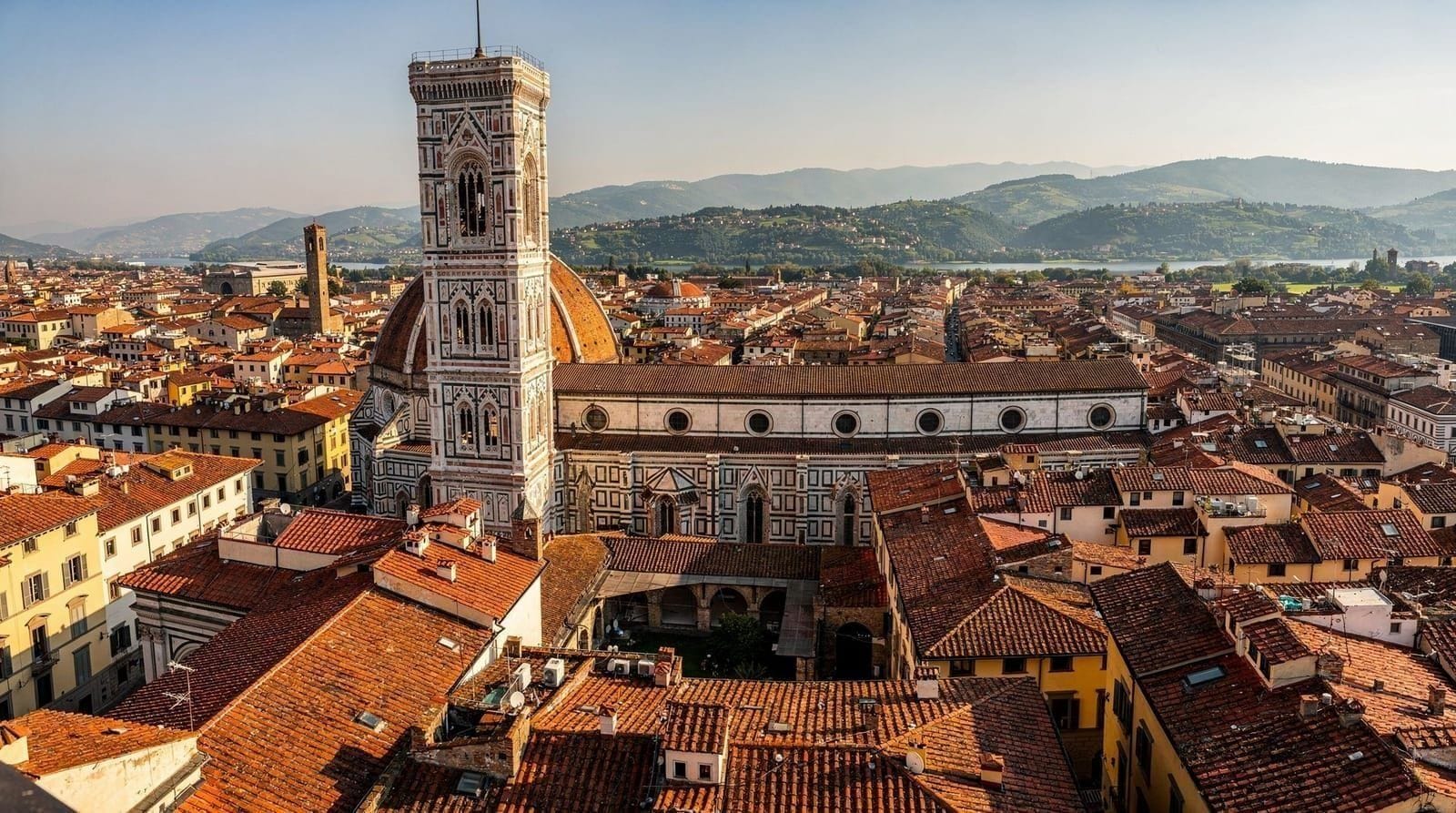
Giotto’s bell tower (Campanile) next to the Duomo is sometimes overlooked in favour of the dome but offers a slightly more open view — you’re standing in an enclosed space on the dome, but the campanile has open arched windows with no glass, which photographers prefer.
Fiesole, the Etruscan and Roman hill town above Florence to the north, offers a panoramic view of the city from a different direction and elevation. The view from the Franciscan friary above the main piazza shows the Arno valley and the city in a way that gives you more sense of Florence’s setting in the landscape. The Fiesole half-day guide covers the logistics.
The Bardini Gardens, on the hillside just east of the Boboli, offer a terrace with a view that rivals the piazzale’s and is consistently much less visited. The gardens cost €10 and are open during museum hours; the view from the upper terrace in the late afternoon is the equal of anything you’ll find at the piazzale.
Practical notes for the piazzale
There is no entrance fee — the piazzale is a public terrace and always open. The bar/restaurant on the terrace is overpriced and not particularly good; bring your own drinks or get something from a bar in the Oltrarno before climbing.
Parking is available (limited), but driving to the piazzale means navigating the one-way roads on the hillside, which is stressful. The ZTL rules don’t apply on the hillside roads, but parking is restricted and fines for parking violations are real.
Public bus line 13 from Piazza della Stazione runs to the piazzale in about 20 minutes. The descent by bus on a crowded summer evening involves being sardined into a vehicle with everyone else who is also descending at sunset; the walk down is preferable.
The bronze David copy stands on a plinth in the centre of the piazzale and is reliably photographed by everyone. It is not the real David. The real David is at the Accademia on Via Ricasoli, where advance booking is essential. The how to see the David without queuing guide covers the booking logistics.
The view by season
Spring (April–May): The hills north of Florence are green, the light is clear, and the city hasn’t yet entered the compressed summer intensity. The view at this time of year tends to have good definition — the Apennines visible on clear days beyond Fiesole.
Summer (June–August): The light is harsh in the middle of the day but the evenings are warm and long, which suits the sunset-seeking programme. The haze that often sits over Florence in July can soften the view considerably; September has better clarity.
Autumn (September–November): The best months for the view in terms of light quality. October and November often produce dramatic clouds and alternating sun-and-rain that creates dynamic lighting conditions. The Chianti vineyards visible on the southern hills start changing colour in October.
Winter (December–February): Cold, occasionally foggy, and the piazzale is almost empty by 5 p.m. In clear winter weather the view has a crystalline quality and the city looks simultaneously more austere and more beautiful. With a coat and patience, a winter morning at the piazzale with nobody else around is one of the best experiences Florence offers.
| Season | Crowd level at sunset | Light quality |
|---|---|---|
| Spring (Apr–May) | Moderate, rising toward May | Clear, good definition of distant hills |
| Summer (Jun–Aug) | Very high, worst in Jul–Aug | Harsh midday sun; hazy evenings, better in Sep |
| Autumn (Sep–Nov) | Moderate, dropping through Nov | Best of the year — dramatic clouds, warm tones |
| Winter (Dec–Feb) | Low, often near-empty | Crystalline on clear days, occasional fog |
An alternative for anyone who can’t face the climb or the crowds
Not everyone wants to climb the Scalinata del Poggi at the end of a long day, and not everyone wants to share the view with a few hundred strangers. If either applies, the Bardini Gardens terrace is the best substitute — a comparable view, a €10 entry fee that filters out casual crowds, and a shorter, gentler approach from the Oltrarno. For those who want the classic postcard shot without the climb at all, the Duomo dome or Giotto’s Campanile give a different but equally striking perspective from inside the city rather than above it — though both require the same advance booking discipline as any major Florence sight.
Frequently asked questions about Piazzale Michelangelo
Is it free to go to Piazzale Michelangelo?
Yes. The piazzale is a public space with no admission charge. The bar on the terrace charges normal (if slightly elevated) bar prices. The surrounding gardens and paths are also free.
How long does it take to walk up from the Ponte Vecchio?
About 20–25 minutes at a moderate pace, via the Viale Poggi and the Scalinata del Poggi steps. The route is well-signed. The walk down takes about 15 minutes.
What time does the sun set in Florence?
In June, sunset is around 9 p.m. In September, around 7:30 p.m. In December, around 4:30 p.m. Plan to arrive at the piazzale 30–45 minutes before sunset for the best light.
Is there parking at Piazzale Michelangelo?
There is a car park on and around the piazzale, but it fills up on summer evenings. The road approach from the Oltrarno is one-way and confusing. Walking up is genuinely easier.
Is Piazzale Michelangelo worth it if I’ve already seen the Duomo dome view?
Yes, and the two views complement each other rather than duplicate one another. The dome view puts you inside the city looking outward at the surrounding hills; the piazzale puts you outside the city looking back at the skyline with the dome as the centrepiece. Most visitors find both worthwhile if time allows, but if forced to choose only one, the piazzale is the more iconic and more relaxed of the two.
Top experiences
Bookable activities with verified prices and instant confirmation on GetYourGuide.