Tuscan wine 101: a beginner's guide to Chianti, Brunello, and everything in between
This is the plain-language version of Tuscan wine — what’s actually in the bottle, what it should cost, and how to order or taste it without pretending to know more than you do. No sommelier vocabulary required.
| Core grape | Sangiovese (in almost every major Tuscan red) |
| Entry price | Around €12–22 for a solid Chianti Classico |
| Splurge price | €50–200+ for top Brunello or Super Tuscans |
| Best places to taste | Florence enotecas, Greve in Chianti, Montalcino |
| Booking | Walk-in tastings work in town; estate visits often need advance notice |
Why Tuscan wine is confusing — and how to stop being confused by it
Italian wine labelling is notoriously difficult for the non-specialist. The labels don’t tell you what grape is in the bottle (they tell you the place); the hierarchy of quality designations (DOC, DOCG, IGT) doesn’t map neatly onto actual quality; and the same grape variety — Sangiovese — produces wines that taste completely different in different zones and under different names.
This guide is for the visitor to Florence or Tuscany who wants to order wine in a restaurant and understand what they’re getting, taste wine at a winery and know what questions to ask, and navigate a wine list without defaulting to “house red” every time.
No sommelier certification required.
The grape you need to know: Sangiovese
Virtually everything important about Tuscan red wine starts with one grape: Sangiovese. It is the dominant variety in Chianti Classico, Brunello di Montalcino (where it appears under the local name Brunello), Morellino di Scansano, and Vino Nobile di Montepulciano (where it’s called Prugnolo Gentile).
The character of Sangiovese: high acidity (that lip-puckering tartness), moderate to high tannin, relatively light body, and a flavour profile that typically includes red cherry, dried herbs (especially dried oregano or rosemary), a hint of tobacco or earth, and in older wines a gradual development of leather, iron, and dried fruit.
The acidity is why Tuscan red wines work so well with food — particularly food with fat (bistecca, pork, aged cheese) or acidity (tomato-based pasta sauces). The tannin, in younger wines, can feel grippy or astringent; in older wines and from good producers, it integrates into the structure of the wine rather than dominating it.
Chianti Classico: the zone and the hierarchy
Chianti is a large DOC zone covering a significant part of central Tuscany. Chianti Classico is a smaller DOCG zone specifically between Florence and Siena — the historic heart of the wine region and the source of the best wines.
The Chianti Classico hierarchy:
Chianti Classico: Minimum 80% Sangiovese (up to 20% other varieties permitted), minimum 12 months of ageing. Entry level; prices typically €12–22. These are drink-now wines, best within 5–8 years of vintage.
Chianti Classico Riserva: Minimum 80% Sangiovese, minimum 24 months of ageing (with at least 3 months in bottle). Better structure and depth than base Classico; prices €18–35. Best from good producers and good vintages; can age 10–15 years.
Chianti Classico Gran Selezione: Introduced in 2014 as the apex of the classification. Single-vineyard wines from the best parcels, minimum 30 months of ageing. Top producers charge €40–100+. These are serious wines that compete with any Italian red for critical attention.
The quality difference between a good Gran Selezione from a producer like Riecine, Isole e Olena, or Montevertine and the entry-level bottles on the tourist-menu wine list is substantial — different fruit, different structure, different ageing potential. If you’re doing one serious Chianti tasting, taste across the hierarchy from the same producer to understand this difference.
The Chianti wine guide and the chianti classico route guide cover the zone in detail.
Brunello di Montalcino: Tuscany’s most prestigious red
Brunello di Montalcino is the most expensive and internationally prestigious Tuscan wine, produced from a single variety — Brunello, a clone of Sangiovese — grown around the hill town of Montalcino, south of Siena. It cannot be released until five years after the harvest (seven years for Riserva), which means you’re drinking wines with genuine age on them.
The profile: deeper and more austere than Chianti Classico, with more tannic grip when young, more complex development with age, and a flavour evolution that can include tar, roses, dried cherry, tobacco, and — in great vintages — an almost indefinable mineral quality. The great vintages (2010, 2012, 2015, 2016 are widely cited) can age 25–40 years or more.
Prices: entry-level Brunello from reliable producers starts at €30–40. Good-to-great Brunello runs €50–100. Riserva from top estates — Biondi-Santi (which invented the classification in the 1880s), Poggio di Sotto, Cerbaiona — can reach €200–500 and more.
If you’re visiting Montalcino itself: the enoteca in the fortress in the main piazza offers a good tasting overview, and several producers maintain tasting rooms in or near the town. The Brunello di Montalcino guide and the Val d’Orcia guide cover the visit in context.
Vino Nobile di Montepulciano: the forgotten aristocrat
Vino Nobile di Montepulciano (not to be confused with the unrelated grape variety Montepulciano d’Abruzzo, which is a different wine from a different region) is a DOCG red from the hilltop town of Montepulciano, east of Montalcino. The grape is Prugnolo Gentile — another Sangiovese clone.
This wine is arguably the least understood of the major Tuscan reds. It falls between Chianti Classico and Brunello in intensity and price, with more structure than many Chianti Classicos and more accessibility in youth than Brunello. Top producers include Avignonesi, Dei, Poliziano, and Salcheto.
Prices: €15–40 for most bottles; top Riserva expressions reach €40–60. The Vino Nobile guide covers producers and tasting options.
Super Tuscans: the rebels that changed Italian wine
In the 1970s, winemakers in Tuscany began experimenting with non-Italian varieties — Cabernet Sauvignon, Merlot, Syrah — that were not permitted in the traditional DOC and DOCG classifications. The resulting wines were technically classified as simple table wines (vino da tavola), the lowest category in Italian wine law, but they were — in the case of Sassicaia and Tignanello — among the most complex and expensive wines being made in Italy.
The Italian wine establishment eventually created a workaround: the IGT (Indicazione Geografica Tipica) designation, which allows wines to be labelled with a regional name without conforming to varietal rules. Most Super Tuscans are now labelled as Toscana IGT.
What counts as a Super Tuscan: broadly, any Tuscan wine that uses non-indigenous varieties or significant percentages of them, and that prioritises modern winemaking techniques (small French oak barrels, cold fermentation, careful sorting) over traditional methods. The iconic names — Sassicaia, Tignanello, Ornellaia, Masseto — are both historically important and extraordinarily expensive (€100–500+ per bottle for current releases).
For most visitors, encountering Super Tuscans means finding them on restaurant wine lists at prices that are lower than retail because restaurants buy in volume. This is a legitimate way to try one without paying retail prices. The Super Tuscans guide covers the full landscape.
Reading a Tuscan wine label at a glance
Labels tell you where the wine is from, not what grape is inside, so learn a handful of terms rather than trying to memorise every producer. DOCG (Denominazione di Origine Controllata e Garantita) is the top legal tier — Chianti Classico, Brunello, Vino Nobile, and Vernaccia di San Gimignano are all DOCG. DOC is a step down, with looser rules and usually lower prices. IGT (Toscana IGT) sits outside the traditional hierarchy entirely and is where most Super Tuscans live, since they use grapes the DOCG rules don’t permit. None of these tiers is a straightforward proxy for quality — a great IGT easily outclasses a mediocre DOCG — but they tell you what rules the producer chose to follow.
Other terms worth recognising: Annata means the standard, youngest release. Riserva means longer mandatory ageing and usually more structure. Gran Selezione (Chianti Classico only) is the newest and highest tier, reserved for single-vineyard or estate-best wines. Vendemmia is simply the vintage year — for Sangiovese-based reds, a warm, dry year like 2015 or 2016 generally outperforms a cooler, wetter one, but producer quality matters more than vintage for anything you’ll drink within a few years of buying it.
Vintage: does it matter if you’re not collecting?
For casual drinking within a year or two of purchase, vintage variation matters less than producer choice — a well-made Chianti Classico from an average year, from a producer who knows their vineyards, will usually beat a mediocre producer’s wine from a celebrated year. That said, if you’re buying a Brunello or a Riserva to lay down, 2015, 2016, 2019, and 2020 are widely cited as strong recent Tuscan vintages, while 2014 and 2017 were more difficult (cool and wet, and hot and dry, respectively). Ask the person pouring — most tasting-room staff and enoteca owners will tell you honestly which vintage on the shelf is drinking well right now.
What to pair with what
Sangiovese’s high acidity makes it a food wine first and a sipping wine second. A young Chianti Classico is the default match for tomato-based pasta and bistecca alla fiorentina, Florence’s iconic grilled steak — the acid cuts through the fat and the char. Brunello, with its more tannic structure, wants something richer: wild boar ragù, aged pecorino, or a slow-braised meat. Vino Nobile sits comfortably in between and is a safe order with most Tuscan restaurant mains. Vernaccia and other Tuscan whites pair best with the region’s simpler seafood and vegetable dishes rather than anything heavily sauced. If you’re building a full meal around wine rather than the other way round, the best restaurants in Florence guide flags which kitchens take their wine lists seriously.
Chianti, Brunello, Vino Nobile, Super Tuscan: how they compare
| Typical price | Character | Ageing potential | |
|---|---|---|---|
| Chianti Classico | €12–35 | Bright acidity, red cherry, food-friendly | 5–15 years (Riserva longer) |
| Brunello di Montalcino | €30–200+ | Deep, tannic when young, complex with age | 15–40 years |
| Vino Nobile di Montepulciano | €15–60 | Between the two above in weight and price | 8–20 years |
| Super Tuscan (Toscana IGT) | €20–500+ | International varieties, modern oak, polished | Varies widely by producer |
Where to base a wine trip
Tasting wine seriously usually means leaving Florence for at least a day. A loop through Chianti covers the Sangiovese heartland in a manageable radius, while Brunello and Vino Nobile require the longer trip toward Siena and the hill towns beyond. If a single day trip is all you have, the Chianti day trip guide lays out a realistic route with tasting stops; for a slower pace, the Chianti wine weekend itinerary spreads the same territory across two days with time to actually linger at a cellar table instead of rushing between stops.
Vermentino and Vernaccia: the whites
Tuscan white wine is less celebrated than the reds but deserves attention. Vernaccia di San Gimignano — Italy’s first DOCG white wine — is made around the medieval tower town and is a dry, aromatic, mineral-edged white at its best. Avoid the mass-production versions; look for single-estate producers like Montenidoli or Teruzzi.
Vermentino, though more associated with Sardinia and the Maremma coast, is increasingly well made in the southern Tuscan Maremma zone — lighter and more sea-influenced than the inland reds.
Galestro — once the workhorse white of Chianti estates — has declined in production but returns to fashion occasionally as a fresh, low-alcohol alternative.
How to taste wine at a Tuscan winery without feeling like an impostor
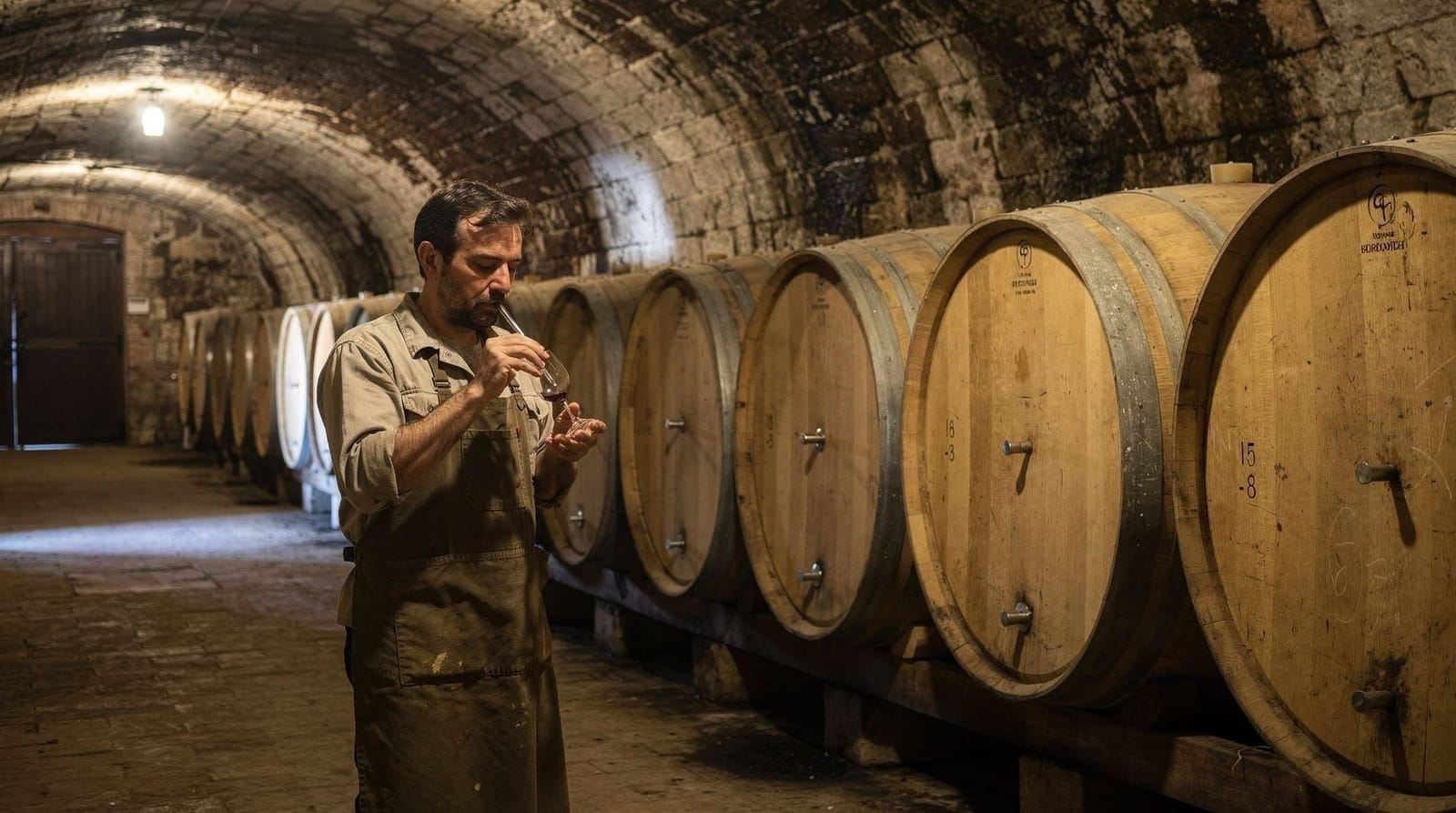
The protocol is simpler than the marketing suggests. You arrive; you’re usually offered a seat at a table or counter. The producer or a guide pours a sequence of wines — typically starting lighter and moving to more complex. You look at the colour, swirl the glass to release aromas, smell it (lean in, take a breath, try to identify what you’re getting), taste it, note your reaction, and decide whether you want more information.
Questions that don’t sound amateur: “What percentage of Sangiovese is this?” “How long was it aged?” “What vintage is this?” “What food would you pair this with?” These are normal questions that any winemaker is happy to answer.
You don’t need to identify every aroma. You don’t need to spit (though this helps if you’re doing several tastings in one day). You don’t need to buy everything you taste. The expectation is that you buy something if you’ve taken up time; a bottle of entry-level wine at €12–18 is an appropriate minimum.
Where to taste without booking ahead
Florence city: Several wine bars and enotecas offer structured tastings without advance booking. The Enoteca Alessi near the Duomo has a good selection of Tuscan producers. Le Murate near the Bargello offers tastings by the glass from a thoughtfully curated list. Buca Mario has an extensive cellar and staff who will discuss the list.
Greve in Chianti: The Enoteca Falorni in the main piazza stocks a comprehensive selection of Chianti Classico and can be tasted at a bar counter without prior arrangement.
Montalcino: The Enoteca Osticcio or the fortress enoteca offer structured Brunello tastings without booking. Most producers’ own estates require appointments but can often accommodate walk-ins outside of harvest season.
The wine tasting in Florence guide and the best wineries near Florence guide cover the practical options in more depth.
Frequently asked questions about Tuscan wine
What is Chianti Classico vs regular Chianti?
Chianti Classico is a DOCG wine made specifically within the historic zone between Florence and Siena, with stricter rules about grape varieties and ageing. Regular Chianti is a DOC covering a larger and more varied area with less rigorous standards. The quality gap between a good Chianti Classico and an average Chianti can be significant.
Is Brunello worth the price?
At the top tier — from producers like Biondi-Santi, Poggio di Sotto, or Cerbaiona — yes, for those interested in great wine. For the casual visitor, a well-made Rosso di Montalcino (the younger, more accessible sibling of Brunello from the same zone) at €15–25 provides a good introduction to the style without the investment.
What wine should I order in a Florence restaurant?
Ask for a recommendation from the Chianti Classico list and specify a producer rather than just “Chianti.” A Chianti Classico Riserva from a decent producer at €30–40 on a restaurant list will be significantly better than the house wine at €12. The Vernaccia di San Gimignano is a good choice with lighter dishes and fish.
Can I bring Tuscan wine home?
Yes, with limitations depending on your destination country. EU travellers face no significant restrictions. US travellers can bring one litre duty-free per person and more with duty paid. Australian travellers can bring 2.25 litres duty-free. Check customs rules for your specific destination. Bubble-wrap packaging and transporting bottles in checked luggage (not carry-on) is the safe approach for transit.
Do I need to book a winery visit in advance?
In Florence and the main Chianti towns, no — walk-in tastings at enotecas are normal and often the easiest way to try a wide range without committing to a single estate. Individual producer estates, especially in Montalcino and Montepulciano, usually prefer or require advance booking, particularly outside the busiest summer weekends. If a specific estate is the goal rather than a general tasting, email or call a few days ahead.
What’s the difference between a Riserva and a regular bottling?
Riserva simply means the wine met a longer minimum ageing requirement before release than the standard (“Annata”) version from the same producer and zone — for Chianti Classico that’s 24 months versus 12. In practice this usually translates into more structure, depth, and ageing potential, and a noticeably higher price, but it’s still made from grapes grown the same way as the base wine, just from better parcels or longer barrel time.
Top experiences
Bookable activities with verified prices and instant confirmation on GetYourGuide.